


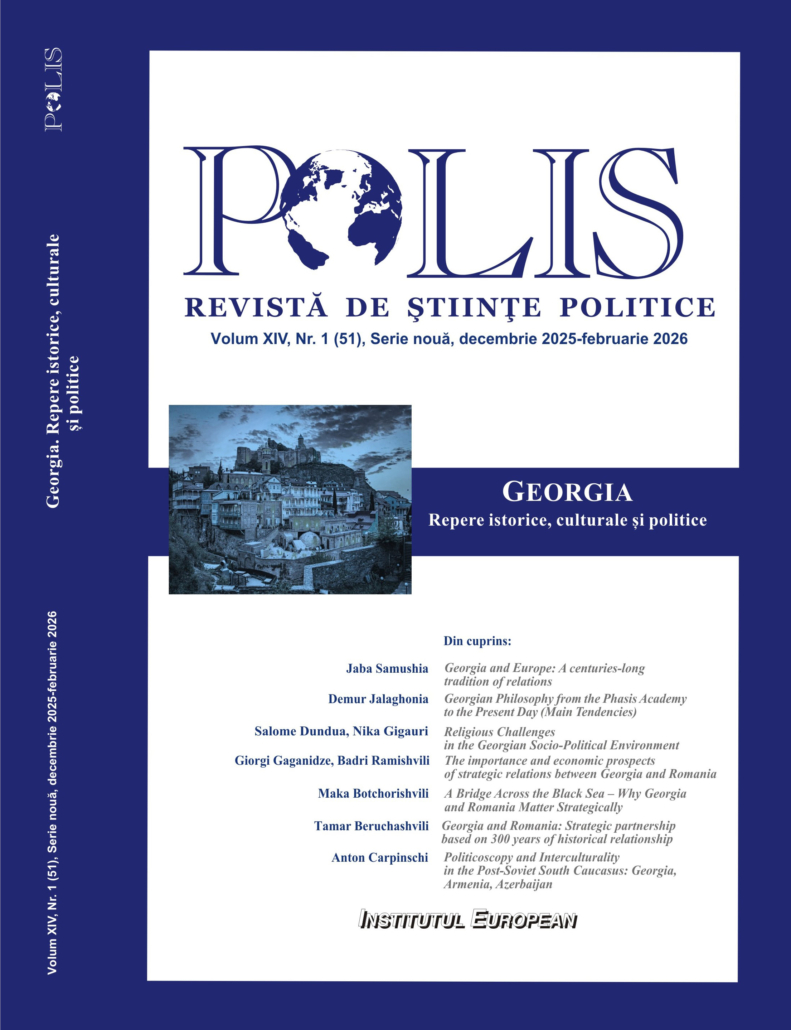
Coordonat de E.S. Tamar BERUCHASHVILI și Sabin DRĂGULIN
Volum XIV, Nr. 1 (51), Serie nouă, decembrie 2025-februarie 2026
 Strategic partnership based on 300 years of historical relationship
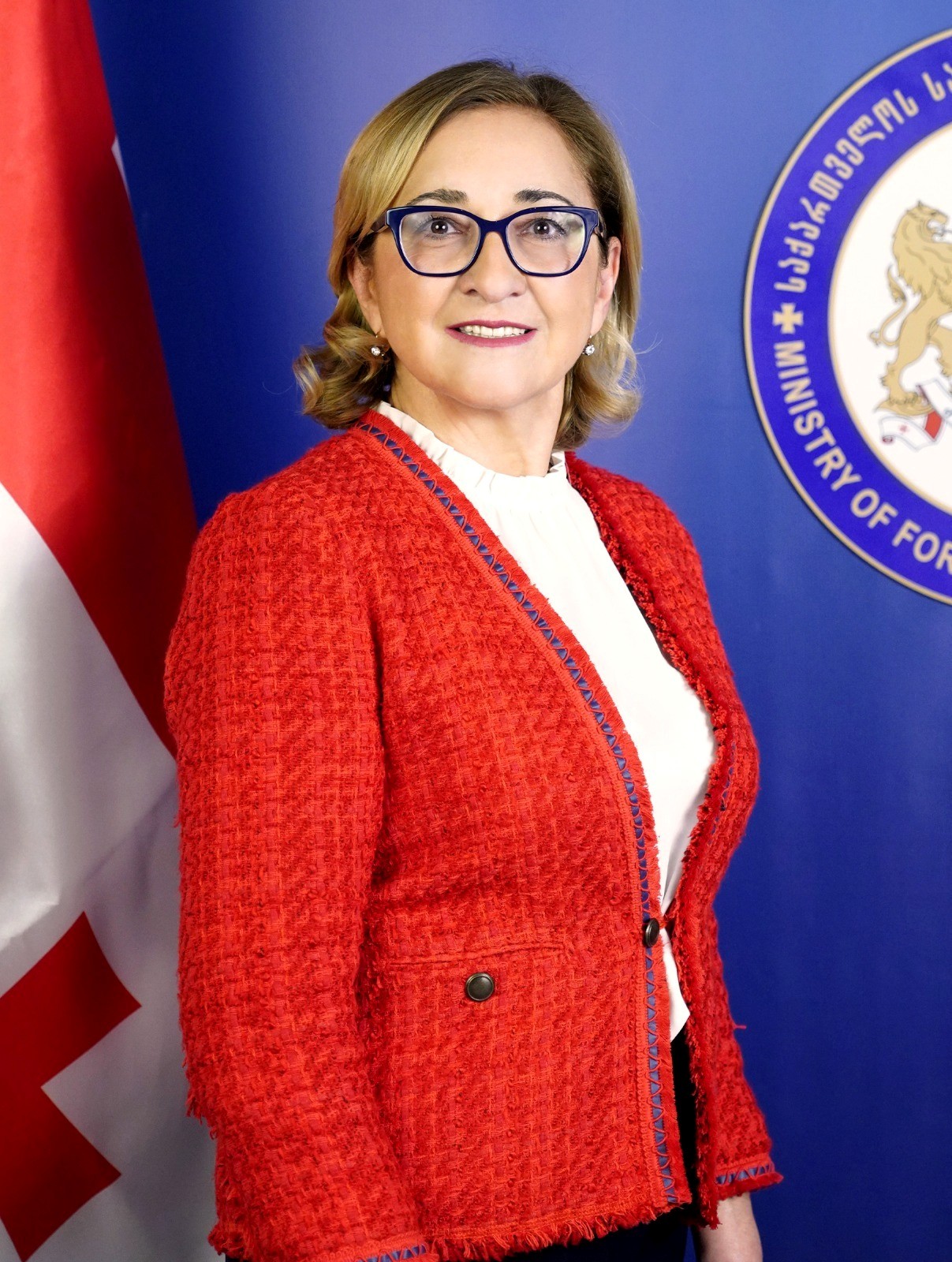
E. Tamar Beruchashvili, Ambassador of Georgia to Romania
Ioana Cristea Drăgulin: Madam Ambassador, you have a rich diplomatic experience in international relations as well. In November 2025, it will be three years since you were appointed ambassador to Romania. What impressions did Romanians and Romania make on you? What were the positive surprises and difficulties you encountered during this period in our country?
Tamar Beruchashvili: Twenty-five years in public service have given me the unique opportunity to be part of Georgia’s historic transformation and to build new relationships as an independent nation. I am proud to have served in various roles, including Foreign Minister, first State Minister of European Integration, Minister of Trade and Foreign-Economic Relations, and as Georgia’s first female Ambassador to the UK and Permanent Representative to the International Maritime Organization. I am honored to serve as the first Georgian woman Ambassador to Romania, a role I have held since November 1, 2022. I am delighted by the new opportunities created by our historic Declaration on Strategic Partnership, which will further strengthen the bonds of friendship between our nations.
I would like to mention that my tenure has coincided with Russia’s unprovoked military aggression against Ukraine, an event that has profoundly altered the security landscape of the wider Black Sea region. Consequently, diplomacy itself must adapt to these new realities, and for us, as diplomats, these are indeed demanding times.
Since the late 1990s, I have had the privilege of visiting Romania in various capacities, including as the first State Minister of European Integration and Foreign Minister, approximately every 5-7 years. I witnessed firsthand Romania’s remarkable development and its transformation into a valued member of the EU and NATO. These changes are a testament to the hard work of the Romanian people and the strong support of EU and NATO partners. Over the years, I have developed a deep affection for Romania and its people, with whom I feel a genuine bond. From my first day here, I felt truly at home, meeting and befriending many wonderful individuals along the way.
Romania is a country that ‘lives in the future, but is always thinking about the past’ – that’s a quote I’ve heard attributed to Mircea Eliade and it kind of sums up the country’s vibe for me. Romania is a country where the past and present coexist, where tradition and modernity blend in a fascinating mix. The natural beauty here is breathtaking: the Carpathian Mountains, the Black Sea coast and the Danube Delta are all must-see destinations. Romania’s architecture is also a stunning blend of old and new. The medieval charm of Sibiu’s squares, the intricate details of Bucharest’s Belle Époque buildings, New Romanian style palaces and the majestic Peleș Castle are amazing! And let’s not forget my favorite – the splendid Ateneul Român in Bucharest, a masterpiece of neoclassical architecture and a hub for the country’s rich musical heritage. The Orthodox churches and monasteries, like those in Moldavia’s Bucovina region, are breathtaking with their vibrant frescoes and tranquil atmosphere. Romania’s Orthodox traditions share similarities with Georgia’s – both countries have a deep spiritual heritage, beautiful chanting and sophisticated church architecture. And the musical culture is amazing: from the hauntingly beautiful doina folk songs to haunting melodies of Orthodox music that touch the soul as well as the powerful orchestras like the George Enescu Philharmonic, Romania’s musical heritage is incredible. It was unforgettable moment to attend performance in recently renovated historic Casino in Constanta during the Enescu festival in September.
On a more practical note, navigating Romania’s infrastructure can be a challenge. The roads and railways often feel like they are still catching up with the rest of Europe. It’s a bit of a contrast to the country’s natural beauty and warm hospitality.
Ioana Cristea Drăgulin: On June 25, 1992, diplomatic relations between the two countries were established. This year marks 33 years of friendship. What can you tell us about the relations between our countries?
Tamar Beruchashvili: Although official diplomatic relations between Georgia and Romania were established 33 years ago, the roots of our friendship reach far deeper into history, spanning more than three centuries. The historic relationship between the two nations rests on three remarkable historical figures: Saint Anthim the Iberian, a Romanian cleric and public figure of Georgian origin and Metropolitan of Hungaro-Wallachia (†1716); Saint Martyr Constantin Brâncoveanu, the Prince of Wallachia (†1714); and King Vakhtang VI Bagrationi (†1737), the ruler of Kartli (east of Georgia). As often happens in history, these distinguished personalities met tragic ends, yet they left behind an enduring legacy that continues to inspire pride and respect in both nations. Among their many contributions, establishment of a strong foundation for Georgian–Romanian relations, including the creation of the first Georgian typography is particularly remarkable.
The 300-year historical relationship between Georgia and Romania is based on the Christian-Orthodox traditions. A distinguished symbol of this bond is the religious and public figure Anthim the Iberian (1650-1716), Saint Antim Ivirianul (ანთიმოზ ივერიელი, in Georgian), the iconic figure whose life and works represent the deep connection between faith, identity, language and cultural memory. As a common Saint of the Georgian and Romanian sister churches since 1992, Saint Antim stands as a solid spiritual, historic, and cultural bridge between our countries.
Later in XX century, when people of Georgia restored its statehood, Romania de jure recognized the independence of the First Democratic Republic of Georgia on February 18, 1921. In 2018, in the center of Bucharest, a memorial plaque was unveiled on the building of the Ramada Bucharest Majestic Hotel (formerly the Majestic Hotel), informing that in 1919, the first diplomatic mission of the Democratic Republic of Georgia in Romania was located in this building, led by Sosipatre Asatiani. After the break up of the Soviet Union, Romania was the first country to recognize Georgia’s independence on August 27, 1991. Since then, our relations have developed dynamically and now encompasses political dialogue, cooperation in the fields of energy, transport, innovation, trade, tourism and culture. Our countries are connected not only by the Black Sea, but also by a shared vision for peace, development and regional cooperation.
Today Romania is our Strategic partner, a staunch supporter of Georgia’s sovereignty and territorial integrity, and our European and Euro-Atlantic integration path, which bears even greater significance today. In this regard, Romania was the first EU member state to ratify the Association Agreement between Georgia and the European Union on July 3, 2014. On October 12, 2022, a new chapter has opened in the history of bilateral cooperation between our countries: the Presidents of Georgia and Romania signed a declaration on the establishment of Strategic cooperation between Georgia and Romania. Within the framework of strategic partnership, new opportunities are opening up for further activating our relations in political, defense and security, people-to-people interaction, transport (especially in the maritime sector) and energy sectors. An important step has already been taken in this direction: on December 17, 2022 a historic agreement was signed in Bucharest on the strategic partnership of Georgia, Azerbaijan, Romania, and Hungary in the development and transmission of green energy. Considering Georgia’s renewable energy potential and geographical location, it has high potential to become a key country in terms of generating and transmitting green energy to the EU market. Taking into account the new geopolitical reality and challenging environment, the strategic partnership between our countries opens new geopolitical and geo-economic opportunities. Georgia and Romania, as neighbors on the Black Sea, have a special role to play to insure better connectivity, energy security and transportation essential to strengthen the stability and development of the region to promote more trade, more business and more tourism.
Now, the task of the Georgian embassy in Bucharest is to make every effort to turn these opportunities into concrete results.
In addition, cultural exchanges, academic programs, tourism, and joint business initiatives are creating lasting bonds of trust and understanding between our societies. In the 2025, tourism from Romania to Georgia increased by 8% that shows growing interest in cultural and business interaction. It is no secret that wine is Georgia’s best Ambassador! Currently Georgian wine is exported in more than 60 countries worldwide promoting Georgian culture and tradition. It also attracts tourists to explore wine routes in Georgia. Some years ago, a tourist visiting Georgia for the first time used to receive a bottle of wine from the border officer as a welcome gesture, together with a stamp in their passport!
Good news is that Romanians enthusiastically started discovering the Georgian wine. There is a high interest to taste Saperavi from its country of origin together with many other unique Georgian varieties. As a result, the Georgian wine export to Romania almost doubled during last year. On the same line, we plan to activate Wine-Diplomacy for better awareness about 8000-year old uninterrupted unique winemaking tradition of Georgia in Romania.
Ioana Cristea Drăgulin: What are the main characteristics of this beautiful country located in the heart of the Southern Caucasus?
Tamar Beruchashvili: I have honor and privilege to represent a country that has lots of to show and share – centuries old culture and history, unique alphabet and polyphony, 8000 years of wine tradition, art, cinema, hospitality, and much more…
Georgia, a Black Sea country nestled in the heart of the Caucasus, is a land of breathtaking beauty and rich cultural heritage. With a history dating back thousands of years, Georgia is home to some of the world’s oldest traditions. As a Christian state since 326, Georgia has a deep spiritual heritage reflected in its stunning churches and monasteries.
The country’s natural beauty, from the Black Sea shores to the snow-capped mountains of Svaneti and the sun-kissed valleys of Kakheti, are matched only by the diversity of its people and its unique blend of European and Asian influences has shaped a distinct history and culture. The country is also a major tourist destination, offering a rare combination of majestic mountains and a beautiful seaside, alongside its deep cultural and historical heritage.
Among all aspects of Georgian culture, perhaps the most cherished is winemaking. Archaeological evidence suggests that wine was first produced in Georgia around 8,000 years ago. This statement finds scientific backing in the discovery of 8000-year-old seeds of the cultivated grape variety, Vitis vinifera sativa, along with the massive clay wine-fermenting amphora, called “Qvevri” (ქვევრი) in the Neolithic settlement in the Eastern Georgia in 2015. The Qvevri – an egg-shaped clay vessel used for fermenting, aging, and storing wine – is a central element of this tradition. Further research by international team of experts has confirmed the early existence of winemaking in the region, which is how Georgia came to be known as the “cradle of wine.” Many etymologists even consider the modern generic word “wine” to be derived from the Georgian equivalent – “gvino” (ღვინო). In 2013, the ancient Georgian method of winemaking in “qvevri” was inscribed on UNESCO’s List of Intangible Cultural Heritage. This unique method distinguishes Georgian wine from all others and remains a symbol of the country’s enduring connection to its land and history.
Together with wine, food and cuisine represent increasingly popular soft power tools that can communicate a country’s culture as well as enhancing its trade and tourism.Georgia’s rich and diverse culinary tradition and table culture was formed over centuries and has been passed down from one generation to another. While making a journey to Georgia in 1672, famous French traveller Jean Chardin described the way that Georgians used to feast as an expression of heartfelt generosity and hospitality. For 2026, Forbes highlights Georgia’s capital, Tbilisi, as a top trending destination, praising its emerging cultural scene, historic sites, unique culinary experience and affordability.
The Georgian alphabet is another source of national pride. It is one of only 14 unique alphabets in existence today. Over centuries, the Georgian script underwent three major transformations, resulting in three distinct writing styles. In 2016, UNESCO inscribed the living culture of Georgia’s three writing systems on the Representative List of the Intangible Cultural Heritage of Humanity.
Georgia’s artistic traditions are equally captivating and diverse. Georgian polyphonic singing and folk dancing are unforgettable expressions of the nation’s spirit and creativity.
Yet Georgia is also a country that is embracing modernity, with a thriving arts scene, innovative architecture and a growing economy. From the bustling streets of Tbilisi to the modern infrastructure of its cities, Georgia is a nation that is looking to the future while honoring its past.
But what truly sets Georgia apart is its resilience. Despite facing many challenges throughout its history, the country has always shown remarkable determination and strength. From the ancient struggles against invaders to the modern day commitment to the peaceful, prosperous and European future for united Georgia, Georgians have always found a way to thrive.
Ioana Cristea Drăgulin: Madam Ambassador, from the rich experience accumulated in a life in which international relations were an integral part, in which areas do you consider that Romania and Georgia have a strong and lasting partnership and where is there a possibility for them to be improved in the future?
Tamar Beruchashvili: By signing the Joint Declaration on Strategic Partnership in 2022, our countries declared readiness for deepening and widening cooperation in various fields. We hope that related bilateral Action Plan will be finalized soon to be endorsed during long-awaited meeting of our foreign ministers.
It is important, that Georgia and Romania are united not only by the waters of the Black Sea, but by the same vision about the Black Sea region that is “secure, prosperous, interconnected, and free from threats to territorial integrity and from economic coercion”. Furthermore, we commend Romania’s role and contributions to the Black Sea regional security and stability.We believe that Strategic partnership between our countries has high potential to reinforce this role by opening new geo-political and geo-economic opportunities. In this regard, we welcome launching the EU’s recent “Black-sea Strategy” and are look forward to collaborative opportunities.
In the current environment of global turbulence and shifting political dynamics, the importance of connectivity across the Black Sea is clearer than ever. Georgia, as the EU’s gateway to Asia offers the shortest alternative route connecting Europe and Asia.
In recent years, strategic projects of common interest have further reinforced our partnership: The final text of the Black Sea-Caspian Sea International Transport Route has been agreed (February, 2025) and will be signed in near future. Once operational, this route will connect Poti, Batumi (and future Anaklia) with Constanța, through Baku and Turkmenbashi, significantly enhancing trade and regional connectivity between Europe and Asia. The Green Energy Corridor/Black Sea Submarine Cable Project continues to advance, linking Georgia and Romania’s electricity systems and contributing to European energy security. The institutional cooperation between our leading agencies of technology and innovation will facilitate joint research, start-up collaboration, knowledge transfer, and innovation ecosystem development. Chambers of Commerce of Georgia and Romania continue to actively support business development, facilitating trade missions, networking, and sectoral partnerships. In parallel, Georgia has established regular ferry connections across the Black Sea – Poti–Constanța, strengthening maritime links and enabling efficient multimodal transport solutions that increase resilience and flexibility for supply chains.
These initiatives demonstrate that Georgia and Romania are natural partners linking Europe and Asia, contributing to a more integrated, resilient, and sustainable Black Sea region. Cooperation with Romania in the development of the Black Sea Submarine Cable and the Green Energy Corridor is of particular importance. The Black Sea Submarine Cable project was initiated by the Georgian side and, thanks to excellent cooperation between the Georgian and Romanian electricity transmission system operators, in December 2025 was successfully granted by the European Commission at the status of a Project of Mutual Interest (PMI).
Despite regional challenges, bilateral trade in the third quarter of 2025, has increased by 45% and amounted to 255.73 million USD. In the third quarter of 2025, exports to Romania increased by 6% and amounted to 26.77 million USD. In the third quarter of 2025, imports from Romania increased by 51% and amounted to 228.95 million USD). This demonstrates that a great economic potential between our countries is still largely untapped. With the expansion of transport, energy, and innovation projects, Romanian companies can increasingly benefit from the opportunities Georgia offers, while Georgian businesses continue exploring the Romanian market.
I am very optimistic about the future of our relations and I’d like to quote the President of Romania H.E. Nicușor Dan, “I look with optimism to strengthening and extending our people’s bonds. I express my full trust for jointly working for further concrete cooperation between Romania and Georgia to advance democracy, peace and regional stability, as well as to consolidate the connectivity initiatives at the Black Sea.’’
Ioana Cristea Drăgulin: Mutual knowledge is fundamental to understanding who we are about each other. What are, in your opinion, the main cultural differences, as well as the similarities between Romania and Georgia? What are the main areas in which our countries collaborate culturally and where do we find the closest collaboration: literature, music, dance, visual arts, etc.?
Tamar Beruchashvili: The cultural and literary ties between Georgia and Romania are long-standing and multifaceted.
Last year marked 375 years since the birth of Saint Hierarch Antim Ivireanul (1650-1716), the great spiritual and cultural figure, the common Saint of the Orthodox sister churches of Romania and Georgia. He is the most vivid symbol of the Georgian-Romanian historical and cultural relations.
Saint Antim’s journey took him to Romania, where he played a significant role in the development of the Romanian literary language. As Metropolit of Bucharest, he promoted the use of Romanian language in church services and masterminded the printing of important liturgical texts in Romanian. The number of books printed with his involvement is estimated to be over 68 to 90, with some sources placing the number even higher. He published these books in multiple languages, including Romanian, Greek, Church Slavonic, and Arabic. What is the most important for us, Georgians, he was critically instrumental in establishing the first Georgian printing press in Tbilisi and printing books there, such as the first Georgian Gospels in 1709 with support of Constantin Brâncoveanu, ruler of Wallachia and Vakhtang VI Bagration, ruler of Kartli. Following a line of Georgian scholars, Anthim Iverianul represents one of the most distinguished theorists and practitioners of Western Enlightenment at that time. In Georgia, we just started translation of his works into Georgian language – most of his writings were originally in Romanian, while his correspondence in Greek and Arabic are currently found in different libraries worldwide. UNESCO has announced 2016 as the year of Saint Anthim Iverianul. On the same year, we celebrated the 300 years’ anniversary of cultural relations between Georgia and Romania with a special exhibition in the National Museum in Bucharest.
Georgian Embassy privileged to maintain strong connections with Saint Antim Monastery, which is a very special place for every Georgian visiting Bucharest, and not only. I would like to express our high appreciation to His Beatitude Daniel, The Patriarch of the Romanian Orthodox Church, for his blessings supporting various bilateral initiatives related to the Saint Hierarch Antim Ivireanul as well as promoting reach religious and cultural heritage of Georgia. Among them, collaboration with the Library of the Holy Synod as we as partnerships with Basilica agency, Basilica Travel and Trinitas TV and University of Buchrest and their partners in Georgia to promote pilgrimage and initiate joint projects.
On the occasion of the 375 years since the birth of Saint Hierarch Antim Ivireanul, the Georgian Embassy in Romania has organized a series of special events. Among them joint choral chanting of Georgian and Romanian choirs at Saint Antim Monastery, academic conference during the Bucharest Poetry Festival, and others. One of the highlights is a play written by Georgian writer Basa Janikashvili, inspired by an idea from Prof. Manana Anasashvili and funded by the Georgian Ministry of Culture. Soon this play will be published as a bilingual book in Georgian and Romanian, marking a unique precedent in cultural exchange between the two countries. We also agreed that later, students from the Tbilisi and Bucharest Theater and cinema Universities would perform the play in Tbilisi and Bucharest. In addition, on the occasion of Saint Hierarch Antim Ivireanul’s commemoration, the National Bank of Romania has issued an anniversary golden coin for numismatic purposes. We perceive this fact as a remarkable tribute to the iconic person who established the lasting bond between our countries.
Coming back to the end of the 18th century, I would like to mention the Georgian poet-diplomat Bessarion Gabashvili who lived in Iasi and contributed to building literary relations. In the more recent past, in January 1950, Georgian poet and translator Giorgi Leonidze visited Romania to mark the anniversary of Romanian poet Mihai Eminescu, which was the first Romanian poet to introduce Romanian Romanticism to the Georgian audience.
In addition, Romania’s Victor Kernbach was one of the earliest Romanian translators of Georgian poetry, including the 12th-century epic poem of the iconic Georgian poet Shota Rustaveli, “The Knight in the Panther’s Skin.” In modern times, Georgian authors such as Aka Morchiladze (with “Journey to Karabakh), Nino Haratischwili (author of “The Eighth Lifes”) and Zurab Karumidze (with “Dagny, or a Love Feast”) have been translated into Romanian and became bestsellers. Conversely, Romanian literary greats like Eminescu, Ion Creangă and Lucian Blaga have been translated into Georgian, particularly through academic efforts in Tbilisi.
Cultural cooperation also spans cinema, dance and folklore: Georgian films appear at Romanian festivals such as the Transilvania International Film Festival (TIFF) and the Astra Film Festival in Sibiu, Georgian national-dance groups perform in Romanian cities like Bucharest and Cluj; and joint folk-music and choral performances take place under Black Sea regional programs in cities such as Constanta SEAS Festival.
In May 2022, the Georgian Embassy in Romania and the Institute for Advanced Studies in Levantine Culture and Civilization presented a Romanian-language edition of the book History of Georgia, bringing Georgian history to a Romanian-speaking audience for the first time.
A recent and noteworthy example of Georgian–Romanian cultural cooperation is the 2024 trilingual publication (in Georgian, Romanian, and English) of selected works by Nikoloz Baratashvili and Mihai Eminescu. This project was initiated by the Embassy of Georgia in Romania and developed in collaboration with the Ministry of Culture of Georgia and the Mihai Eminescu Cultural Centre in Bucharest.
It is remarkable, that during the 2025 Bucharest poetry festival, the heads of four institutions: the Writers’ House of Georgia, the Museum of Georgian Literature, the National Museum of Romanian Literature and the Union of Romanian Writers, signed a quadrilateral memorandum of cooperation aimed at promoting literary exchange and popularization of Georgian and Romanian literature.
Ioana Cristea Drăgulin: Cultural, economic and trade relations have always created a bridge for strengthening political ties between countries. What advantages does your country offer to the Romanian business world and foreign investors?
Tamar Beruchashvili: Indeed, cultural, economic, and trade ties are essential to strengthen political partnership. In the current environment of global turbulence and shifting political dynamics, the importance of connectivity across the Black Sea is clearer than ever. Georgia, as the EU’s gateway to Asia offers the shortest alternative route connecting Europe and Asia. We are dedicated to further invest in strengthening Georgia’s connectivity potential within the framework of the Middle Corridor by upgrading airports and ports infrastructure. Just recently, French ADP Group has invested approximately 150 million USD in the development of Tbilisi International Airport’s infrastructure. Nowadays, 77 airlines perform flights to 125 direct destinations from all three international airports of the country. The development of the aviation sector is directly proportional to the sustainable and diversified development of the tourism sector –- in 2025, we achieved unprecedented success in the tourism sector – Georgia, with population of 3,7 mil., hosted more than 5,5 million visitors!
December 2025 marked the completion of the 14-years railway modernization project – one of the largest investments in Georgia’s transport sector projecting higher cargo capacity, shorter transit times between, Tbilisi and Batumi reduced by 30 minutes. It’s main highlight being the overhaul of the central, mountainous, and technically challenging pass that links eastern and western Georgia.
Tbilisi Dry Port is another demonstration of Government’s priority to enhance trade and connectivity. Officially opened in June 2025, it is a large-scale, multimodal logistics hub implemented by Abu Dhabi Ports Group, the Norwegian Wilhelmsen Port Service and the local company Inveco. It strengthens Georgia’s transport and logistics capabilities and is an important part of the Middle Corridor. Port’s strategic location with all types of transport networks provides access to important transport hubs including railways, airports, Black sea ports of Batumi and Poti. The Tbilisi Dry port shall be developed in 3 phases over an area of 286 000 m2. The first phase with $ 21 mil. investment value has already been completed.
In addition to existing PACE terminal in Poti (investment from US Overseas Private Investment Corporation,OPIC (currently The U.S. International Development Finance corporation, DFC) in June, 2025 Poti Multimodal Terminal was officially opened-a multimodal container terminal located near the Poti port on 9 hectare area and with 31.5 mln $ investment value. The terminal serves both international and local shipments.
In 2026, Georgia will start the active phase of construction of the Anaklia deep-sea port, complete the Baku-Tbilisi-Kars railway and fully commission of the East-West Highway.
The Deep-Sea Port in Anaklia will be capable of receiving large-capacity PANAMAX-type cargo ships. In August 2024 a Belgian company Jan De Nul won an international tender for provision of construction works of the marine infrastructure of the Anaklia Deep Sea Port.
The East-West Highway is a strategic transit route between Europe and Central Asia, when Baku-Tbilisi-Kars railway directly connects Turkey, Georgia and Azerbaijan and reduces the shipment period from 35 to 15-17 days.
All listed above represent a clear political and strategic messages of Georgia to continue to be a key, reliable and indispensable link in the Middle Corridor, ensuring fast, safe and uninterrupted movement of goods and positioning the route as the most reliable, secure and efficient corridor in the region.
In a global context marked by the green transition and the need for energy security, Georgia intend to become a green energy exporter and a reliable partner of the European Union. Georgia’s abundant hydropower resources remain the main source of domestic electricity generation, with up to 80% of local production coming from renewable energy. We are accelerating the development of our renewable energy potential by supporting green energy projects in solar, wind and hydropower. We are also encouraging the introduction of new technologies, such as hydrogen. At the same time, we are working to strengthen our grid by building new transmission lines, strengthening existing ones, and improving grid flexibility. For example, we are promoting the introduction of battery energy storage, which will expand the integration of variable renewable sources into the system. These efforts are complemented by cross-border initiatives with Romania – notably the Black Sea Submarine Cable and the Green Energy Corridor, which can transform the region into a foothold of European energy security.
Georgia with the significant hydropower potential aims to diversify its energy mix by investing in solar, wind and hydrogen energy, as well as by modernizing the grid and integrating new technologies.
In addition, Georgia offers liberal economic and tax policies supporting the country’s economic development and attracting foreign investments: Georgia is a member of WTO having free trade agreements with the EU (DCFTA), UK, Turkey, Ukraine, CIS countries, EFTA (European Free Trade Association) countries, China (including Special Administrative Region – Hong Kong), United Arab Emirates. Georgia also enjoys GSP regimes with Canada and Japan. Just six flat taxes (Corporate Profit Tax – 0% or 15%, Personal Income Tax – 20%, Value Added Tax – 18%, Property Tax up to 1%, Customs/Import Tax – 0%, 5% or 12%, Excise Tax (depends on goods). In addition, strong protection for foreign investments are guarantee under the legal frameworks and international treaties.
Georgia’s favorable investment climate is reflected in the following international institutions ratings. Georgia holds leading position in Business Ready 2024 ranking. In particular, Georgia ranks 2nd in operational efficiency pillar and 3rd in regulatory framework pillar. Further, Georgia scores highest in Business Location, Labor, and Dispute Resolution topics: within these areas, the economy implements good practices in its labor dispute resolution mechanisms and land dispute mechanisms, and offers substantive legal safeguards in mediation. In the 2025 Index of Economic Freedom (Heritage Foundation), Georgia’s economic freedom score is 69 with Moderately Free status, making its economy the 35th freest among 184 countries; also, Georgia is ranked 20th out of 44 countries in the Europe region, and its overall score is well above the world and regional averages. OECD SME Policy Index 2024 (covers Armenia, Azerbaijan, Georgia, Moldova and Ukraine), places Georgia at the top in 11 out of 12 categories, ranging from institutional and regulatory framework, operating environment, insolvency and second chances, entrepreneurial training and women’s entrepreneurship. TRACE Bribery Risk Matrix 2024 – Georgia ranks 44th among 194 countries in terms of assessment of Bribery Risk to Business. Fitch – BB “Stable” . Standard and Poor’s – BB “Stable”.
Ioana Cristea Drăgulin: A final question: Polis is a political science journal and therefore please allow me to move the plane of our discussions to the geopolitical one. From a geostrategic perspective, the entire Caucasus region seems to be an area in which great powers, or regional powers, compete for influence. How do you think this fluid geopolitical situation influences Georgia?
Tamar Beruchashvili: Indeed, our geographic space, which connects Europe and Asia, has always been a crossroads of civilizations. Through centuries, Georgia witnessed numerous trials and turbulences. After restoration of independence in 1991, with strong efforts of the Georgian people and support of our friends, Georgia has emerged as a valuable partner and ally. As the EU candidate country since 2023, Georgia remains committed to the process of the European and Euro-Atlantic integration that is a choice of the Georgian people enshrined in our Constitution.
Despite challenges of Russian occupation of Georgian regions of Abkhazia and Tskhinvali/South Ossetia (20% of our territories) as a result of Russian invasion in 2008, today Georgia continues to maintain strong economic growth reaching 7 % and tries to strengthen its geopolitical, economic, and cultural ties globally. We highly value Strategic partnership between Georgia and the U.S. as well as Strategic partnerships with our immediate neighbors Türkiye, Azerbaijan and Armenia.
In times of distractions and unpredictability, we are committed to ensuring peace and stability in the South Caucasus. Lasting peace is not just a desirable condition; it is the very foundation upon which prosperity, resilience and shared development must be built. Therefore, peace in Ukraine is essential not only for the Ukrainian people, but also for safeguarding the stability of Europe and the Black Sea region. Therefore, Georgia supports all efforts aimed at achieving a lasting and just peace based on international law and respect for the sovereignty and territorial integrity of states. I would also like to underscore the historic opportunity before our region: a sustainable peace agreement between Azerbaijan and Armenia that transformed the security landscape of the South Caucasus unlocking vast potential for the entire Black Sea region in terms of economic development and connectivity.
To quote the Speaker of the Parliament of Georgia, H.E. Shalva Papuashvili: “We believe that connectivity – physical, digital, economic and human – must be one of the central pillars of our cooperation in the Black Sea region and beyond. Georgia remains committed to this vision: a bridge between regions, a partner for trade and a platform for sustainable connectivity”.
Interview conducted
by Ioana CRISTEA DRĂGULIN