


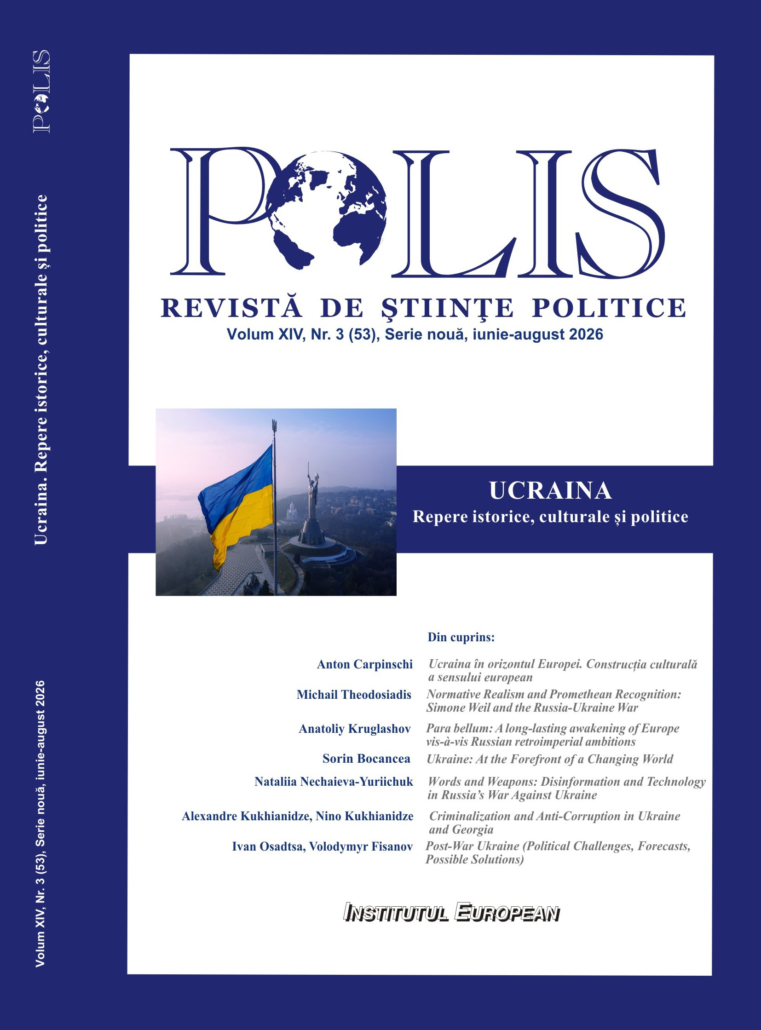
Coordonatori: E.S. Ihor PROKOPCHUK, Sabin DRĂGULIN și Sorin BOCANCEA
Volum XIV, Nr. 3 (53), Serie nouă, iunie-august 2026
Collective Trauma and Resilience in Contemporary Ukraine: War, Identity, and Psychosocial Reconstruction
Lavinia PRUTEANU
Abstract: Beyond its geopolitical implications, the war in Ukraine constitutes a social experience with profound psychological, identity-related, and cultural consequences. The conflict that began in 2014 and escalated with the full-scale invasion of 2022 has exposed the population to multiple and cumulative potentially traumatic experiences associated with loss, displacement, family separation, and prolonged insecurity. At the same time, Ukrainian society has demonstrated significant processes of adaptation, solidarity, and collective mobilization.
This article provides interdisciplinary analysis of the relationship between trauma and resilience, integrating recent contributions from psychology and political science. Methodologically, the study is based on a narrative-integrative review of the scientific literature published predominantly between 2022 and 2026, focusing on individual and collective trauma, vulnerability and protective factors, displacement, developmental particularities, and the role of identity and solidarity.
The analysis shows that trauma and resilience are not mutually exclusive realities but may coexist under conditions of prolonged adversity. From this perspective, the reconstruction of Ukraine entails, alongside political, economic, and institutional dimensions, a process of psychosocial reconstruction.
Keywords: Ukraine; war, psychological trauma, collective identity, solidarity
Introduction
War is one of the most extreme ways in which political events enter the psychological life of individuals and communities. Beyond changes to borders, the destruction of infrastructure, and the reconfiguration of international power relations, armed conflict affects the sense of security, biographical continuity, family and community relationships, and the ways in which a society constructs its memory and imagines its future. War may therefore be analysed simultaneously as a geopolitical phenomenon and as a collective psychosocial experience.
The Russo-Ukrainian war provides a particularly relevant setting for such an interdisciplinary perspective. The conflict that began in 2014 and escalated with the full-scale invasion of 24 February 2022 has exposed the Ukrainian population to violence, loss of life, destruction, displacement, family separation, and prolonged uncertainty. The threat can therefore no longer be understood as a temporally circumscribed event; rather, it may acquire the character of a persistent experience.
This feature is crucial from a psychological perspective: in a prolonged war, traumatic exposure, anticipation of danger, and processes of adaptation may overlap. Individuals are required to adapt while the threat persists, and recovery may be disrupted by new stressors. Frolova and Silver describe the Ukrainian experience precisely in terms of this conjunction between the sudden onset of the full-scale invasion and the persistence of threat, with consequences at both individual and collective levels1.
Such a perspective nevertheless requires conceptual caution. The existence of a collectively traumatizing experience does not mean that the entire exposed population develops mental disorders, nor that individual responses are homogeneous. The intensity of exposure, age, losses sustained, personal resources, social support, and living conditions all contribute to variation in psychological responses. The concept of trauma should therefore be used without turning it into a generalized label applied to an entire population.
At the same time, an exclusive focus on vulnerability provides an incomplete picture of responses to adversity. The systematic review conducted by Rizzi and colleagues on Ukrainian refugees and internally displaced persons identifies, alongside risk factors, individual and socio-environmental protective resources and differentiated coping strategies. A psychological analysis of war must therefore address both suffering and mechanisms of adaptation2.
Within this framework, resilience becomes a fundamental concept. It refers to a dynamic process of adaptation supported by individual, relational, and contextual resources, rather than to invulnerability or the absence of suffering. Individuals may experience fear, sadness, anxiety, or grief while simultaneously mobilizing resources that enable them to maintain or rebuild psychosocial functioning.
Resilience displayed under conditions of war should not be romanticized: trauma does not automatically generate resilience, and repeated exposure may have severe psychological consequences. Adaptation results from the interaction between vulnerabilities and resources, between the individual and the social environment, and between personal experience and the collective meanings attributed to it.
At this point, psychology and political science intersect. War affects not only individuals but also communities, identities, and collective representations. Belonging, solidarity, identification with a political community, trust, and collective memory may function as resources but, under certain conditions, also as sources of vulnerability. Resilience must therefore be analysed not only at the individual level but also at the family, community, and societal levels.
The psychosocial consequences of war extend beyond the duration of military operations. Grief, disability, veterans’ experiences, the reintegration of displaced persons and refugees, family separations, the experiences of children growing up during the conflict, and the memory of victims will continue to shape Ukrainian society after hostilities cease.
From this perspective, post-war reconstruction cannot be reduced to rebuilding infrastructure and reviving the economy. It also entails rebuilding a sense of security, social relationships, trust, and the capacity to envision the future. The psychosocial dimension is therefore not a secondary element of reconstruction but one of the conditions of its sustainability.
Starting from these premises, the article examines the relationship between trauma and resilience in contemporary Ukraine by integrating psychological, social, and political-cultural perspectives. The central question is: how do processes of individual and collective traumatization coexist, in the context of a prolonged war, with processes of adaptation, solidarity, and psychosocial resilience?
The interpretive hypothesis is that trauma and resilience are not mutually exclusive realities. Under conditions of extreme adversity, psychological suffering may coexist with adaptive functioning, a sense of belonging, and the capacity for collective action. Understanding this relationship is relevant both to the current consequences of the war and to the psychosocial challenges of post-war reconstruction.
Methodology
This study employs a narrative-integrative review of recent literature, an approach suited to the interdisciplinary nature of the topic and to the objective of examining the relationship between trauma and resilience in the context of the war in Ukraine. This approach enables the critical analysis and integration of research findings from psychology, public health, migration and displacement studies, and political science.
The main corpus comprises works published between 2022 and 2026, with priority given to peer-reviewed empirical studies, systematic reviews, and theoretical contributions directly relevant to the issues under examination. Reports produced by international organizations are used as complementary sources to contextualize demographic, social, and institutional dimensions of the war. Works published before 2022 are included only when necessary for conceptual grounding or for contextualizing processes that began before the full-scale invasion.
The selection of literature was guided by the principal dimensions of the analysis: individual and collective trauma, mental health, resilience and protective factors, displacement, developmental particularities, collective identity, solidarity, and psychosocial reconstruction. Research findings are examined comparatively and interpretively, with attention to both convergences and differences relevant to understanding the psychosocial experience of war.
Conceptually, the analysis is organized around the relationship between trauma and resilience, understood as processes that may coexist and evolve over time. The objective is to identify the main vulnerability and protective factors and to examine the interaction between individual experience and family, community, identity-related, and political processes.
The analysis does not seek to establish a single prevalence estimate for psychological disorders in the Ukrainian population, since the findings available in the literature derive from different contexts, populations, and forms of exposure. They are therefore interpreted in relation to the contexts of the studies from which they originate, avoiding extrapolation to the Ukrainian population as a whole.
The Trauma of War: From Individual Experience to Collective Trauma
War as Prolonged Traumatic Exposure
Under conditions of war, traumatic exposure may include threats to life, violence, the loss of loved ones, destruction of the home, family separation, and displacement. In Ukraine, these experiences occur within a context of prolonged and cumulative exposure that began for part of the population in 2014 and was substantially intensified by the full-scale invasion of 2022.
The persistence of threat, however, gives psychological responses a particular significance. Fear, hypervigilance, temporary sleep disturbances, or concern for the safety of loved ones may constitute understandable reactions to the existence of a real and continuing danger.
Exposure to war does not, however, inevitably lead to the development of a mental disorder, nor can distress automatically be equated with post-traumatic stress disorder. The interpretation of psychological consequences must take into account the intensity and persistence of symptoms, functional impairment, and the context in which they occur.
Frolova and Silver describe the Ukrainian experience as a “sudden but prolonged collective trauma,” a phrase that captures the conjunction between the sudden onset of the full-scale invasion and the persistence of threat. In such a context, psychological adaptation takes place while adversity continues, and its effects arise from the accumulation of experiences of danger, loss, displacement, and disruption to the continuity of everyday life3.
Empirical evidence highlights both the extent of the psychological consequences of war and their heterogeneity. A nationwide study of 3,173 Ukrainian participants found lower levels of stress, anxiety, and post-traumatic stress symptoms among non-displaced individuals, with higher levels among internally displaced persons and, especially, refugees4.
These findings must, however, be interpreted within the limitations of a cross-sectional study and cannot be equated with clinical diagnoses. This distinction is important in order to avoid the generalized pathologization of populations exposed to war.
Another large study of 6,993 adult Ukrainian refugees in Denmark identified a prevalence of 15.9% for post-traumatic stress disorder (PTSD) and 13.5% for complex post-traumatic stress disorder (CPTSD). Direct and indirect exposure to war was associated with PTSD, whereas exposure to war prior to the 2022 invasion was associated with CPTSD. Because the study was cross-sectional, these associations do not permit causal inferences5.
The distinction between PTSD and CPTSD is relevant in the context of prolonged exposure. In addition to the core symptoms of PTSD, CPTSD includes persistent difficulties in emotion regulation, a negative self-concept, and disturbances in interpersonal relationships. This distinction contributes to understanding the diversity of the psychological consequences of war without implying an automatic relationship between the duration of exposure and the development of a particular disorder.
In the case of Ukraine, it is therefore more appropriate to speak of differentiated trajectories of psychological response to war than of a uniform effect on the population. These trajectories may range from persistent disorders and significant distress to the maintenance of relatively stable functioning despite adversity.
From Individual Trauma to Collective Trauma
Individual trauma concerns the psychological impact of an experience on the person, whereas collective trauma refers to the effects of a disruptive experience on the life of a community, its systems of meaning, its memory, and its sense of collective continuity. The two levels intersect but do not overlap.
War may thus be understood not only through individual traumatic experiences but also as a socially shared experience. Human and material losses, displacement, and damage to spaces of cultural and symbolic value acquire meanings that extend beyond individual biographies and become incorporated into family and public memory, commemorative practices, and the collective narrative of the war.
Collective trauma is not a “diagnosis” attributed to a society: societies do not develop PTSD in the clinical sense applicable to individuals. Rather, the concept refers to the social, symbolic, and identity-related consequences of an experience that threatens the continuity of the group and may alter collective representations of the past, present, and future6.
The collective character of the experience does not, however, imply uniformity of responses. Refugees, internally displaced persons, military personnel, people living in regions exposed to attacks, and families who have suffered losses experience the same war from different positions and in different psychological registers. It is therefore more appropriate to speak of a collective experience characterized by varying forms and degrees of exposure, vulnerability, and adaptation than of a homogeneous “Ukrainian trauma.”
Displacement: Loss of Place, Continuity, and Belonging
Forced displacement entails more than a change of residence; it may disrupt the reference points that sustain the continuity of personal identity: the home, social relationships, professional or educational activity, and familiarity with one’s environment.
After removal from immediate danger, secondary stressors may emerge, including material insecurity, social isolation, difficulties of integration, and uncertainty about return. The systematic review by Rizzi and colleagues highlights precisely the interdependence of psychological and socio-environmental factors, showing that vulnerability and adaptation are influenced both by exposure to war and by access to support, safety, and a sense of belonging7.
Displacement can thus be understood as a simultaneous spatial, relational, and biographical rupture. Its psychological effects depend not only on what a person has lost but also on the conditions under which they are able to rebuild routines, relationships, and a sense of belonging.
Longitudinal research shows that psychological responses following displacement may change over time. A 2026 study of Ukrainian refugees in Germany found a general tendency for post-traumatic stress symptoms to decrease, while life satisfaction remained low. Distinct trajectories of change were also identified, indicating the differentiated nature of psychological adaptation8.
The finding highlights an important distinction: symptom reduction is not equivalent to the recovery of well-being. Adaptation after displacement is a dynamic process in which a reduction in symptoms may coexist with difficulties concerning life satisfaction and psychosocial functioning.
Psychological Resilience under Conditions of War: Concept, Mechanisms, and Protective Factors
Resilience as a Contextual Process
In the context of the war in Ukraine, research supports an ecological and contextual understanding of resilience. A comparative study of Ukrainian adults living in seven European countries or internally displaced within Ukraine identified differences in psychological distress, resilience, and coping strategies according to the context of residence. Other research on Ukrainian refugees underscores the relevance of post-migration conditions and psychosocial support for mental health and adaptation9.
Resilience cannot therefore be reduced to an individual’s “psychological strength.” Safety, stability, social relationships, access to resources, and a sense of belonging can create the conditions in which individual resources are mobilized and adaptation becomes possible. Resilience should thus be understood as an outcome of the relationship between the person and the environment in which they attempt to continue or rebuild their life.
Social support constitutes an important resource for adaptation by sustaining relationships and a sense of safety and belonging. Alongside the findings of the review by Rizzi and colleagues, the qualitative study by Giordano and colleagues on Ukrainian youth highlights the interaction among individual, relational, and community resources in resilience processes10.
Hope, Meaning, and Future Orientation
When war profoundly disrupts the predictability of life, hope may constitute a psychological resource by sustaining the capacity to envision goals and continuities beyond the immediate situation. It does not imply uncritical optimism, but rather the preservation of a conceivable future.
The study by Kimhi and colleagues shows that Ukrainian participants reported simultaneously high levels of distress and perceived threat, but also high levels of hope and societal resilience; among the protective factors examined, hope emerged as the most consistent predictor of resilience. This finding supports the idea that vulnerability and resilience may coexist and that hope may contribute to sustaining future orientation under conditions of prolonged adversity11.
In Ukraine, this psychological dimension intersects with a political one: the meaning of experience is also constructed through collective representations of community continuity, sovereignty, and European belonging. The psychology of resilience thus intersects with political psychology and identity processes.
From the perspective of political science, Sorin Bocancea situates the war in Ukraine within a broader European framework in which the conflict extends beyond its military-territorial dimension and involves fundamental political choices. This contextualization is also psychologically relevant: societal resilience is not constructed in a political vacuum, and the perceived threat to sovereignty and community continuity may influence the meanings attributed to solidarity and sacrifice12.
Conclusions
The recent literature indicates that the relationship between trauma and resilience constitutes one of the key frameworks for understanding the psychosocial consequences of the war in Ukraine. Prolonged exposure to threat, loss, and displacement may produce significant psychological effects, yet individual and collective responses remain differentiated. Trauma and resilience are therefore not mutually exclusive realities: psychological suffering may coexist with adaptation, the maintenance of relationships, solidarity, and the capacity to envision the future.
The collective character of the experience of war does not, however, imply uniformity. Military personnel and civilians, refugees and internally displaced persons, people who remained in areas exposed to attacks, and families that suffered direct losses relate to the same historical event from different biographical positions. In the post-war period, this plurality may even generate “informal hierarchies of suffering,” through comparisons concerning the severity and legitimacy of lived experiences. Recognizing these differences will therefore constitute one of the challenges of psychosocial reconstruction.
At the same time, the Ukrainian case shows that resilience extends beyond the individual level. Social support, belonging, solidarity, civic mobilization, and the functioning of institutions may serve as resources for adaptation, while collective identity may provide frameworks of meaning in a situation dominated by uncertainty. These processes should not, however, be idealized. The strengthening of cohesion may be accompanied by sharper identity boundaries, a process reflected in transformations of Ukrainian national identity observed during the war. Sustaining solidarity once the external threat diminishes will remain one of the challenges of the post-war period13.
The discourse of “Ukrainian resilience” also requires critical scrutiny. Resilience may function not only as a psychosocial reality but also as a public representation and a resource of political discourse. Turning it into an idealized image of a society capable of enduring adversity indefinitely would risk minimizing suffering and shifting responsibility for adaptation onto individuals. A resilient society is one that develops institutional, community, and relational resources capable of reducing vulnerability and supporting recovery, not one that expects individuals simply to endure suffering14.
From this perspective, the cessation of hostilities will not mean the end of the war’s psychosocial consequences. The reintegration of veterans and displaced persons, the return of refugees, the experiences of children and adolescents, grief, the memory of victims, the restoration of trust, and the rebuilding of community relationships will continue to shape Ukrainian society. Post-war reconstruction cannot therefore be reduced to infrastructure, the economy, and institutions; it must also encompass the psychosocial reconstruction of a sense of security, continuity, and belonging.
Ultimately, the relevance of an interdisciplinary approach lies in this articulation between individual experience and collective processes. Psychology makes it possible to understand vulnerability, adaptation, and personal resources, while political science provides a framework for analysing institutions, identity, solidarity, and the collective meanings of war. Ukraine’s post-war future will depend not only on what is materially rebuilt, but also on the capacity of individuals and communities to transform the experience of war into social continuity and a shared future.
Notes
- Nataliia Frolova, Roxane Cohen Silver, „A sudden but prolonged collective trauma: The Ukrainian experience”, PLOS Mental Health, vol. 1, nr. 1, 2024, e0000056, pp. 1-4, DOI: 10.1371/journal.pmen.0000056.
- Damiano Rizzi, Giulia Ciuffo, Marta Landoni, Matteo Mangiagalli, Chiara Ionio, „Psychological and environmental factors influencing resilience among Ukrainian refugees and internally displaced persons: a systematic review of coping strategies and risk and protective factors”, Frontiers in Psychology, vol. 14, 2023, art. 1266125, DOI: 10.3389/fpsyg.2023. 1266125.
- Nataliia Frolova, Roxane Cohen Silver, cit., pp. 1-4.
- Oleh Lushchak, Mariana Velykodna, Svitlana Bolman, Olha Strilbytska, Vladyslav Berezovskyi, Kenneth B. Storey, „Prevalence of stress, anxiety, and symptoms of post-traumatic stress disorder among Ukrainians after the first year of Russian invasion: a nationwide cross-sectional study”, The Lancet Regional Health – Europe, vol. 36, 2023, art. 100773, DOI: 10.1016/j.lanepe.2023.100773.
- Karen-Inge Karstoft, Nataliia Korchakova, Vibeke J. Koushede, Thomas A. Morton, Anders A. Pedersen, Seamus A. Power, Mette H. Thøgersen, „(Complex) PTSD in Ukrainian refugees: Prevalence and association with acts of war in the Danish refugee cohort (DARECO)”, Journal of Affective Disorders, vol. 366, 2024, pp. 66-73, DOI: 10.10-16/j.jad.2024.08.170.
- Nataliia Frolova, Roxane Cohen Silver, cit., pp. 1-4.
- Damiano Rizzi et al., cit.
- Liudmyla Krupelnytska, Nazar Yatsenko, Olha Morozova-Larina, „Longitudinal Trajectories of Post-Traumatic Stress Among Ukrainian Refugees: A Cohort Study”, Chronic Stress, vol. 10, 2026, art. 24705-470261422385, DOI: 10.1177/247-05470261422385.
- Agata Ewa Chudzicka-Czupała, Nina Zhou, Andrew Tay et al., „Mental health, psychological wellbeing, and coping with stress by Ukrainian war refugees staying in Poland”, Frontiers in Public Health, vol. 13, 2026, art. 1731764, DOI: 10.3389/ fpubh.2025.1731764. Małgorzata Szkup, Sabina Krsnik, Marta Kozybska et al., „Psychological distress, resilience, and coping among Ukrainian war refugees: cross-national differences across seven European host countries and Ukraine”, Frontiers in Public Health, vol. 14, 2026, art. 1771440, DOI: 10.3389/fpubh.2026.1771440.
- Francesca Giordano, Shannon Lipscomb, Philip Jefferies, Kyong-Ah Kwon, Marianna Giammarchi, „Resilience processes among Ukrainian youth preparing to build resilience with peers during the Ukraine-Russia war”, Frontiers in Psychology, vol. 15, 2024, art. 1331886, DOI: 10.33-89/fpsyg.2024.1331886. Damiano Rizzi et al., cit.
- Shaul Kimhi, Yohanan Eshel, Hadas Marciano, Bruria Adini, „Impact of the war in Ukraine on resilience, protective, and vulnerability factors”, Frontiers in Public Health, vol. 11, 2023, art. 1053940, DOI: 10.3389/fpubh.2023.1053940.
- Sorin Bocancea, „Zidul Kievului. Din nou, două Europe”, in Sorin Bocancea (coord.), Războiul din Ucraina. Un conflict regional cu efecte globale, Iași, Editura Polis Books, 2023, pp. 140-163.
- Volodymyr Kulyk, „National Identity in Time of War: Ukraine after the Russian Aggressions of 2014 and 2022”, Problems of Post-Communism, 71, nr. 4, 2024, pp. 296–308, DOI: 10.1080/1075-8216.2023.2224-571.
- Janine Natalya Clark, „Resilience as a ‘Concept at Work’ in the War in Ukraine: Exploring Its International and Domestic Significance”, Review of International Studies, vol. 50, nr. 4, 2024, pp. 720-740, DOI: 10.1017/ S0260210524000305.
Bibliography
Articles and studies
BOCANCEA, Sorin, „Zidul Kievului. Din nou, două Europe”, în Sorin Bocancea (coord.), Războiul din Ucraina. Un conflict regional cu efecte globale, Iași, Editura Polis Books, 2023, pp. 140-163.
CHUDZICKA-CZUPAŁA, Agata Ewa, ZHOU, Nina, TAY, Andrew, CHIANG, Soon-Kiat, CAPIŃSKA, Monika, POMYLUIKO, Vira, OSTAFIŃSKA-MOLIK, Barbara, CZUPAŁA, Marta, ŻYWIOŁEK-SZEJA, Marta, YEN, Cheng-Fang, MCINTYRE, Roger S., HO, Roger C., „Mental health, psychological wellbeing, and coping with stress by Ukrainian war refugees staying in Poland”, Frontiers in Public Health, vol. 13, 2026, art. 1731764, DOI: 10.3389/fpubh.2025.1731764.
CLARK, Janine Natalya, „Resilience as a ‘Concept at Work’ in the War in Ukraine: Exploring Its International and Domestic Significance”, Review of International Studies, vol. 50, nr. 4, 2024, pp. 720-740, DOI: 10.1017/ S0260210524000305.
FROLOVA, Nataliia, SILVER, Roxane Cohen, „A sudden but prolonged collective trauma: The Ukrainian experience”, PLOS Mental Health, vol. 1, nr. 1, 2024, e0000056, pp. 1-4, DOI: 10.1371/journal.pmen.0000056.
GIORDANO, Francesca, LIPSCOMB, Shannon, JEFFERIES, Philip, KWON, Kyong-Ah, GIAMMARCHI, Marianna, „Resilience processes among Ukrainian youth preparing to build resilience with peers during the Ukraine-Russia war”, Frontiers in Psychology, vol. 15, 2024, art. 1331886, DOI: 10.3389/fpsyg.2024. 1331886.
KARSTOFT, Karen-Inge, KORCHAKOVA, Nataliia, KOUSHEDE, Vibeke J., MORTON, Thomas A., PEDERSEN, Anders A., POWER, Seamus A., THØGERSEN, Mette H., „(Complex) PTSD in Ukrainian refugees: Prevalence and association with acts of war in the Danish refugee cohort (DARECO)”, Journal of Affective Disorders, vol. 366, 2024, pp. 66-73, DOI: 10.1016/j.jad.2024.08.170.
KIMHI, Shaul, ESHEL, Yohanan, MARCIANO, Hadas, ADINI, Bruria, „Impact of the war in Ukraine on resilience, protective, and vulnerability factors”, Frontiers in Public Health, vol. 11, 2023, art. 1053940, DOI: 10.3389/fpubh.2023.1053940.
KRUPELNYTSKA, Liudmyla, YATSENKO, Nazar, MOROZOVA-LARINA, Olha, „Longitudinal Trajectories of Post-Traumatic Stress Among Ukrainian Refugees: A Cohort Study”, Chronic Stress, vol. 10, 2026, art. 24705470261422385, DOI: 10.11-77/24705470261422385.
KULYK, Volodymyr, „National Identity in Time of War: Ukraine after the Russian Aggressions of 2014 and 2022”, Problems of Post-Communism, vol. 71, nr. 4, 2024, pp. 296-308, DOI: 10.1080/10758216.2023.2224571.
LUSHCHAK, Oleh, VELYKODNA, Mariana, BOLMAN, Svitlana, STRILBYTSKA, Olha, BEREZOVSKYI, Vladyslav, STOREY, Kenneth B., „Prevalence of stress, anxiety, and symptoms of post-traumatic stress disorder among Ukrainians after the first year of Russian invasion: a nationwide cross-sectional study”, The Lancet Regional Health – Europe, vol. 36, 2023, art. 100773, DOI: 10.10-16/j.lanepe.2023.100773.
RIZZI, Damiano, CIUFFO, Giulia, LANDONI, Marta, MANGIAGALLI, Matteo, IONIO, Chiara, „Psycholo-gical and environmental factors influ-encing resilience among Ukrainian refugees and internally displaced persons: a systematic review of coping strategies and risk and protective factors”, Frontiers in Psychology, vol. 14, 2023, art. 1266125, DOI: 10.338-9/fpsyg.2023.1266125.
SZKUP, Małgorzata, KRSNIK, Sabina, KOZYBSKA, Marta, ROUSOU, Elena, FEDORTSIV, Olha, BURBELA, Emilia, STANISAVLJEVIĆ, Sanja, KLESZCZ, Agnieszka, FERNANDES, Rita, MIKLA, Marzena, ELLINA, Panagiota, CZEPONIS, Linda, LOURENÇO, Tânia, ERJAVEC, Karmen, „Psychological distress, resilience, and coping among Ukrainian war refugees: cross-national differences across seven European host countries and Ukraine”, Frontiers in Public Health, vol. 14, 2026, art. 1771440, DOI: 10.3389/fpubh.2026.1-771440.