


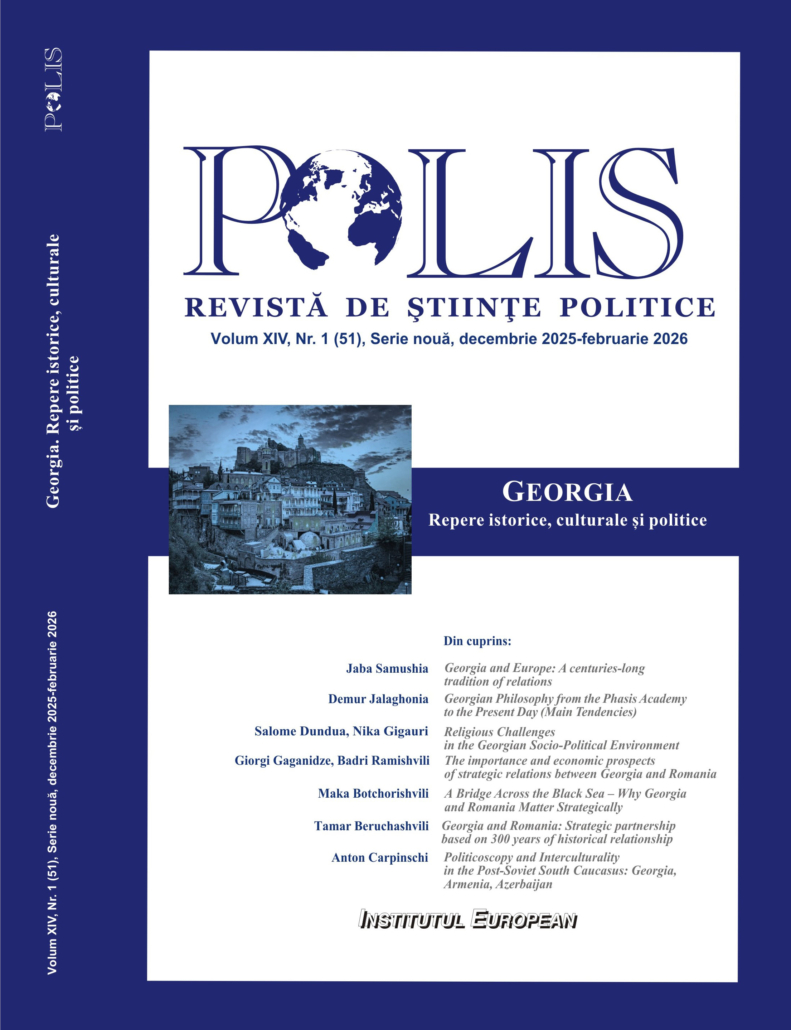
Coordonat de E.S. Tamar BERUCHASHVILI și Sabin DRĂGULIN
Volum XIV, Nr. 1 (51), Serie nouă, decembrie 2025-februarie 2026
Constantin Brâncoveanu and Antim Ivireanul – Culture as a Strategy of Resistance in the Orthodox World under Ottoman Domination
Nicoleta ZAGURA
Abstract: The martyrdoms of Romanian Prince Brâncoveanu (1714) and Georgian monk Antim Ivireanul (1716) that became Metropolitan of Wallachia, beside its religious and cultural narrative, are pointing their work into a theological and historical model of resistance grounded in faith, education, and dignity. The Brâncovenian era thus appears not merely as a political episode, but as a foundational moment in the articulation of Orthodox culture as a strategy of survival and resilience under Ottoman domination and illustrates the cultural and religious diplomacy between Romania and Georgia.
Keywords: Education, Culture, Tradition, Antim Ivireanul, Georgia.
Constantin Brâncoveanu – the Voivode of Culture and Spiritual Diplomacy
Beginning in 1688, Wallachia entered the reign of one of the most complex and visionary rulers in the history of South-Eastern Europe: Constantin Brâncoveanu1. A personality of European stature, formed at the confluence of Byzantine tradition and the spirit of the late Renaissance2, Brâncoveanu understood that resistance to Ottoman domination could not be waged solely through arms or direct confrontation, but rather through a profound, long-term strategy grounded in culture, education, and the consolidation of spiritual identity among subjugated peoples3.
The Ottoman Empire, which ruled over territories that had once belonged to the Byzantine Empire, exercised not only political control but also cultural and religious domination4. In this context, Brâncoveanu conceived culture as a silent weapon – capable of preserving historical memory, language, and faith under pressure. Nicknamed by contemporary sources “the Golden Prince of Europe” because of his considerable wealth, the voivode used his material resources not for personal ostentation but to build an extensive network of Orthodox cultural diplomacy5.
This policy materialized in the support of printing and book production across multiple regions under Ottoman influence: Wallachia, Moldova, Transylvania, Georgia, the Levant, and the Near East. Printing houses supported by Brâncoveanu operated or were initiated in Georgia and in Aleppo, where books were printed in Greek, Arabic, and Georgian, including editions using Arabic script – clear evidence of an open and universal cultural vision6. Through the printed book, Brâncoveanu sought to awaken national and religious consciousness among peoples dominated by the Ottomans, preparing the ground for future political emancipation7.
Within this vast cultural project, the ruler needed exceptional collaborators – polyglot scholars, printers, theologians, and artists – capable of translating his ideals into concrete achievements. The most brilliant among them would be a Georgian monk who became one of the greatest figures of Romanian culture: Antim Ivireanul.
Antim Ivireanul – the Scholar-Martyr and Founder of the Romanian Liturgical Language
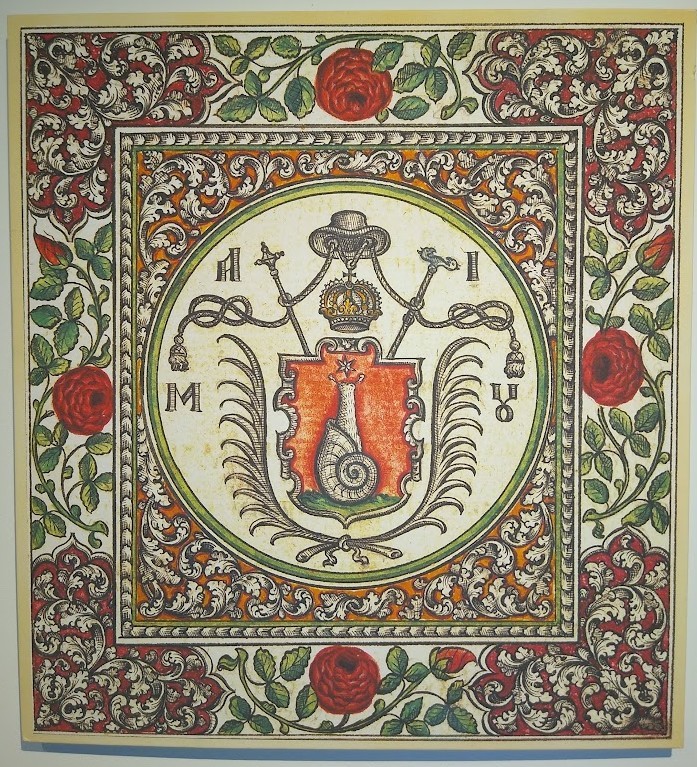
Coat of arms of Metropolitan Antim
The providential encounter between Constantin Brâncoveanu and Antim took place in Iași, where the ruler recognized in the Georgian monk an enlightened mind animated by the same faith in the redemptive power of culture8. Born around 1650 in Georgia, Antim’s biography reflects the dramatic fate of Orthodox Christians under Ottoman expansion, marked by captivity, exile, and spiritual endurance9.
Redeemed by the Ecumenical Patriarchate of Constantinople, Antim received a solid theological and cultural education and was tonsured into monastic life. His subsequent protection by the Patriarchate of Jerusalem and his mission in Moldova placed him at the intersection of the Greek, Arab, and Romanian Orthodox worlds10.
Summoned to Wallachia around 1690 under the direct protection of Brâncoveanu, Antim became abbot of Snagov Monastery and coordinator of the Metropolitan printing house. In 1694 he founded a printing school at Snagov, consciously linking education, book culture, and spiritual renewal11. His Romanian-language publications aimed not only to make worship accessible but also to refine and elevate the Romanian language, including through the selective introduction of Latin-based vocabulary.
Elected Bishop of Râmnic in 1705 and Metropolitan of Wallachia in 1708, Antim Ivireanul carried out an exceptional printing activity: 63 books, of which 39 were printed by his own hand, 21 in Romanian. By publishing the first fully Romanian Liturghier (1713) and the Molitfelnic (1716), he definitively consecrated the Romanian as the liturgical language of the Church12.
His major work, the Didahies, comprising sermons and occasional orations, stands as a masterpiece of Romanian theology and rhetoric and a foundational text of the modern literary and liturgical language13. His foundation, the Monastery of All Saints in Bucharest (today Antim Monastery), remains a lasting symbol of the synthesis of art, faith, and culture.
Antim Ivireanul: The Unity of Word, Print, and Architectural Form
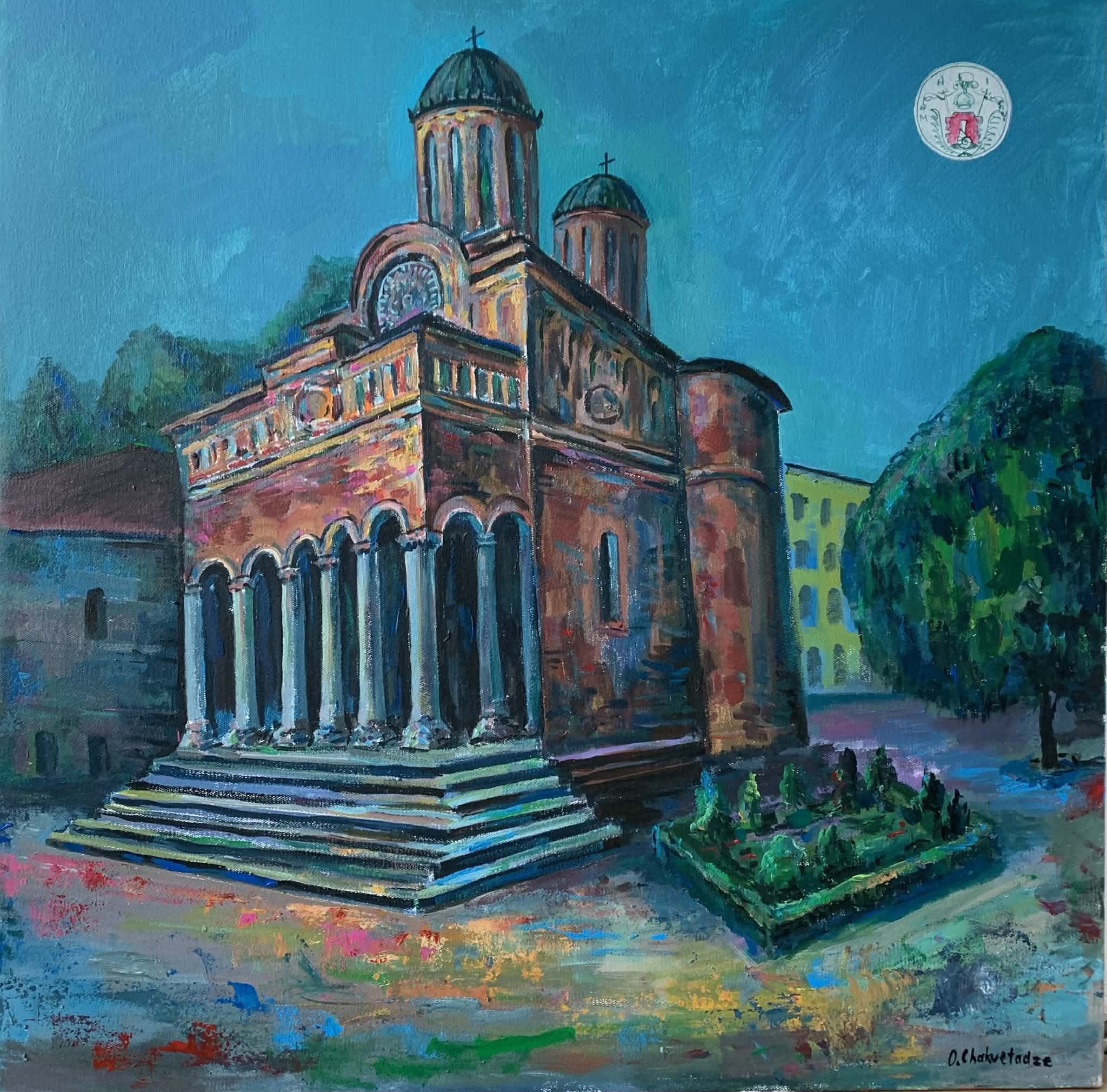
Antim Monastery painted by Otar Chacvetadze
Antim Ivireanul’s cultural personality stands out in the Brâncovenian era through his capacity to synthesize theology, rhetoric, typography, and architecture into a single spiritual project. His monastery in Bucharest embodies the Brâncovenian artistic style, characterized by harmony, symbolic ornamentation, and the fusion of Byzantine tradition with Oriental and Renaissance elements14. At the same time, Georgian influences – stemming from Antim’s origins and formation – introduce a distinctive note within Wallachian ecclesiastical arch Thus, while the Didahies represent the supreme expression of theological logos in Romanian, Antim Monastery constitutes the material expression of the same thought: a theology of form, in which architecture is not merely a liturgical setting but also a catechetical and symbolic instrument. In this perspective, Antim Ivireanul’s work may be understood as a total œuvre, in which the printed word, the spoken sermon, and architectural form converge into a coherent project affirming Romanian spiritual and cultural identity.
Touching the wood of the church’s entrance doors, delicately carved by Saint Antim himself, the visitor is permeated by the gentleness of his grace. Enduring across centuries, those doors speak of a man who, coming from the distant lands of Georgia, became a symbol of resistance through education, culture, and faith.
Legacy
Through his long-term political vision and cultural diplomacy, Prince Constantin Brâncoveanu became, in the final years of his reign, an increasingly inconvenient figure for the Ottoman authorities – his cultural strategy was perceived as subversive15.
In the spring of 1714, Constantin Brâncoveanu was arrested, dethroned, and transported to Istanbul, where he was imprisoned in the dreaded fortress of the Seven Towers, Yedikule. Alongside him were incarcerated his four sons – Constantin, Ștefan, Radu, and Matei – as well as his trusted counselor, Enache Văcărescu.
By order of Ahmed III, they were demanded to renounce the Christian faith and convert to Islam, a condition essential for sparing their lives and for abandoning their policy of supporting Orthodoxy and the identity of Christian peoples under Ottoman domination. According to Christian and Western narrative sources, this possibility was offered to them repeatedly.
Constantin Brâncoveanu’s firm refusal, coupled with his exhortations to his sons to remain steadfast in the Orthodox faith, transformed the execution by decapitation into an act of full theological martyrdom. Forced to witness the death of his sons before his own execution, the ruler’s ordeal intensified the tragic, exemplary, and symbolic dimension of the event, inscribing it permanently in Christian memory as a model of fidelity to faith and princely dignity.
Like Constantin Brâncoveanu, Antim Ivireanul also paid with his life for his moral uprightness. Arrested in 1716 amid the establishment of the Phanariot regime, unjustly deposed and condemned to exile, he was martyred on the road by Turkish soldiers, his body thrown into the waters of the Tungia River near Adrianople. His sacrifice spiritually completes the Brâncovenian martyrdom, transforming this era into a paradigm of cultural resistance and Christian dignity.
Notes
- Cândea, Constantin Brâncoveanu, Editura Academiei Române, Bucharest, 1979.
- Pippidi, Tradiția politică bizantină în Țările Române, Corint, Bucharest, 2001.
- Idem, Tradiție și cultură în epoca lui Constantin Brâncoveanu, Humanitas, Bucharest, 2011.
- Cernovodeanu, Țările Române și Levantul în epoca lui Constantin Brâncoveanu, Editura Enciclopedică, Bucharest, 1995.
- Iorga, Studii și documente cu privire la istoria românilor, Minerva, Bucharest, 1995.
- Cernovodeanu, Epoca brâncovenească, Editura Enciclopedică, Bucharest, 2001.
- Pippidi, Tradiție și cultură în epoca lui Constantin Brâncoveanu, op.cit.
- Brătulescu, Antim Ivireanul – viața și opera, EIBMBOR, Bucharest, 1989.
- Iorga, Istoria Bisericii Românești, Minerva, Bucharest, 1909.
- Brătulescu, op.cit.
- D. Ștefănescu, Arta brâncovenească, Meridiane, Bucharest, 1972.
- Antim Ivireanul, Didahii, ed. G. Ștrempel, Minerva, Bucharest, 1972.
- Iorga, Istoria Bisericii Românești, op.cit..
- Brătulescu, Arta brâncovenească, op.cit.
- Cernovodeanu, Țările Române și Levantul în epoca lui Constantin Brâncoveanu, op.cit., chapters on 1714-1716.
Bibliography
BRĂTULESCU, V., Antim Ivireanul – viața și opera, Editura Institutului Biblic și de Misiune al B.O.R., Bucharest, 1989.
IDEM, V., Arta brâncovenească, Editura Meridiane, Bucharest, 1989.
CÂNDEA, V., Constantin Brâncoveanu, Editura Academiei Române, Bucharest, 1979.
CERNOVODEANU, P., Țările Române și Levantul în epoca lui Constantin Brâncoveanu, Editura Enciclopedică, Bucharest, 1995.
IDEM, Epoca brâncovenească, Editura Enciclopedică, Bucharest, 2001.
IORGA, N., Studii și documente cu privire la istoria românilor, Editura Minerva, Bucharest, 1905.
IDEM, Istoria Bisericii Românești, Tipografia „Minerva”, Bucharest, 1909.
IVIREANUL, Antim, Didahii, Edited by G. Ștrempel, Editura Minerva, Bucharest, 1972.
PIPPIDI, A., Tradiția politică bizantină în Țările Române, Corint, Bucharest, 2001.
IDEM, Tradiție și cultură în epoca lui Constantin Brâncoveanu, Humanitas, Bucharest, 2011.
ȘTEFĂNESCU, I. D., Arta brâncovenească, Meridiane, Bucharest, 1972.