


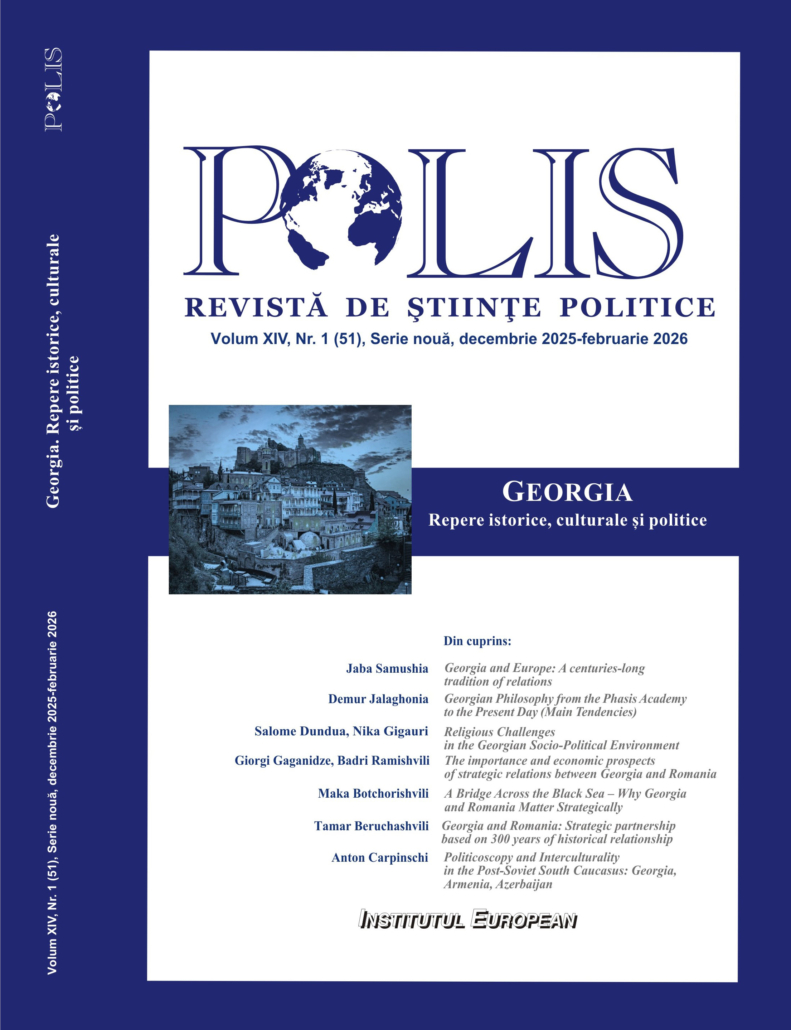
Coordonat de E.S.Tamar BERUCHASHVILI și Sabin DRĂGULIN
Volum XIV, Nr. 1 (51), Serie nouă, decembrie 2025-februarie 2026
Georgia and Europe: A Centuries-Long Tradition of Relations
Jaba SAMUSHIA
Abstract: Georgia’s aspiration to join the European family is rooted in a long historical process shaped by geography, culture, religion, and security needs. Located at the crossroads of Europe and Asia, the Caucasus has been a space of interaction between Eastern and Western civilizations, yet Georgia consistently identified with the Western cultural and political sphere. From antiquity and Christianization through the medieval era, Georgian elites repeatedly chose Western alliances, values, and institutions, despite persistent pressure from Eastern empires. Cooperation with Byzantium, European monarchies, and the Crusaders reflected this strategic and civilizational orientation. Although foreign domination and geopolitical constraints often hindered effective integration, the European vector remained central to Georgian statehood. The article argues that Georgia’s contemporary European integration represents the continuation and restoration of a historically grounded civilizational choice.
Keywords: Caucasus, Georgia, Europe, Christianity, civilizational identity.
Georgia faces a significant prospect of becoming a member of the European family1. This aspiration is a logical continuation of the foreign policy trajectory developed by the Georgian state over the centuries. It should not be examined in isolation; this process has its roots in millennia of preconditions.
The Caucasus is a connecting link between Europe and Asia. Due to its geographical location, this region has long attracted great empires striving to establish their control over this territory. The Caucasus functions as a juncture where the political and cultural areas of North-South and East-West intersect, thereby amplifying the importance of this seemingly small region in global political processes. This geopolitical location has and continues to determine the fate of the nations occupying the Caucasus for centuries.
Within the structure of global international relations, the Caucasus was mainly distinguished as a meeting point of multiple great powers. Multipolarity and bipolarity significantly decided the fate of this region. A significant role in the state and cultural evolution of the Caucasian people was played not only by the region’s division into the spheres of influence of great empires but also by its position along the dividing line separating two major civilisations. Nowhere is the interaction of the Western and Eastern worlds more evident than in the Caucasus region. A distinct intercultural environment was formed as a consequence of the proximity of these two civilisations, in which Western values are merged with characteristics of Eastern culture. Politicians were also aware of this reality, since the phenomena such as David IV the Builder’s visits to mosques, the presence of Muslim scholars at the courts of Demeter I and Queen Tamar, the appearance of Arabic inscriptions on Georgian coins, etc. caused no surprise2. Despite this, Georgia has always remained part of Western civilisation, with Christianity creating a big gap between Georgia and the East. Modern researchers of civilisations (e.g., Samuel Huntington) unequivocally note that religion produces sharper divisions between people than ethnicity, whereas religious unity presents a stronger determinant of civilisational identity than any other factor3. Thus, after Christianisation, Georgia finally separated itself first from the Zoroastrian and later from the Islamic East.
It would, however, be incorrect to conclude that Georgia’s European orientation was attributed to the adoption of Christianity. This tendency has much deeper roots. After Alexander the Great’s campaign through the East in the 4th century BC, Georgia became part of the Hellenistic world. From the 1st century BC, Roman influence extended into the Caucasus, integrating Kartli and Egrisi into relations with the Roman world.
The establishment of the Christian faith on the territory of Georgia intensified ties with the Christian civilisation of Europe. Christianity was not just a faith; it functioned as an entire system of cultural values. The decision of King Mirian, to use modern political terminology, implied the integration of Georgia into the European cultural space. For this reason, it is reasonable to assume that the Christianisation of the country was, in part, politically motivated. Georgians adopted a distinctly pro-Western orientation and distanced themselves from the Eastern Zoroastrian world.
West or East?
This question has consistently confronted the Georgian political elite. The response to it shaped the country’s foreign policy trajectory. One point requires clarification, namely, the last words spoken by Vakhtang Gorgasali before his death: “Do not forsake the love of the Greeks”, did not particularly signify a pro-Byzantine stance, but rather support for Western, Christian values4. One of the clearest examples of how the Georgian political elite resolved this dilemma is the dispute held at the Council of Nobles in 554 after the murder of the king of Egrisi, Gubaz. The nobles of Egrisi discussed whether to adopt a pro-Iranian or a pro-Byzantine orientation5. It is evident that this discussion did not concern the continuation of cooperation with one specific state. The issue was more global – East or West? From this dispute we may draw an important conclusion, which does not only apply to the 6th century but may be extended to the entire medieval era. The Georgian nation, in terms of its mentality, belonged to Western civilisation and found comfort in its cultural space. The aspiration to orient towards the West was not driven solely by political expediency.
***
In antiquity and the Middle Ages, the Georgian state possessed a national security doctrine that encompassed a comprehensive set of political, military, religious, economic, and cultural priorities. It was the co-occurrence of these factors that shaped the national values of the Georgians and determined the political interests of the country.
The Arab invasions and the spread of a new religion – Islam – once again divided the Near East into two parts. Georgia found itself under the pressure of the Arab Caliphate and the Byzantine Empire. Once again, Georgian society had to choose between the alliance with the Muslim East and Christian Byzantium.
Although Byzantium was never a classical European state, it represented one of the centers of Christian civilisation. This clarifies the motivation of King Ashot Kurapalates and a part of Georgian society in relocating the political and cultural center of the country from the Arab-controlled territory to Tao-Klarjeti, a region under Byzantine influence. This created the possibility for the national statehood and culture to flourish.
In the 11th century, Georgians fought the Byzantine Empire for almost half a century for supremacy in the South Caucasus. Notably, during this same period, Georgian monasteries operated within the Byzantine Empire, exporting the Western culture to Georgia.
***
The 11th-13th centuries represent a period of political strength for Georgia. The international interests of the Georgian state increased significantly, which facilitated the establishment of closer contacts with European powers. The Crusades demonstrated that the Near East lay within the scope of their interests. Georgia’s military cooperation with European knights was conditioned by the aim of maintaining the balance of power in the Near East, from which the military threat to Georgia originated.
The relationship between Georgia and the Crusaders is a notably significant issue, and we will consider it in more detail.
In 1095, in the small French town of Clermont, Pope Urban II called on Christian believers to liberate the tomb of Christ. This event marked the beginning of the longest confrontation between the West and the East, known as the Crusades6. For nearly two centuries, Europe organized eight military campaigns against the Muslims of the East. For the first time in European history, a large-scale military-political coalition was formed, bringing together virtually all Western countries.
The arrival of the Crusaders in the East radically altered the regional balance of power. Byzantium and Georgia were no longer alone in the face of Muslim states. The certain impact of the Crusaders’ appearance on the political life of Georgia is also acknowledged by the chronicler of King David IV the Builder. It is no coincidence that the historian links the capture of Jerusalem by European knights with David the Builder’s decision to stop paying kharaj tax to the Seljuk Turks: “At this time, the Franks came, seized Jerusalem and Antioch… David gained more power, and gathering his forces, he stopped paying kharaj to the Sultan”, the chronicler notes7.
At the beginning of the 12th century, two fronts emerged in the East – the Crusaders and the Georgians shared common military-political interests. This fact significantly accelerated the expulsion of the Seljuks from the Caucasus. For more than two decades, the unification of the Muslim world proved to be impossible, a situation that was advantageous for both Georgia and the Crusaders. The defeat of the coalition army of Najm al-Dīn Ilghazi near Didgori in 1121 brought relief not only to Georgia but also considerably improved the situation of the Crusaders in the East. Ilghazi earned the nickname “Nejm ad-Din” (“Star of Faith” Arab.) after defeating the Crusader knights on the so-called “Bloody Field” on the banks of the Orontes River in 1119. Naturally, elimination of such an opponent was the primary concern of the Crusaders8. Thus, the political motivation of the relationship between Georgia and the military coalition of the Crusaders is absolutely reasonable – they had a common enemy and plans in the East. In this context, the visit of the King of Jerusalem, Baldwin II, to Georgia appears entirely logical (Baldwin II’s visit to David the Builder is recounted by a later chronicler and is therefore regarded as unreliable by some historians)9. It was evident that the European knights had a serious ally in the East in the form of Georgia. Later, in the XII-XIII centuries, when the situation of the Crusaders in the East had notably deteriorated, the legendary figure of the Savior of Christians, John the Presbyter, was created in Europe, whose prototype, according to several scholars, should have been David the Builder10.
After the initially intense phase of Georgian–Crusader relations, a partial shift occurred in the 1180s. Following the death of George III in 1184, the throne was taken by the young Queen Tamar. In fact, the kingdom was ruled by Tamar’s aunt Rusudan – the wife of the Sultan of Western Iran, Ghiyath ad-Din Mas’ud, who returned to Georgia after his death. Rusudan appeared to have been well acquainted with Eastern politics and harboured a certain sympathy toward Muslim rulers. In any case, during her regency, the Georgians chose a neutral stance in the confrontation between the Crusaders and Muslims. In 1185, the Georgian royal court concluded a non-aggression pact with the Egyptian Sultan Salah ad-Din11. Two years later, Salah ad-Din seized Jerusalem from the Crusaders. Owing to their miscalculated foreign policy, the Georgians practically contributed to the unprecedented consolidation of the Ayyubid Sultanate. Soon, the interests of Georgia and the Ayyubids in the Near East also intersected. Unfortunately, by this time the Crusaders no longer presented a significant force in the East. Georgian politicians quickly perceived this loss, and Lasha-George proceeded re-established close relations with the Crusaders. At the request of Pope Honorius III, the Georgian king resolved to join the Fifth Crusade (1219-1221). The principal goal of this campaign was the recovery of Jerusalem and the weakening of the Egyptian Sultanate in the Near East. Then Georgian and Western European interests aligned; however, the Mongol invasion of Georgia in 1220 prevented any practical implementation of this intention. Queen Rusudan wrote to Pope Honorius III: “We received your noble advice and command from your legate in Damietta to go to the aid of my brother Christians. This was his sincere desire, and he was preparing to depart. Yet, as you have heard, a wicked tribe of Tatars has entered our land and caused great damage upon our people”12. Georgians were also actively preparing for the Sixth Crusade, but the organisation of this campaign was significantly delayed. In the meantime, Georgia was devastated by Jalal ad-Din, rendering its participation in the Pan-European coalition impossible.
In the 13th century, the Mongol invasions constrained Georgia’s active foreign policy. Relations with European states weakened. The country became preoccupied with the domestic issues13.
In the 14th century, under George V the Brilliant, the situation changed drastically, and Georgian-European relations resumed their old pace. The Catholic world of Western Europe was interested in securing a strong ally in the East. In turn, Georgia also tried to establish a military-political alliance with European monarchies. Pope John XXII transferred the episcopal residence from Smyrna to Tbilisi in order to strengthen ties with Georgia14.
At the same time, King George V of Georgia proposed the creation of a coalition with the monarchs of Europe in order to protect Christianity. A letter from George the Brilliant to the French King Philip VI of Valois has been preserved, in which he states: “The divine sovereigns of France often incite the kings of the East to fight against the Saracens, but the fact is that they do not join them anymore, leaving them alone in this painful war. Therefore, I ask you to determine how and when you will cross the sea, and to meet me there, according to your good will, with thirty thousand soldiers”15.
The style of this letter is particularly noteworthy. There is no plea or request for help; rather, the correspondence reflects negotiations between partners of equal standing and thus George V’s reproach to Philip VI (“The divine sovereigns of France often incite the kings of the East… and leave them alone in this painful war”) should be understood in this context. Evidently, the Georgian king sought a genuine military alliance with European states. However, soon France and England themselves turned against each other (the so-called Hundred Years’ War), and the problems of the Middle East consequently lost their relevance in Western Europe.
The need for military-political cooperation between European states and Georgia re-emerged after the Ottoman conquest of Constantinople in 1453. Europe now acutely perceived the growing Ottoman threat, and, at the initiative of the Pope, began to create a powerful anti-Ottoman coalition. The Georgians, for their part, were motivated by specific considerations: following the fall of Constantinople, the principal route through which Georgia maintained contact with European civilisation was cut off. In 1456, the famous diplomat Ludovico da Bologna arrived in Georgia with the aim of persuading Eastern rulers to join the anti-Ottoman alliance. At the same time, Pope Pius II tried to transform the fight against the Ottomans into a shared European issue. He convened the Congress of Mantua in 1459 and appealed to the rulers of all major states to participate. He even sent a special golden rose to the French king and awarded him the title of “Defender of the Faith”. Simultaneously, Ludovico of Bologna returned to Georgia, and King George VIII dispatched his envoy, Nikoloz Tbileli, to accompany him to Europe. Atabeg of Samtskhe Kvarkvare II also actively participated in the anti-Ottoman coalition16. Georgian envoys appeared before the Pope as well as other European rulers; however, the effort to create a unified European coalition was not successful. Georgia found itself alone in the face of the Ottomans and Safavid Iran.
In the Middle Ages, Western civilisation was associated with the Christian world. The religious factor certainly played a big role in shaping Europe as a coherent geo-cultural space. The Georgians’ aspiration towards Europe was rooted in this factor. In the late Middle Ages, Georgians, surrounded by Muslim states, sought guarantees of national security within Western space.
Since the 15th century, after the division of Georgia into kingdoms and principalities, ties with Europe have not been severed; however, from this period onward, negotiations were conducted between unequal partners. Georgian rulers mainly appealed to Europe for assistance, although there were still instances in which initiatives for establishing a common military-political coalition originated from Georgia itself17. King Simon I of Kartli wrote to King Philip II of Spain: “Therefore, we beseech your royal power that Caesar grant us an alliance and not make peace with the Turk, so that after the peace he may not rise up against us, against our people, and against all Christians indiscriminately, that destructive one…”18. Simon I appealed to the Pope of Rome: “Let us encourage the Christian kings to come out against the common enemy”19. Georgia faced the aggression of two great empires alone. In 1578, following the campaign of the Ottoman Grand Vizier Mustafa Lala Pasha, a large part of the Caucasus came under Ottoman control. Had the European powers opposed them, Georgia might have had a chance to free itself from foreign domination. However, if we realistically assess the international political situation of that period, Simon I’s proposal could only be regarded as a dream. The embassy of Sulkhan-Saba Orbeliani – sent to Europe in search of support –likewise ended in failure. The only thing that remained memorable from the visit of the Georgian diplomat at the French court was Saba’s witty exchange with Louis XIV. During the audience, when Sulkhan-Saba congratulated the French king on his recovery, “Sun King”, Louis XIV complained that maintaining his health was no easy task at his age, being over sixty. Saba responded: ”Your Majesty lives this age with such grace that anyone would wish to be in your place”20. This clever retort remained in the memory of those at the Louvre, while the request he presented was quickly forgotten.
Since the 18th century, a third major power – Russia – began to intervene actively in the politics of the Caucasus. Georgia’s rapprochement with Russia was partly motivated by the hope that this would facilitate its return to the broader European space. At the same time, Georgian political entities sought security guarantees through a strong alliance with Russia. Initially, it seemed that Russia would serve as a shield for Georgia and act as a defender of our national interests. Georgia in turn also offered Russia an alliance in the fight against the common enemies – Iran and the Ottoman Empire. The conclusion of the Treaty of Georgievsk with Russia by Erekle II in 1783 was an attempt to halt the Iranian-Ottoman aggression through external force. The treaty clearly outlined the obligations of both parties – two full battalions, with four cannons, were to be stationed in Kartli-Kakheti, the costs of which Erekle II would bear21. However, this process soon took a different course. In the late 1780s Russia refused to fulfill the obligations assumed by the treaty. Moreover, a plan for the annexation of the Kingdom of Kartli-Kakheti was drafted in St. Petersburg. By the late 1780s, Russia had effectively refused to fulfill its treaty obligations. Moreover, a plan for the annexation of the Kingdom of Kartli-Kakheti was drafted in St. Petersburg. Contrary to the terms of the treaty, after the death of Giorgi XII in 1800, a new king was not confirmed; instead, the monarchy in Kartli-Kakheti was abolished altogether. Shortly thereafter, Imereti and the remaining Georgian kingdoms and principalities shared the same fate.
The prospect of our country’s integration into the European family existed in 1918-1921.
The foremost priority of the foreign policy of the independent Democratic Republic of Georgia was to establish cooperation with European states and institutions. In 1919, within the framework of the Versailles Peace Treaty, 44 countries founded the first intergovernmental organization – the “League of Nations”. The aim of this organization was to establish a system of collective security for the first time in Europe. Article 10 of its Covenant declared: “The Members of the League undertake to respect and preserve as against external aggression the territorial integrity and existing political independence of all Members of the League. In case of any such aggression or in case of any threat or danger of such aggression, the Council shall advise upon the means by which this obligation shall be fulfilled”22. Moreover, the League of Nations laid the foundation for the formation of shared European foreign policy priorities. The government of the Democratic Republic of Georgia actively sought to join the League of Nations. On December 6, 1919, the Georgian organization of the League of Nations was founded in Tbilisi23. Georgian politicians believed that integration into this European structure would strengthen the international authority of Georgia and provide at least a degree of security.
The first European delegation visited Georgia in 1920. With this visit, the Georgian government sought to gain international recognition. On September 15, 1920, at a session held in honor of European guests, the deputy of the Constituent Assembly, Giorgi Gvazava, laconically formulated the foreign policy priority of our country: “Over the course of a century, we have become disconnected from global culture, and some have even grown accustomed to the notion that Georgia must necessarily remain within the borders of Russia. Yet, you see that England and France are closer to Georgia than Russia. Georgia began its existence at a time when Mediterranean culture was flourishing. The turmoil of the Middle Ages cut Georgia off from this natural course. The most recent clash and war between nations have restored this original direction. Georgia has naturally separated from Russia, as it should have, and has regained the initial path that brings us closer to and unites us with Western Europe. We have become closer to Belgium, France, England, and those countries where the modern human culture thrives”24.
On November 15, 1920, at the first session of the League of Nations, Georgia’s membership was put to a vote. Sixteen votes were required for admission; Georgia received ten25. This outcome, to some extent, accelerated the occupation and Sovietization of Georgia by Bolshevik Russia in February-March 1921.
To summarize, Georgian-European relations can be divided into several distinct periods: First, when the Georgian royal court maintained equal relations with European monarchies and participated in European military alliances. This mainly occurred during the era of the unified Georgian state, when Georgia had higher international authority. Second, the period in which Georgian contacts with European powers were conducted indirectly, mediated by a third party – Rome, Byzantium, or Russia. Third, the most humiliating and fruitless period, during which Georgian politicians attempted connecting with European states, yet the latter took no effective steps in response. In such circumstances, Georgia, segregated into spheres of influence between the Ottoman Empire and Iran, did not have a single allied state capable of assisting its rapprochement to Europe. Considering this historical background, it becomes evident that in the event of joining the European Union, Georgia would integrate directly, without any external force or intermediary, into a large international economic and security system.
Notes
- The issue of relations between Georgia and Europe has been the subject of research for numerous Georgian historians. A summary of this scholarship is presented in D. Shvelidze’s article “Georgia and the West (The First Millennium of Relations),” in D. Shvelidze’s book The Road to the West, Tbilisi, pp. 145–190.
- History of the Jazira, 1100-1150, The Contribution of ibn al-Azraq al-Fariqi, Volume II, By Carole Hillenbrand, Thesis presented for the Degree of Doctor of Philosophy, University of Edinburgh, 1979, p. 279; 524. On the Arabic legend on the coins of Georgian kings, see G. Dundua and T. Dundua, Georgian Numismatics, Part I, Tbilisi, 2006, pp. 199-203 (in Georgian).
- Samuel P. Huntington, “The clash of civilizations?”, Foreign Affairs, Summer 1993, Vol. 72, Number 3, p. 27.
- Juansher Juansheriani, The Life of Vakht’ang Gorgasali, translated and commentary Dmitri Gamq’relidze, Kartlis Tskhovreba, A History of Georgia, Editor in Chief of the English edition, Professor Stephen Jones, Mount Holyoke College (USA), Tb. 2014, p. 105.
- Agathias, The Histories, English translation with introduction and short explanatory notes by J. D. Frendo, Corpus Fontium Historiae Byzantinae, vol. 2A, Series Berolinensis, Berlin-New York, 1975, pp. 76-80.
- S.C. Riley-Smith, The First Crusade and the Idea of Crusading, London, 1986, pp. 20-30. R. Grousset, L’épopée des Croisades, Librairie Académique Perrin, Paris, 1995, pp. 10-17. А. В. Грановский, Крестовыепоходы, Т 1, С.П. 2013, pp. 24-41. Jean Richard, The Crusades, c.1071–c.1291 (Cambridge Medieval Textbooks), Cambridge University Press, 1999, pp. 24-27. Steven Runciman, A History of the Crusades, The First Crusade and the Foundation of the Kingdom of Jerusalem, vol. I, Cambridge University Press, 1954. Marcus Bull, „Origins”, The Oxford history of the crusades, Edited by Jonathan Riley-Smith, Oxford University Press, 1999.
- The Life of David, King of Kings, translated and commentary Dmitri Gamq’relidze, Kartlis Tskhovreba, A History of Georgia, Editor in Chief of the English edition, Professor Stephen Jones, Mount Holyoke College (USA), Tb. 2014, p. 174.
- On Najm ad-Din Il-Ghazi and the Muslim coalition formed prior to the Battle of Didgori, see J. Samushia,The Battle of Didgori: “The Wondrous Victory”, Tbilisi, 2021 (in Georgian); see also G. Japaridze, Georgia and the Islamic World of the Near East, Tbilisi, 1995 (in Georgian).
- Metreveli, David the Builder, Queen Tamar, Tbilisi, 2002, p. 333 (in Georgian).
- For a detailed discussion of this issue, see A. Gogoladze, On the Historical and Biblical Foundations of the Legend of Prester John, Tbilisi, 2005, pp. 47–50 (in Georgian); see also Sh. Badridze, „The Crusader Legend about David the Builder and Demetre I”, in Sh. Badridze, Georgia’s Relations with Byzantium and Western Europe (10th-13th Centuries), Tbilisi, 1984 (in Georgian).
- The Georgian translation of the letter of pledge addressed to Salah ad-Din, see Todua, Georgian-Persian Studies, Vol. III, Tbilisi, 1979, pp. 26-27.
- Tabaghua, Georgia in European Archives and Libraries (13th-16th Centuries), Vol. I, Tbilisi, 1984, pp. 176-177 (in Georgian).
- On the foreign affairrs challenges faced by Georgia during the Mongol period, see J. Samushia, David Ulu, Tbilisi, 2019; and J. Samushia, David Narin, Tbilisi, 2020.
- Tamarashvili, A History of Catholicism among the Georgians, Tiflis, 1902, p. 33 (in Georgian).
- Kiknadze, “European Sources of Georgian History,” Journal Mnatobi, 1983, no. 4, pp. 158-164 (in Georgian). Idem, Georgia in the 14th Century, Tbilisi, 1989, p. 96 (in Georgian).
- Paichadze, The Anti-Ottoman Coalition of European Countries and Georgia in the 1460s, Tbilisi, 1989, pp. 76-125 (in Georgian).
- On the anti-Ottoman activities of Georgian kings in the 16th century, see M. Papashvili, T. Karchava, T. Tsitlanadze, A. Gogoladze, N. Silagadze, Georgia in 16th-Century European Sources, Tbilisi, 2021.
- Tabaghua, Georgia in European Archives and Libraries (13th–16th Centuries), Vol. I, p. 225 (in Georgian).
- Ibidem, pp. 229-230 (in Georgian).
- Idem, Georgian-French Relations (First Quarter of the 18th Century), Tbilisi, 1972, p. 182 (in Georgian).
- The Treaty of Georgievsk: The 1783 Agreement on the Entry of Eastern Georgia under Russian Protection, text prepared for publication with an introduction and notes by G. Paichadze, Tbilisi, 1983, p. 37 (in Georgian).
- „The League of Nations”, Old Colony Trust Company, Boston, 1919, p. 10.
- Newspaper The Georgian Republic, 9 December 1919, p. 1.
- „Documents of the Democratic Republic of Georgia”, 9 July – 31 December 1920, Volume VII, Editorial Board: akli Iakobashvili, Mzia Khositashvili, Emzar Jgerenaia, Tbilisi, 2019, p. 445 (in Georgian).
- Charles Noble Gregory, „The First Assembly of the League of Nations”, The American Journal of International Law, Vol. 15, No. 2, Cambridge University Press,1921, p. 242. Z. Avalishvili, The Independence of Georgia in the International Politics of 1918-1921, Tbilisi, 2011, pp. 345-350 (in Georgian).
Bibliography
Documents
„Documents of the Democratic Republic of Georgia”, 9 July-31 December 1920, Volume VII, Editorial Board: Irakli Iakobashvili, Mzia Khositashvili, Emzar Jgerenaia, Tbilisi, 2019, (in Georgian).
Books
AVALISHVILI, Z., The Independence of Georgia in the International Politics of 1918-1921, Tbilisi, 2011 (in Georgian).
BULL, Marcus, „Origins”, The Oxford history of the crusades, (Edited by Jonathan Riley-Smith), Oxford University Press, 1999.
DUNDUA, G. and DUNDUA, T., Georgian Numismatics, Part I, Tbilisi, 2006 (in Georgian).
ГРАНОВСКИЙ, А. В., Крестовыепоходы, Т 1, С.П. 2013.
GOGOLADZE, A., On the Historical and Biblical Foundations of the Legend of Prester John, Tbilisi, 2005 (in Georgian).
GROUSSET, R., L’épopée des Croisades, Librairie Académique Perrin, Paris, 1995.
HILLENBRAND, Carole, History of the Jazira, 1100-115, University of Edinburgh, 1979.
JAPARIDZE, G., Georgia and the Islamic World of the Near East, Tbilisi, 1995 (in Georgian).
KIKNADZE, V., Georgia in the 14th Century, Tbilisi, 1989, p. 96 (in Georgian).
METREVELI, R., David the Builder, Queen Tamar, Tbilisi, 2002 (in Georgian).
PAICHADZE, D., The Anti-Ottoman Coalition of European Countries and Georgia in the 1460s, Tbilisi, 1989 (in Georgian).
RICHARD, Jean, The Crusades, c.1071–c.1291 (Cambridge Medieval Textbooks), Cambridge University Press, 1999.
RILEY-SMITH, J.S.C., The First Crusade and the Idea of Crusading, London, 1986.
PAPASHVILI, M., KARCHAVA, T., TSITLANADZE, T., GOGOLADZE, A., SILAGADZE, N., Georgia in 16th-Century European Sources, Tbilisi, 2021.
RUNCIMAN, Steven, A History of the Crusades, The First Crusade and the Foundation of the Kingdom of Jerusalem, vol. I, Cambridge University Press, 1954.
SAMUSHIA, J., The Battle of Didgori: “The Wondrous Victory”, Tbilisi, 2021 (in Georgian).
IDEM, David Ulu, Tbilisi, 2019.
IDEM, David Narin, Tbilisi, 2020.
TODUA, M., Georgian–Persian Studies, Vol. III, Tbilisi, 1979.
TABAGHUA, I., Georgia in European Archives and Libraries (13th-16th Centuries), Vol. I, Tbilisi, 1984 (in Georgian).
IDEM, Georgian–French Relations (First Quarter of the 18th Century), Tbilisi, 1972 (in Georgian).
TAMARASHVILI, M., A History of Catholicism among the Georgians, Tiflis, 1902 (in Georgian).
“The League of Nations”, Old Colony Trust Company, Boston, 1919.
Journal
The Georgian Republic, 9 December 1919, p. 1.
Articles and studies
AGATHIAS, The Histories, In J. D. Frendo (English translation with introduction and short explanatory notes by), Corpus Fontium Historiae Byzantinae, vol. 2A, Series Berolinensis, Berlin-New York, 1975, pp. 76-80.
BADRIDZE, Sh., „The Crusader Legend about David the Builder and Demetre I”, in BADRIDZE, Sh., Georgia’s Relations with Byzantium and Western Europe (10th–13th Centuries), Tbilisi, 1984 (in Georgian).
GREGORY, Charles Noble, „The First Assembly of the League of Nations”, The American Journal of International Law, Vol. 15, No. 2, Cambridge University Press,1921, p. 242.
HUNTINGTON, P. Samuel, „The clash of civilizations?”, Foreign Affairs, Sum-mer 1993, Vol. 72, Number 3, p. 27.
JUANSHERIANI, Juansher, „The Life of Vakht’ang Gorgasali”, translated and commentary Dmitri Gamq’relidze, TSKHOVREBA, Kartlis, A History of Georgia, Editor in Chief of the English edition, Professor Stephen Jones, Mount Holyoke College (USA), Tb. 2014, p. 105.
KIKNADZE, V., “European Sources of Georgian History”, Journal Mnatobi , 1983, no. 4, pp. 158-164 (in Georgian).
SHVELIDZE, D., “Georgia and the West (The First Millennium of Relations),” in SHVELIDZE, D., , The Road to the West, Tbilisi, pp. 145-190.
“The Life of David, King of Kings”, (translated and commentary Dmitri Gamq’relidze), In Kartlis Tskhovreba, A History of Georgia, (Editor in Chief of the English edition, Professor Stephen Jones), Mount Holyoke College (USA), Tb. 2014, p. 174.
“The Treaty of Georgievsk: The 1783 Agreement on the Entry of Eastern Georgia under Russian Protection”, (text prepared for publication with an introduction and notes by) G. Paichadze, Tbilisi, 1983, p. 37 (in Georgian).