


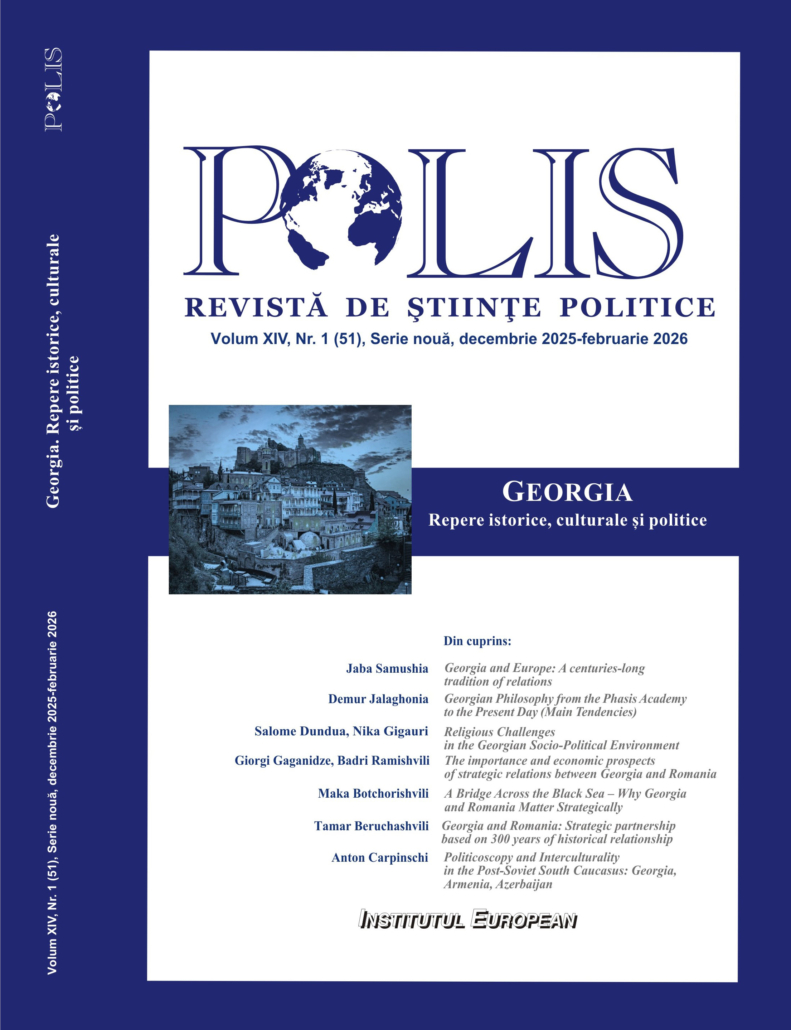
Coordonat de E.S. Tamar BERUCHASHVILI și Sabin DRĂGULIN
Volum XIV, Nr. 1 (51), Serie nouă, decembrie 2025-februarie 2026
Georgian Philosophy from the Phasis Academy to the Present Day (Main Tendencies)
Demur JALAGHONIA
Abstract: Georgian philosophy has a long and rich tradition spanning over fifteen centuries, dating back to the 4th century. It reached particular heights during the 11th–12th and 19th–20th centuries. Georgian thinkers became familiar, often contemporaneously, with the philosophical heritage from antiquity to modern times, interpreting, translating, and producing their own original works. Through this, they engaged with the prevailing intellectual paradigms of their eras and contributed actively to the study and development of the fundamental problems of philosophy.
There was a prolonged period characterized by a decline in philosophical thought (from the second half of the 13th century to the 17th century), which was primarily conditioned by the weakening and fall of Georgian statehood. Notably, the 20th century saw the rise of Georgian philosophical thinking, which fully integrated European intellectual traditions and gave rise to a new and original body of philosophical thought.
For a long time, the prevailing assumption was that philosophy could only be either German or Greek, as Wilhelm Windelband asserted, and that its study was confined to these two centers. Yet perhaps Gilles Deleuze and Félix Guattari were correct in suggesting that wherever philosophy emerges, it undergoes a process of territorialization. Philosophy, as the exchange of ideas, requires wandering across various “territories”, Thinking about the “geography of philosophy” has become relevant since the paradigm of a single philosophical center was abandoned. This provides a solid foundation for confidently discussing the existence of a “Georgian philosophy”.
Keywords: Georgian philosophy, Phasis, Gelati, Areopagitic tradition, Eastern Renaissance.
Introduction
The cultural affinity of Georgia with Western Europe is distinctly evident. The process of Georgian philosophical thought, which boasts a history of over a millennium, originates from the intellectual interactions of Late Antiquity. In Georgian philosophy, during the late Middle Ages, human existence and the universe began to be interpreted through Neoplatonic concepts. Subsequently, the focus shifted toward the study and understanding of modern European transcendental idealism, particularly the classical German philosophical systems, and, more recently, toward the postmodern philosophical examination of human existence within an era of rapid change. Such is the intellectual journey and evolution of philosophical activity in Georgia.
The idea of a “Georgian philosophical school” emerged in the mid-19th century and became a subject of debate in the 20th century. In Judeo-Christian scripture, philosophy is referred to as “Hellenic wisdom”, Martin Heidegger considered philosophy to be a “mode of Greek thinking,” which later found renewal in modern Europe, especially within classical German idealism. During the 19th century, philosophy underwent a period of modernization once again, a process that continued throughout the 20th century with the establishment of several well-known philosophical schools.
The beginnings of Georgian philosophy coincide with the spread of Christianity, and it naturally developed in close connection with theology. From its origins to the present day, Georgian philosophy has traversed an intellectually engaging path. The development of Georgian philosophical thought can be conditionally divided into distinct stages, each encompassing specific centuries. In these stages, the influence, assimilation, and creative transformation of Western philosophical models are clearly observable processes that have collectively shaped what we refer to as Georgian philosophy. These stages may conditionally be envisioned as separate epochs, each representing a distinct phase in the evolution of Georgian philosophical reasoning.
- The Era of Late Antiquity and the Early Middle Ages (4th-9th Centuries). This period begins with the existence of the Phasis Philosophical Academy and the intellectual activity of Peter the Iberian. At this stage, it is still difficult to speak of a distinct “Georgian philosophy” in the strict sense. However, certain philosophical reflections can already be found in various types of Georgian literary monuments. It is therefore more appropriate to speak about the presence of philosophical thinking in Georgia during this time rather than about an original Georgian philosophical system. Nevertheless, it would not be unfounded to acknowledge the efforts of historians and specialists of philosophy who, in discussing the history of Georgian philosophical thought, analyze the particular characteristics of philosophical reflection within Georgia and examine the influence and intellectual legacy of philosophical-theological schools that existed within the framework of ancient Greek colonies in the region.
- The Medieval Era (10th–12th Centuries). This period in Georgian philosophy is marked by the foundation of the Gelati and Ikalto Academies, as well as the translation and intellectual activity of the Athonite Fathers. It was during this era that philosophical literature and terminology began to emerge, be translated, and develop in the Georgian language. The process is closely linked with the intellectual and spiritual work of the Great Athonite Monks (Mtatsmindeli Fathers), Ephrem the Minor, Arsen Ikaltoeli, and Ioane Petritsi. Georgian philosophical thought reached its peak of development through the philosophical synthesis and commentaries of Ioane Petritsi, whose works integrated Neoplatonic ideas with Christian theology. Unfortunately, from the second half of the 13th century, Georgian philosophical thought entered a period of decline, primarily due to political instability and foreign invasions that profoundly impacted the country’s intellectual and cultural life.
- The Early Modern Stage of Georgian Philosophy (17th–19th Centuries). During this period, Georgian philosophy experienced a revival marked by the establishment of significant educational and theological-philosophical centers such as the Tbilisi Seminary (1755) and the Telavi Seminary (1782). This era marked the beginning of a philosophical and intellectual awakening in Georgia, primarily driven by new educational initiatives and reforms that were taking place in the country. Georgian philosophical thought of this period became deeply engaged with classical European philosophy, translating and assimilating its ideas into the national intellectual context. Among the thinkers of this epoch, Solomon Dodashvili stands out as a distinguished philosopher whose works exemplify the synthesis of European rationalism and Georgian intellectual heritage.
- For Georgian philosophy, the 20th century marks an exceptional and formative stage, fundamentally associated with the founding of Tbilisi State University in 1918. The university’s founders included eminent philosophers Shalva Nutsubidze, a figure of global significance, creator of the concept of the Eastern Renaissance, and the scholar who identified the true historical identity of Peter the Iberian, and Dimitri Uznadze, who later became world-renowned as a psychologist and the author of the Theory of Attitude.
In the 20th century, the world, along with Georgia, underwent profound social and political transformations. Georgia, in particular, came under the pressure of Marxist ideology, which heavily influenced intellectual and cultural life. Nevertheless, Georgian philosophers continued to produce highly original and intellectually rich works, demonstrating remarkable creativity and resilience. Contemporary Georgian philosophy is both diverse and multifaceted, in terms of both its thematic substance and its formal expression. On the one hand, there is a continuing study and reinterpretation of the finest examples of Georgian philosophical tradition; on the other hand, there is a pronounced aspiration to develop new perspectives and conceptual frameworks based on insights drawn from Western intellectual thought1.
A separate category can be distinguished for the activities of Georgian philosophers abroad. During the Middle Ages, Georgian thinkers worked beyond the country’s borders, in Constantinople, Palestine, Mount Athos, Bulgaria, and Romania, where they played an essential role in the development and transmission of theological and philosophical ideas. A second wave of Georgian intellecttuals abroad emerged in the 19th and 20th centuries, when philosophers and scholars were active in Russia and various European countries, particularly Germany. Their works, published in Greek, German, and other local languages, contributed to enriching and expanding Georgian philosophical thought.
The topic presented, “Georgian Philosophy from the Phasis Academy to the Present Day (Main Tendencies)”, by its very title, encompasses a broad and multifaceted spectrum. The epochs discussed include a significant number of Georgian philosophers, each representing a unique stage in the evolution of national philosophical thought. The scope and format of this work do not allow for a detailed examination of every influential thinker individually. Therefore, I will follow the four-stage structural framework outlined above and focus on the most prominent philosophers of each era, whose ideas best illustrate the intellectual continuity and transformation of Georgian philosophical reasoning from the time of the Phasis Academy to the present day. In addition to the analysis of individual philosophers, I will briefly discuss the key philosophical-educational centers that shaped Georgian thought, namely, the Phasis Academy, the Gelati and Ikalto Academies, and, in the 20th century, the foundation of Tbilisi State University, which became the new nucleus for the revival of Georgian philosophy. The establishment of the university under the leadership of Shalva Nutsubidze laid the intellectual foundation for the modern Georgian philosophical school. Furthermore, special attention will be devoted to Metropolitan Anthim the Iberian (Antimoz Iverieli), a distinguished Georgian thinker active in Wallachia (modern-day Romania) during the early modern period, whose theological and philosophical concepts represent a remarkable synthesis of Christian spirituality and intellectual reasoning, and who occupies a distinctive place in the history of both Georgian and European philosophical thought.
The Phasis Academy – The Cradle of Philosophy and Rhetoric
In ancient times, the academic world knew Georgia by two names, both referring to its regions: Colchis and Iberia (Iveria). Colchis was the easternmost stronghold of the ancient world. Well-known Greek myths recount the expedition of the Argonauts to Colchis.
The southern border of the ancient world, the precursor to modern Europe, was located in Colchis, which extended along much of the Phasis River (now the Rioni River). Colchis was the land of King Aeëtes and his daughter Medea, about whom Greek authors have written1.
“Argonautica” by Apollonius of Rhodes is one of the earliest Greek sources in which the name “Colchis” appears. Apollonius describes an ancient kingdom and region located on the Black Sea coast, inhabited by the Colchians, an early Georgian (Kartvelian) tribe. According to Herodotus, the Phasis River in Colchis formed the boundary between Asia and Europe2. The mythological figures associated with Colchis embody these cultural and geographical connections. According to some ancient accounts, King Aeëtes came to Colchis from Ephyra, a historic region of Greece; one of his sisters, Pasiphaë, was the wife of Minos, the legendary king of Crete, while his other sister, Circe, the famous sorceress, went to Italy, where she became the ancestress of several Italic tribes. Medea, the daughter of Aeëtes, first went to Hellas (Greece) and later returned to Colchis with her son Medus, symbolizing once again the enduring links between these civilizations3.
In Iberia, Christianity was proclaimed the official state religion in 327 A.D. In Late Antiquity, the name Iberia referred to the Kingdom of Eastern Georgia. According to Christian tradition, the first Christian communities in Georgia were founded by the Apostles Andrew and Simon the Zealot, also known as Simon the Canaanite4.
With the adoption of Christianity as the state religion, pagan Georgia, particularly Colchis, gradually lost its former power and influence. In the following period, Colchis became one of the earliest eastern strongholds of the European-Christian world and a supporting center of Byzantine civilization.
As Shalva Nutsubidze noted: “The difference between the economic life of Eastern Georgia (Iberia) and Western Georgia (Colchis) was inevitably reflected in the ideological and cultural life of both regions, and this distinction cannot be ignored”, Indeed, during the 4th-5th centuries, there were both similarities and differences in the content of philosophical thought in Colchis and Iberia. These distinctions were determined by both the nature of the ancient philosophical heritage and the specific environment in which that heritage was received and developed5.
As for Georgia, according to ancient Greek sources, it can be stated that a philosophical school existed on the Black Sea coast as early as the 4th century, in Colchis. This was the so-called Phasis Academy, a philosophical school that had a wide sphere of influence and dissemination6.
In one of his orations (XXVII), Themistius responds to a young provincial, noting that “near the River Phasis, where the Argonauts once came to Colchis, there is a perfect school of rhetoric and also a “school of the Muses,” whose participants come from various regions of the Hellenic world”, This information may serve as evidence supporting the view that Georgian philosophy has a history of approximately 1,700 years.
During Antiquity, particularly in the 3rd and 4th centuries, Georgia possessed a highly developed philosophical culture, with its own advanced center of philosophical education. According to the Greek sources themselves, this center stood at such a high intellectual level that it even attracted Greek scholars who came to ancient Georgia to pursue philosophical studies7.
The Higher Rhetorical School of Colchis, also known as the Colchian Academy, existed in the 3rd-4th centuries near Phasis (present-day Poti) and represented an educational institution of the Greek type. Information about this academy comes from a single direct reference by the prominent Greek thinker of Late Antiquity, Themistius (who lived and worked approximately between 317 and 388 A.D.). Themistius advises a young man not to master the art of rhetoric in Athens, but rather in a lesser-known place near the River Phasis, specifically in Pontus. According to Themistius himself, it was there, near Phasis, that he studied the highest achievements of oratory. In this educational center, philosophy and rhetoric were inseparable disciplines, forming the intellectual foundation of what became known as the Colchian (or Phasis) Academy, a remarkable example of early philosophical and rhetorical education on Georgian soil.
There is a single direct reference to this school, found in the writings of the great Greek thinker of Late Antiquity, Themistius (who lived and worked approximately between 317 and 388 A.D.). In one of his orations, Themistius advises a young man not to study the art of rhetoric in Athens, but rather in a lesser-known place near the River Phasis, specifically in Pontus. According to Themistius himself, he mastered the heights of oratory precisely there. In this educational institution, philosophy and rhetoric were inseparable disciplines.
“I, too, my dear friend, gathered the fruits of rhetoric in a place far more obscure than this not in a peaceful and Hellenic land, but at the end of Pontus, near the River Phasis, where Argus, having come from Thessaly, made his landing, as the poets recount with wonder and where he was taken up into the heavens. There lies Thermodon, the field of the Amazons, and Themiscyra. Yet this barbarous and gloomy land was made Hellenic and transformed into a temple of the Muses by the wisdom and virtue of one man a man who settled among the Colchians and Armenians, and who taught not archery, spear-throwing, or horseback riding according to the customs of neighboring barbarians, but rather how to be trained in the art of rhetoric and how to shine at the festivals of the Hellenes. Whether what I say is true will soon become evident if I add the following: I went there not by my own choice or decision, but was sent by a benevolent man, as loving as a father and as just in thought as a philosopher. Perhaps you will reproach him because he himself acquired his renowned philosophy there, or reproach me even more, who from childhood have been initiated into its mysteries”, This passage illustrates not only the existence of a high-level rhetorical and philosophical school near Phasis but also its reputation as a Hellenic center of learning in what Greek authors otherwise described as a remote and “barbarian” land. It stands as a remarkable testimony to the intellectual vitality of Colchis and to the early integration of philosophical education within Georgian cultural space8.
According to Themistius, the history of Georgian philosophy begins in the period of Late Antiquity. During this time, within the territory of present-day Georgia, the Phasis Rhetorical School existed, attended by the renowned Greek philosopher Eugenius (3rd–4th centuries A.D.) and his son Themistius, a famous commentator on Aristotle’s works.
It is known that both Themistius and his father, Eugenius, were distinguished for their philosophical writings, and that in the 4th century A.D., they worked at the Rhetorical School of Phasis. Themistius became a celebrated philosopher, orator, and statesman, earning recognition throughhout the Hellenic world.
This figure is of particular interest because Themistius preserved valuable information about the Rhetorical School of Phasis in Greek sources. Among his contemporaries and correspondents were Libanius, a renowned teacher of rhetoric and philosophy, and a close friend of Saint Gregory the Theologian (also known as Gregory Nazianzus). Of special note are Libanius’ letters written in 394 A.D. to the Georgian philosopher and orator Bacurius the Iberian, which are preserved in the four-volume collection of Libanius’ works. According to Shalva Nutsubidze, Bacurius the Iberian was active at the Phasis Academy9. Greek sources contain highly significant information about Georgian scholars, confirming that the Phasis Academy was among the oldest educational institutions in the world. Following Plato’s Academy and Aristotle’s Lyceum, the third such institution known to history was the Rhetorical School, which may rightly be referred to as the Phasis Academy. According to Greek and Latin sources, the Academy was attended by both local Colchians and young students who came specifically from the Byzantine Empire, that is, from the Eastern Roman Empire, to pursue their studies there. This underscores the international prestige of the Phasis Academy as a center of philosophical and rhetorical education, linking ancient Georgia with the broader Hellenic intellectual tradition10.
It is presumed that the curriculum and teaching methods of the Phasis Academy followed the programs and methodologies known from Greek academies. The Colchian Academy likely continued to function even after the closure of Plato’s Academy in Athens in 529 AD. Thus, the Colchian (Phasis) Academy stands as the first center in Georgia to testify to the existence of a highly developed philosophical culture.
At the Phasis Academy, Themistius studied the philosophical systems of Pythagoras and Plato, as confirmed by ancient sources. His father, Eugenius, held that there was no essential difference between Plato and Aristotle; somewhat, Aristotle had systematized Plato’s ideas, thereby protecting his teacher from excessive criticism. Themistius continued his father’s intellectual path and became, in the history of philosophy, one of the greatest commentators on Aristotle, being the first to introduce the method of paraphrastic interpretation of Aristotle’s works.
In 355 A.D., Themistius was appointed a Roman senator, and later, upon the recommendation of Emperor Theodosius I, he became the Prefect of Constantinople (modern-day Istanbul) in 384 A.D..11 We also have records from the Neoplatonist Libanius indicating that Prince Bacurius, the son of the King of Iberia (4th century), was highly educated in ancient philosophy.
In addition, during the period of Late Antiquity, the great Georgian church figure and scholar Peter the Iberian (5th century) lived, one of the most significant representatives of Christian philosophy, about whom further discussion will follow below.
The Mystery of
Petre the Iberian
Philosopher Shalva Nutsubidze, while working on the problems of the history of Georgian philosophy, elaborated two theories, which, due to their content, outcomes and importance, transcend the limits of the Qartvelological studies and belong to the sphere of the historical development of world thinking. One of them is a theory of the Eastern Renaissance, and the second is the theory of identity of Petre the Iberian and Pseudo-Dionysus the Areopagite12.
Petre the Iberian (Murvan in the secular world; 411-491) is a Georgian theologian and philosopher who is considered the founder of Christian Neoplatonism.
Petre the Iberian’s life is described in Ioane Rufus’s work, though the original text did not reach our times, and only a Syriac translation is available13.
Petre the Iberian is a grandson of the king of Iberia, Bakur the Great. Bakur, who was an Iberian and of noble origin, is an outstanding figure of the second half of the 4th century; chronologically and ideologically, he was closely related to the Kolkha school. He was a person of strong intellect and talent, well-known in the East Roman Empire for his versatile activities. Interestingly, a famous Georgian philosopher, Mithridates the Laz from Kolkha, was invited as a teacher and tutor of Murvan. In 423, Murvan and his retinue were summoned as hostages to Constantinople by the Caesar of the Byzantine Empire, Theodosius II. At the court, the wife of Caesar Eudocia, together with Mithridates the Laz, supervised the education of the Georgian prince. Murvan, from early childhood, showed great talent and received a brilliant education, “assimilating any knowledge, theological and philosophical” (Life of Kartli).
As conveyed, in Byzantium, Murvan listened to outstanding scholars and philosophers. His biographer Zakarias the Georgian witnesses that the prince astonished the Caesar and the court philosophers by his education, knowledge of Greek and acuteness. Later, together with several Georgians, he escaped to Palestine.
During his stay in Jerusalem, he mastered the Syrian language and literature. Here in Jerusalem, Murvan and Mithridates became monks, changed their names: Murvan became Petre and Mithridates – Ioane. They settled in Maiuma, near Gaza. In 452, Petre the Iberian was appointed to the episcopal see of Maiuma14.
Petre the Iberian is one of the most remarkable representatives of philosophical-theological thinking of the second part of the 5th century. He built a Georgian monastery and founded a school, the main contingent of which were Georgians living in Syria, though children of other nations – Greeks, Syrians, etc. studied in this school as well. Some authors think that part of the Georgians educated at this school returned to their homeland in the 6th century, and this event is known in the Georgian historiography as the arrival of the Assyrian Fathers to Georgia.
The so-called Corpus Areopagiticum, which consists of 10 epistles and four books, “On the Divine Names”, “Mystical Theology”, “On the Celestial Hierarchy” and “On the Ecclesiastical Hierarchy” – had been for centuries ascribed to Dionysius the Areopagite. These treatises are of particular importance for the theology of the Orthodox and Western European churches. Later, it was proved that it was impossible for St. Dionysius, who lived and worked in the 1st century, to be the author of this Corpus; therefore, an anonymous author was since then called Pseudo Dionysius the Areopagite15. In 1942, an outstanding Georgian scientist, Shalva Nutsubidze, proposed an idea of the identity of Pseudo Dionysus the Areopagite and a famous Georgian figure, Petre the Iberian. In 1952, a famous Belgian scientist, Ernest Honingmann, independently of Shalva Nutsubidze, arrived at the same conclusion. Since then, this theory has been called the Nutsubidze- Honingmann theory.
Petre the Iberian’s historical merit consists in forming a theory of negative theology and dialectics. According to him, it is impossible to give a positive definition of God as infinity since God is above any positive definition. Therefore, we do not know what God is, but we know what He is not. We cannot say that God exists because God is more than existence. God’s nature demands non-existence. Therefore, in contrast to Proclus, Petre the Iberian thinks that God’s negative definition is more appropriate than positive.
Petre the Iberian thinks that knowing God negatively serves to demolish the borders between the world and God. Through cognition of the steps of the world and elevating to God, it is possible to state what God is not. At the same time, the border between God and what god is not is annihilated, and we will find ourselves elevated to God, but it is not the only way to comprehend God. There is another way – immediate contemplation of God through mystical ecstasis.
Founding of Gelati Academy – Ioane Petritsi
Exact data of birth and death of an outstanding Georgian philosopher of the Middle Ages, Ioane Petrirsi, are unknown. We know that he went to Constantinople to get an education. At that time, the position of the leading philosopher was taken by Michael Psellos (1018-1077); later, his position as the head philosopher was taken by his pupil Ioane Itlus (born 1025). In 1083, Ioane Italus was put on trial as the church considered him a heretic, as he admitted the eternity of matter, the timeless existence of the world, etc.16 He violated the essential dogmas of Christianity.
Byzantine Ioane Petritsi studied philosophy, theology and the Greek language. Since circa 1083, Petritsi stayed at the Petritzonitissa Monastery, founded by Grigol Pakourianos. He took the name Petritsi from it. It seems that Petritsi left Constantinople after Italus’s trial. It was not safe for him to stay there as he was Italus’s pupil and shared his positions. Petritsi, as he himself admits, was persecuted by Georgians as well. Petritsi says regretfully that his fellow men impeded him from mastering philosophy and presenting theology in its pure form17. He explains it by envy and ignorance of his fellowmen18.
The research conducted by the 20th-century prominent linguists and philosophers (Nikoloz Marr, Korneli Kekelidze, Shalva Nutsubidze) in the 20s-60s established a scientific and religious tradition to consider that “De Natura Hominis” by Nemesius and “Elementatio Theologica” by Proclus Diadochi were translated by a person who lived in the second half of the 11th century and the beginning of the 12th century (during the reign of the king David Aghmashenebeli). This person was Ioane Petritsi, one of the founders and rector of Gelati Academy as well as of a solid school of theology.
Ioane Petritsi praises the king Davis Aghmashenebeli, who founded Gelati Academy in 1106 and produced the conditions suitable for his work.
Petritsi’s colossal translational, philosophical and pedagogical activities were finished in Gelati Academy. He translated: two logical treatises by Aristotle, which did not reach our times, Nemesius of Emesa’s “On Human Nature” and Proclus’s “The Elements of Theology”. Petritsi’s main and original work is “Comments on Proclus Diadochi’s and Plato’s philosophy”, which he added as vast comments to the translation of Proclus’s mentioned work.
Petritsi enjoyed great recognition in Georgia. He was characterised as a learned man, like Plato. “A Georgian philosopher, Solomon Dodashvili, thought very highly of him and said: “Petritsi was a true philosopher, very dear poet of Georgia, a really great and wonderful man of his times …”19.
Ioane Petritsi creatively reconceptualised “The Elements of Theology” by Proclus and managed to harmonise a deep knowledge and understanding of Proclus’s philosophy with superb originality and depth of his own philosophical theory.
To scrutinise Ioane Petritsi’s works and his originality seems possible only in the case of a detailed comparison of his treatise to the works by Proclus, since Petritsi, as the translator of “The Elements of Theology”, is at the same time its interpreter. It is also a task for the historians of Georgian philosophy 20.
Opinions of the Georgian scholars on Ioane Petritsi’s philosophy vary. Some of them (N.Marr, Sh. Nutsubidze, I. Fantskhava, Sh. Khidasheli) consider Petritsi as a continuator and developer of the Neoplatonic tradition, i.e. a Neoplatonic; M Gogiberidze characterises Ioane Petritsi’s philosophy as scholastic. At the same time, it should also be noted that Sh. Nutsubidze considered Petritsi’s philosophy from a different aspect. In particular, he thought it a Renaissance philosophy and associated the beginning of the Georgian Renaissance with it21.
As it has already been said, the comments attached to Proclus’s “The Elements of Theology” constitute an independent and original philosophical treatise. The originality of Petritsi’s philosophy is underlined by various thinkers. An outstanding Georgian philosopher of our times, Guram Tevzadze, thinks that the originality of Ioane Petritsi’s philosophy is evident with respect to one of the most important problems of the Middle Ages, that of analogy. According to a widespread position, the principle of analogy is for the first time given in the works of Alexander of Hales, a 13th-century English theologian; till the 13th century, this principle was not used either in the works of Arabian philosophers, nor in the works of Aristotle’s commentators. But the understanding of “being” or existing and “kind”, similar to the understanding given by Alexander of Hales, is present in its full form in Ioane Petritsi’s doctrine, that is, not in the 13th century, but at the beginning of the 12th 22. It is important as the problem of analogy is foremost in Medieval philosophy. It will suffice to say that “many consider it as the central problem of Thomas Aquinas’ philosophy!” 23.
Considering Ioane Petritsi’s world outlook in its wholeness makes the Neoplatonic character of his philosophical outlook evident.
It is true that Petritsi follows Neoplatonists, especially Proclus, but he is not a passive adherent of Neoplatonic philosophy. One of the problems taken by Petrits from Neoplatonic philosophy is that of the triad, regarding which he formed his own original position. We can say that the feature by which Sh. Nutsubidze classified Petritsi’s philosophy as Renaissance (the idea of unity of the first cause and the species) is clearly seen in Petritsi’s doctrine on the triad.
To understand perfectly the problem of the triad as well as other issues in Petritsi’s philosophy, it is necessary to briefly characterise the main objective and task of his work.
Petritsi’s objective is to state the first One or the first Cause. He thinks that if we understand the First Cause correctly, the nature of the species ensuing from it will also be seen correctly. In this respect, he, up to a point, develops the core principles of Neoplatonic philosophy. What is One, and how can it be characterised?
Petritsi thinks that the First Cause will be detected if we state One, though it is necessary to defend its purity. One can be only simple. Therefore, neither the sky, nor the soul, nor the spirit can be One and the First Cause since everything aforementioned contains parts and therefore is complex. One can be only simple (flawless): the flawless One is not linked to nature or species or parts but is above all these24. Here we can see the main principle of Petritsi’s philosophy, consisting in presenting One (the First Cause) as super-perfection in relation to other species.
The main principle of Petritsi’s philosophy is derived from Neoplatonism. As we know, the First Cause is recognised as the most perfect and the highest among all the beings in Plotin’s and Proclus’s philosophy.
Petritsi discusses two ways of cognition – through the soul and through reason. Soul cognises step-by-step; it is a result of judgement and comparison of various aspects of the object of cognition. Cognition through reason differs from cognition through the soul. It instantly, immediately grasps the object. Its object is immediately given in mind, like the halo eternally attached to the sun25. Just as the sun rays are always given with the sun, so the object of cognition is always given with the reason.
Aforementioned Aristotelian statement, Petritsi interprets based on Neoplatonic philosophy. In particular, he associates the ontological primacy and gnosiological minority of the first entities with a widely known statement of Neoplatonism according to which to reach the First Cause, it is necessary to pass every stage from the lowest to the highest up to the first Cause26.
Thus, the main thing in Petritsi’s philosophy is to state the One (First Cause). He resorts to a logical method that is necessary to state the One. The first One and the entities flowing from it are united in a one hierarchical order and ranged according to their perfection. The more perfect an entity is, the closer it is to the First Cause and vice versa, the less perfect is farther from it. The order between the entities is stated by the First Cause: each has its place assigned from the beginning27.
In his Comments, Petritsi first refers to Proclus’s statement and then interprets it. In the process of interpretation, Petritsi usually expresses original ideas.
Petritsi discusses Proclus’s statement that beings originate from one cause – the First Cause. Here, as Pertitsi notes, Proclus rejects Aristotle’s and Alexander Aphrodisias’s positions, who separated the creative Cause from the existents28.
Petritsi thinks that the first One is not to be understood as a force, or action or something comprehensible by reason. If we ascribe any of these characteristics to it, then it will not be pure, true or, using his terms, “flawless” One. Then Petritsi says that beings are endowed with existence by the supreme essence. He refers to Socrates, who insisted that every creator endows the created with their quality. Petritsi thinks that the first One is the highest – the Supreme. He uses a comparison with Apollo (Sun): as the Sun is above all that is created, just so is the first One. The first One, as the source of everything, is interpreted in the Neoplatonic manner: the One is the supreme Good as the highest expression of its perfection. If the first Cause is not Good, then there should be something else better than Good, supreme to it, and the existing should flow out of it as from the first Cause. And to it should they return as to the first Cause.
Petritsi is a Medieval thinker, and the importance of his ideas is to be evaluated from the viewpoint of his epoch. Monotheism was a dominant theory in the Middle Ages. Petritsi develops the main idea of Neoplatonic philosophy. As it is known, Neoplatonism opposes monotheism. Monotheism shares the idea of opposing God and the world. But in Neoplatonism, the world flows out of God, and it itself is also God, though at a certain stage of the development of God.
According to monotheism, God created the world from nothing; in Neoplatonism, the whole world exists eternally. Just because the essential difference between God and the world is annihilated in Neoplatonism, “Neoplatonism in the Middle Ages as well as in the Renaissance period remains a progressive theory and the monotheistic perceptions (Talmud, Bible, Islam) remain naïve childish superstitions”. The main principles of Neoplatonic philosophy are retained and originally developed in Petritsi’s philosophical world outlook.
Ioane Petritsi aimed to create a Georgian conceptual system which could equal the Greek philosophical terminology.
He formed the basic philosophical concepts: logos, cosmos, noema, nous, psyche, anima, ethos, theos, aletheia, dianoia, gnosis, etc29.
Ephrem Mtsire, who translated “Corpus Areopagiticum” into Georgian, in his will, asked the Christians to pray for Ioane, “divine philosopher”, because if he were not his mentor and assistant, he would never dare translate that work. It is thought that speaking of a “divine philosopher” Ioane, Ephrem Mtsire meant Petritsi.
Later, Ioane Petritsi was considered a teacher and a principal adviser of Ephrem Mtsire when he was translating Corpus Areopagiticum into Georgian. Scientists who share Shalva Nutsubidze’s position think that “divine philosopher” was Ioane Petritsi’s academic rank30.
Comments as a genre of philosophical literature were widespread in the epoch of Ioane Petritsi [3]. The influence of Ioane Petritsi’s version of Neoplatonism on Georgian culture was really profound, especially on the philosophical poem “The Knight in the Panther’s Skin” by Shota Rustaveli, which was created in the epoch of early Renaissance31.
Return to the European Intellectual Space – Solomon Dodashvili
The Georgian philosopher Solomon Dodashvili (1805-1838) lived a brief yet profoundly complex and existentially challenging life, spanning only thirty-three years. He received his early education at the St. Nino Monastic School in Bodbe and later continued his studies at the Tbilisi Theological Seminary. At the age of nineteen, on the advice and recommendation of Metropolitan Ioane of Bodbe, Dodashvili traveled to St. Petersburg to further his education. In 1824, he was admitted to the Imperial University of St. Petersburg, where he pursued advanced studies in philosophy and the humanities. During this period, Dodashvili received significant support and intellectual guidance from the renowned Georgian theologian and philosopher, Monk Ioane Khelashvili (1778-1837), whose influence greatly shaped his spiritual and philosophical worldview.
In 1827, after graduating from the Imperial University of St. Petersburg, Solomon Dodashvili returned to his homeland, where he became actively involved in public affairs and in the revival of Georgian culture and education.
During his studies at St. Petersburg University (beginning in 1824), the ideas and concepts of German classical philosophy had already gained vast influence across Russian universities. The university’s professors of philosophy were eclectic thinkers, and this intellectual environment had a significant impact on Dodashvili’s philosophical education and outlook.
While studying in St. Petersburg, Dodashvili had the opportunity to become acquainted with the works of the most prominent European philosophers and scholars freely. He thoroughly studied Kant’s and Schaad’s works on logic, Fichte’s systematic treatise “The Science of Knowledge” (Wissenschaftslehre), as well as Friedrich Schlegel’s “History of Ancient and Modern Literature”, and the writings of Ludwig Tieck and Wilhelm Wackenroder.
Drawing upon these philosophical sources and the spiritual heritage of Georgian culture, Dodashvili developed an ontological concept based on the monistic principle of objective idealism, which closely resembles Schelling’s philosophy of identity.
Solomon Dodashvili was among the first Georgian intellectuals to achieve notable success in the field of European philosophy immediately after completing his studies at St. Petersburg University. He gained wide recognition for his “Logic”, a philosophical textbook that established his reputation as a prominent philosopher and educator both in Georgia and beyond.
Dodashvili notes: “The realm of science extends only as far as the boundaries of activity marked out for the mind by nature; and since this faculty encompasses only what is subject to sensation and experience, logic may justly be called phenomenology, the science of phenomena. To apply the principles of logic to objects lying beyond the sphere of experience, to the very essence of things, means to attribute to them a value and power greater than they can actually possess; it means to confuse things that are entirely distinct and even opposed, and to give rise to dualism, skepticism, and other erroneous systems, which inevitably follow from such confusion between the two faculties of the soul and the two corresponding worlds that together make up the unity of existence. Phenomena do not constitute the essence of things; judgment is not the same as reason; logic is not metaphysics. These are the distinctions that alone can lead philosophy out of the labyrinth of confusions in which it had remained until the time of the philosopher of Königsberg32”, In 1827, at the age of twenty-two, Solomon Dodashvili published his principal work in Russian, A Course in Philosophy, Part One: Logic33. Building upon the foundations of German classical philosophy and the Georgian philosophical tradition, Solomon Dodashvili created a highly significant and systematic model of thought.
Dodashvili placed the human being at the very center of philosophical inquiry, making philosophical anthropology the core of his system. According to him, human reason is truly self-sufficient only when it finds a firm foundation in knowledge, for it is upon this foundation that the entire essence of the human being rests.
Thus, the human being is not only the principal object of cognition but also its cognizing subject; the knower and the known are the same essence. This is the fundamental structure that Dodashvili developed in accordance with the model of classical German philosophy, and it is precisely what distinguishes philosophy from the particular sciences34.
The knowledge of one’s inner world, he argued, can belong only to the person capable of disregarding the external and abstracting from it in the process of cognition. The investigation of the causes and grounds of one’s own being (the Self) is possible only for one who can concentrate inwardly. Dodashvili thus made the inner world of man the central subject of philosophical investigation. In this context, he identified three principal objects and aims of philosophical inquiry, which will be discussed further below:
(1) Abstraction and Reflection
(2) Self-Knowledge
(3) Self-Sufficiency through Self-Knowledge
Dodashvili developed his philosophical vision both methodologically and systematically. He devoted special attention not only to the foundation of philosophy itself, but also to the construction of his own philosophical system, grounded in the principles of German Idealism.
He presented the main ideas of his philosophy at the very beginning of his Logic, specifically in the section titled “General Introduction to Philosophy”, In the concluding part of this work, he proposed a systematic scheme of philosophy, dividing philosophical knowledge into distinct fields.
According to Dodashvili, the primary branches of philosophy are Logic, Psychology, and Metaphysics. These are followed by Aesthetics, and finally by the Philosophy of Morality and the Philosophy of Law.
This structure clearly demonstrates that, in Dodashvili’s system, philosophy begins with logic and psychology, expands through metaphysics and aesthetics, and culminates in moral and legal philosophy.
The core of his philosophical thought was philosophical anthropology. Dodashvili viewed the human being as a rational and thinking entity, and thus placed man and his essential faculties at the center of his philosophical framework. Morality and law, in his view, are the foundational existential principles that distinguish the human being from all other creatures and reveal humanity as the culmination of creation.
Unlike all other beings, humans alone appear as moral and just entities. Therefore, a philosophical system must not only adequately describe the essential aspects of human existence but also formulate the laws governing moral and just action.
Solomon Dodashvili’s philosophical system resembles the systematic undertakings of classical German philosophy, those of Kant, Fichte, Schelling, and Hegel, although the Georgian philosopher’s attempt was less monumental in scope. Solomon Dodashvili was an original thinker, not a mere imitator35.
As Shalva Nutsubidze aptly and accurately observed: “With this bold step, a new direction was opened –one that was inherent from the very beginning in Solomon Dodashvili’s philosophical thought, and which was linked to the turning point in Western European philosophy through the application of some aspects of Fichte’s philosophy.
Fichte was a disciple of Kant, and even after attempting to transcend the limits of Kant’s agnosticism, he retained certain Kantian elements of thought. In the history of Western philosophy, an erroneous view was established early on, namely, that Fichte was merely a continuator of Kant. This misunderstanding arose not only because Fichte’s book on religious questions was mistakenly attributed to Kant (since the actual author’s name was omitted), but also due to a deeper reason: it was assumed that Fichte began his philosophical work where Kant had ended—namely, with the problems of practical philosophy.
This, however, reflected a profound misunderstanding in Western philosophy, which failed to grasp the novelty introduced by Fichte’s thought, that he began his philosophical inquiry through action itself36”,
Solomon Dodashvili died prematurely, and as a result, he was unable to complete his philosophical system. He finished only the first part of his system, “Logic”, This circumstance must necessarily be taken into account when reconstructing the specific nature and characteristics of his philosophy.
According to Dodashvili, logic is no longer merely an organon of philosophy, that is, an instrument or tool for philosophical reasoning, but rather a science concerned with the general and necessary laws of thought.
His philosophy had a broad resonance, not only in the national but also in the international context. Thus, Dodashvili belongs to the group of Georgian philosophers whose work became the subject of detailed and specialized study. Upon its publication, Dodashvili’s Logic received wide recognition in Russia. Major Russian journals and periodicals – such as Moskovskiy Vestnik (Московскій вѣстникъ), Moskovskiy Telegraf (Московскій телеграфъ), and Severnaya Pchela (Сѣверная пчела) — reviewed the work and praised the Georgian author for his achievements. Noteworthy references to this work also appeared in major Russian-language lexicons and encyclopedias, including E. L. Radlov’s “Philosophical Dictionary” (St. Petersburg, 1904) and the Brockhaus and Efron Encyclopedia (St. Petersburg, 1893), which further attest to the intellectual significance and lasting influence of Dodashvili’s contribution to philosophy.
According to Shalva Nutsubidze, when the rhetorical question is raised about the place Solomon Dodashvili occupies in the history of Georgian philosophy, it is essentially equivalent to asking what place he holds within the broader context of world philosophical thought37.
Dodashvili’s invaluable intellectual work coincides with one of the most momentous epochs in human history, a period marked by profound revolutionary transformations and intense socio-political upheavals, during which the formation and consolidation of national and state political systems were actively taking place.
Nutsubidze, Shalva. Aletheological Realism and the Theory of the Eastern Renaissance.
Shalva Nutsubidze (1888-1969) was one of the most distinguished Georgian philosophers and intellectual figures of the twentieth century. For more than five decades, he profoundly influenced Georgian society, establishing himself as a renowned philosopher, founder of the Georgian philosophical school, author of the theory of the Eastern Renaissance, translator, co-founder of Tbilisi State University, Rustvelologist, brilliant orator, and a man of exceptional intellect and talent.
He graduated from the Faculty of Philosophy at St. Petersburg University in 1910, where he studied under prominent professors such as A. Vvedensky, N. Lossky, and I. Lapshin. As part of his academic work, he twice visited Germany, where he conducted research under the guidance of famous philosophers W. Wundt, I. Volkelt, and K. Barth.
Shalva Nutsubidze was one of the founders of Tbilisi State University (1918). At that time, two major ideas were competing in Georgia – the establishment of a technical institute and that of a humanities-oriented university. Nutsubidze succeeded in upholding and realizing the humanistic vision, ensuring the creation of a true university of knowledge.
He was not merely one of the founders but the spiritual architect of the idea itself. From the very beginning, he worked to revive the philosophical traditions of the Gelati Academy within the new university. This aspiration is exemplified by his monumental two-volume work, “History of Georgian Philosophy,” which stands as a cornerstone of modern Georgian philosophical thought.
At the initiative of Shalva Nutsubidze, a philosophical society was established in Tbilisi in 1918, the “Ioane Petritsi Philosophical Society”. The society’s primary goal was to revive the philosophical tradition that had been lost over the preceding centuries. In Petritsi’s era, the language of philosophy was Greek, which gave rise to extensive translation activities. By contrast, at the beginning of the 20th century, German philosophy had assumed a leading position worldwide, and Neo-Kantian philosophical schools had come to dominate the intellectual landscape.
In Europe, phenomenology and existentialism were taking their first steps, marking a new stage in the development of philosophy. At that time, a need arose for a new system of articulating Georgian philosophical concepts, one that would address themes relevant to the broader field of philosophy and serve as an equivalent counterpart to the conceptual frameworks of German philosophy38.
Shalva Nutsubidze began to work in this direction, formulating a new philosophical framework. In his monographs “Truth and the Structure of Cognition” 39 (1926) and “Philosophy and Wisdom”40 (1931), he developed the fundamental principles of Alethiology.
He called his original philosophical conception “Alethiological Realism”, According to Nutsubidze, Alethiology occupies an intermediary position, somewhere between philosophy and what may be called wisdom”.
If the first work (Wahrheit und Erkenntnisstruktur) represents the “First Introduction to Alethiological Realism,” the second, Philosophie und Weisheit (“Philosophy and Wisdom”), was conceived as a “Special Introduction to Alethiology41”,
Shalva Nutsubidze’s writings attracted wide recognition among Western scholars. His studies published in Germany received twelve reviews in various German, French, and English journals. Although the reviewers’ positions on Alethiological Realism were not entirely uniform, their discussions reveal a deep interest in the issues raised, and most offered high praise for the originality of his thought.
As early as 1911, Nutsubidze delivered a lecture in Leipzig entitled “On the Principles of Alethiology,” which was later published in 1913 in the journal `Вопросы философии и психологии~.
Nutsubidze’s academic activity can be divided into two significant periods. The first period, often referred to as the metaphysical period, is characterized by his original thinking and his attempt to construct a new philosophical system. The second period is devoted to the history of Georgian philosophy and to the formulation of the concept of the Eastern Renaissance within the framework of Georgian intellectual culture. Ultimately, these two periods represent two stages in the realization of one incredible intellectual journey in Nutsubidze’s philosophical development.
Within the framework of Alethiology, Nutsubidze wrote: “Philosophizing is solely and exclusively a human activity. On a higher level of being, it would not be necessary; on a lower level, it would not be possible”,
At the center of philosophy, he places the human being, not as an end in itself, but as a path and a search, endowed with an endless potential for striving and inquiry. Approaching truth, for Nutsubidze, means a gradual limitation of this potential and a detachment from the human. The ultimate goal, therefore, is to approach truth and, in doing so, to transcend the merely human condition.
Cognition, according to Shalva Nutsubidze, is a process that unfolds between the human being and the object of knowledge. Within human cognition, it is essential to distinguish between what is “specifically human” and what is “especially human”,
Special sciences do not aim to uncover truth as revealed within phenomena, because their task does not lie on the alethiological (truth-revealing) plane of reality. Science investigates the objects of truth, whereas philosophy studies truth itself as a domain. It is essential, Nutsubidze writes, to maintain two key principles: “We affirm existence not as untrue, but as truly existing. Therefore, our realism is Alethiological Realism”42.
According to Shalva Nutsubidze, within Aletheological Realism, understood as a form of “first philosophy,” substance is defined as Truth itself, that which exists beyond being, or more precisely, outside the sphere of oppositional logic, the “pre-logical” realm. The central question for Nutsubidze is: How is it possible to grasp the pre-logical, Truth “in itself”, which constitutes the unconditional precondition of cognition? In response, Nutsubidze introduces the concept of “directionless seeing” (Richtungsloses Sehen). He explains that “Truth in itself” is not a concept about an existent, but rather exists together with the existent. The existent as such is not “Truth in itself”,
Shalva Nutsubidze presented an original theory, elaborated in several of his significant works, including “Rustaveli and the Eastern Renaissance”43 (1947) and the two-volume “History of Georgian Philosophy”6 (1956-1958). Through these studies, Nutsubidze became acquainted with the mystical author of the 5th century, known under the name Dionysius the Areopagite. Nutsubidze advanced the bold hypothesis that this name was, in fact, a pseudonym of Peter the Iberian, a Georgian theologian and philosopher who lived and worked in Palestine, conducting highly significant theological and philosophical research and composing his works in Greek. Scholars of the time believed that all of Peter the Iberian’s writings had been lost. Still, Nutsubidze’s theory reopened the question of their identity and authorship, offering a groundbreaking interpretation that connected Georgian intellectual heritage with the roots of Christian Neoplatonism.
Shalva Nutsubidze’s most significant achievement lies in his contribution of two ideas of immense significance to the global intellectual heritage. First, Nutsubidze demonstrated that the author of the well-known Corpus Areopagites was none other than the 5th-century Georgian thinker, Peter the Iberian. Second, through the creation of his theory of the Eastern Renaissance, he introduced an entirely new concept into the study of world philosophical and cultural history. According to Nutsubidze, the Eastern Renaissance preceded the Western Renaissance by several centuries, and indeed, the foundations of Western culture are deeply rooted in the East. As he wrote: “The mystery of Pseudo-Dionysius the Areopagite is the symphony of the fifth century”.
A direct analogy can be drawn between Peter the Iberian’s doctrine and the methodological approaches he employed, particularly the apophatic (negative) and cataphatic (affirmative) methods. These two approaches, Nutsubidze noted, became the fundamental methods of philosophical inquiry during the Renaissance era of humankind.
Nutsubidze broke through the darkness. He discovered that within Ioane Petritsi’s “Georgian reception” and the Corpus Areopagites lie all the necessary prerequisites for understanding a new ontological theory of truth. According to Nutsubidze, the study of Alethiology is also of great importance from a phenomenological perspective. He sought to construct his own version of ontological phenomenology, which can be interpreted as a post-secular theory of humanism. Shalva Nutsubidze’s conception remains highly vital and relevant within the space of Georgian culture. It has become a model for the philosophical interpretation of culture, providing a framework that can be actively applied to the study of contemporary philosophical problems and the analysis of spiritual conditions in modern society44.
Prof. Gigi Tevzadze notes that Shalva Nutsubidze’s works are also of great importance for identifying the points of connection between ancient and Christian cultures. He writes: “More than two centuries have passed since The Knight in the Panther’s Skin entered the field of vision of intellectuals interested in the Middle Ages, first in Europe, and later throughout the entire world”, Through Nutsubidze’s research, these connections between antique and Christian worldviews became clearer, allowing scholars to trace the continuity of philosophical and cultural thought that unites the classical, medieval, and modern traditions within both Georgian and global intellectual history.
Georgians, despite the rich heritage of medieval, colonial, modernist, postmodern, and even post-postmodern literature, “The Knight in the Panther’s Skin” remains the central text, the foundational work around which intertextual annotations, allusions, deconstructions, and reconstructions continue to unfold. In the modern world, it isn’t easy to find another cultural context in which the living backbone of national literature is still formed by a text written nine centuries ago”.
As Shalva Nutsubidze wrote, the Renaissance represents “one of the most debated issues in Western scholarship”, What may appear, at first glance, to be a purely academic question has in fact provoked heated controversy, for, as he observed, “It has become a question of the very roots of Western European culture,”9 touching upon matters of national cultural interests and attempts to justify claims of national superiority. A large number of prominent Western scholars, including Jules Michelet, Voigt, and Burckhardt, among others, have maintained that the Renaissance was an exclusively Western phenomenon, with its origins concentrated entirely within Europe itself. Shalva Nutsubidze considers this view a clear manifestation of Eurocentrism. He not only provided its immanent critique, but also sought to refute it through factual evidence demonstrating the existence of a Renaissance culture in the East45.
One of the central propositions of Shalva Nutsubidze’s theory of the Eastern Renaissance concerns the philosophical grounding of the Renaissance as a distinct cultural phenomenon.
In Western scholarship, it is widely held that Renaissance philosophy is based on Neoplatonism. Nutsubidze extended this concept to the Eastern (and specifically Georgian) Renaissance culture, enriching and expanding its philosophical content. He argued that the monotheistic form of Neoplatonism, known as the Areopagite doctrine and historically associated with Dionysius the Areopagite, played a decisive role in shaping the Renaissance worldview and humanism. It is well established that both Neoplatonism and the Areopagite tradition were well known in Georgia during the 11th and 12th centuries, profoundly influencing the development of Georgian philosophical and theological thought46.
This line of thought led Shalva Nutsubidze to confront the question of the actual authorship of the works attributed to Dionysius the Areopagite, resulting in his identification of Pseudo-Dionysius with Peter the Iberian. Nutsubidze’s research on this issue later received strong confirmation through the discovery of the Belgian scholar Ernest Honigmann, whose findings caused a sensational reaction within Western academic circles, lending significant support to Nutsubidze’s groundbreaking hypothesis.
The view that Neoplatonism forms the philosophical foundation of the Western Renaissance and Humanism is well established both in Western and Russian scholarship. It had also long been recognized that the philosophical worldview of Shota Rustaveli was rooted in Neoplatonism, a view that Shalva Nutsubidze not only deepened and substantiated with further arguments but also extended to the phenomena of the Eastern Renaissance.
However, the founder of the study of Georgian philosophy’s history soon faced an unexpected and serious challenge, one that was, in part, artificially amplified. This difficulty arose from the fact that within Soviet scholarship, Neoplatonism was subjected to a highly nihilistic and pessimistic evaluation, as it was often seen as a reactionary and religiously dogmatic doctrine, incompatible with the officially sanctioned materialist worldview47.
Conclusion
The work “Georgian Philosophy from Phasisi Academy up to the Present” (the Main Tendences) proved rather bulky. But did we answer the problem posited? Formation of the Georgian philosophical world outlook begins at the Phasisi philosophical academy, and as historical sources witness, even Greeks strived to get an education in this school. As a result of the conceptual analysis of various situations related to Phasisi academy, it was found that a mystical person known under the name of Petre the Iberian was associated with it.
Shalva Nutsubidze created an absolutely new conceptual field to substantiate and solve the mystery of the authorship of the Areopagitical works. Dionysus the Areopagite, a figure of the 5th century, was known as the author of these treatises. Nutsubidze argued that the author of the Areopagetical works is a Georgian, Petre the Iberian, an ecclesiastic hierarch who lived and worked in Palestine.
Georgian theologian and philosopher Petre the Iberian is considered a founder of Christian Neoplatonism, and it is very important.
As it is shown, in 1942, a famous Georgian philosopher, Shalva Nutsubidze, introduced into the world scientific sphere the issue of identity of Pseudo Dionysus the Areopagite and an outstanding Georgian figure, Petre the Iberian. In 1952, independently of Nutsubidze, a famous Belgian scientist, Ernest Honigmann, arrived at the same conclusion, and since then, the theory is known as the Nutsubidze-Honigmann theory.
The Neoplatonic direction was continued in Ioane Petritsi’s works. Discussion of his world outlook makes the Neoplatonic character of his philosophy evident.
Petritsi, though he follows the Neoplatonics, especially Proclus, is not a passive adherent of Neoplatonic philosophy. He is a creator and forms a new original theory. According to Nutsubidze, it is the philosophy of Petre the Iberian and Ioane Petritsi that can be considered Renaissance. This tendency is partially continued by Solomon Dodashvili, who attempted to profoundly reconceptualise Western thinking, in particular, German philosophy.
Shalva Nutsubidze placed the ideas of Georgian philosophers working in different epochs in a new thinking context. Nutsubidze’s greatest achievement is that he stepped into the world intellectual sphere with two exquisite discoveries: Shalve Nutsubidze proved that the author of the famous Areopagitical Corpus is a 5th-century Georgian ecclesiastic and philosopher, Petre the Iberian; by creating the theory of Oriental Renaissance, Nutsubidze opened an absolutely fresh perspective in the scientific studies of the world thinking and culture proving that the Oriental Renaissance outruns the western Renaissance for centuries.
In the work, ideas of eminent Georgian philosophers are pushed to the foreground, thus demonstrating the whole united line of philosophical thinking that builds the landscape of Georgian philosophical thought. After Nutsubidze, the tradition continued and embraced phenomenological, existential and other modern developments. The contemporary philosophical world is acquainted with eminent Georgian philosophers.
Notes
- Tengis Iremadze, Medieval Georgian Philosophy: A Systematic Outline for Understanding Its Specificity, Favorite Style, Tbilisi, 2019, pp. 123-124.
- Apollonius of Rhodes, Argonautica, Translated and annotated by Akaki Urushadze, Ganatleba Publishing House, Tbilisi, 1972, pp. 247-249 (in Georgian). See also: Akaki Urushadze, The Argonauts in the History of Ancient Colchis, Ganatleba Publishing House, Tbilisi,1964.
- Rismag Gordeziani, The World of Greek Mythology: The Argonauts, Logosi Publishing House, Tbilisi, 1999, pp. 109-123.
- Nodar Lomouri, Relations Between Georgia and the Byzantine Empire. Part I (4th–9th Centuries), TSU Press, Tbilisi, 2011, pp. 85-90.
- Shalva Nutsubidze, The Mystery of Pseudo-Dionysius the Areopagite, Translated by Levan Gigineishvili, TSU Press, Tbilisi, 2013, p. 19.
- For information about Georgia in Byzantine sources, see GEORGICA, Vol. I.
- Themistius, In Georgica: Information about Georgia from Byzantine Writers, Vol. I. Texts translated into Georgian with commentary by A. Gamkrelidze and S. Qaukhchishvili, Publishing House of the Academy of Sciences of the Georgian SSR, Tbilisi, 1961, pp. 50-54.
- Ibidem
- Shalva Nutsubidze, History of Georgian Philosophy, 1, Tbilisi, 1956.
- Idem, History of Georgian Philosophy, Vol. 1. Tbilisi, 1956.
- Tengiz Iremadze, Philosophy of Late Antiquity in Georgia, In Patriarchate Bulletin, No. 8 (February 28 – March 6, 2019), pp. 13-15.
- Apollonius of Rhodes, cit., pp. 247-249 (in Georgian). See also: Akaki Urushadze, The Argonauts in the History of Ancient Colchis, op.cit.
- Chachibaia, Life of Petre the Iberian According to the 8-9th century Assyrian Manuscripts, Universali, Tbilisi, 2005, p. 45 (in Georgian)
- Nutsubidze, Petre the Iberian and the Anrique Philosophical Heritage, works, vol. 5, Tbilisi, 1975 (in Georgian).
- Kaukhchishvili, A History of the Greek Literature, vol. 3, Tbilisi, 1973, pp. 103-113. (in Georgian)
- Danelia, “A New Attempt on Identification of Petre the Iberian and Dionysus the Areopagite”, Matcne #1, Tbilisi, Publishing of the Academy of Sciences of Georgian SSR, 1960, pp. 269-274 (in Georgian).
- Marr, “The Life of Petre the Uberian, the Prince-Ascetic and the Episcope of Maiuma in the 5th century”, Palestina Orthodox Digest, 1896, v. 16. p.2 (in Russian).
- “Proceedings of the Imperial Novorosiisk University”, vol. 59, Odessa, 1893, pp. 420-424. (in Russian)
- Shalva Khidasheli, Ioane Petritsi, Tbilisi, 1956, p. 7 (In Georgian)
- Petritsi Ioane, Comments on Proclus Diadochi’s and Plato’s Philosophy, Works, vol. II, Tbilisi, 1937, p. 222. (In Georgian)
- Nemesius of Emesa, “On Human Nature”, Tbilisi, 1914. (The Georgian text is studied, prepared for publishing and equipped with vocabulary and indexes by S. R. Giorgadze). (In Georgian)
- Dodashvili Solomon, works, Tbilisi, 1961, p. 199. (In Georgian).
- Losev, „The Translator’s Introduction”, Proclus, The Elements of Theology, 1972. (in Russian)
- Mikeil Makharadze, Letters on Georgian Philosophy, Sabchota Saqartvelo, 1988. (In Georgian)
- Problems of the history of Medieval Philosophy, part I, Tbilisi, 1981, p. 232. (In Georgian)
- Ibidem, p.233. (In Georgian)
- Petritsi Ioane, works, vol. II, pp. 3-4. (In Georgian)
- Ibidem, p.9.
- Solomon Dodashvili, Logic, Translated by P. Iashvili, edited and introduced by A. Kutelia. Sakhelgami Publishing House, Tbilisi,1949, pp. 16-17.
- Idem, (Додаев-Магарский), Курсъ философіи. Часть первая. Логика, Санкт-Петербургъ: Въ Типографіи Александра Смирдина, 1827.
- Shalva Nutsubidze, History of Georgian Philosophy, Vol. II., Publishing House of the Academy of Sciences of the Georgian SSR, Tbilisi, 1958, p. 491.
- Ibidem, p. 495.
- Gigi Tevzadze, Solomon Dodashvili, Diogene Publishing House, Tbilisi, 2005.
- Khatuna Katsitadze, On the Question of Solomon Dodashvili’s Worldview, Carpe Diem Publishing, Tbilisi, 2014. Shalva Nutsubidze, Aletheological Realism and the Theory of the Eastern Renaissance.
- Anastasia Zakariadze, Irakli Brachuli. Philosophy in Georgia from Neoplatonism to Postmodernism, Ivane Javakhishvili Tbilisi State University Press, 2018, p. 43.
- Shalva Nutsubidze, Wahrheit und Erkenntnisstruktur. Erste Einleitung in den Aletheologischen Realisms, Berlin und Leipzig, 1926.
- Idem, Philosophie und Weisheit. Spezielle Einleitung in die Alethiology, Berlin und Königsberg, 1931.
- See review and full bibliographic data in Shalva Nutsubidze, Works, Vol. I. Tbilisi, 1979, p. 21.
- Idem, Works, Vol. II. Tbilisi, 1979, p. 207.
- Idem, Rustaveli and the Eastern Renaissance, Academy of Sciences Publishing House, Tbilisi, 1947.
- Idem, History of Georgian Philosophy, Vols. I–II., Academy of Sciences Publishing House, Tbilisi, 1956-1958.
- Anastasia Zakariadze, Irakli Brachuli. Philosophy in Georgia from Neoplatonism to Postmodernism, Ivane Javakhishvili Tbilisi State University Press, 2018, p. 46.
- Gigi Tevzadze, “KPS?”: In the final analysis, what is this “Knight in the Panther’s Skin”? In Zurab Kiknadze. Anniversary Collection, Ilia University Press, Tbilisi, 2013, pp. 100-105 (in Georgian).
- Misha Makhardze, History of Georgian Philosophical Thought, Tbilisi, 2013, p. 13.
- Shalva Nutsubidze, History of Georgian Philosophy, Vol. I. Tbilisi, 1956, p. 123.
- Misha Makhardze, History of Georgian Philosophical Thought, cit., p. 13.
- Idem, History of Georgian Philosophical Thought, Tbilisi, 2013, p. 141; Tengis Iremadze, Medieval Georgian Philosophy: A Systematic Outline for Understanding Its Specificity, Favorite Style, Tbilisi, 2019, pp. 123124.
Bibliography
Books
APOLLONIUS OF RHODES, Argonautica, Translated and annotated by Akaki Urushadze, Ganatleba Publishing House, Tbilisi, 1972.
CHACHIBAIA, M. “Life of Petre the Iberian According to the 8-9th Century Assyrian Manuscripts”, Universali, Tbilisi, 2005. (In Georgian).
DODASHVILI, Solomon, Logic, Translated by P. Iashvili, (edited and introduced by A. Kutelia), Sakhelgami Publishing House, Tbilisi,1949.
IDEM, Solomon. Works, Tbilisi, 1961. (In Georgian)
IDEM (Додаев-Магарский), Курсъ философіи. Часть первая, Логика, Санкт-Петербургъ: Въ Типографіи Александра Смирдина, 1827. (In Russian)
GEORGICA, Information about Georgia from Byzantine Writers. Vol. I.
GORDEZIANI, Rismag. The World of Greek Mythology: The Argonauts, Logosi Publishing House, Tbilisi, 1999.
IREMADZE, Tengiz, Medieval Georgian Philosophy: A Systematic Outline for Understanding Its Specificity, Favorite Style, Tbilisi, 2019.
KATSITADZE, Khxhaber, On the Question of Solomon Dodashvili’s Worldview, Carpe Diem Publishing, Tbilisi, 2014.
KAUKHCHISHVILI, Simon, A History of Greek Literature, Vol. 3. Tbilisi, 1973. (In Georgian)
KHIDASHELI, Shalva, Ioane Petritsi, Tbilisi, 1956. (In Georgian)
LOMOURI, Nodar, Relations Between Georgia and the Byzantine Empire, Part I (4th-9th Centuries), TSU Press, Tbilisi, 2011.
LOSEV, Alexhi, “Translator’s Introduction”, In Proclus, The Elements of Theology, 1972. (In Russian)
MAKHARADZE, Mikeil, Letters on Georgian Philosophy, Sabchota Saqartvelo, 1988. (In Georgian)
MAKHARDZE, Misha, History of Georgian Philosophical Thought, Tbilisi, 2013. (In Georgian)
NEMESIUS OF EMESA, On Human Nature, Georgian text prepared by S. R. Giorgadze. Tbilisi, 1914. (In Georgian)
NUTSUBIDZE, Shalva, Aletheological Realism and the Theory of the Eastern Renaissance.
IDEM, History of Georgian Philosophy, Vol. I., Tbilisi, 1956.
IDEM, History of Georgian Philosophy, Vol. II., Publishing House of the Academy of Sciences of the Georgian SSR, Tbilisi, 1958.
IDEM, Petre the Iberian and the Antique Philosophical Heritage. Works, Vol. 5, Tbilisi, 1975. (In Georgian)
IDEM, Rustaveli and the Eastern Renaissance, Academy of Sciences Publishing House, Tbilisi, 1947.
IDEM, Wahrheit und Erkenntnisstruktur. Erste Einleitung in den Aletheologischen Realismus, Berlin und Leipzig, 1926.
IDEM, Philosophie und Weisheit. Spezielle Einleitung in die Alethiology, Berlin und Königsberg, 1931.
IDEM, The Mystery of Pseudo-Dionysius the Areopagite, Translated by Levan Gigineishvili, TSU Press, Tbilisi, 2013.
PETRITSI, Ioane, Comments on Proclus Diadochi’s and Plato’s Philosophy. Works, Vol. II. Tbilisi, 1937. (In Georgian)
IDEM, Works, Vol. II. (In Georgian)
Problems of the History of Medieval Philosophy, Part I., Tbilisi, 1981. (In Georgian)
Proceedings of the Imperial Novorossiisk University, Vol. 59, Odessa, 1893. (In Russian)
TEVZADZE, Gigi, Solomon Dodashvili, Diogene Publishing House, Tbilisi 2005.
Themistius, In Georgica: Information about Georgia from Byzantine Writers, Vol. I. Texts translated into Georgian with commentary by A. Gamkrelidze and S. Kaukhchishvili. Tbilisi: Publishing House of the Academy of Sciences of the Georgian SSR, 1961.
ZAKARIADZE, Anastasia, and Irakli BRACHULI, Philosophy in Georgia from Neoplatonism to Postmodernism, Ivane Javakhishvili Tbilisi State University Press, 2018.
URUSHADZE, Akaki, The Argonauts in the History of Ancient Colchis, Ganatleba Publishing House, Tbilisi, 1964.
Articles and studies
DANELIA, Sergi, “A New Attempt on Identification of Petre the Iberian and Dionysus the Areopagite”, Matcne, no. 1., Publishing of the Academy of Sciences of the Georgian SSR, Tbilisi, 1960. (In Georgian).
IREMADZE, Tengiz, “Philosophy of Late Antiquity in Georgia”, Patriarchate Bulletin, no. 8 (February 28 – March 6, 2019).
MARR, Nikoloz, “The Life of Petre the Iberian, the Prince-Ascetic and the Episcope of Maiuma in the 5th Century”, Palestina Orthodox Digest, vol. 16, 1896. (In Russian)
TEVZADZE, Gigi, „“KPS?: In the Final Analysis, What Is This Knight in the Panther’s Skin?”, In Zurab Kiknadze, Anniversary Collection, Ilia University Press, Tbilisi, 2013. (In Georgian).