


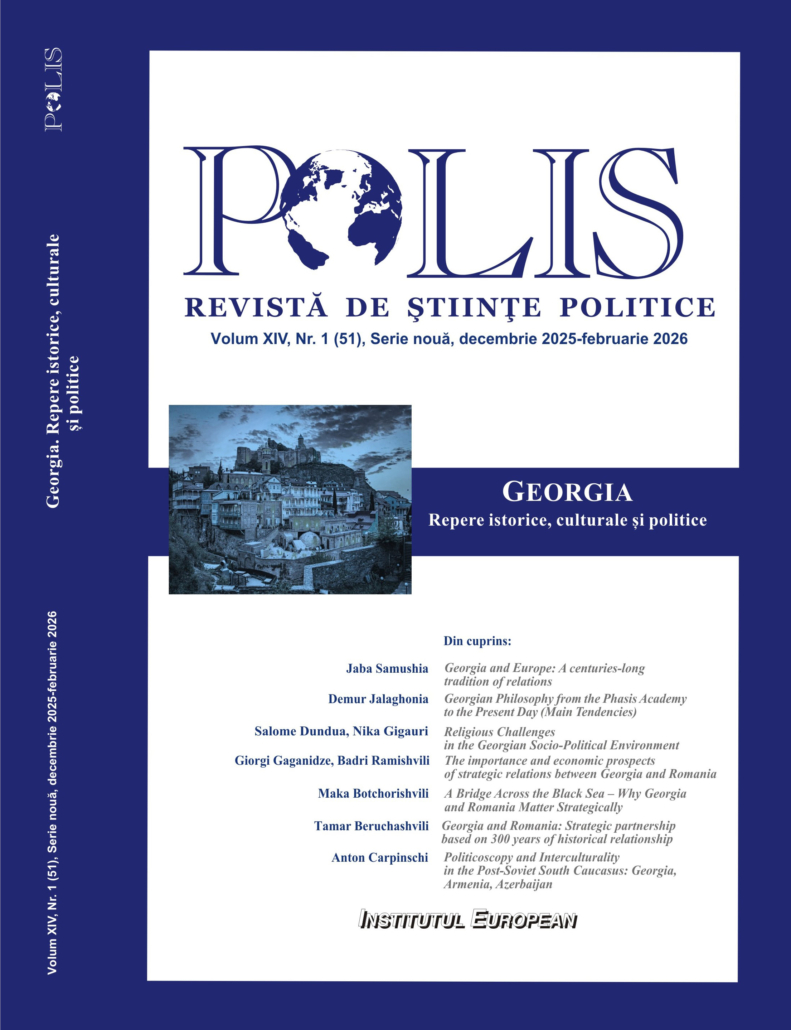
Coordonat de E.S. Tamar BERUCHASHVILI și Sabin DRĂGULIN
Volum XIV, Nr. 1 (51), Serie nouă, decembrie 2025-februarie 2026
Ideological Foundations of Russian Aggression in Georgia (August 2008)
Tengiz PKHALADZE
Abstract: The August 2008 Russian military aggression against Georgia constitutes a landmark episode in the post-Soviet international order, marking the first open, large-scale use of the Russian Federation’s regular armed forces beyond national borders for offensive military purposes and resulting in the illegal occupation of parts of neighbouring country’s internationally recognised territory. Beyond its immediate military and diplomatic consequences, this aggression illuminated the deeper ideological and civilizational assumptions shaping contemporary Russian foreign policy.
The article examines how Eurasianism, understood both as a long-standing intellectual tradition and as a modern political discourse, provided a framework through which Russian political elites interpreted Georgia, the Caucasus, and Russia’s regional role. Tracing the genealogy of Eurasianist thought from classical authors to late-Soviet and post-Soviet reinterpretations, the article demonstrates how the Caucasus has been constructed as the “southern gate” of Eurasia and as a civilizational boundary zone whose loss, from a Russian perspective, would threaten the integrity of a Eurasian whole.
Within this ideological imaginary, Georgia’s post-Soviet political transformation and European orientation were not perceived merely as a foreign policy divergence, but as a challenge to Russia’s civilizational self-conception. The article argues that the 2008 aggression translated Eurasianist narratives into concrete political practice through discursive legitimation, spatial re-imagination, and symbolic restoration. In this sense, the Georgian case anticipated the later Russian annexation of Crimea (2014) and large-scale military intervention in Ukraine (from 2022), where civilizational geopolitics has similarly been mobilised to justify territorial domination.
Keywords: Russia; Georgia; aggression; Eurasianism; critical geopolitics.
Introduction
The August 2008 Russian aggression against Georgia marked a turning point in the post-Cold War European security order. It represented the first openly acknowledged, large-scale use of Russian regular armed forces beyond national borders for offensive military purposes, rather than peacekeeping operations or indirect intervention through proxies. Unlike earlier post-Soviet engagements framed as peacekeeping missions or conducted through paramilitary and proxy actors, the August 2008 aggression involved the open and large-scale deployment of the Russian Federation’s regular armed forces in offensive military operations against a neighbouring sovereign state and resulted in the de facto occupation of Abkhazia and the Tskhinvali region (South Ossetia)1.
A significant portion of existing analyses explains Russian aggression in August 2008 through realist frameworks, interpreting it as a response to NATO enlargement, shifting regional balances of power, or immediate security dilemmas2. While such interpretations capture important strategic dimensions of the conflict, they tend to underestimate the role of ideology, identity, and civilizational narratives in shaping Russian foreign policy behaviour.
This article advances the argument that the August 2008 aggression cannot be fully understood without reference to Eurasianism as an ideological framework that structures Russia’s perception of space, sovereignty, and civilizational hierarchy. Drawing on constructivist theories of ontological security3 and insights from critical geopolitics4, the article conceptualises Russian aggression as an act of civilizational securitization, an attempt to frame Georgia’s political transformation and European orientation as an existential threat to a putative Eurasian civilizational order.
From this perspective, Georgia’s western-oriented trajectory did not merely challenge Russia’s regional influence but undermined its self-image as the core of a distinct Eurasian world. Constructivist scholarship emphasises that such challenges to identity generate ontological insecurity, prompting states to engage in practices aimed at restoring a stable sense of self5. The August 2008 aggression thus functioned not only as a strategic intervention, but also as an identity-restoring act through which the Russian state sought to reaffirm its geopolitical and civilizational ambitions, and symbolic centrality in the post-Soviet space.
Georgia in Eurasianist Thought: Civilizational Hierarchy and Spatial Control
Georgia in Classical Eurasionism
The intellectual foundations of Russian aggression against Georgia can be traced to the classical Eurasianist movement that emerged among Russian émigré intellectuals in the early 1920s. Reacting both to the collapse of the Russian Empire and to what they perceived as the cultural and political exhaustion of Western liberal modernity, Eurasianists such as Nikolai Trubetskoy and Petr Savitsky rejected the dominant opposition between Westernism and Slavophilism. Instead, they advanced the claim that Russia constituted a distinct civilizational entity – Eurasia, whose historical development, cultural logic, and spatial organisation were fundamentally different from those of Europe6.
At the core of Trubetskoy’s thought lay a critique of Eurocentric universalism and linear models of historical development. In “The Legacy of Genghis Khan”, he argued that Western civilization had falsely elevated its own historical experience to a universal norm, delegitimising alternative civilizational trajectories7. Against this logic, Trubetskoy insisted on the plurality and incommensurability of civilizations, each rooted in a specific territorial and cultural environment. Russia, in this framework, was not a peripheral or “incomplete” European society, but the historical and political heir to a Eurasian continental synthesis shaped by Slavic, Turkic, and Mongol elements8.
Crucially, Trubetskoy’s vision of Eurasia was not egalitarian. Although he frequently spoke of synthesis and integration, his conception of Russia’s role vis-à-vis neighbouring regions was explicitly hierarchical. In a series of early Eurasianist texts, he emphasised that political stability and cultural integration within Eurasia required the active exercise of Russian power in adjacent regions such as the Caucasus and Central Asia9. Unlike simplified imperialist frameworks, Trubetskoy did not frame Russian expansion as domination for its own sake. Instead, he presented it as a strategic and civilizational imperative, linking geopolitical control to a purported mission of cultural integration and systemic stability. In doing so, he constructed an ideological justification for Russian authority over neighbouring territories grounded not in coercion alone, but in claims of historical responsibility and civilizational necessity.
This logic is particularly explicit in Trubetskoy’s 1925 text “About the Peoples of the Caucasus”, which offers direct recommendations to Russian authorities on how the region should be governed10. With regard to Georgia, Trubetskoy acknowledged that the autonomy acquired by Georgians after the 1917 Revolution could not simply be revoked without provoking intensified separatism. Nevertheless, he argued that any form of Georgian independence posed a strategic danger that Russian authorities were obliged to suppress by all available means. According to Trubetskoy, Georgian sovereignty would deprive Russia of control over Baku’s oil resources and, subsequently, over the entire South Caucasus, thereby undermining Moscow’s ability to retain the North Caucasus as well11.
Equally significant is Trubetskoy’s assessment of Georgian nationalism. He characterised it as particularly resilient and deeply infused with European ideas, which rendered purely coercive solutions insufficient. As a result, he proposed that the “final solution” to the Georgian question could only be achieved through the creation of a specifically Georgian variant of Eurasian ideology – re-encoding nationalism within a Eurasian civilizational framework rather than eliminating it outright12. This approach reveals a sophisticated strategy of ideological governance, combining coercion, fragmentation, and normative adaptation.
More broadly, Trubetskoy advocated the dismantling of large territorial units in the South Caucasus – Azerbaijan, Georgia, and Armenia, and their replacement with smaller administrative districts13. This reorganisation, he argued, would prevent the consolidation of strong national identities capable of sustaining separatism. In Georgia, for example, Trubetskoy supported the promotion of Megrelian and Svan languages, provided that such cultural differentiation did not result in the emergence of new autonomous national entities. At the same time, he explicitly opposed the assimilation of smaller peoples by larger ones and warned against the “Georgianisation” of Abkhazia and South Ossetia14.
This dual logic – simultaneously encouraging internal fragmentation while preventing upward national consolidation – reveals a governance strategy aimed at preserving Russian centrality by managing diversity through controlled differentiation. Far from contradicting one another, Trubetskoy’s opposition to both separatism and assimilation reflected a coherent civilizational hierarchy in which Russia functioned as the indispensable arbiter and stabiliser of Eurasian diversity.
Trubetskoy also rejected the notion that ideological cohesion alone, such as adherence to socialism, was sufficient to sustain a unified state across the post-imperial space. In his 1927 article On Eurasian Nationalism, he argued that shared socio-economic ideals did not necessitate political unity15. Instead, he maintained that the territories of the former Russian Empire, now constituting the Soviet Union, required a stronger unifying principle: the creation of a new, multi-ethnic Eurasian nation, centred on Russia as its core and organising nucleus16.
Taken together, the works of Trubetskoy and Savitsky established a durable ideological template that linked space, culture, and political authority within a hierarchical civilizational framework. By conceptualising the Caucasus as the “southern gate” of Eurasia and by assigning Russia a protective, supervisory, and integrative role, classical Eurasianism provided a normative foundation for subordinating regional sovereignty to civilizational unity. Although these early formulations did not advocate military aggression in a modern sense, they normalised the idea that Russian intervention in the Caucasus could be framed as a defensive, restorative, and even ethical act undertaken in the name of a higher civilizational order. This intellectual legacy would later be reactivated and politicised in ways that directly informed justifications of Russian aggression against Georgia.
Georgia in Late-Soviet and Post-Soviet Eurasianism
The next stage in the evolution of Eurasianist thought unfolded in the late Soviet and early post-Soviet periods, when earlier civilizational concepts were reintroduced, reformulated, and ultimately politicised. This phase is crucial for understanding how abstract cultural hierarchies and spatial imaginaries were translated into a language capable of legitimising concrete foreign policy practices, including military aggression.
A pivotal role in this transition was played by Lev Gumilev, whose theories of ethnogenesis and passionarity reactivated Eurasianist assumptions under the guise of natural science. Although Gumilev avoided explicit ideological commitments, his work reintroduced civilizational determinism into Soviet academic discourse at a moment when Marxist-Leninist explanations were losing credibility17. By conceptualising ethnic communities as quasi-biological organisms shaped by geography, climate, and energetic impulses originating in the biosphere, Gumilev provided Eurasianism with a veneer of scientific objectivity18.
Central to Gumilev’s framework was the notion of passionarity, defined as an excess of vital energy that enabled certain ethnic collectives to expand, dominate, and organise broader political spaces19. Within this schema, Russia emerged as the core of a coherent Eurasian super-ethnos, formed through the long-term interaction of Slavic, Turkic, and Finno-Ugric peoples within the continental steppe zone20. Western Europe, by contrast, was portrayed as an aging and entropic civilization, exhausted by excessive individualism and detached from the ecological conditions necessary for sustained vitality21.
The Caucasus occupied a particularly significant place in Gumilev’s ethnological geography. He described the region as part of Eurasia’s “passionary belt,” where ethnogenetic energy manifested itself with exceptional intensity and volatility22. Such regions, according to Gumilev, were inherently unstable and prone to conflict unless integrated into a larger civilizational system capable of regulating and harmonising their excess energy. Only the Russian super-ethnos, as the stabilising core of Eurasia, possessed the capacity to perform this function23. Russian dominance in the Caucasus was thus reframed not as imperialism, but as an ethno-biological necessity required to preserve systemic equilibrium.
By naturalising civilizational hierarchy through biology and geography, Gumilev transformed normative Eurasianist claims into descriptive “laws of nature.” Russian authority over peripheral regions appeared not as a political choice, but as an objective requirement dictated by the structure of the Eurasian biosphere24. This justification of domination proved highly influential. Gumilev’s ideas circulated widely among historians, geographers, and military intellectuals in the late Soviet period, particularly through his lectures at Leningrad State University and works such as Ethnogenesis and the Biosphere of the Earth25. In this way, Eurasianist spatial thinking re-entered Soviet strategic culture with renewed legitimacy.
In the post-Soviet period, these quasi-scientific foundations were explicitly politicised by neo-Eurasianist thinkers, most notably Aleksandr Panarin and Aleksandr Dugin. Panarin reframed Eurasianism as a moral and civilizational response to globalization, which he interpreted as a form of Western spiritual imperialism aimed at eroding cultural plurality26. Liberal universalism, in his view, threatened the Orthodox and communitarian foundations of Eurasian society. Russia was therefore assigned a defensive civilizational role as the guardian of cultural diversity and spiritual sovereignty.
Within Panarin’s framework, the Caucasus acquired a distinctly moral significance. He depicted the region as Eurasia’s “southern moral frontier,” where the confrontation between Western liberalism and Eurasian spiritual values was particularly acute27. Georgia’s post-Soviet turn toward European integration was thus framed not merely as a geopolitical realignment, but as a civilizational defection that endangered the ethical coherence of the Eurasian space. Preserving Russian influence in the Caucasus became synonymous with defending sobornost’ – spiritual unity – against Western atomisation28.
Aleksandr Dugin completed the transformation of Eurasianism into a comprehensive geopolitical doctrine. In The Foundations of Geopolitics (1997), he synthesised classical Eurasianist thought, Gumilev’s ethnological concepts, and Western geopolitical theory into a strategic blueprint for Russian power29. Drawing on Halford Mackinder’s Heartland theory, Dugin identified Russia as the core of a continental civilization locked in an existential struggle with Atlanticism, represented by the United States and its European allies.
In Dugin’s geopolitical vision, the post-Soviet space constituted Russia’s natural sphere of civilizational responsibility. The Caucasus, and Georgia in particular, was conceptualised as the southern bastion of the Eurasian Heartland. Western political and normative influence in Georgia was portrayed as a direct threat that would “open the gates” of Eurasia to Atlantic domination30. Within this framework, Georgian sovereignty was subordinated to Eurasian strategic necessity, and Western alignment was treated as an inherently hostile act rather than a legitimate foreign policy choice.
Crucially, neo-Eurasianism erased the distinction between aggression and protection. Military force, territorial control, and political intervention were reframed as morally justified instruments for defending Eurasia’s ontological integrity and civilizational balance31. By the mid-2000s, this ideological repertoire had migrated from intellectual circles into the semi-official language of Russian strategic culture. Concepts such as multipolarity, civilizational plurality, and sovereign democracy echoed core neo-Eurasianist assumptions, even when explicit references were avoided32.
This intellectual evolution provided a ready-made framework for interpreting Georgia’s Europeanization as an existential civilizational threat and for legitimising coercive measures. The August 2008 Russian aggression against Georgia thus represented the first major instance in which this worldview was translated into open military action, marking the institutionalisation of what has been described as “state Eurasianism” – the fusion of civilizational ideology with state power33.
Georgia’s European Path and Russia’s Eurasianist Expansion
Georgia’s orientation toward Europe and the Euro-Atlantic world represents a long-term civilizational and political choice articulated in the aftermath of the Soviet Union’s collapse. From the moment of restored independence, Georgian statehood was defined in opposition to imperial and post-imperial structures of Russian dominance and grounded in an explicit aspiration to “return to Europe.” This orientation was not merely instrumental or tactical, but existential: it concerned the foundational question of where Georgia belonged politically, normatively, and civilizationally34.
Throughout the 1990s, despite acute internal instability, armed conflicts, and economic dislocation, Georgian political elites consistently articulated Western integration as the primary framework for securing sovereignty and state survival. Cooperation with European institutions, alignment with liberal conceptions of sovereignty, and engagement with Euro-Atlantic security structures were framed as mechanisms for escaping the post-Soviet sphere of influence and consolidating independence35. These commitments were embedded in early foreign policy doctrines, constitutional discourse, and diplomatic practice, long before Georgia possessed the institutional capacity to implement comprehensive reforms.
Georgia’s Europeanization should therefore be understood as a continuous process, rather than as the product of discrete political events. While the depth and effectiveness of institutional transformation varied over time, the underlying strategic and civilizational orientation remained consistent. The persistence of this orientation is analytically significant, as it underscores that Georgia’s Western path was not a reactive choice shaped by short-term political shifts, but a sustained attempt to redefine national identity and international belonging outside Eurasian frameworks.
From Moscow’s perspective, this long-term trajectory constituted a challenge that exceeded conventional geopolitical competition. Constructivist scholarship on ontological security emphasises that states rely on stable identity narratives to maintain a coherent sense of self, purpose, and legitimacy in international politics36. When these narratives are disrupted, particularly by actors located within a state’s perceived civilizational space, ontological insecurity emerges, producing anxiety over historical mission, moral authority, and status37.
Georgia’s Europeanization was unacceptable precisely because it unfolded within a space that Russian Eurasianist discourse defined as inherently belonging to a Eurasian civilizational order. As a former imperial periphery and a key component of the imagined “southern gate” of Eurasia, Georgia’s refusal to conform to this spatial and cultural hierarchy undermined Russia’s self-conception as the natural centre of the post-Soviet world. The possibility that a post-Soviet state could pursue sovereign development outside Eurasian civilizational frameworks challenged the narrative that Russian leadership was historically necessary, culturally legitimate, and normatively justified38.
This challenge was ontological rather than merely realistic. Georgia’s Western orientation called into question the presumed naturalness of Eurasian boundaries by exposing their contingent and constructed character. If Georgia – considered by Russia as the traditional zone of influence, predominantly Orthodox, and geographically embedded in the Caucasus – could define itself as European, then the Eurasian civilizational project appeared neither inevitable nor universally compelling. In this sense, Georgia functioned as a symbolic counter-example that undermined Russia’s civilizational self-image39.
Russian political discourse increasingly framed this process in securitized terms. Georgia’s Europeanization was not acknowledged as a legitimate sovereign choice, but was instead portrayed as the product of external ideological expansion. Western political norms, democratic institutions, and liberal conceptions of sovereignty were represented as instruments of “civilizational intrusion” designed to extract Georgia from Russia’s normative orbit and weaken Eurasian unity40. This framing transformed normative divergence into an existential threat.
Such representations align with what critical geopolitics describes as civilizational securitization: the construction of ideological and normative difference as a danger to collective identity that necessitates extraordinary measures41. Within this logic, Russia’s policies toward Georgia, including economic pressure, diplomatic isolation, and the manipulation of unresolved territorial conflicts, functioned not simply as tools of coercion, but as identity-restoring practices aimed at reaffirming Russia’s civilizational centrality.
By the mid-2000s, Georgia had become a focal point of Russia’s ontological insecurity. Its persistent Western orientation symbolised the erosion of post-imperial hierarchy and the failure of Eurasian integration to function as a natural gravitational force. The August 2008 Russian aggression must therefore be understood as the culmination of a longer process in which Russia sought to resolve this ontological crisis through coercive action. Military aggression offered a means of reasserting civilizational boundaries, disciplining deviation, and restoring a sense of historical continuity disrupted by imperial collapse and the defection of a former periphery.
2008 – From Civilizational Discourse to Military Aggression
The August 2008 Russian aggression against Georgia constituted the moment in which Eurasianist ideology was most clearly and decisively translated into concrete foreign policy practice. Rather than representing a reactive response to immediate security concerns, the aggression functioned as an act of civilizational securitization through which long-standing ideological narratives about space, identity, and historical mission were operationalised by means of military force. In this sense, the events of August 2008 marked the culmination of a process in which Eurasianist thought migrated from intellectual discourse into the domain of state action.
Civilizational securitization differs from conventional security logics in that it frames normative, cultural, and ontological challenges as existential threats. Georgia’s long-standing Western orientation was represented within Russian political discourse not simply as a geopolitical divergence, but as a danger to the moral and civilizational integrity of the Eurasian space. The aggression was thus aimed at resolving an ontological crisis by reasserting boundaries, hierarchies, and meanings that Eurasianist ideology had long portrayed as natural and historically justified42.
In the discursive sphere, Russian political elites systematically framed the use of force through a vocabulary that closely mirrored Eurasianist assumptions. Official statements by President Dmitry Medvedev and Foreign Minister Sergei Lavrov avoided the language of war or invasion and instead portrayed Russia’s actions as the defence of compatriots, the prevention of humanitarian catastrophe, and the restoration of historical justice43. This rhetoric positioned Russia as a moral guardian acting on behalf of a broader civilizational community, while Georgia’s sovereignty was implicitly delegitimised by representing the Georgian state as either incapable of governing responsibly or as a conduit for external civilizational intrusion. Western political and normative support for Georgia was thus reframed as aggressive interference rather than assistance to a sovereign state.
Such discursive strategies correspond to what critical geopolitics identifies as the moralisation of space, whereby geopolitical actions are justified not through international law but through appeals to cultural authenticity and civilizational duty44. Through this inversion, Russia appeared as a force of order and stability, while Georgia and its Western partners were cast as agents of disruption. The legitimising function of this discourse was crucial, as it allowed military aggression to be presented as a defensive and ethically necessary response to an existential threat.
At the same time, the aggression involved a profound re-imagination of political space. Russian political discourse and media narratives systematically privileged symbolic civilizational borders over internationally recognised state boundaries. Abkhazia and the Tskhinvali region (South Ossetia) were increasingly described as organic components of the Russian or Eurasian civilizational space, whose separation from Georgia was portrayed as both natural and historically justified45. This reflected what critical geopoliticians describe as imaginative geography—the production of spatial meanings that render certain territories inherently belonging to a particular civilizational order regardless of legal status46.
Within this spatial imaginary, Georgia’s internationally recognised borders appeared artificial and imposed, while Russia’s military presence was framed as a corrective act restoring an authentic civilizational configuration. Neo-Eurasianist commentators articulated this logic explicitly. Aleksandr Dugin described the conflict as a test of Eurasia’s metaphysical boundaries, arguing that failure to intervene would result in the opening of Eurasia’s “southern gate” to Atlantic domination47. Public demonstrations organised by Eurasianist movements reinforced this imagery by framing South Ossetia as a civilizational outpost, further entrenching the idea that the conflict concerned civilizational space rather than sovereign territory.
Beyond discourse and spatial redefinition, the 2008 aggression performed a deeper symbolic function. From a constructivist perspective, the collapse of the Soviet Union produced a rupture in Russia’s national narrative, generating what ontological security theorists describe as a crisis of continuity and purpose48. The loss of empire undermined Russia’s self-understanding as a great power and civilizational centre, creating a persistent sense of historical dislocation. Georgia’s sustained Western orientation intensified this rupture by demonstrating that former imperial peripheries could reject Eurasian integration and define themselves outside Russia’s normative orbit.
The aggression against Georgia functioned as an empire’s identity-restoring act through which the Russian state sought to repair this narrative rupture. By intervening militarily and imposing control over contested territories, Russia reaffirmed its capacity to act decisively, enforce hierarchy, and shape regional outcomes. As ontological security scholarship suggests, such practices serve as identity performances through which states reaffirm who they believe themselves to be49. In this sense, the occupation of Abkhazia and the Tskhinvali region was less about territorial expansion than about symbolic confirmation of Russia’s historical mission as the organiser and protector of a Eurasian civilizational order.
This moment marked the institutionalisation of what has been described as state Eurasianism – the fusion of civilizational ideology with state power50. Eurasianism ceased to function merely as a discursive resource and became embedded in strategic practice, providing a template for future interventions. The Georgian case thus served as a laboratory in which civilizational narratives were translated into military and diplomatic action, establishing a precedent later replicated in Crimea in 2014 and in the large-scale aggression against Ukraine from 2022.
Taken together, the discursive, spatial, and symbolic dimensions of the August 2008 aggression reveal it as more than a regional conflict. It constituted a transformative moment in which Eurasianist ideology achieved operational coherence, enabling Russia to convert civilizational claims into practices of territorial domination. Through this act of civilizational securitization, the Russian state temporarily resolved its ontological insecurity by reaffirming its self-image as a distinct civilizational pole capable of resisting Western normative expansion. In this sense, August 2008 represents not only a turning point in Russian–Georgian relations, but a foundational episode in the emergence of civilizational geopolitics as a guiding logic of Russian foreign policy in the twenty-first century.
Conclusions
The August 2008 Russian aggression against Georgia illustrates how ideological frameworks can shape, enable, and legitimise the use of military force in contemporary international politics. Strategic and material factors formed part of the broader context, but they are insufficient to explain the symbolic intensity and normative framing of Russia’s actions. The aggression unfolded within an ideological environment in which Eurasianist narratives structured perceptions of space, sovereignty, and civilizational hierarchy.
The long-standing construction of the Caucasus, and Georgia in particular, as a civilizational boundary zone rendered Georgian sovereignty conditional within Eurasianist thought. Georgia’s persistent Western orientation questioned this hierarchy by challenging Russia’s self-conception as the natural centre of the post-Soviet space. From an ontological security perspective, this challenge generated anxiety over historical mission, moral authority, and imperial – civilisational ambitions, creating incentives for revanchist, identity-restoring practices.
The events of August 2008 reveal how Eurasianist discourse was converted into political practice through civilizational securitization. Discursive strategies reframed aggression as moral obligation; spatial imaginaries privileged symbolic civilizational borders over internationally recognised state boundaries; and military intervention functioned as a ritual of symbolic restoration following the disruption caused by imperial collapse. Together, these processes transformed ideological claims into concrete acts of territorial domination.
Importantly, identifying the ideological foundations of Russian aggression does not confer legitimacy upon it. On the contrary, the analysis highlights how civilizational narratives served to mask violations of international law, the erosion of Georgian sovereignty, and the use of force against a neighbouring state. Appeals to historical destiny and cultural responsibility functioned as mechanisms of justification that obscured coercion and normalised violence. Such narratives may explain behaviour, but they cannot excuse it.
The Georgian case underscores the dangers inherent in civilizational geopolitics when claims of cultural authenticity are elevated above the principles of sovereign equality and territorial integrity. By recasting normative divergence as an existential threat, civilizational securitization transforms political disagreement into grounds for military action. The August 2008 aggression therefore stands as a clear breach of the foundational norms of the international order.
Finally, the patterns observed in Georgia foreshadowed subsequent Russian interventions in Crimea in 2014 and in Ukraine from 2022 onward, where similar civilizational framings were mobilised to justify territorial seizure and prolonged warfare. Recognising the ideological mechanisms at work in the Georgian precedent is essential for understanding how civilizational narratives continue to pose risks to regional stability and international peace. Sovereign choices made by independent states cannot be subordinated to civilizational claims without undermining the international legal order itself.
Notes
- Roy Allison, “Russia resurgent? Moscow’s campaign to ‘coerce Georgia to peace’”, International Affairs, vol. 84, no. 6, 2008, pp. 1145-1171.
- Cory Welt, “Georgia and the Limits of Containment,” Europe-Asia Studies, vol. 62, no. 3, 2010, pp. 503-523.
- Marlène Laruelle,Russian Eurasianism: An Ideology of Empire, Johns Hopkins University Press, Baltimore, 2008, pp. 23-31.
- Jennifer Mitzen, “Ontological Security in World Politics”,European Journal of International Relations, vol. 12, no. 3, 2006, pp. 341-347.
- Brent J. Steele,Ontological Security in International Relations, Routledge, London, 2008, pp. 12-16.
- Marlène Laruelle,Russian Eurasianism: An Ideology of Empire, Johns Hopkins University Press, Baltimore, 2008, 1-11.
- Nikolai Trubetskoy,Наследие Чингисхана, Paris, 1925, pp. 41-49.
- Ibidem, pp. 52-57.
- Nikolai Trubetskoy, “О народах Кавказа,” inНаследие Чингисхана, Agraf, Moscow, 2000, pp. 472-476.
- Ibidem, p. 475.
- Ibidem, pp. 475-476.
- Ibidem, p. 478.
- Ibidem, pp. 477-479.
- Ibidem, pp. 479-480.
- Nikolai Trubetskoy, “О евразийском национализме,” inИстория. Культура. Язык, Progress, Moscow, 1995, pp. 417-420.
- Ibidem, pp. 420-423.
- Lev Gumilev,Этногенез и биосфера Земли, Mysl’, Moscow, 1990, pp. 1-10.
- Ibidem, pp. 200-206.
- Ibidem, pp. 312-318.
- Ibidem, pp. 316-318.
- Mark Bassin, “Lev Gumilev and the European New Right,”Nationalities Papers, vol. 40, no. 1, 2012, pp. 69-72.
- Lev Gumilev,Этногенез и биосфера Земли, Mysl’, Moscow, 1990, pp. 8-15.
- Ibidem, pp. 308–315.
- Lev Gumilev,Конец и вновь начало, Mysl’, Moscow, 1992, pp. 45-49.
- Marlène Laruelle,Russian Eurasianism: An Ideology of Empire, Johns Hopkins University Press, Baltimore, 2008, pp. 42-44.
- Aleksandr Panarin,Россия в цивилизационных циклах, Respublika, Moscow, 1999, pp. 33-36.
- Idem,Искушение глобализмом, Respublika, Moscow, 1995, pp. 214-216.
- Ibidem, pp. 210-214.
- Aleksandr Dugin,Основы геополитики, Arktogeia, Moscow, 1997, pp. 221-223.
- Ibidem, pp. 218-220.
- Aleksandr Panarin,Россия в цивилизационных циклах, Respublika, Moscow, 1999, pp. 251-256.
- Vladislav Surkov, “Суверенитет – это политический синоним конкурентоспособности,”Эксперт, no. 43, 2006. Richard Sakwa, The Crisis of Russian Democracy: The Dual State, Factionalism and the Medvedev Succession, Cambridge University Press, Cambridge, 2011, pp. 73-78.
- Aleksandr Dugin, “Южная Осетия – форпост Евразии,”Евразийское движение, August 2008; see also Idem, “Война в Грузии как метафи-зическое испытание”, Русский журнал, 2008.
- Jennifer Mitzen, “Ontological Security in World Politics”,European Journal of International Relations, vol. 12, no. 3, 2006, pp. 347-350.
- Jennifer Mitzen, “Ontological Security in World Politics”,European Journal of International Relations, vol. 12, no. 3, 2006, pp. 347-350.
- Andrey Makarychev, “In Quest of ‘True Sovereignty’: The Discursive Foundations of Russia’s Policy toward Georgia”,Problems of Post-Communism, vol. 55, no. 6, 2008, pp. 3-15.
- Andrei Tsygankov,Russia and the West from Alexander to Putin: Honor in International Relations, Cambridge University Press, Cambridge, 2012, pp. 259-263.
- Vladimir Putin, “Address to the Nation Following the Terrorist Act in Beslan”, September 4, 2004. Vladislav Surkov, “Суверенитет — это поли-тический синоним конкурентоспо-собности,”Эксперт, no. 43, 2006.
- Richard Sakwa,Russia Against the Rest: The Post-Cold War Crisis of World Order, Cambridge University Press, Cambridge, 2017, pp. 102–108. Andrei Tsygankov, Russia’s Foreign Policy: Change and Continuity in National Identity, 4th ed., Rowman & Littlefield, Lanham, 2019, pp. 157-164.
- Andrei Tsygankov,Russia and the West from Alexander to Putin: Honor in International Relations, Cambridge University Press, Cambridge, 2012, pp. 259-266. Roy Allison, “The Russian Case for Military Intervention in Georgia: International Law, Norms and Political Calculation”, European Security, vol. 18, no. 2, 2009, pp. 173-200.
- Pål Kolstø and Helge Blakkisrud, “Living with Non-recognition: State- and Nation-Building in South Caucasian Quasi-States”,Europe-Asia Studies, vol. 60, no. 3, 2008, pp. 483–509.
- Gerard Toal (Gearóid Ó Tuathail), John O’Loughlin, and Vladimir Kolossov, “The Georgia–South Ossetia Conflict: A Case of Contested Sovereignty”,Eurasian Geography and Economics, vol. 52, no. 1, 2011, pp. 1-24.
- Gearóid Ó Tuathail,Critical Geopolitics, University of Minnesota Press, Minneapolis, 1996, pp. 29-33. Klaus Dodds, Geopolitics: A Very Short Introduction, Oxford University Press, Oxford, 2007, pp. 18-21.
- Jennifer Mitzen, “Ontological Security in World Politics”,European Journal of International Relations, vol. 12, no. 3, 2006, pp. 347-350. Brent J. Steele, Ontological Security in International Relations, Routledge, London, 2008, pp. 13-15. Vera Tolz, Russia’s Own Orient: The Politics of Identity and Oriental Studies in the Late Imperial and Early Soviet Period, Oxford University Press, Oxford, 2014, pp. 143-147.
- Dmitry Trofimov, “Eurasian Metaphors in Post-Soviet Discourse,” Moscow, 2003, pp. 33-36. Marlène Laruelle,Russian Eurasianism: An Ideology of Empire, Johns Hopkins University Press, Baltimore, 2008, pp. 101-105. Gerard Toal, Near Abroad: Putin, the West, and the Contest over Ukraine and the Caucasus, Oxford University Press, Oxford, 2017, pp. 44-47.
- Brent J. Steele, cit., pp. 13-15. Roy Allison, “The Russian Case for Military Intervention in Georgia: International Law, Norms and Political Calculation”,European Security, vol. 18, no. 2, 2009, pp. 173-200.
- Marlène Laruelle, “The Ideological Shift on the Russian Radical Right: From Demonizing the West to Fear of Migrants”,Problems of Post-Communism, vol. 57, no. 6, 2010, pp. 19-31.
- Gerard Toal,Near Abroad, cit., pp. 46-47.
- Andrei Tsygankov,Russia and the West from Alexander to Putin, cit., pp. 210-212.
- Marlène Laruelle, cit., pp. 101-105. Gearóid Ó Tuathail and John O’Loughlin, “Russian Geopolitical Culture and Public Opinion: The Masks of Proteus Revisited”, Transactions of the Institute of British Geographers, vol. 34, no. 3, 2009, pp. 316-332.
Bibliography
Books
DODDS, Klaus, Geopolitics: A Very Short Introduction, Oxford University Press, Oxford, 2007.
DUGIN, Aleksandr, Основы геополитики, Arktogeia, Moscow, 1997.
GUMILEV, Lev, Этногенез и биосфера Земли, Mysl’, Moscow, 1990.
IDEM, Конец и вновь начало, Mysl’, Moscow, 1992.
LARUELLE, Marlène, Russian Eurasianism: An Ideology of Empire, Johns Hopkins University Press, Baltimore, 2008.
PANARIN, Aleksandr, Искушение глобализмом, Respublika, Moscow, 1995.
IDEM, Россия в цивилизационных циклах, Respublika, Moscow, 1999.
SAKWA, Richard, The Crisis of Russian Democracy: The Dual State, Factionalism and the Medvedev Succession, Cambridge University Press, Cambridge, 2011.
IDEM, Russia Against the Rest: The Post-Cold War Crisis of World Order, Cambridge University Press, Cambridge, 2017.
STEELE, Brent J., Ontological Security in International Relations, Routledge, London, 2008.
TOLZ, Vera, Russia’s Own Orient: The Politics of Identity and Oriental Studies in the Late Imperial and Early Soviet Period, Oxford University Press, Oxford, 2014.
TOAL, Gerard (Ó Tuathail), Critical Geopolitics, University of Minnesota Press, Minneapolis, 1996.
IDEM, Near Abroad: Putin, the West, and the Contest over Ukraine and the Caucasus, Oxford University Press, Oxford, 2017.
TROFIMOV, Dmitry, Eurasian Metaphors in Post-Soviet Discourse, Moscow, 2003.
TRUBETSKOY, Nikolai, Наследие Чингисхана, Paris, 1925.
IDEM, “О народах Кавказа,” in Наследие Чингисхана, Agraf, Moscow, 2000, pp. 472-480.
IDEM, “О евразийском национализме” in История, Культура, Язык, Progress, Moscow, 1995.
TSYGANKOV, Andrei P., Russia and the West from Alexander to Putin: Honor in International Relations, Cambridge University Press, Cambridge, 2012.
TSYGANKOV, Andrei P., Russia’s Foreign Policy: Change and Continuity in National Identity, 4th ed., Rowman & Littlefield, Lanham, 2019.
Articles and Studies
ROY, Allison, “Russia resurgent? Moscow’s campaign to ‘coerce Georgia to peace’”, International Affairs, vol. 84, no. 6, 2008, pp. 1145-1171.
IDEM, “The Russian Case for Military Inter-vention in Georgia: International Law, Norms and Political Calculation”, European Security, vol. 18, no. 2, 2009, pp. 173-200.
BASSIN, Mark, “Lev Gumilev and the European New Right”, Nationalities Papers, vol. 40, no. 1, 2012, pp. 69-72.
DUGIN, Aleksandr, “Южная Осетия – форпост Евразии”, Евразийское движение, August 2008.
IDEM, “Война в Грузии как метафи-зическое испытание”, Русский журнал, 2008.
KOLSTØ, Pål, BLAKKISRUD, Helge, “Living with Non-recognition: State- and Nation-Building in South Caucasian Quasi-States”, Europe-Asia Studies, vol. 60, no. 3, 2008, pp. 483-509.
LARUELLE, Marlène, “The Ideological Shift on the Russian Radical Right: From Demonizing the West to Fear of Migrants”, Problems of Post-Communism, vol. 57, no. 6, 2010, pp. 19-31.
MAKARYCHEV, Andrey, “In Quest of ‘True Sovereignty’: The Discursive Foundations of Russia’s Policy toward Georgia”, Problems of Post-Communism, vol. 55, no. 6, 2008, pp. 3-15.
MITZEN, Jennifer, “Ontological Security in World Politics”, European Journal of International Relations, vol. 12, no. 3, 2006, pp. 341-360.
TOAL, Gerard (Ó Tuathail), O’LOUGHLIN, John, KOLOSSOV, Vladimir, “The Georgia–South Ossetia Conflict: A Case of Contested Soverei-gnty”, Eurasian Geography and Economics, vol. 52, no. 1, 2011, pp. 1-24.
TOAL, Gearóid Ó, O’LOUGHLIN, John, “Russian Geopolitical Culture and Public Opinion: The Masks of Proteus Revisited”, Transactions of the Institute of British Geographers, vol. 34, no. 3, 2009, pp. 316-332.
WELT, Cory, “Georgia and the Limits of Containment”, Europe-Asia Studies, vol. 62, no. 3, 2010, pp. 503-523.
Online Resources
PUTIN, Vladimir, “Address by President Vladimir Putin Following the Terrorist Act in Beslan,” September 4, 2004, http://en.kremlin.ru/events/president/transcripts/22589
SURKOV, Vladislav, Суверенитет — это политический синоним конкурентоспособности, Эксперт, no. 43, 2006, https://expert.ru/expert/ 2006/43/surkov/