


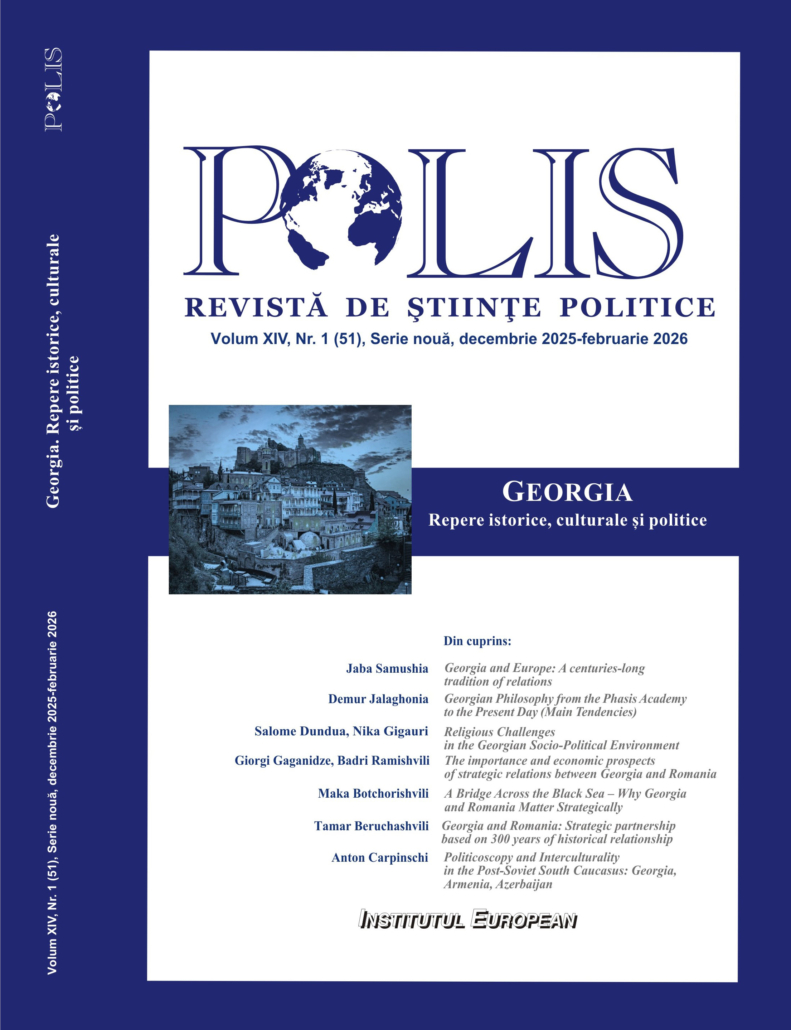
Coordonat de E.S. Tamar BERUCHASHVILI și Sabin DRĂGULIN
Volum VI, Nr. 1 (19), Serie noua, decembrie 2017 – februarie 2018
The Beginning of Renewed Life-A Code of Repentance
(Saint David the Builder and Saint Anthim the Iberian)
Anastasia ZAKARIADZE
Abstract: This study explores two exemplary theological and moral approaches to repentance as reflected in the lives and writings of two great figures of Georgian spirituality: Saint King David IV of Georgia, known as David the Builder, and Saint Anthim the Iberian, the Holy Hierarch of Romania. The reflections of two great saints draw attention to one of the most important concepts of Christian ethics: repentance.
Although they lived in seemingly different eras, it is evident that both thinkers belong to the same conceptual and intellectual tradition.
Their teachings illuminate both the universal and particular aspects of repentance as a means of ethical and spiritual renewal, emphasizing the role of conscience in shaping the renewed human being. For each of them, one of the essential and decisive factors is the subjective infallibility of one’s own conscience.
Repentance, in both saints’ thought, represents not only contrition for sin but also the conscious act of spiritual reorientation – a turning back to God. It evokes the biblical image of the Prodigal Son returning to his father’s house after long estrangement: repentance as homecoming, renewal, and victory of divine grace within the human soul. A “Code of Repentance” in Christianity is essentially a spiritual roadmap guiding believers from recognition of sin to transformation and renewal. This and its structural elements are revealed in the discourse of Saint David the Builder and Holy Hierarch Anthim the Iberian. With their teaching, they encourage human beings to examine their lives regularly, for self-examination and continually seek God’s guidance.
Keywords: a code of repentance, conscience, Saint David the Builder, Saint Anthim the Iberian.
Introduction
The moral and theological significance of repentance lies in the recognition of God’s existence and His transformative presence within the human soul. Repentance constitutes an essential marker of spiritual maturity, extending beyond the mere acknowledgment of sin and remorse for transgression. It signifies an inner transformation – the spiritual rebirth of the individual.
As expressed in sacred tradition, “Obedience to God is more beneficial than sacrifice, for one who offers sacrifice gives to God something external, whereas obedience means offering oneself – one’s own will and freedom – to Him”. Obedience and repentance are therefore intrinsically interwoven, reflecting the ethical and spiritual dimensions of human submission to the divine will.
The role of the clergy in facilitating repentance is of paramount importance, yet it is the believer’s genuine disposition toward moral purification that ultimately determines the efficacy of this spiritual act. Every Christian is called to bear witness to the transformative power of the Gospel through a life characterized by peace, humility, and spiritual integrity – ever conscious of God’s infinite love.
However, adherence to Christianity alone does not guarantee forgiveness; authentic faith presupposes active engagement in repentance as a living, dynamic process.
The present study seeks to examine the theological and spiritual pathways toward the renewal of human life through repentance. For this purpose, we have selected two eminent Georgian saints, in whose works the mystery of repentance occupies a central and transformative place. It is particularly fruitful to juxtapose the perspectives of two figures from different epochs and social standings – the supreme secular authority, King David IV of Georgia1, and the supreme ecclesiastical authority, Saint Anthim the Iberian – in order to discern their shared understanding of repentance as the foundation of spiritual renewal.
King David IV stands as one of the greatest monarchs in Georgian history. His reign marked a period of national unification, military and administrative reform, and profound Christian revival. He is venerated not only as a ruler but as a saint, reformer, and hymnographer. His reforms — particularly those inspired by the monastic and theological legacy of George the Hagiorite — contributed to the harmonious integration of church and state.
The ecclesiastical counterpart to David’s legacy is Saint Anthim the Iberian2, a metropolitan of Wallachia, theologian, and scholar, holy hierarch of the Romanian Orthodox Church, maintaining a deep connection to his Georgian spiritual roots. The works of Romanian and Georgian scholars3 – including – have illuminated the depth of Anthim’s theological and pastoral writings, particularly his treatment of repentance as the path toward spiritual regeneration.
For both saints, communion with God must take place through the discerning power of the conscience. Both of them follow the New Testament concept of conscience, on which is based their understanding of regret which is more individual in nature and involves three major truths.
First, conscience is a God-given capacity for human beings to exercise self-evaluation. Paul refers several times to his own conscience being “good” or “clear” (Acts 23:1, 24:16, 1 Corinthians 4:4). Paul examined his own words and deeds and found them to be in accordance with his morals and value system, which were, of course, based on God’s standards. His conscience verified the integrity of his heart. Second, the conscience as a witness to something. Paul says the Gentiles have consciences that bear witness to the presence of the law of God written on their hearts, even though they did not have the Mosaic Law (Romans 2:14-15). He also appeals to his own conscience as a witness that he speaks the truth (Romans 9:1) and that he has conducted himself in holiness and sincerity in his dealings with men (2 Corinthians 1:12). He also says that his conscience tells him his actions are apparent to both God and the witness of other men’s consciences (2 Corinthians 5:11). Third, the conscience is a servant of the individual’s value system. An immature or weak value system produces a weak conscience, while a fully informed value system produces a strong sense of right and wrong. In the Christian life, one’s conscience can be driven by an inadequate understanding of scriptural truths and can produce feelings of guilt and shame disproportionate to the issues at hand. Maturing in the faith strengthens the conscience.
There exists the monastery – the sacred space of practice, a means of direct communication with God – yet above all, conscience itself assumes the highest significance, the utmost importance. It is the inner place and mediator that every human being carries within. In Saints’ understanding, the human being is, by nature, sinful. Yet at the same time, man is also a being who is conscious of the guilt inherent in his own nature. Conscience is that through which a person stands in direct relation with God, and it is within this inner sphere of infallibility that forgiveness and reconciliation are manifested – not through external evidence.
The intense feeling evoked by the recognition of sins is accompanied by bright tones, hope for human transformation, and a deep faith in one’s perfection. The emergence of a sense of repentance in a person’s consciousness already implies a qualitative transformation of the personality. Repentance prepares the ground for the birth of a new self.
Praise of the King to the Mystery of Repentance
Saint David the Builder’s Chants of Repentance constitute a unique monument of Georgian Christian culture and are recognized as part of the world’s spiritual heritage. The text stands out for its profound emotional and theological depth – a moving expression of guilt, humility, and spiritual striving.
Georgian scholars such as Ivane Javakhishvili, Zurab Chavchavadze, Simon Kaukhchishvili, and Laura Grigolashvili have examined The Chants from codicological, philological, theological, and literary perspectives, situating them both within Georgian culture at large and within the history of Georgian hymnography in particular.
There are several attempts to translate the text into English. Although the English translation by Dodona Kiziria4 brought this work to international attention, it is not entirely faithful to the original. The translation by Lali Jokhadze5 is closer in spirit and precision to the Georgian text, particularly in rendering the theological nuances of repentance rather than mere remorse6.
Saint David’s “The Chants” take the form of hymns dedicated to the Creator, expressing the paradox of human imperfection before divine perfection. Saint David laments humanity’s inability to reflect God’s image fully, transforming this sorrow into a pathway toward renewal. His repentance is not despair but hope – the inner recognition of divine love and the possibility of restoration.As he writes:
“I betrayed my own nature,
moving away from Thy image,
and I gave birth to evil,
turning all my thoughts
to all that is visible and lustful”7.
Throughout the Chants, David’s voice resonates with both awe and intimacy, blending fear of divine majesty with joy at divine mercy. The structure of the hymns recalls the Confessions of Augustine and the Meditations of Marcus Aurelius – introspective dialogues of the soul before God.
The hymn draws upon Scripture, particularly Exodus 15:1–19, and the Epistle to the Philippians (2:10–12):
“At the name of Jesus every knee should bow,
in heaven and on earth and under the earth,
and every tongue confess that Jesus Christ is Lord.”
Saint David the Builder echoes this in Troparion I:
“Thou before whom
every neck is bowed
and bent is every knee
and every tongue confesses
Thou, O, Word,
hearken to me, a penitent”8.
Saint David carefully selects words that both glorify God and revere the Word, which is God Himself, encompassing omnipotent power. The Word created the world, whose energy and omnipresence are infinite. This inspires in the poet both fear and joy: fear that he may not be able to praise God adequately, and joy that he has been chosen to reveal the hidden meaning of the Word, fulfill human potential, and carry out his divine duty.
We share Lali Jokhadze’s opinion that the Word (Logos) here refers to the second person of the Holy Trinity – Christ Himself – whose light restores and sanctifies the fallen image of man9.
Saint David addresses Almighty God with tears, lamenting his sins. Within the process of repentance, the human being aspires to return to the divine archetype – the image and likeness of God. Along this transformative journey, the “old self” dies, giving way to the birth of a “new self”. The human being, whose divine image has been obscured by sin, must once again strive to resemble God by renouncing the old nature and embracing renewal. Saint David thus appeals to the human conscience, which must awaken repentance as the essential agent of the soul’s moral and spiritual transformation.
“Thou madest me in thine own image,
a natural entity
of the material and spiritual,
enlightening me with wisdom
as a being like unto Thee;
but ungrateful I proved to be”10.
It becomes evident in the concluding part of the text that, for Saint David, the only path to salvation lies in recognizing his own guilt, confessing it, and being willing to overcome it. This journey involves hope in God, love for God, and the triumph over despair. Repentance, therefore, unites faith, hope, and love: one believes in God, hopes for His protection and help, and loves God while feeling His love in return.
“Knowing that according to his promise
He will bring to life and join bone to bone,
and joint to joint,
I believe
that with his dexter hand
God will restore
all my sinful body;
after my repentance!”11
In Saint David’s code of repentance exist all essential structural elements of the code, but there is set forth recognition of his personal sins, full acknowledgment that he has sinned against God, his people, his country. He calls for reflection, prayer, confession, admission of sins. Saint David emphasizes genuine sorrow for having offended God. This sincere sorrow is emotional and spiritual. Contrition for saint David is not merely feeling guilty, but truly regretting the sin. Repentance for Saint David, is the victory of divine grace within the soul. It is both confession and creation, the beginning of a renewed life.
His final testament – asking to be buried at the threshold of Gelati Monastery so that all who enter “may tread upon my heart” – embodies ultimate humility and repentance.
The Holy Hierarch’s call
to Repentance
Saint Anthim the Iberian has a keen sense of the spirit of the times and the religious and spiritual processes taking place in Europe, which posed a challenge to Christianity, the Church. He was to provide contemporary Orthodox Christians with a new orientation based on the spirit of the times. His task was to find a fundamental foundation for the Christian community and show the way to the truly and sincere believer. He offers Orthodoxy’s response to this historical challenge. The Holy Hierarch saw the solution in a sense of repentance and a sense of duty as the path to conversion to Christ and spiritual rebirth. In his view, repentance is and should be the primary step of a Christian towards renewal, and it is precisely this that will return Christians to the true faith.
Why namely Repentance? In Saint Anthim’s teaching Repentance is the last chance for man to survive. It is the path back to God. The words of John the Baptist: Repent, for judgment is near, are the foundation and starting point for Saint Anthim.
He gives us a strict definition in one passage of his “Ecclesiastic Teaching “calls the Mystery of Confession or Repentance”: Repentance is a person’s conversion from evil to good and from the devil to God through diligent work, passion, and free will12. So, it is clearly seen that for Saint Anthim repentance is a free, conscious attempt by a person to repent, which is no less valuable to God. The position of Anthim the Iberian, unlike that of other thinkers of Modernity, is an expression of positive hope. The society of Anthim’s day, lost in hope and deprived of love, finds itself in a grave spiritual state. But there is a way out of this situation. The Holy Hierarch sees it in repentance. The path of the human’s return to God and the Church is repentance.
He believes that it is necessary to clarify this path and remind Christians of the importance of repentance. Repentance and baptism are the path to rebirth in Christ and a return to Christ. Repentance is a way to draw closer to God and atone for sins. It also speaks of the duty of the believer, the priest, and the church.
Repentance is one of the basic themes of Saint Anthim’s sermons. Among them we would single out: “On the birth of our Savior Jesus Christ, December 25”, “On Sunday of foegiveness”, “On Saint Nicholas Day, December 6”, “On the transfiguration of our Lord, August, 6”, “On Pharisee and the Publican Sunday”, “ Ecclesiastic Teaching”, etc. Holy Hierrach also devotes a special work to revealing the essence of repentance: “a Brief Teaching on the Mystery of Repentance”.
In these works, the Holy Hierarch proves that Repentance is an intermediate path that requires great patience. God calls people to repentance both directly and indirectly.
For Holy Hierarch repentance begins with the awakening of the conscience. He follows Patristic Teaching on Conscience and describes it as “a teacher given to us by God, not from without but from within” [St. John Chrysostom Homily 24 on the Gospel]. Even if a person has never heard Scripture, conscience acts as a lawgiver, making excuses or accusations. Saint Hierarch understands conscience as “the natural law” written in the human heart. “When God formed man, He implanted within him something divine – a certain thought which shows him what is good and what is evil; this is conscience” [Homily on Romans 13].
When the conscience is stirred – by prayer, Scripture, or the Holy Spirit – a person perceives their spiritual condition and feels the need for reconciliation with God. This inner movement leads to confession and transformation. A healthy spiritual life keeps the conscience sensitive and “alive”, responding quickly to sin through repentance. But if one repeatedly ignores the conscience, the Fathers warn it becomes “seared” [1 Timothy 4:2], losing its ability to discern right from wrong – leading to spiritual blindness.
Thus, Saint Anthim argues that repentance purifies the conscience, and the conscience guides repentance – a continuous, healing cycle sustained by grace.
At the very beginning of “a Brief Teaching on the Mystery of Repentance” Saint Anthim preached to us: “I will briefly explain what the path to repentance means. I beseech God and I address you, I who am the most sinful person in the whole world, let us all of us, together with me, repent our evil deeds, let us cry with bitter tears, let us groan, and let us address our Lord who loves humans with the publican’s words “God be merciful to me a sinner” [ Luke, 18:13] and let us repeat the words of the prodigal son: “Father, I have sinned against heaven and before thee” [Luke, 15:18] and below he goes on “And our heavenly father when He sees our true repentance and tears will truly forgive us our sins as the merciful and long-suffering God. If repentance is not such as it should be therefore, it will bring no good to man”13.
Saint Anthim is confident in the Lord’s mercy and calls on people to repent of their sins with all their hearts. “It is a manifestation of God’s love, patience, and humility, and also an opportunity for the believer to return to their homeland to strengthen their faith and obedience”14.
Among those countless graces that the all-wise healer of souls, our Saviour Jesus Christ, our Lord bestowed on us, one is the mystery of repentance. He bestowed it on us so that we might rid ourselves of all the sources of evil, the enemy of man’s soul, the Devil. And, having sinned, to be able to return to innocence, and to free ourselves from perpetual tortures by means of repentance”. The Holy Hierarch seeks reasons for committing sin; for him it is ignorance.: “Because of this shameful ignorance, therefore, we have no fear of God, and are not ashamed before men, and commit evil and mortal sins: we drink hard all day, fight in the inns, fornicate, and perform all kinds of injustice. We hurt people, tell lies, make false oaths, commit perjury, do not refrain from blasphemy, commit murder, defame and envy others, are at enmity with others and persecute them, and commit many other sins. And it makes our wretched souls mortally ill”15. Below it is vividly described what happens to an ignorant and pitiful person if he dies without repentance and confession: “ his soul will get into the Devil’s hands, i.e., fall into eternal fire and pitch-darkness, where there is a relentless worm, the gnashing of teeth, and where this person will lack the grace of the Lord, the joy of angels, the splendour of Eden, the bliss of the saints and eternal life”16. Describing the story of Noah, Holy Hierarch emphasizes that people were given 100 years to repent, and finally it rained for 40 days and nights, showing great patience by giving people time to repent, but in vain17.
Saint Anthim discusses in detail what repentance is, how repentance is reached, and how it can be carried out. There are two types of repentance: repentance as the basis for a person becoming a Christian, when a person repents of the old period of sinful life and receives the light of Christ, and repentance, which is shown by an already baptized Christian. There is a fundamental difference between them. At this time, the Christian feels like a traitor who has betrayed God and himself. He fights with himself so that the good beginning may triumph in him. Saint Anthim returns to this theme in several of his sermons, notably “On Pharisee and the Publican Sunday” and “On Modesty at Palm Sunday”18.
He proves that true repentance is achieved through three steps. The first is contrition of heart, the second the confession of sins, i.e. the admission of sins to a spiritual guide, and the third carrying out the canon of repentance. These three steps should be taken by the man who desires to save his soul. He who desires with all his heart to return to God and enter his father’s house like a prodigal son should know that the first door he has to pass through is contrition of heart, which is a great sacrifice made to God: “a broken and contrite heart, O God, thou wilt not despise” [Ps. 51:17].
There are two parts to contrition of heart: the first implies repentance and the complete distancing from past sins; the second implies a firm resolution and true responsibility that we will never sin again in our life. Holy Hierarch teaches”: The first thing you should do therefore if you truly repent is to hate and despise your sins with all your soul; you should do it with the deepest inner heart-searching and grief: first, you should know that sins bring you perpetual tortures, and that you will lose the kingdom of heaven; secondly, you should know that because of hateful sins you cause grief and pain to the kindest God. For it is our duty to love and venerate the Lord on High more than anything else in this world. We should especially feel pain and worry when we sin before Him and thus lose closeness to Him. We, pitiful people, should shed bitter tears and cry because we have lost the grace of God; we should cry even more bitterly than if we had lost the most expensive thing we possessed, because the greater the loss, the stronger the grief. We should hate sin therefore and become its enemies, because the loss caused by sin is indescribable”19.
He warns a man that there may be plenty of reasons that are worth thinking over and are inspiring, but one should think them over candidly and with a firm will. Saint Anthim underlines the role of personal will in the process of coming back to Christ.
“Man, tell your soul: my wretched soul, open your eyes and see what you were, and what you have become as a result of sinning; you were the bride of those in heaven, the abode of the living God, an exquisite precious vessel and the true throne of Solomon, that is of Christ; Isaac’s throne of wisdom, the angels’ brother and heir to eternal bliss”20.
The essence of the mystery of repentance is confession with the lips, contrition of the heart, and the fulfillment of the law. The epiclesis of this mystery is the power that the Savior gave only to His disciples and apostles, as stated in the 18th chapter of the Gospel of Matthew “Truly I tell you, whatever you bind on earth will be bound in heaven, and whatever you loose on earth will be loosed in heaven”. And the purpose of this sacrament is the cleansing of a person from sins and the re-acceptance of God’s grace. It is the starting point of re-birth in other word re-newed life of Person.
Saint Anthim clearly defines elements of the code of repentance. First of all, it’s recognition of sin – acknowledging that one has sinned against God and others. This involves self-examination through prayer, reflection, or confession, culminating in the admission of sins, often verbally, in private prayer, and in the Sacrament of Confession before a spiritual father. Genuine sorrow for having offended God is an imminent element. It is worthy noticed that, for Saint David the Builder this element takes an important place in the code of repentance. Genuine sorrow is sincere, has an emotional and spiritual essence. Contrition is not merely feeling guilty, but truly regretting the sin. Abandonment or turning away from Sin is also emphasized by Saint Anthim – it’s a conscious decision to cease sinful behavior, coupled with prayer and seeking God’s forgiveness. This relies on invoking God’s mercy through prayer, fasting, and other spiritual practices. Reliance on God’s grace is essential, as humans cannot earn forgiveness; it is a gift freely given through Jesus Christ. Commitment to change is one of the important elements of the code – Repentance requires active transformation: changing behavior and avoiding repetition of the same sins. Words alone are insufficient; life must be genuinely transformed. Amends or restitution – where possible, repairing wrongs, such as apologizing to someone harmed, returning what was stolen, or otherwise making restitution. Awakening of the Conscience – Recognition of sin and alienation from God, coupled with the conscious striving to live according to divine will, is core of the code. It forms the basis for ongoing spiritual renewal.
Conclusions
Despite differences in epoch, status, and vocation, both Saint David the Builder and Saint Anthim the Iberian converge in their understanding of repentance as the beginning of renewed life – the rebirth of the soul in Christ.
The saints’ “Code of Repentance” is not a formal legal document but rather a structured approach to practicing genuine repentance.
For both great Saints, the most important and decisive thing is the subjective authenticity of one’s own conscience. The Gospel is the basic saving power for all who receive it by faith. By moving from blind faith into Personal faith. The main theme for both is to draw attention to the changing understanding of the essence of salvation. Direct communion with God is possible only through the discerning ability of conscience, an impartial judge. It is conscience that tells a human whether he/she is abandoned by God or not. Conscience is what brings a person into direct relation with God. It is in this realm of inner truthfulness, and not in external evidences, that the forgiven and saved person is revealed. The church, as the only place of sacred rites, a means of direct communication with God, is losing its primary significance, the process of mystery begins inside every person – such a place and mediator is his/her conscience.
In the Christian world outlook, man is a sinful being by his nature. But at the same time, man is a creature who is capable of realizing it. This subtle difference highlights the different emphases in the theological worldview of this period.
The main focus is on a human’s subjective awareness of his own guilt/sin as the basis for conscious repentance. Both emphasize the priority of a human’s personal consciousness. The sinfulness of human nature is perceptible and real to those who recognize it; a man is ready to acknowledge his finitude, his guilt. The importance of human consciousness in recognizing and overcoming guilt is stressed. The energy directed against the evil within a human must be directed into the depths of his own spiritual world. Before you begin to fight evil in the world, to transform the country, first correct yourself – this is the moral program, the code of repentance that relates Saint Hierarch Antim with Saint David the Builder.
For both great Saints, the most crucial and determinative element is the subjective authenticity of individual conscience. The Gospel constitutes the fundamental salvific power for all who receive it through faith, marking a transition from unreflective or “blind” faith to personal, interiorized faith.
The central theme uniting their thought is a reconfiguration of the understanding of salvation’s essence. Direct communion with God is mediated not through external institutions alone but through the discerning faculty of conscience, which functions as an impartial and ultimate judge. It is conscience that discloses to the human person whether he or she stands in a state of divine abandonment or grace. Through conscience, the individual enters into an immediate and unmediated relationship with God.
Salvation is thus revealed within the interior realm of truthfulness, rather than through external signs or ritual evidence. The Church – traditionally regarded as the exclusive locus of sacred rites and the privileged channel of divine communication – gradually relinquishes its primacy as the sole mediator. The mystery of salvation unfolds within the inner depths of each person, with conscience assuming the role of both sacred place and intermediary.
Within the Christian theological worldview of this period, the human being is conceived as inherently sinful by nature, yet simultaneously endowed with the capacity for self-awareness and moral reflection. This dialectic between innate sinfulness and the ability to recognize it underscores the nuanced theological emphases of the era. The subjective awareness of personal guilt and sin emerges as the foundational precondition for authentic repentance.
Both Saints accord primacy to personal consciousness in the process of salvation. Human sinfulness becomes perceptible and existentially real to those who acknowledge it; such individuals are prepared to confront their finitude and culpability. Consciousness thus plays a decisive role in both recognizing and overcoming guilt. The struggle against evil must begin within the depths of the individual’s spiritual life, rather than through external action alone.
Before engaging in efforts to confront societal evils or implement social reform, one must first undertake the rigorous work of self-correction. This ethical and spiritual program, often conceptualized as the code of repentance, is not a singular act but a sustained, lifelong process of moral and spiritual development. It encompasses systematic self-examination, recognition of transgression, sincere sorrow and contrition, deliberate renunciation of sinful behavior, commitment to behavioral change, restitution or reparative action, and the cultivation of a vigilant conscience. This framework of personal moral accountability establishes a profound connection between the approaches to virtue exemplified by Saint Hierarch Antim and Saint David the Builder.
Notes
- David IV, known as David IV the Builder (1073 – 1125) the official title of the Georgian king was: “King of Kings, of the Abkhazians, Iberians, Ranis, Kakhetians, Armenians of Shaki Alania, and the Rus, Sword of the Messiah, emperor (basileus) of all the East, the invincible, servant and defender of God, the Orthodox king. For some more information on the issue one may read Donald Rayfield, Edge of Empires: A History of Georgia, Reaktion Books, 2013; Christian Hannik, „David IV of Georgia”, in Religion Past and Present. 1st., 2006, Jost Gippert, Manana Tandashvili, The Epitaph of David the Builder Archived 2012-03-03 at the Wayback machine, Gelati Academy of Sciences Project, 2002: Old Georgian texts from the Gelati school (Titus project), Accessed 19 June 2011, Mariam, Lortkipanidze, Roin Metreveli, Kings of Georgia, Tbilisi, 2007, pp. 122-130. Blessed David IV the King of Georgia. OCA – Lives of the Saints.
- Holy Hierarch Martyr Anthim the Iberian (c. 1650 – 1716), Metropolitan of Wallachia (1708–1716). Saint Anthim the Iberian was born in Georgia (ancient Iberia) and received the name Andria at Holy Baptism. He himself affirmed his Georgian origin, signing his name in the books he printed, translated, edited, and conducting his corresponddence under the title “Anthim the Iberian.” A man of profound faith and extraordinary learning, he was a peerless teacher of repentance and philanthropy. Fluent in many languages, he used his talents in the service of the Church and the people of God. For his great theological works, cultural contributions, and his steadfast defense of the Orthodox faith, he is rightly honored as a “pillar of Orthodoxy.”
- In this regard, the following studies are worth noting: Georgia and the European World – Philosophical – Cultural Dialogue, volume I, II, ed. Anastasia Zakariadze, Tbilisi, TSU press, 2009-2017. Otar Gvinchidze, Anthim the Iberian-typographer and politician, Metscniereba, Tbilisi, 1973, Vasile-Lucian V. Goldan, „The Archbishop Anthim the Iberian’s (1708-1716) – Interactions Between the Orthodox Religion, Spirituality and Creativity”, Management Intercultural, Vol. XVII, Nr. 2 (34), 2015, pp. 339-346. Fanny Djindjikhashvili, Anthim the Iberian, Tbilisi, 1967, Georgeta Marghescu, „Anthim Iverianul and European Identity Building of Romanian Culture” in Anthim Iverianul-Georgian-Romanian in Georgia and European World- Philosophical-Cultural Dialogue, Tb. 2008. pp.97-102. Eugen Negrici, Antim, logos şi personalitate, Bucureşti, 1971, (analiza Didahiilor). Mircea Pacurariu, „A new saint of our Church, Metropolitan Anthim the Iberian” in Romanian Hagiographic Anthology Publisher Metropolitan of Oltenia, Craiova, 1994, 211-214. Gabriel Strempel, Introduction to the volume Anthim the Iberian, Homilies, ed. Basilica, Bucharest, 2010, Arch. Mihail Stanciu, „Holy Hierarch Martyr Anthim the Iberian, Metropolitan of Wallachia (1708-1716)”, In Georgia and the European World – Philosophical – Cultural Dialogue, volume II, Tbilisi, TSU press, 2017, pp. 17-38, Brachuli A. Zakariadze, I, others Anthim the Iberian-Georgian-European Dialogue, Tbilisi, Dobera press, 2016, A. Zakariadze, Irakli Brachuli, and others, Anthimian Studies-Tradition and Perspectives, Tbilisi, Logos, 2022.
- The Prayers of Remorse of King David IV the Builder, Le Muséon, 107(3), (transl. Dodona Kiziria,), 1994, pp. 335-347
- Lali Jokhadze, „The State of the Study of David the Builder’s Canon of Repentance Literary Studies, Criticism, Journalism”, Georgian Almanac, 2016, pp. 146-156, https://georgianalmanac.openjournals.ge › article, (archived 01.08. 2025).
- The title translated by Kiziria is questionable and we cannot share it. She translated “repentance” as “remorse. The chant itself is a hymn, a dedication to the Lord, who created humanity in His image. Yet creation cannot respond to the Creator with perfection. Because of this, the author of Chants expresses profound regret—a regret meant to guide humans toward correcting imperfection and overcoming sinfulness. Saint King David IV the Builder’s prayers cannot be estimated as a result of his remorse; as remorse is feeling sorry for one’s sin’s consequences. Saint king is sorry enough to stop sinning. He feels repentance. In Saint David’s case we have transformation of remorse into repentance. The intense feeling evoked by the recognition of sins is accompanied by bright tones, hope for human transformation, and a deep faith in one’s perfection. The emergence of a sense of repentance in a person’s consciousness already implies a qualitative transformation of the personality. Repentance prepares the ground for the birth of a new self.
- In our study, we use translation by Lali Jokhadze, which is included in her survey. See cit. p. 151.
- Ibidem, p 153.
- Ibidem, p. 149.
- Ibidem, p. 152.
- Ibidem, p. 156.
- Anthim the Iberian, Didahii and other works, Dobera, Tbilisi, 2016, (tr.a.), pp. 233-234.
- Anthim the Iberian, Selected works, trilingual parallel texts, (tr.a and Ambokadze), Logos, Tbilisi, 2022, pp. 166.
- Ibidem, pp. 164.
- Ibidem, pp. 166-167.
- Ibidem, p. 167.
- Ibidem, p. 105.
- The passages on pages 39 and 129 (see cit.) are especially significant for understanding his views on moral humility and social conduct.
- Ibidem, p. 168.
- Ibidem, p. 171.
Bibliography
Books
DJINDJIKHASHVILI, Fanny, Anthim the Iberian, Mecniereba, Tb, 1967.
GVINCHIDZE, Otar, Anthim the Iberian-typographer and politician, Metscniereba, Tbilisi, 1973.
the IBERIAN, Anthim, Selected works, trilingual parallel texts, (trans. Kshutashvili, Zakariadze/ Ambokadze), Logos, Tbilisi, 2022.
IDEM, Didahii and other works Dobera, Tbilisi, 2016.
JANNIK, Christian, David IV of Georgia, in: Religion Past and Present. Brill Academic Pub, 2006.
LORTKIPANIDZE, Mariam, METREVELI, Roin, Kings of Georgia, “Nekeri”, Tbilisi, 2007.
NEGRICI, Eugen, Antim, logos şi personalitate, Bucureşti, 1971.
PACURARIU, Mircea, „A new saint of our Church, Metropolitan Anthim the Iberian” in volume Romanian Hagiographic Anthology Publisher Metropolitan of Oltenia, Craiova, 1994.
RAPP, Stephen H., Studies in Medieval Georgian Historiography. Early Texts and Eurasian Contexts, Leuven: Peeters, 2003.
RAYFIELD, Donald, Edge of Empires: A History of Georgia, Reaktion publishers, 2013.
STREMPEL, Gabriel, Introduction to the volume Anthim the Iberian, Homilies, ed. Basilica, Bucharest, 2010.
ZAKARIADZE, Anastasia (edited by), Georgia and the European World – Philosophical – Cultural Dialogue, volume I, IITSU publishing house, Tbilisi, 2009-2017.
Articles and studies
GOLDAN, Vasile-Lucian V., “The Archbishop Anthim the Iberian’s (1708-1716) – Interactions Between the Orthodox Religion, Spirituality and Creativity”, Management Intercultural, Vol. XVII, Nr. 2 (34), 2015, pp. 339-346.
KIZIRIA, Dodona, „The Prayers of Remorse of King David IV the Builder”, Le Muséon, 107 (3), 1994, pp.335–347.
KHUROSHVILI, Giorgi, „Conceptions of Political Thought in Medieval Georgia: David IV “the Builder”, Arson of Ikalto”, In Veritas et subtilitas. Truth and Subtlety in the History of Philosophy. John Benjamins Publishing Company, Amsterdam/ Philadelphia, pp. 149-156, 2018.
MARGHESCU, Georgeta, „Anthim Iverianul and European Identity Building of Romanian Culture” in Anthim Iverianul-Georgian-Romanian in Georgia and European World- Philosophical-Cultural Dialogue, Tb., 2008. pp.97-102.
STANCIU, Arch. Mihail, Holy Hierarch Martyr Anthim the Iberian, Metropolitan of Wallachia (1708-1716), In Georgia and the European World – Philosophical – Cultural Dialogue, volume II, TSU publishing house, Tbilisi, 2017, pp. 17-38.
ZAKARIADZE, A, BRACHULI, I, others, Anthim the Iberian- Georgian-European Dialogue, Dobera press, Tbilisi, 2016.
IDEM, Anthimian Studies-Tradition and Perspectives, Tbilisi, Logos, 2022.
Online resources
Blessed David IV the King of Georgia. OCA, Lives of the Saints. https://www.oca.org/saints/lives/2022/01/26/100326-blessed-david-iv-king-of-georgia.
GIPPERT, Jost, TANDASHVILI, Manana, The Epitaph of David the Builder, 2012-03-03 at the Wayback Machine. Gelati Academy of Sciences Project: Old Georgian texts from the Gelati school (TITUS project).
JOKHADZE, Lali, „The State of the Study of David the Builder’s Canon of Repertance. Literary Studies, Criticism, Journalism” in Georgian Almanac, 2016. pp.146-156 https://georgianalmanac.openjournals.ge › article.