


Coordonatori: E.S. Ihor PROKOPCHUK, Sabin DRĂGULIN și Sorin BOCANCEA
Volum XIV, Nr. 3 (53), Serie nouă, iunie-august 2026
The Circulation of Petru Movilă’s Intellectual Paradigm in the Orthodox World of the Seventeenth and Eighteenth Centuries
From the Kyiv-Mohyla Academy to Muscovite Baroque Culture. Word, Image and Theology in “The Cross – the Tree of Life”
Nicoleta ZAGURA
Abstract: The personality of Metropolitan Petru Movilă (1596/1597–1646/1647) occupies a fundamental place in the intellectual and ecclesiastical history of seventeenth-century Eastern Europe. His importance cannot be reduced to his pastoral activity, the drafting of the Orthodox Confession, or the reform of monastic and ecclesiastical life. His most enduring legacy lies in the establishment of a model of Orthodox education capable of assimilating the intellectual instruments of Western Europe and redirecting them towards Eastern theological ends1.
Keywords: Petru Movilă, Kyiv-Mohyla Academy, Simeon Polotsky, Sylvester Medvedev, Sophia Alekseevna, Orthodox Baroque.
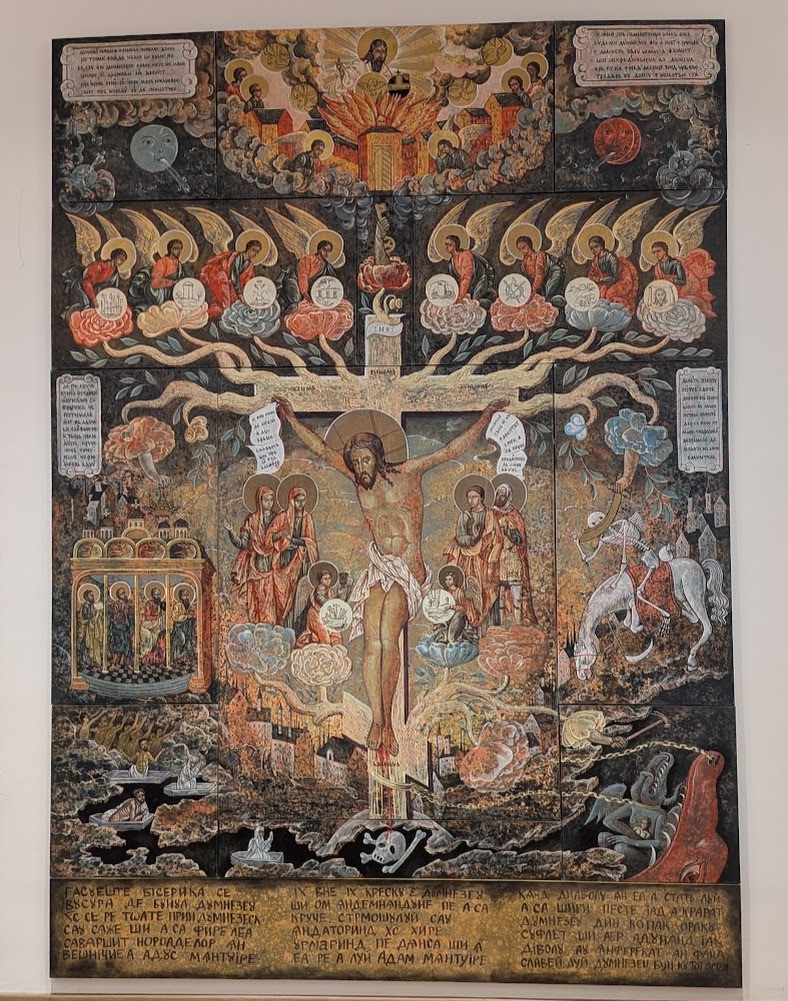 This icon is exhibited at the Old School Museum in Predeal and it is a faithful reproduction of an original icon preserved in the collection of the Arocena Art Museum in Torreón, Mexico.
Petru Movilă and the Formation of a New Orthodox Intellectual Paradigm
Petru Movilă was formed within a cultural space situated at the intersection of Moldavia, the Polish-Lithuanian Commonwealth and the Ruthenian world. His descent from the Movilești family gave him access to an aristocratic culture in which political and military experience coexisted with literary and religious education. His studies within the Orthodox schools of Lviv and, probably, his contact with the academic institutions of Central Europe placed him within a zone of interaction between the Eastern tradition and Western intellectual culture2.
This position is essential for understanding his project in Kyiv.
During the first half of the seventeenth century, the Orthodox world within the Polish-Lithuanian Commonwealth was subject to considerable intellectual and institutional pressure. The Catholic Reformation, the activity of religious orders, the development of Jesuit schools and the intensification of confessional controversies required a response from Orthodoxy that could no longer be based exclusively upon the preservation of traditional forms3.
The problem was, essentially, one of language.
Orthodoxy had to formulate its doctrine within an intellectual universe in which Latin, Aristotelian logic, rhetoric, disputatio, poetics and systematic theology had become indispensable instruments of public debate4.
Petru Movilă understood this situation in a remarkably modern way. He did not consider the defence of Orthodoxy to require the rejection of Western intellectual instruments. On the contrary, he sought to transform them into instruments of his own tradition. This strategy would produce what modern scholarship has suggestively termed a form of “Latin Orthodox learning”5. This does not mean transforming Orthodoxy into Catholicism, nor does it signify a simple imitation of Western schools. Rather, it was an operation of cultural transfer: Western forms of organisation and intellectual methods were adopted, translated and redirected towards an Orthodox purpose.
This is the key to understanding the Mohyla legacy.
The Kyiv-Mohyla Academy: The Institution as an Instrument of Cultural Circulation
In 1631, Petru Movilă organised at the Kyiv Pechersk Lavra a school intended to educate an intellectual and ecclesiastical elite. In the following year, it was united with the Kyiv Brotherhood School, forming the nucleus of the institution that would become known as the Kyiv-Mohyla Academy6. The curriculum was impressive for the Orthodox world of the period. Grammar, Latin, Greek, Church Slavonic, Polish, rhetoric, poetics, philosophy and theology were integrated into a programme of education that provided students with access to European culture without severing them from their religious tradition7.
Here lies one of the great innovations of the Mohyla project.
Education was no longer conceived merely as the transmission of a tradition, but as the formation of a person capable of arguing, interpreting, engaging in polemic and producing cultural discourse.
Through this, the Academy became more than a school. It became an infrastructure of cultural circulation. Teachers travelled. Books circulated. Students moved between centres. Manuscripts were copied. Literary models were translated. Western texts were adapted. Theology was reformulated in the language of philosophy and rhetoric8. This mobility explains why Petru Movilă’s influence cannot be measured solely through the texts he himself wrote. His model continued to exist through people One of these people was Simeon Polotsky.
From Petru Movilă to Simeon Polotsky: An Institutional, Not Personal, Lineage
The relationship between Petru Movilă and Simeon Polotsky must be formulated with precision. Petru Movilă died before Simeon Polotsky had completed his studies in Kyiv. Polotsky therefore cannot be described as the Metropolitan’s personal disciple9. The correct formulation is a different one:
Petru Movilă → the Kyiv institution → Mohyla academic culture → Simeon Polotsky
This formula is more interesting than the presumed teacher-disciple relationship. It allows us to observe a phenomenon characteristic of intellectual cultures: the founder of an institution can influence generations whom he never personally encountered. Simeon Polotsky thus became one of the bearers of an already established culture In Moscow, he introduced a number of intellectual forms that had been cultivated in the Kyiv and Polish-Lithuanian environment: Latin erudition, syllabic poetry, pedagogical discourse, catechetical systematisation, the use of allegory and, above all, a new conception of the relationship between word and image10.
This last dimension is essential to understanding the icon that concerns us.
Simeon Polotsky and the Transformation of Theology into a Cultural Programme
Simeon Polotsky was not merely a theologian and educator. He was a poet, catechist, translator, editor and creator of literary forms that would influence Muscovite culture. In The Crown of Faith (Венец веры), written in 1670-1671, he constructed an extensive catechetical synthesis. The manuscript preserved at the State Historical Museum in Moscow demonstrates the systematic character of his theological project11. What is important is that this work should not be viewed separately from visual culture. The title itself – “The Crown of Faith” – introduces a vegetal and regal metaphor: faith may be imagined as a crown, while doctrine becomes a structure in which disparate elements are brought together into a whole. This metaphorical language of the flower, crown, fruit and tree would receive an extraordinary visual materialisation in the engraving The Crucifixion with Miracles. The transition from Polotsky to the image is therefore not accidental. It is a transition from discursive theology to visual theology.
Sylvester Medvedev: Heir to and Transformer of the Paradigm
Sylvester Medvedev represents one of the most important links between the culture of Simeon Polotsky and the emergence of a new visual culture in Moscow. A disciple of Polotsky, Medvedev was simultaneously a theologian, poet, editor, educator and participant in the intellectual controversies of his age12.
He was not merely a continuator. He was a mediator. In his editorial activity, Medvedev understood that the image could perform a theological function comparable to that of the text. Within the Upper Printing House milieu, an engraved image could become a genuine visual “conclusion”: a summary of doctrine, a theological diagram, a composition in which text and image explained one another. Here Vasili Andreev enters the picture. The engraving The Crucifixion with Miracles, dated to around 1682, occupies a particularly important place in this process. The research of P. V. Maier has highlighted the relationship between the engraving, Medvedev’s activity and the project to publish The Crown of Faith13. The engraving should therefore not be treated as a mere illustration. It represents an intellectual project in images.
“The Crucifixion with Miracles”: The Birth of an Intellectual Image
Around 1682, Vasili Andreev, a master of the Kremlin Armoury, produced the engraving The Crucifixion with Miracles14. The composition belongs to an artistic environment in which Russian art was beginning to assimilate Western models intensively, particularly allegorical and emblematic forms15. It is significant that the image does not limit itself to the representation of Christ crucified. The Cross is transformed into a tree. Its branches bear scenes, symbols, flowers and the instruments of the Passion. Around it, a genuine visual encyclopaedia of faith is constructed. This structure is fundamentally Baroque. The Baroque is not satisfied merely with representation. It explains. It offers not only the image, but also an interpretation of the image. It does not leave the viewer confronted with a single symbol, but invites them to follow a network of meanings.
In this respect, The Crucifixion with Miracles is closely related to the culture of the Western emblem: the image is accompanied by text, the text explains the image, and both lead towards a theological idea16. Yet the result is profoundly Orthodox. The West provides the instrument. Orthodoxy provides the content. This is, ultimately, the very logic of the Mohyla paradigm.
The Cross – the Tree of Life
The central theme of the icon is the transformation of the Cross into the Tree of Life. This transformation is one of the most powerful theological images in Christianity. In Genesis, humanity loses access to the Tree of Life through the Fall. In medieval and post-medieval Christian iconography, the Cross of Christ may be understood as the new Tree of Life17.
The tree of the Cross therefore connects two extremes of sacred history: Paradise and Golgotha. At the beginning stands the tree through which humanity falls. At the end stands the wood through which humanity is restored. Thus, the Cross is not merely an object. It is the axis of salvation history. Its roots descend into the earth. Its branches rise towards heaven. Between the two stands Christ. This verticality is also an image of the relationship between humanity and God.
Adam and the New Adam
One of the most important dimensions of the composition is the association of the Cross with Adam. Christian tradition interprets Christ as the “New Adam”18. The first Adam introduces death into human history. Christ, the New Adam, introduces the possibility of life. In the icon, this theology becomes visible. The root of the Cross descends towards the place of Adam. The Cross thus penetrates into humanity’s very primordial memory. There are not two separate histories – one of the Fall and another of salvation. There is a single history. And the Cross is the place where the two meet. This explains why the tree is so important. It is simultaneously: the tree of knowledge, the tree of the Fall, the tree of death, the tree of the Cross, the Tree of Life.
The icon therefore transforms theology into a visual cosmology.
The Flowers and the “Fruits” of the Passion
The branches of the Cross are not simply branches. They bear what the iconographic tradition would call the Fruits of Christ’s Passion19. This formula is extraordinarily evocative. The Passion bears fruit. Suffering produces life. Death produces salvation. The instruments of torture – the spear, nails, crown of thorns and the other arma Christi – are not represented merely as objects of suffering. They become fruits of the Cross. Here lies one of the image’s most original symbolic operations. Evil is converted into good. The instrument of death becomes an element of the Tree of Life. This logic of transformation runs throughout the entire icon.
The Cross as the “Cosmic Tree”
If we view the icon as a whole, the Cross can no longer be understood merely as an instrument of execution. It becomes a cosmic tree. Its roots lie in the earth. Its trunk traverses the human world. Its branches rise towards heaven. Above it lies the heavenly Jerusalem.
Within this vertical structure, the entire order of the Christian cosmos may be read:
earth – humanity – Christ – heaven – God.
The Cross becomes the axis mundi. It unites what sin has separated. This interpretation is reinforced by the presence of cosmic elements: the sun, the moon, clouds, the celestial sphere and the city above.
At the moment of the Crucifixion, the cosmos participates in Christ’s death. The sun is darkened. The moon is associated with the disturbance of cosmic order. Heaven and earth exist in a state of tension. But from this rupture the new order is born.
The Tetramorph and the Gospel
Another element of great importance is the tetramorph. The four living creatures – the man, the lion, the ox and the eagle – derive from the prophetic tradition of Ezekiel and from the subsequent iconographic development associated with the four Evangelists20.
In iconography:
Matthew – the man;
Mark – the lion;
Luke – the ox;
John – the eagle.
In the composition under examination, this structure acquires an additional function. The tetramorph is an image of cosmic order. The four Evangelists, however, are historical witnesses to Christ.
The image therefore brings together: cosmos and history.
Cosmic revelation is translated into the Gospel. This operation is characteristic of the entire intellectual programme. An abstract theological reality is transformed into a visual structure that the viewer can follow.
The Passion as Visual Memory
The icon does not present the Crucifixion alone. It constructs a visual memory of the Passion.
Each instrument of suffering refers to an episode: the crown of thorns, the spear, the nails, the scourging, the prayer in Gethsemane, the Last Supper, the betrayal of Judas, the thirty pieces of silver, the journey to Golgotha. The image thus functions like a book. The viewer reads with their eyes. This characteristic is fundamental to Baroque culture. The image is no longer merely an object of veneration. It also becomes a pedagogical instrument. In an environment in which literacy was not universal, the image could convey an extraordinary amount of doctrinal information. Yet in the case of this composition, we encounter an even more complex situation. The image is accompanied by verses. The verses explain the image. The image explains the verses. Theology explains both. This may be described as theological intermediality.
Word and Image: Medvedev’s True Innovation
One of Sylvester Medvedev’s most important contributions lies precisely in this reunification of word and image. Medvedev should not be regarded merely as a poet who wrote some verses for an engraving. He should be understood as the author of an intellectual programme in which text and image are inseparable. Research into Andreev’s engraving shows that the flowers on the branches of the Cross may be related to the floral metaphor in The Crown of Faith, in which Polotsky speaks of the composition of a crown21.
The image thus becomes a visual translation of a literary metaphor. This relationship is essential. It demonstrates that we are dealing with a culture in which the boundary between literature and the visual arts becomes permeable. The poet thinks in images.The engraver thinks through text. The theologian thinks through metaphor. And the viewer receives all these levels simultaneously.
“The Fruits of Christ’s Passion”: The Icon as Heir to the Engraving
The engraving The Crucifixion with Miracles did not remain isolated. It generated an iconographic family that would spread through Russian painting, particularly in northern Russia and other regions. An important example is the 1689 icon from northern Russia, in which the flowering Cross is surrounded by representations of the instruments of the Passion22. Another example, dating from the late eighteenth century, develops the programme into an extensive composition in which, alongside the flowering Cross, allegories of life, death, virtues and sins appear23. This fact is essential to our thesis.
If the Mohyla model had simply been a school curriculum, its transmission would have ended within institutions.
But it did not end there. It passed: from school into book, from book into poetry, from poetry into engraving, from engraving into icon, from icon into popular visual culture.
This is the true circulation of the paradigm.
The “Intellectual” Icon
Icons of the type The Fruits of Christ’s Passion may, in a methodological sense, be regarded as intellectual icons. The term should not be understood as an opposition to the traditional icon. It designates a category in which the image presupposes a high degree of erudition in order to be fully deciphered.
The viewer encounters simultaneously: biblical references, patristic symbols, allegories, quotations, metaphors, narrative scenes, instruments of the Passion, vegetal symbolism, cosmology, eschatology.
This density is characteristic of the Baroque.
But it is also one of the consequences of the academic culture promoted by Petru Movilă. A person formed within such a culture no longer sees the image merely as an image.
They see it as a structure of argument.
The Problem of Sophia Alekseevna
At this point, the figure of Tsarevna Sophia Alekseevna must be introduced with caution. It is tempting to interpret the entire composition as a programme commissioned by Sophia and to associate the symbol of Wisdom (Sophia) with her name. Such a reading is seductive. But it must not be transformed into documentary certainty in the absence of evidence.
What can be stated with confidence is that this visual culture developed during Sophia’s regency, within an intellectual environment in which Sylvester Medvedev occupied an important position24.
In 1685, Medvedev presented Sophia with the project Privilege for the Academy. The sources show that he sought to continue Simeon Polotsky’s educational project and to secure the institutionalisation of an academy in Moscow25.
At the same time, Patriarch Joachim supported the Greek solution, while the brothers Ioannikius and Sophronius Likhud arrived in Moscow and began organising the institution that would become the Slavo-Greek-Latin Academy26.
Thus, Sophia’s court was a space in which several cultural projects intersected: the Kyiv-Latin project of Medvedev, the Greek project of the Likhuds, the Muscovite tradition, the political interests of the court.
In this context, the icon “The Cross – the Tree of Life” may be read as the product of an era in which visual culture had become part of a competition to define Russia’s intellectual identity.
Sophia, Sophia and Wisdom
The symbol of Sophia must be approached on two levels. The first is historical. Sophia Alekseevna was an educated woman, involved in the political and cultural life of the court and associated with the educational projects of the period.
The second is iconological.
The name Sophia inevitably evokes, within Christian culture, Sophia, Wisdom. This coincidence does not prove that every image of Wisdom from the period was a symbolic portrait of the Tsarevna. But it creates a horizon of interpretation. In the case of a composition in which the key, the heavenly city, the Cross, the Tree of Life and Wisdom appear, the association with Sophia’s intellectual milieu may become a legitimate research hypothesis.
It must, however, be formulated as such: not “Sophia is represented in the icon”, but rather “the context of Sophia permits an additional iconological reading of the motif of Wisdom”.
This distinction is essential for an academic study.
The Key of Paradise and the Problem of Interpretation
The motif of the hand holding the key is one of the most interesting elements of the composition. If the visual identification is correct, the key may first and foremost be interpreted within the Christian tradition concerning access to the Kingdom and the opening of the heavenly gates. A direct association with the keys of Saint Peter in papal iconography, however, should be made with caution. More interestingly, within the context of the composition as a whole, the key may be understood as a sign of passage.
The Cross is passage.
Death is passage.
Resurrection is passage.
The tree is passage from death to life. And the key is the symbolic instrument of opening. The key therefore completes the meaning of the Cross. The Cross closes the old order. The Cross opens the new order.
Judas: Betrayal as an Image of Lost Freedom
The presence of Judas and the demons in the lower part of the composition introduces into the image the problem of human freedom. Judas represents the human being who transforms temptation into action. The thirty pieces of silver thus become a symbol of the degradation of the relationship between humanity and value. Money, neutral in itself, becomes in the image a sign of a corrupted moral economy. Judas does not merely sell a man. He sells the truth he knows. This theme is perfectly compatible with the moral pedagogy of the Baroque. The viewer must not merely contemplate. They must learn. Choose. Recognise evil. Understand the consequences of choice.
That is why, in later developments of the Fruits of the Passion iconography, representations of virtues and sins also appear, including the two ways or two ladders: one leading towards salvation and the other towards perdition27. The icon thus becomes a visual manual of Christian anthropology.
From Judas to Adam: Two Forms of the Fall
There is a profound relationship between Adam and Judas.
Adam falls through disobedience.
Judas falls through betrayal.
Adam is the first man of death.
Judas becomes the image of the human being who voluntarily separates himself from truth.
Between them stands Christ. The entire composition can therefore be read as a triangle:
Adam – Judas – Christ.
Adam represents the beginning of the Fall.
Judas represents the Fall within salvation history.
Christ represents restoration.
The Cross connects these three moments.
Thus, the icon is not merely about the Passion of Christ. It is about the human condition.
The Cross and the Cosmology of Time
One of the image’s most profound dimensions is the relationship between the Cross and time. In the upper part lies the cosmic and eschatological world. In the central part lies the historical event of the Crucifixion. In the lower part lie humanity, sin, death and the possibility of salvation. The Cross unites all these levels. The Cross is therefore not merely vertical in space. It is vertical in time.
It unites:
Genesis – the Passion – the Resurrection – the Judgement – Eternity.
This conception is profoundly Baroque, because the Baroque is fascinated by the relationship between time and eternity, death and life, appearance and truth28.
A Theology of Transformation
Viewed as a whole, the icon may be defined as a visual theology of transformation.
Everything is transformed.
The Cross becomes a Tree.
Death becomes life.
Blood becomes fruit.
The Passion becomes salvation.
The word becomes image.
The image becomes catechesis.
And catechesis becomes culture.
This logic of transformation is, ultimately, also the logic of the history of the Mohyla paradigm. The Western model is transformed into Orthodox education. Kyivan education is transformed into Muscovite culture. Muscovite culture is transformed into poetry. Poetry is transformed into image. Image is transformed into icon. The icon is transformed into a popular language of faith. This is the true circulation of the paradigm.
From Academy to Icon: An Invisible Intellectual Infrastructure
If we follow the trajectory of the ideas, we observe that institutions are merely the visible points of a far broader network.
Petru Movilă created the school.
The school created teachers.
The teachers created students.
The students travelled.
They carried books and methods to other centres.
In Moscow, Simeon Polotsky created a new literary and pedagogical environment. Medvedev continued the project. Around them emerged printing houses, manuscripts, engravings, translations and iconographic programmes. Thus, Mohyla influence should not be sought only in quotations. It must also be sought in structures. In the way teaching is conducted.
In the way writing is practised. In the way texts are printed. In the way text is placed alongside image. And, above all, in the way the image is transformed into a form of theological argument.
From Kyiv to Moscow: Not a Copy, but a Mutation
It is important not to fall into the trap of a linear history. There is no simple line:
Movilă → Polotsky → Medvedev → Moscow Academy.
There is rather a succession of transformations.
In Kyiv, the Western model is adapted to Orthodoxy.
In Moscow, this model is adapted to a centralised monarchy.
Within Polotsky’s milieu, it becomes literary culture.
Within Medvedev’s milieu, it becomes an institutional and theological project.
In Andreev’s art, it becomes image.
In the Fruits of the Passion icons, it becomes visual catechesis.
In August–September 1689, Peter the Great removed Sophia from the throne. Medvedev’s fate was sealed. Because he had been regarded as one of the principal intellectuals of Sophia’s circle, he became a target of the new political and ecclesiastical configuration29.
– Medvedev attempted to flee, but was captured.
– He was tortured in order to force him to confess that he and Sophia had allegedly conspired to assassinate Tsar Peter with the assistance of the streltsy.
– Although the assassination accusations were not conclusively demonstrated, he was defrocked and executed by beheading in 169130.[30]
With the death of Sylvester Medvedev and Sophia’s confinement to a monastery, the direct line of the “Kyivan Latin-oriented scholars” in Moscow was temporarily defeated by the conservatives. Yet the irony of history is that Peter the Great, after removing Sophia, adopted precisely the same policy of radical Westernisation of Russia that his sister and her mentors had begun.
Conclusions
The legacy of Petru Movilă must be understood as a long-term phenomenon that extends far beyond his biological existence and the geographical boundaries of Kyiv. He did not personally “form” Simeon Polotsky. But he contributed decisively to the formation of the institution and academic culture within which Polotsky’s generation was educated.
This distinction is essential. The correct relationship is one of institutional and cultural lineage, rather than personal discipleship. In Moscow, Simeon Polotsky transformed this legacy into a new literary and theological language.
Sylvester Medvedev continued it, seeking to give it an institutional form as well. Around them developed an environment in which book, poetry, theology and image began to function together. The engraving The Crucifixion with Miracles, produced by Vasili Andreev around 1682, represents one of the most important expressions of this process.
It is, at the same time: theology, poetry, image, catechesis and cultural programme.
From it developed the iconography of the Fruits of Christ’s Passion, in which the Cross becomes the Tree of Life and the instruments of the Passion become fruits. Within this image Adam and Christ, death and life, earth and heaven, time and eternity, sin and redemption meet.
But, above all, word and image meet. This encounter is one of the most important legacies of the intellectual culture developed within the Kyiv-Mohyla sphere. If Petru Movilă created the institution, Polotsky created the discourse, and Medvedev created the bridge towards the image, then Andreev’s engraving and the icons that followed represent the moment when the academic paradigm became visible.
For this reason, The Cross – the Tree of Life may be regarded not only as a masterpiece of Russian religious Baroque, but also as a fundamental document for the history of the circulation of ideas in Eastern Europe. It demonstrates that ideas circulate not only through treatises and teachers. They also circulate through images. And sometimes the image survives the book. In the present case, an intellectual project born in the world of Orthodox academies crossed generations and cultural environments, transforming itself from pedagogy into poetry, from poetry into engraving and from engraving into icon.
Thus, the true legacy of Petru Movilă is neither merely an academy nor simply a theological work. It is a transregional intellectual infrastructure, capable of transforming culture.
And The Cross – the Tree of Life is one of the images in which this transformation can be seen almost in its entirety.
From Kyiv to Iași and from Kyiv to Moscow, Mohyla culture functioned as a network. Books, teachers, students and educational methods crossed political and confessional boundaries. In this sense, the true legacy of Petru Movilă is not merely an academy, nor only a Confession of Faith.
It is a transregional intellectual infrastructure, one of the major origins of modern Eastern European academic culture.
And today, as then, those who embraced the Light of knowledge, like Sylvester Medvedev… die beheaded in Red Square…
Notes
- For Petru Movilă’s role in the development of collegiate-style Orthodox education and for the transregional character of Kyivan-Mohyla culture, see Liudmyla Sharipova, The Library of the Kiev Mohyla Academy (1632–1780) in its Historical Context, PhD thesis, University of Cambridge; Maksym Iaremenko, “Key Dates in the History of the Kyiv-Mohyla Academy”, Kyiv-Mohyla Humanities Journal, no. 2 (2015), pp. 31-41, DOI: 10.18523/kmhj51020.2015-2.31-41. Iaremenko distinguishes between the establishment of the Collegium and its subsequent transformation, in 1701, into an institution with academy status.
- For Petru Movilă’s intellectual formation and the cultural context of Kyiv and the Ruthenian-Polish world, see studies devoted to the Kyiv-Mohyla Academy and the intellectual environment of the seventeenth century. In academically cautious terms, direct contact with Western academic institutions should be presented as a documentary probability rather than as an established fact where the sources do not permit the identification of a direct institutional affiliation.
- For the confessional and educational context of Eastern Europe in the seventeenth century, see Liudmyla Sharipova, The Library of the Kiev Mohyla Academy (1632–1780) in its Historical Context, as well as Nikolaos A. Chrissidis, An Academy at the Court of the Tsars: Greek Scholars and Jesuit Education in Early Modern Russia, Ithaca–DeKalb, Cornell University Press/ Northern Illinois University Press, 2016.
- On the importance of the Latin curriculum, logic, rhetoric and philosophy in Kyivan Orthodox education, see studies devoted to Kyiv-Mohyla academic culture and its intellectual bibliography. Sharipova emphasises the decisive role of the Academy as an environment for the formation and circulation of culture in Eastern Europe.
- The expression “Latin Orthodox learning” is used here in an analytical sense, to designate the adoption of Western academic instruments within an Orthodox confessional framework. It should not be understood as an equation between Kyiv-Mohyla culture and Roman Catholic theology.
- In 1632, the institution resulting from the association of the school organised by Petru Movilă with the Kyiv Brotherhood School was established. For the periodisation of the institution and the distinction between the Collegium and the Academy, see Iaremenko, “Key Dates in the History of the Kyiv-Mohyla Academy”, pp. 31–41. Iaremenko identifies 1701 as the essential moment in the change of the Collegium’s legal status and its transformation into an Academy.
- For the characteristics of the Kyiv-Mohyla curriculum and the role of Western-style education in the formation of the Orthodox intellectual elite, see Sharipova, The Library of the Kiev Mohyla Academy, and Iaremenko, “Key Dates…”.
- The circulation of books and intellectual models constitutes one of the fundamental aspects of the history of the Academy. Sharipova treats the Academy’s library precisely as an indicator of intellectual sources and cultural circulation within the Ukrainian and Russian spheres.
- The statement must be understood chronologically: Petru Movilă died in 1647, while Simeon Polotsky subsequently pursued his intellectual and pedagogical activity within the Muscovite environment. The expression “personal disciple” is therefore inappropriate; the notion of institutional and cultural lineage is more accurate.
- For Simeon Polotsky’s literary and pedagogical culture and the Muscovite intellectual environment of the late seventeenth century, see studies devoted to Polotsky and to Russian-Ukrainian academic culture.
- The manuscript Венец веры кафолической, dated 1670–1671, is held at the State Historical Museum in Moscow, shelfmark Син. 285. The manuscript comprises 247 folios. For identification of the manuscript and its catalogue description, see Государственный исторический музей, catalogue of the manuscript Венец веры кафолической, Син. 285.
- For the activity of Sylvester Medvedev in the context of the theological and educational controversies in Moscow, see A. Prozorovski, Сильвестр Медведев (его жизнь и деятельность): опыт церковно-исторического исследования, Moscow, 1896, as well as subsequent scholarship devoted to Simeon Polotsky’s circle.
- V. Maier, “Гравюра Василия Андреева к несостоявшемуся изданию «Венца веры» Симеона Полоцкого”, in Четвёртые Казанские искусствоведческие чтения. The study examines the relationship between Vasili Andreev’s engraving, the editorial project for Венец веры and the intellectual milieu associated with Simeon Polotsky and Sylvester Medvedev.
- [1] The engraving Распятие с чудесами is attributed to Vasili Andreev and is dated in specialist literature to around 1682; some catalogues use a broader dating of approximately 1680–1682. In the present text, the formulation “around 1682” is therefore preferable.
- [1] For the Westernisation of Russian art at the end of the seventeenth century, see the literature concerning the import and adaptation of Western engravings within the Muscovite environment. In this context, the Westernising character of the visual formulas should not be confused with a confessional Westernisation of the message.
- The term “Baroque” is used here not exclusively in a stylistic sense, but also to designate a culture of allegory, the accumulation of meanings, the relationship between text and image, and the visual representation of abstract concepts. The comparison with Western emblem culture should be understood as a methodological analogy rather than as a direct genealogical identification.
- The relationship between the Tree of Life and the Cross has a theological and iconographic tradition considerably older than the Russian Baroque. For the interpretation of the Cross as the new Tree of Life and for the connection between the tree of Paradise and the wood of the Cross, see patristic literature and Christian iconographic studies devoted to the Arbor Vitae
- For the Adam-Christ/New Adam parallel, the scriptural foundation is found, among other places, in Romans 5 and 1 Corinthians 15. In patristic tradition, the opposition between Adam and Christ constitutes one of the major structures of the theology of salvation.
- In Russian specialist literature, the iconographic type appears under several names: Плоды страданий Христовых, Плоды страстей Христовых, Процветший Крест, Древо Креста. The formula “The Cross – the Tree of Life” is used in the present study as an analytical formulation and not as the standard museum designation of the iconographic type. For the corpus, see O. B. Kuznetsova, Процветший крест: Иконография «Плоды Страданий Христовых» из церквей, музейных и частных собраний России, Германии, Италии, Финляндии, Швейцарии, Moscow, Indrik, 2008.
- The identification of the four living creatures with the Evangelists belongs to an iconographic tradition developed from the prophetic visions of Ezekiel and the Apocalypse: man/angel – Matthew, lion – Mark, ox – Luke, eagle – John. See the iconographic literature devoted to the tetramorph.
- The relationship between the floral metaphor in Венец веры and the visual programme of the engraving is one of the central observations of P. V. Maier’s study, “Гравюра Василия Андреева к несостоявшемуся изданию «Венца веры» Симеона Полоцкого”.
- For the 1689 icon from northern Russia, preserved at the Arkhangelsk Museum of Fine Arts, see Иконы Русского Севера: Шедевры древнерусской живописи Архангел-ьского музея изобразительных искусств, Moscow, 2007, vol. II, as well as the catalogue entry for Плоды страданий Христовых, inv. 334-држ. The icon is dated to 1689 and is one of the important works for the transmission of this iconographic type.
- For the iconographic developments of the late eighteenth century, see O. B. Kuznetsova, Процветший крест, Moscow, Indrik, 2008. The author identifies a corpus of works in which the iconography of the flowering Cross and the Fruits/Passion of Christ is expanded through allegories, moral symbols and representations of the two ways.
- For the intellectual context of Sophia’s regency and the relations between the court, academic projects and Moscow intellectual groups, see Nikolaos A. Chrissidis, An Academy at the Court of the Tsars: Greek Scholars and Jesuit Education in Early Modern Russia, 2016. The volume analyses in particular the establishment of the Slavo-Greek-Latin Academy and the competition between Greek-oriented and Latin-oriented tendencies.
- Sylvester Medvedev’s project for the Academy must be considered in relation to the educational projects developed in Moscow during the final decades of the seventeenth century. The dating of the document should be treated carefully according to the manuscript or documentary edition used; for a publishable version, it is preferable to provide the exact archival collection and shelfmark whenever these are available.
- For the role of the brothers Ioannikius and Sophronius Likhud in the establishment of the Slavo-Greek-Latin Academy, see Nikolaos A. Chrissidis, An Academy at the Court of the Tsars: Greek Scholars and Jesuit Education in Early Modern Russia, Ithaca–DeKalb, 2016. Chrissidis shows that the institution organised in 1685 by the two Greek hieromonks incorporated structural and pedagogical characteristics of Jesuit educational models.
- For the subsequent development of the Fruits of Christ’s Passion iconography and the association of the Cross with virtues, sins and the two ways, see Kuznetsova, Процветший крест, Moscow, Indrik, 2008.
- The interpretation of the relationship between time, eternity, death and life as an element of Baroque sensibility is employed here in a hermeneutic sense, and not as a claim that every element of the composition must be attributed to a unified Baroque programme.
- For the political crisis of 1689 and Sylvester Medvedev’s position in the conflict between Sophia’s faction and Peter’s faction, see the historical literature devoted to the Muscovite court at the end of the seventeenth century. The expression “Sophia’s ideological mastermind” is interpretative and should be understood in this sense, rather than as a documentary title.
- For the condemnation and execution of Sylvester Medvedev, see A. Prozorovski, Сильвестр Медведев (его жизнь и деятельность): опыт церковно-исторического исследования, Moscow, 1896, as well as subsequent historical scholarship. In an academically cautious formulation, the accusations of conspiracy against Peter should be distinguished from the documented facts concerning Medvedev’s interrogation, defrocking and execution.
Bibliography
Primary Sources and Documentary Editions
„Akty i dokumenty, otnosiashchiesia k istorii Kievskoi Akademii”, Ed. N. I. Petrov. Kyiv, 1904–1908.
Духовный регламент (The Spiritual Regulation), Feofan Prokopovich, Documentary and historical editions.
Венец веры кафолической, Simeon Polotsky, 1670–1671. Manuscript, Государственный исторический музей, Moscow, Син. 285.
Привилегия на академию, Documents relating to the institutional project of the Moscow Academy, 1680-1685.
La confession orthodoxe de Pierre Moghila, Editions and critical studies concerning the Orthodox Confession.
Studies on Petru Movilă, the Kyiv-Mohyla Academy and Cultural Circulation
CHRISSIDIS, Nikolaos A. An Academy at the Court of the Tsars: Greek Scholars and Jesuit Education in Early Modern Russia. Cornell University Press; DeKalb: Northern Illinois University Press, Ithaca, NY, 2016.
FEDIAI, Mykola. “The Kyiv-Mohyla Academy and the Rise of Latin Orthodox Learning”, Latin Philosophy and Greek Faith: The Kyiv-Mohyla Academy on the Intellectual Map of Early Modern Europe. Firenze University Press, 2026, pp. 69-96.
IAREMENKO, Maksym. “Key Dates in the History of the Kyiv-Mohyla Academy”, Kyiv-Mohyla Humanities Journal, no. 2 (2015), pp. 31-41. DOI: 10.18523/kmhj51020.2015-2.31-41.
IVLEV, Vitaly, INOZEMTSEV, Vladimir, OSELEDCHIK, Mikhail, Philosophical and Logical Ideas of Representatives of Kyiv-Mohyla and Moscow Slavic-Greek-Latin Academies at the Turn of the 17th–18th Centuries, 2018.
KOVALENKO, Anastasia. “The Formation of the Kyiv-Mohyla Academy as a Higher Educational Institution”, Visnyk of Cherkasy University, Historical Sciences, nr. 4, 2017.
MAKARIE, A History of Kiev Academy, Metropolitan of Moscow, Saint Petersburg, 1843.
SHARIPOVA, Liudmyla, The Library of the Kiev Mohyla Academy (1632–1780) in its Historical Context, PhD thesis, University of Cambridge. DOI: 10.17863/CAM.16027.
Studies on Simeon Polotsky and Sylvester Medvedev
BOGDANOV, A. P., “К вопросу об авторстве «Созерцания краткого лет 7190, 7191 и 7192…»”, In Исследования по источниковедению истории СССР дооктябрьского периода, Moscow, 1987, pp. 114-146.
KOLOSOVA, E. V., “«Созерцание краткое» Сильвестра Медведева и традиции русской исторической повести в XVII веке”. In Русская литература на рубеже двух эпох (XVII – начало XVIII в.), Moscow, 1971, pp. 207-229.
Prozorovski, A., Сильвестр Медведев (его жизнь и деятельность): опыт церковно-исторического исследо-вания, Moscow, 1896.
VOLKOV, M. Ia., “«Созерцание краткое» как источник по истории общественно-политической мысли”. In Общество и государство феодальной России, Moscow, 1975, pp. 198-208.
Studies and Catalogues on Art and Iconography
Иконы Русского Севера: Шедевры древнерусской живописи Арха-нгельского музея изобразительных искусств. 2 vols., Moscow, 2007.
KUZNETSOVA, O. B. Процветший крест: Иконография «Плоды Страданий Христовых» из церквей, музейных и частных собраний России, Германии, Италии, Финляндии, Швейцарии, Indrik, Moscow, 2008.
MAIER, P. V. “Гравюра Василия Андреева к несостоявшемуся изда-нию «Венца веры» Симеона Полоц-кого”, In Четвёртые Казанские искусствоведческие чтения.
РОВИНСКИЙ, Д. А., Русские народные картинки, Saint Petersburg, 1881.
София Премудрость Божия, Выставка русской иконописи XIII–XIX веков из собраний музеев России, Exhibition catalogue, Moscow, 2000.