


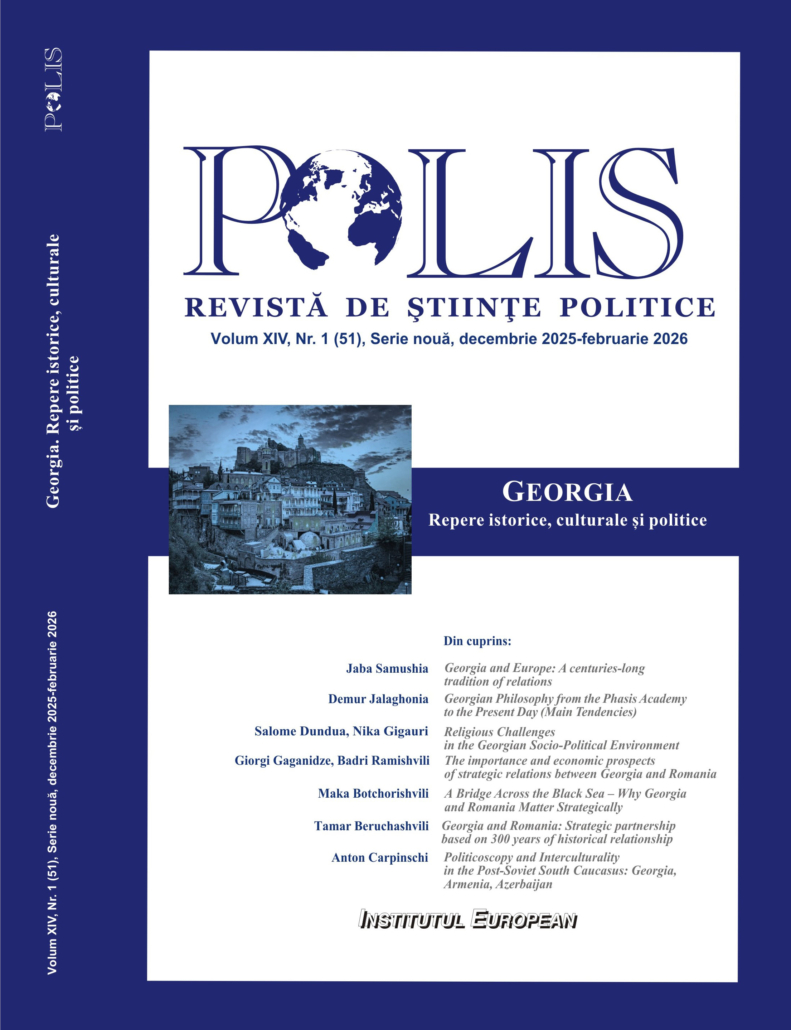
Coordonat de E.S. Tamar BERUCHASHVILI și Sabin DRĂGULIN
Volum XIV, Nr. 1 (51), Serie nouă, decembrie 2025-februarie 2026
The Issue of National and Religious Minorities in the Democratic Republic of Georgia
Otar JANELIDZE
Abstract: The Democratic Republic of Georgia became the first precedent in human history where a government was led by a social democratic party. This state existed for only three years, but left us with a remarkable experience and legacy of democratic development, including in its treatment of minorities. The government and representatives of the opposition approached the issue of national and religious minorities based on the principle of protecting their rights and not violating the interests of the state.
In the Democratic Republic of Georgia, minorities had the full right and opportunity to participate in the political, economic, and cultural life of the state. Their rights were guaranteed by legislation, including the Law on the State Language, the Regulation on Citizenship/Subjecthood, and the Constitution. In areas densely populated by national minorities, where they constituted a majority, the use of the minority language in court alongside the state language was permitted.
The religious policy of the leadership of the Democratic Republic of Georgia was also characterized by tolerance. Despite the ongoing policy of secularization and the separation of church and state, and school and church, numerous synagogues, mosques, madrassas, and Orthodox churches operated throughout the country. Religious rites were performed there unhindered.
Despite the targeted policies of the authorities of the Democratic Republic of Georgia, the civic integration of national minorities was delayed. The process of political consolidation of the “fragmented nations” within the Georgian state was complex and could not be fully realized between 1918 and 1921.
In this article, various on a variety of primary sources, archival materials, periodicals, memoirs, and scholarly literature, we seek to analyze the issue of national and religious minorities in the Democratic Republic of Georgia, highlighting the positive results of measures taken in this field and the contradictions that accompanied the coexistence of Georgians and national minorities during the period under review.
Keywords: Georgia, national minorities, religious policy, cultural autonomy.
Introduction
The historical development of Georgia, situated on the crossroads of Europe and Asia, occurred in such a way that alongside Georgians, the representatives of various other ethnic groups also found a home within its territory. On the eve of the restoration of state independence, the ethnic and confessional composition of Georgia resembled a mosaic. Alongside Georgians lived representatives of many different nationalities.
In the Democratic Republic of Georgia, whose population amounted to 2 466 630 people, approximately twenty percent consisted of national minorities1. These included Armenians, Turkic-speaking Muslims (then referred to as “Tatars”, later known as Azerbaijanis), Russians, Abkhazians, Greeks, Ossetians, Jews, Germans, Kurds, Ukrainians, and others. The approximate figures for the non-Georgian population were as follows: Armenians – slightly more than 200 000; Tatars – 85 000; Abkhazians – 60 000; Ossetians – 45 000; Russians – 45 000; Georgian Jews – up to 40 000; Jews – about 7 000; Greeks – 25 000; Germans – 8 0002.
Thus emerged the demographic picture that Georgia, taken to the path of freedom, inherited as a puzzle legacy from the Russian Empire upon the restoration of its independence. Although Georgia’s ethnic diversity had been largely shaped artificially in the nineteenth century as a result of Russia’s colonial policy, the leaders of the Democratic Republic took into account the existing reality and provided national minorities with full opportunities for civic integration.
Much has been written on this topic in both Georgian and foreign historiography. Different authors have examined the issue from various perspectives, and their assessments often diverge.
The purpose of this article is to analyze the issue of national and religious minorities in the Democratic Republic of Georgia, to demonstrate the positive outcomes of the measures implemented in this regard, and to highlight the challenges that accompanied the coexistence of Georgians and national minorities during the period under consideration.
Methods
This article is based on a wide range of primary sources, archival materials, periodical press data, memoirs, and scholarly literature. In the course of the research, the methods of historicism, historical-comparative analysis, and document analysis were employed.
Minorities and Georgian Political Parties
In the Democratic Republic of Georgia, four main political groups were active: the ruling Social- Democratic (Labour) Party (led by Noe Jordania) and three opposition parties – the Socialist- Federalist Party of Georgia (Samson Pirtskhalava), the National-Democratic Party of Georgia (Spiridon Kedia), and the Socialist-Revolutionary Party of Georgia (Leo Shengelaya). So. Democratic Republic of Georgia was led by the Social-Democratic Government. It was a phenomenon that had no precedent before in the history of mankind. This Georgian state, which emerged in May 1918, was initially led by a coalition government, but in February 1919, after a great success in the elections to the Constituent Assembly, the executive power was completely filled by the victorious party – the Social Democratic Party.
Upon assuming governance, the Georgian Social Democrats adopted a tolerant course toward national minorities. In the words of Noe Jordania, in Georgia “there was neither Greek nor barbarian; we were all Greeks”3. The Social Democrats opposed the oppression or discrimination of one nation by another. They pledged to the population that within the borders of the Democratic Republic of Georgia, all nations would be equal and each would be granted full opportunity to satisfy its national needs4.
The Socialist-Federalist Party held that Georgian citizens of non-Georgian nationality should be granted the right to form their own national-cultural associations and the special administrative organs necessary to govern them. In its pre-election platform for the Constituent Assembly, the Federalists declared: “To those non-Georgian peoples who are dispersed among us, …we shall grant autonomy in the management of their cultural affairs. A portion of state revenues will pass into their hands, and their language will be introduced into local institutions”5. A similar attitude toward the non-Georgian population of Georgia was expressed by the Socialist-Revolutionary Party.
As for the National-Democratic Party of Georgia, it proclaimed that “every non-Georgian should see in Georgia a mother, not a stepmother”. The party’s program declared: “The cultural and national rights of all non-Georgian tribes are protected by law,” and “freedom of religion is guaranteed”6.
As early as November 1917, the National Congress of Georgia adopted a resolution emphasizing that “the national minorities residing within Georgia shall receive full legal guarantees for their cultural development”7. The Act of Independence adopted by the National Council of Georgia on 26 May 1918 proclaimed that “Georgia equally guarantees to all citizens of the Republic their civil and political rights and provides free conditions of development for all nations inhabiting its territory”8.
The establishment of the rights of national minorities – then referred to as “small nations” or “fragmented nations” – was a constant concern of the Georgian state. Every possible option was considered to ensure the protection of minority rights without infringing upon the interests of the state.
After prolonged debates, the government of the Republic and the opposition political spectrum reached a consensus to grant the non-Georgian population national-cultural autonomy. This entailed the establishment of self-governing communities in compactly settled minority areas under the leadership of national administrations, as well as the creation of national courts, national schools, and other similar institutions9.
Legislation on National Minorities
It is well known that until the end of the First World War, the rights of national minorities were not given due attention even in developed states. This issue had not yet become a serious concern of international law or international politics. Against this background, in the Democratic Republic of Georgia, minorities enjoyed full rights and opportunities to participate in the political, economic, and cultural life of the state. All of this was guaranteed by legal acts, including the Law on the State Language, the Statute on Citizenship (Subjecthood), and the Constitution.
In the Democratic Republic of Georgia, ethnic identity was not an obstacle for anyone to obtain citizenship or, among other rights, political participation. Many individuals of Russian, Armenian, Azerbaijani, Ossetian, and other non-Georgian nationalities were employed in the central state administration as well as in local self-government bodies. Numerous representatives of national minorities held high and responsible positions in both civil and military institutions.
Each national minority in the Democratic Republic of Georgia had its own national council established to manage local affairs, and these councils functioned freely. Religious denominations, as well as cultural and educational institutions, operated without restriction. In Georgia, there were 80 Armenian, 60 Russian, and 31 Tatar schools, where education was conducted in native languages. Alongside Georgian – periodicals, newspapers and magazines were also published in Russian, Armenian, English, German, and French – among them Грузия, Закавказское слово, Մշակ, The Georgian Messenger, The Georgian Mail, Kaukasische Post, La Géorgie indépendante, La République Géorgienne, and others.
The law “On the Representation of National Minorities in the National Council of Georgia”, adopted on 13 September 1918, allowed the “fragmented nations” to elect 26 representatives to Georgia’s supreme legislative body. These included: Armenians – 10, Tatars – 4, Abkhazians – 3, Russians – 2, Ossetians – 2, Georgian Israelites – 2, Jews – 1, Greeks – 1, and Germans – 1.
Later, during the elections for the Constituent Assembly, participation was not restricted for political organizations formed on an ethnic basis. There were several such organizations: the National Council of Muslims of Georgia (N 6), the Muslim Union of Borchalo District (N 12), the Hellenic Democratic Union of Georgia (N 15), the Armenian Dashnaktsutyun (N 4), and the Russian Social-Democratic Labour Party (N 13).
It is noteworthy that the Georgian Social-Democratic Party included 20 representatives of national minorities on its list of 130 candidates. Other political parties had smaller numbers (Socialist-Revolutionaries – 4, Federalists – 1, National-Democrats – 2)10. As a result of the elections, deputies of nearly all nationalities residing in Georgia were represented in the Constituent Assembly, including 8 Armenians, 3 Abkhazians, 4 Russians, 2 Ossetians, 2 Germans, 2 Jews, 1 Greek, 1 Azerbaijani, and 1 Russian Molokan. Among the representatives of national minorities was also a female deputy, Eleonora Ter-Parsegova (Makhviladze).
The issue of Georgian Jews and their legal status in the Democratic Republic of Georgia deserves particular attention. The coexistence of Georgians and Georgian Jews had withstood the trials of history, and the latter had never felt like foreigners in the country. After Georgia restored its independence, Georgian Jews, like other national minorities, were nevertheless classified as an ethnic group whose political rights required additional guarantees, and parliamentary seats were allocated to them under a national quota.
One of the prominent representatives of Georgian Jews, the publicist Mikhako Khakhanashvili, regarded such an approach as mistaken, declaring that Georgian Israelites did not require special protection. “We have always participated in elections together with the Georgians and not separately… Therefore, today, the deputies sitting in our National Council, elected by us together, are our deputies as well”11.
The National Council of the Democratic Republic of Georgia had already adopted, on 16 July 1918, the Law on Citizenship (Subjecthood), which granted citizenship to all residents of the Republic, including members of national minorities. (A resident was defined as any person registered in any administrative unit of Georgia prior to 19 July 1914)12.
The Law on Citizenship of the Democratic Republic of Georgia, approved by the Constituent Assembly on 27 May 1919, further simplified the process of obtaining citizenship. Representatives of national minorities were actively involved in drafting the Basic Law – the Constitution of the Democratic Republic of Georgia – a process led by the Constitutional Commission of the Constituent Assembly13.
The Constitution of the Democratic Republic of Georgia, adopted on 21 February 1921, devoted an entire chapter (Chapter XIV) to national minorities, consisting of nine articles. These provisions codified the rights that national minorities had in practice enjoyed during the years 1918-1921.
The Constitution fully reflected and legalized the policy and attitude that the Georgian government and opposition political forces had maintained toward national minorities from the moment of the restoration of statehood until the end of the Democratic Republic14.
During the period under discussion, national minorities felt more secure and comfortable in the Democratic Republic of Georgia than in any other political entities of the Caucasus, because in Armenia, Azerbaijan, and the Mountain Republic, ethnic tensions were much more severe.
Religious Policy
Due to its geopolitical location, Georgia has for centuries been a place not only for dialogue between various cultures and civilizations, but also for the interaction of Eastern and Western religions. It is largely because of these special circumstances that Georgians have become a tolerant people. In Tbilisi, you can still find a mosque and synagogue next to an Orthodox cathedral. A little further away is a Catholic church, and before the establishment of Soviet rule, a Lutheran church also stood here.
It is well known that the Democratic Republic of Georgia pursued a policy of secularism: the Church was separated from the state, and the school was separated from the Church. Nevertheless, the Georgian Orthodox Church welcomed the country’s liberation and the renewal of its sovereign life. On 2 June 1918, Catholicos-Patriarch Kirion II offered a thanksgiving prayer to mark the restoration of Georgia’s state independence. The clergy, in the presence of a large congregation, celebrated a service of thanksgiving at the Sioni Cathedral on 12 March 1919, the day of the opening of the Constituent Assembly of Georgia.
Georgian Catholics also convened a gathering in Tbilisi, at the Church of Saints Peter and Paul, where they unanimously adopted an address congratulating all of Georgia on its independence and wishing success to the young Republic.
From the perspective of the Georgian Orthodox clergy, the state was expected to support the autocephalous Church of Georgia, which was in a difficult financial condition and struggled for survival. Church leaders likewise believed that, in an independent country, the traditional relationship between Church and state should continue, yet this did not occur.
As a result of the Democratic Republic’s confessional policy, the rights and competence of the Church were significantly restricted. All types of theological schools were declared state property and placed under the jurisdiction of the Ministry of Education15. The Church was entirely excluded from the process of education and upbringing; the teaching of the Law of God in schools was prohibited by a special law16. The Church was deprived of property of historical significance – ecclesiastical lands, mills, forests, and other holdings.
By the law of 17 June 1919, several church holidays were abolished: Candlemas, Good Friday, the third day of Easter, Pentecost, the Transfiguration, the Dormition, the Nativity of the Virgin, the Elevation of the Cross, and the Presentation of the Virgin17.
The Church retained only the functions of maintaining and protecting churches, and of registering births, marriages, and deaths. For this reason, throughout the entire existence of the Republic, the Church continued to receive financial support from the state budget.
It should be noted that the state was relatively more accommodating toward other confessions. For example, the prohibition of the Law of God instruction in schools applied in practice only to Georgian schools. As for non-Georgian schools, this law was not enforced upon them; in the schools of national minorities, religion could be freely taught. Moreover, in Muslim schools, the salaries of teachers of Sharia were paid by the State18.
Another noteworthy example is that the Ministry of Labor of the Democratic Republic of Georgia sent official letters to the national councils of Armenians, Muslims, and Jews, asking them to specify which days were considered religious holidays within their communities. The government intended to exempt workers and employees of those nationalities from work on those days18.
Between 1918 and 1921, Georgian Jews enjoyed a form of religious autonomy. The government took their interests into account and approved the “Statute on the Religious and Cultural-Educational Rights of Georgian Jews”, which confirmed their full freedom in spiritual and cultural-educational activities such as establishing Torah synagogues, prayer houses, scientific, educational, and charitable institutions, and others20.
The authorities of the Democratic Republic of Georgia also ensured, through legislative acts, the freedom of the Islamic faith. At that time, numerous mosques and madrasas operated throughout the country, where religious rituals were performed without interference21. Religious communities of the Roman Catholic and Armenian-Gregorian Apostolic confessions likewise enjoyed full protection.
In the Democratic Republic of Georgia, no one ever questioned that citizens of other faiths were as legitimate and complete members of the Georgian state as Orthodox Christians. As the newspaper Sakartvelos Respublika (“The Georgian Republic”) observed: “For the Georgian nation, the question has never been confined to religious boundaries. For it, every believer of any faith is equally Georgian – whether Orthodox, Catholic, Israelite, Muslim, or otherwise. All of them are children of one family – Georgia”22.
The 1921 Constitution enshrined these principles, declaring: “No religion shall have any preeminence… Every citizen enjoys complete freedom of conscience. No one may be persecuted or have their political or civil rights restricted because of religion or belief. Everyone is free to profess any faith they choose, to change their faith, or to belong to no religious denomination at all”.
Language Policy
On 1 October 1918, the National Council of Georgia enacted a law declaring the Georgian language as the state language. The same law stipulated that “a representative of a national minority who does not know the state language may deliver a speech in his or her mother tongue”23. A subsequent law, the Regulation on the Use of Language, further clarified this provision, stating: “A representative of a national minority who does not know the Georgian language may speak, besides his or her native tongue, in any minority language that is understood by at least one member of the presidium”.
Legislation also regulated the use of languages in local self-government bodies. It was specified that “if more than half of the citizens residing within a local self-governing unit speak a non-Georgian language, the self-governing body may, by its own decision, allow the use of this majority language alongside the state language”24.
National minorities were entitled to receive education in their native languages; however, the law also required that they study the state language. In the regions compactly populated by minorities, where they formed a majority, judicial proceedings could be conducted in minority languages in parallel with the state language25. The Constitution of the Democratic Republic of Georgia further guaranteed national minorities access to education and the right to cultural self-determination, ensuring the principle of non-interference by the state26.
A segment of the Armenian population demanded that, alongside Georgian, the Armenian and Russian languages be granted the status of official administrative languages. The Russian National Council in Georgia and other Russian nationalist groups supported maintaining the dominant position of the Russian language, seeking to preserve their “political and social privileges through linguistic supremacy”27. The Georgian government, however, remained firm in its position and did not satisfy these demands. As a result, the Armenian press accused the Georgian authorities of national discrimination and violations of human rights.
The Armenian National Council in Tbilisi advocated for self-gov-ernment among the Armenian popu-lation, criticized the government’s policy of nationalization, and req-uested that the Armenian language be equalized with Georgian in local administrations and courts28.
Certain minority groups expressed dissatisfaction with the policy of “Georgianization” in schools, which introduced the compulsory teaching of the Georgian language, Georgian history, and Georgian geography in all educational institutions. The government did not revise this state-oriented decision but agreed to a partial compromise: for those who did not know Georgian, the above subjects could be taught in Russian. To assist citizens unfamiliar with the state language, special Georgian language courses were established, and civil servants were granted a six-month period to learn Georgian.
Overall, the language policy of the Democratic Republic of Georgia did not contradict democratic principles. The state did not oppress any national group; rather, it showed benevolence even toward foreign nationals who had fled the civil war in their own countries. In this regard, the Republic became a safe haven for many Russian intellectuals, including almost the entire troupe of the Moscow Art Theatre, who continued their artistic work in Tbilisi under favorable conditions. Among those who found refuge in Georgia in 1920 was the distinguished poet Osip Mandelstam, along with other prominent Russian cultural figures.
Civil Integration Challenges
A significant portion of Georgia’s national minorities identified themselves with the Georgian state and shared the values promoted by the newly established sovereign republic. However, a smaller segment became alienated from the independent Georgian state. Their unfriendly attitude toward Georgia’s independence complicated the timely and successful resolution of the national question. For instance, while the majority of Armenians residing in Georgia remained loyal to the Democratic Republic, the population of Armenian villages compactly settled in Borchalo District sided with the Armenian army during the Georgian-Armenian military conflict in December 1918. Moreover, a large cache of weapons was discovered in the office of the Armenian National Council in Tbilisi, intended by the leaders of the Dashnaktsutyun party for distribution among the city’s Armenian population. As a result, the Ministry of Internal Affairs conducted searches in the Armenian-populated districts of the capital and arrested several individuals with anti-Georgian sentiments. By government decision, around two thousand Armenians were temporarily resettled from Tbilisi to western Georgia. The absolute majority of Armenians who maintained loyalty to the Georgian Republic were not subjected to any repressive measures.
At the same time, the Georgian government extended assistance to Armenian refugees who had fled to Georgia, allocating 40 million maneti (the Georgian currency) for their relief in 1918, whereas only 3 million maneti could be raised for Georgian refugees in need29.
During the period under consideration, national minorities felt more comfortable in the Democratic Republic of Georgia than in other political entities of the Caucasus region, where ethnic conflicts in Armenia, Azerbaijan, and the Mountain Republic were far more acute.
Despite this reality, some representatives of non-Georgian ethnic groups residing in Georgia refused to recognize the jurisdiction of the Georgian state and attempted to distance themselves from it. In Abkhazia and in Ossetian-inhabited villages of Inner Kartli, separatist movements emerged under slogans of secession from Georgia and unification with Soviet Russia. These movements were led by local (including Georgian) Bolsheviks, who enjoyed significant support from the Kremlin.
The Ossetians demanded the creation of a “South Ossetian Autonomous Region,” with Tskhinvali as its administrative center, while the government’s proposal envisaged only a district (mazra) with Java as its center30. Ossetian communities rose against the Democratic Republic of Georgia several times, alternately demanding autonomy, independence, or incorporation into Russia. Bolshevik uprisings aimed at establishing Soviet power also took place in Abkhazia31.
The Democratic Republic of Georgia successfully prevented separatism and safeguarded the country’s territorial integrity. The Abkhazians, who had no other homeland, were constitutionally granted political autonomy within Georgia, whereas the Ossetians – whose principal homeland lay in the North Caucasus – were not entitled to and did not receive such status.
The government of the Democratic Republic of Georgia was obliged to protect the sovereignty of the newly created state, ensure internal peace and stability, and therefore, individuals involved in anti-state activities, regardless of their ethnicity, were sometimes imprisoned or expelled from Georgia. These circumstances, along with migratory processes, somewhat altered the demographic composition of the Georgian capital. By the summer of 1920, for every 100 Georgians in Tbilisi there were: 125 Armenians, 49 Russians, 13 Tatars, and 18 others32.
While recognizing, protecting, and respecting the rights of national minorities, the state also required them to fulfill certain civic obligations. The prevailing approach was as follows: “Everything that can be granted without harm to the state should be granted”, yet “the minority must understand that our republic is their republic, and whatever harms the state harms them as well”33. For example, representatives of national minorities were subject to the same military conscription – service in the armed forces, whether in the regular army or militia – as Georgian men aged 20 to 40.
It must be noted that the non-Georgian citizens of the Republic who were loyal to the Georgian state performed this duty conscientiously and contributed to strengthening the country’s defense capability.
Foreign authors also drew attention to the difficulties faced by the Democratic Republic of Georgia in its relations with national minorities. Unfortunately, some of them were unfamiliar with Georgian primary sources. For instance, Firuz Kazemzadeh, whose book – based mainly on Russian Bolshevik literature – was published in 1951, even spoke of “Georgian nationalism and imperialism,” writing that as a result of this policy, in Georgia “tens of thousands Russian officials, telegraph and postal employees, and even railway workers, lost their jobs”34.
The complete opposite of nationalist policy is demonstrated by an event that occurred in 1918. At the end of that year, the authorities permitted the settlement of Yazidi Kurds, persecuted by the Ottoman government, and some Muslim Kurds in Georgia35.
The American historian Stephen Jones also identifies certain shortcomings in the Democratic Republic’s treatment of national and religious minorities. However, he offers an explanation, noting that “the Democratic Republic of Georgia was a nation-building, nationalizing state. For newborn states that need modernization, unification, and consolidation of legitimacy, this is a normal condition.” He further emphasizes that for the Georgian government, the ethnic question was simultaneously “a question of national security”36.
Conclusion
The Democratic Republic of Georgia existed less than three years. Despite this short period and the many external and internal challenges that accompanied the construction of the Georgian state, the foundations of liberal democracy were set up, with its inherent equality of individuals, civil liberties, separation of powers, multi-party system, universal suffrage, and so on. Among the democratic values affirmed in this state, the rights of national and religious minorities were particularly prominent. Freedom of religion, speech, and expression was protected, and individuals were not subjected to discrimination. The republic’s leadership understood well that the country’s internal strength and stability largely depended on the correct and reasonable regulation of interethnic relations. This is precisely why, in Georgia from 1918 to 1921, no nation or nationality was subjected to oppression on the basis of nationality.
Despite the Georgian government’s consistent policy, the civil integration of national minorities progressed slowly. The process of political consolidation between the “fragmented nations” and the Georgian state unfolded in a contradictory manner and was not fully achieved during the years 1918-1921.
Notes
- Peradze, „The Population of Georgia According to the 1917 Census, Central Statistical Office of the Georgian SSR”, Statistical Bulletin, Nr. 1, Tbilisi, 1921, pp. 14-15.
- Newspaper Sakhalkho Sakme (Public Affair), 10 September 1918.
- Jordania, My Past, “Sarangi” Publishing House, Tbilisi, 1990, p. 104.
- Newspaper Ertoba (Unity), 22 January 1919.
- Newspaper Sakhalkho Sakme, 26 January 1919.
- Newspaper Sakartvelo (Georgia), 29 January 1921.
- Ibidem, 21 November 1917.
- National Archives of Georgia, Central Historical Archive, Fund 1836, ref. 1, cas. N 99, sheet 1.
- Ibidem, Fund 1825, ref. 1, cas. N 126, sheet 34.
- The First General Democratic Elections in Independent Georgia, Tbilisi, 2018, pp. 35, 39, 42, 49.
- Newspaper Sakhalkho Sakme, 1918, August 3-4.
- Collection of Legal Acts of the Democratic Republic of Georgia, 1918-1921, Tbilisi, 1990, p. 46.
- Collection of Laws and Government Decrees, Tbilisi, 1919, Nr. 8.
- Janelidze, N. Sadghobelashvili, „The Issue of National Minorities in the Constitution of the Democratic Republic of Georgia”, e-Journal History, Archaeology, Ethnology, Vol. XII, 2024, p. 182.
- National Archives of Georgia, Central Historical Archive, Fund 1836, ref. 1, cas. N 258, sheet 12.
- Collection of Legal Acts of the Democratic Republic of Georgia. 1918-1921, Tbilisi, 1990, p. 110.
- Ibidem, pp. 273-274.
- National Archives of Georgia, Central Historical Archive, Fund 1836, ref. 1, cas. N 261, sheet 3.
- Newspaper Sakhalkho Sakme, 18 September 1920.
- Ephremashvili, The History of the Jews of Georgia, Vol. 1, Tbilisi, 2023, pp. 337-339.
- National Archives of Georgia, Central Historical Archive, Fund 1836, ref. 1, cas. N 258, sheet 12.
- Newspaper Sakartvelos Respublika (The Georgian Republic), 9 August 1918.
- Collection of Legal Acts of the Democratic Republic of Georgia. 1918-1921, Tbilisi, 1990, pp. 80-81.
- Ibidem, pp. 83, 206.
- Newspaper Ertoba, 23 September 1919.
- Khvedeliani, Educational Policy and the Formation of National Identity in the Democratic Republic of Georgia (1918-1921), PhD Dissertation in Cultural Studies, Tbilisi, 2022, p. 165.
- Newspaper Sakartvelos Respublika, 8 August 1918.
- Memorandum to the Constituent Assembly on the National Self-Government of Armenians in Georgia, 1919, p. 74.
- Kvachantiradze, „The Migration of Armenians to Georgia in 1918”, Clio, Nr. 11, 2001, p. 92.
- Janelidze, The Democratic Republic of Georgia 1918-1921, Georgian National Museum, Tbilisi, 2018, p. 48.
- Idem, „The Abkhaz Issue in the Constituent Assembly of Georgia”, Global Journal of Human-Social Science: F Political Science, Vol. 21, Issue 4, Version 1.0, 2021, pp. 1-7.
- Jurnal chveni qalaqi (Our City), 1920, Nr. 4-5, p. 46.
- National Archives of Georgia, Central Historical Archive, Fund 1833, ref. 1, cas. N 180, sheet 177.
- Kazemzadeh, The struggle for Transcaucasia (1917-1921), Philosophical Library, New York, 1951, pp. 197-200.
- Janiashvili, „Ethnocultural Processes in Georgia”, in the book Ethnos in Georgia, Tbilisi, 2008, p. 18.
- Jones, „The Legacy of the First Republic”, Journal Georgian Parliamentarism, Vol. 6, N 2 (12), 2024, p. 4.
Bibliography
Archival documents
National Archives of Georgia, Central Historical Archive, Fund 1825, ref. 1, cas. N 126.
IDEM, Fund 1833, ref. 1, cas. N 180.
IDEM, Fund 1836, ref. 1, cas. N 99, N 258, and N 261.
Document
Collection of Laws and Government Decrees, Tbilisi, 1919, N 8.
Collection of Legal Acts of the Democratic Republic of Georgia. 1918-1921, Publishing House „Iverta mchare”, Tbilisi, 1990.
Memorandum to the Constituent Assem-bly on the National Self-Government of Armenians in Georgia, 1919.
The First General Democratic Elections in Independent Georgia, Tbilisi, 2018.
Periodic press materials
Our City, Nr. 4-5, 1920.
Unity, January 22, September 23, 1919.
Georgia, November 21, 1917, January 29, 1921.
Public Affairs, August 3-4, September 10, 1918, January 26, 1919, September 18, 1920.
The Georgian Republic, August 9, 1918.
Books
JANELIDZE, O., The Democratic Republic of Georgia 1918-1921, Georgian National Museum, Tbilisi, 2018.
JANIASHVILI, L., „Ethnocultural Processes in Georgia”, in Ethnos in Georgia, Tbilisi, 2008.
EFREMASHVILI, I., History of the Jews of Georgia, Vol. 1, Tb., 2023.
JORDANIA, N., My Past, “Sarangi” Publishing House, Tbilisi, 1990.
KAZEMZADEH, F., The struggle for Transcaucasia (1917-1921), Philosophical Library, New York, 1951.
KHVEDELIANI, A., Educational Policy and the Formation of National Identity in the Democratic Republic of Georgia (1918-1921), PhD Dissertation in Cultural Studies, Tbilisi, 2022.
Articles and studies
JANELIDZE, O., „Abkhaz issue in the Constituent Assembly of Georgia”, Global Journal of Human-Social Science: F Political Science, Volume 21, Issue 4 Version 1.0 Year 2021.
JANELIDZE, O., SADGHOBELASHVILI, N. The Issue of National Minorities in the Constitution of the Democratic Republic of Georgia, e-Journal History, Archaeology, Ethnology, Vol. XII, 2024.
JONES, S., „The Legacy of the First Republic”, Journal Georgian Parliamentarism, Vol. 6, Nr. 2 (12), 2024.
KVACHANTIRADZE, E., „The Migration of Armenians to Georgia in 1918”, Clio, Nr. 11, 2001.
Peradze, G., „The Population of Georgia According to the 1917 Census”, Central Statistical Office of the Georgian SSR, Statistical Bulletin, Nr. 1, Tbilisi, 1921.