


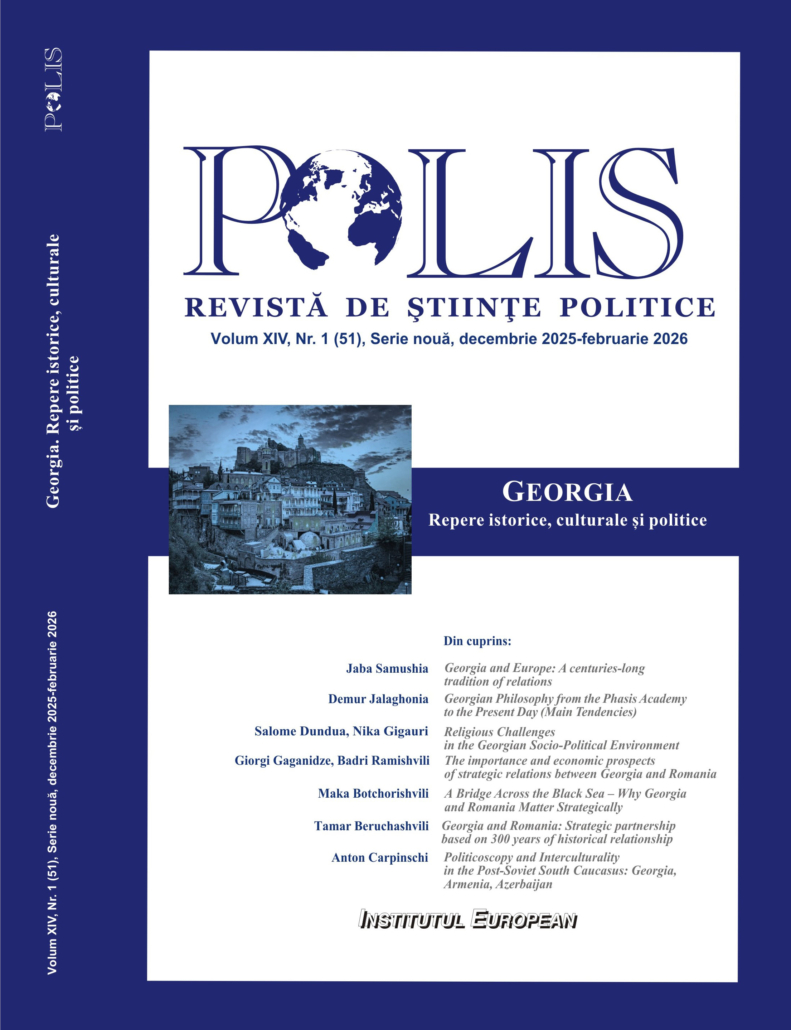
Coordonat de E.S. Tamar BERUCHASHVILI și Sabin DRĂGULIN
Volum XIV, Nr. 1 (51), Serie nouă, decembrie 2025-februarie 2026
The Strategies on Cultural Heritage: Challenges and Discourses in Urban Environment
(The Case of Georgia)
Ketevan KHUTSISHVILI
Abstract: The paper discusses the development of the attitudes towards the cultural heritage in Georgia and the challenges in contemporary urban areas. The problem of cultural heritage is a particularly sensitive issue for the comparatively small ethno-cultural groups like Georgia, which has an ancient culture and for a long period was under the domination of the Russian Empire and later, after a short period of independency in 1918-1921, became a part of the Soviet Union. During that time the maintenance of the national identity was highly oriented on the past, ethnographic elements and cultural heritage. The urban environment and contemporary economic developments put different tasks into the agenda of protecting the monuments of cultural heritage. The term itself goes under the process of reconsideration. The cases of Tbilisi and Batumi are used for displaying the contemporary problems. In modern Georgia, the issue of cultural heritage protection is one of the most important issues. The Ministry of Culture of Georgia, the National Agency for the Protection of Cultural Heritage of Georgia, various governmental and non-governmental structures, civil society groups, and educational institutions work in this field. The Georgian Law on Cultural Heritage regulates cultural heritage protection issues. Despite the fact that many activities directed to protect the cultural heritage were/are carried out in Georgia, the activities still need further elaboration. Culture is in a state of constant development, and constant changes along the way require new approaches.
Keywords: Cultural Heritage, Urban Studies, Ethnology, Georgia.
The issue of cultural heritage is a particularly sensitive issue for the comparatively small ethno-cultural groups like Georgia, which has an ancient culture and for a long period was under the domination of Russan Empire and later, after a short period of independency in 1918-1921, became a part of the Soviet Union. During that time the maintenance of the national identity was highly oriented on the past, ethnographic elements and cultural heritage.
The protection of the cultural monuments is rooted in the 19th century, when particular individual scholars were collecting, researching and protecting the artifacts considered to be monuments of cultural heritage. This interest was supported by the development of ethnographic curiosity.
From the middle of the nineteenth century, interest in ethnographic research grew in Georgia, as it did elsewhere in Europe and Russia. In 1850 the Caucasian Department of the Russian Geographic Society was opened in Tbilisi1. Based on it, in 1852 the Caucasian Museum was founded2.
The Museum became a center of activities related to the tangible cultural heritage. The Georgian statesman and members of the national movement tried to use museum activities for the embodiment of their ideas regarding the fixation and popularization of ethnic culture. The special input in the development of the preservation of the artifacts is appointed to the Georgian statesman and put Rafiel Eristavi, who created the catalogue of the museum and carried out the catalogization of the artifacts. Thus, since 1855 the museum had an elaborate catalogue3. The museum was closed in 1856 due to several objectives (among them the incorrect attitude of the leadership to the aim and function of the museum)4. In 1865, a new museum called “Museum of the Caucasus” opened its doors under the leadership of Gustav Rade5. The director of the museum, Gustav Rade, has collected a wide range of artifacts from the whole Caucasus. Consequently, the activities were focused on gathering ethnographic collections and organizing exhibitions. These actions were meant to contribute to the popularization of ethnography.
Together with the museum activities, the process of gathering the ethnographic narratives was going on. In the second half of the nineteenth century, the leader of the Georgian national movement, Ilia Chavchavadze, founded a working group, which collected ethnographic data throughout Georgia and published articles in Georgian periodical issues6. They realized the threats facing Georgians and, under the leadership of Ilia Chavchavadze, set themselves the goal of consolidating the nation7. Along this path, their efforts were naturally directed towards instilling and strengthening a sense of shared history and culture among Georgians in order to strengthen a unified ethno-cultural identity. Antiquities, folklore, art, historical sources and ethnographic life – this is a general list of the characteristics that needed to be described, studied and popularized. During this period the ethnographic idea was bound up with the national movement, which raised such questions as the autonomy and unity of Georgian people, and their cultural features and origins. A vivid interest in folklore also developed at this time, as did the studies on mountaineers, social organization, marriage forms and family relations. The ethnographic data were collected and analyzed by Vazha-Pshavela, A. Kazbegi, T. Sakhokia, N. Khizanashvili, B. Nijaradze, I. Margiani, I. Gvaramadze, D. Janashvili, M. Janashvili, N. Janashia and others – many of them well-known writers and/or statesmen. Their articles, published in Georgian and Russian periodicals, not only consisted of ethnographic descriptions but also analysis and interpretation. In their literary works, some authors used ethnography as a source for novels and poetry. These works now provide important documents for historical anthropologists8. They made an invaluable contribution to the fixation of ethnographic material. Their conclusions and generalizations are also very interesting, some of which still sound quite modern today.
In 1907, at the initiative of Ekvtime Takaishvili, a new stage in the development of ethnology began with the establishment of the Georgian Historical and Ethnographic Society9. This was the first precedent when the term ‘ethnography’ was recorded in the name of an institutional association. The society had “historical, archaeological, ethnographic, anthropological, linguistic and numismatic” departments. The members of the society collected material and introduced it to the general public through letters published in periodicals, organized exhibitions and public lectures. In this way, they were engaged in the popularization of ethnology along with historical disciplines. The members of the Historical and Ethnographic Society were those public figures who collected historical and ethnographic material in different parts of Georgia. Today, this is invaluable material for the scientific circles.
The collection of artifacts, folklore and ethnographic data provoked the idea of protecting the elements of culture. In the 19th century, the goal of interested persons was to collect, preserve, research and protect the surviving antiquities. In 1921, the Section for the Protection of Museum Antiquities and Art Monuments was created at the People’s Commissariat10. Since that time, the cultural monuments of Georgia have been protected by the state. In 1934, by a decree of the Government of Georgia, the Committee for the Protection of Culture and Monuments was established11. In 1948, by a decree of the Government of Georgia, scientific-restoration workshops were created for the first time in the Soviet Union. In 1959, a voluntary organization was established for the first time in the Soviet Union – the Society for the Protection of Cultural Monuments of Georgia. Its goal was to identify, protect, restore, strengthen and study cultural heritage monuments existing in Georgia and outside the country. In 1977, Georgia adopted the Law “On the Protection and Use of Historical and Cultural Monuments”, and by the resolution of 1978, the previously existing monument protection body was abolished and the Main Scientific-Production Department for the Protection and Use of Historical, Cultural and Natural Monuments (abbreviated as the Monument Protection Department) was created. In 2004, after the liquidation of the Monument Protection Department, the Cultural Heritage Department was created within the structure of the Ministry of Culture, Monument Protection and Sports of Georgia, with departments of various directions, which combined the functions of a customer and a controller. From this period, a new stage began in the field of cultural heritage management.
In order to implement state policy and promote the development of the field, a “Cultural Heritage Protection Program” was created with a clearly expressed tendency of increasing state funding of the field and a structure adapted to the European model of cultural heritage management. In November 2008, by the decree of the President of Georgia, a monument protection organization was established – LEPL National Agency for Cultural Heritage Protection of Georgia – with various and highly specific directions of cultural heritage protection – tangible and intangible cultural heritage, museums, museum-reserves and archaeological sites, information systems, research and popularization of cultural heritage, monitoring and documentation of monuments, educational and international projects. The National Agency for Cultural Heritage Protection was created on the basis of the country’s complex monuments of national and world importance, and represents their unity and legal successor12. The tasks of the agency include preservation, protection and promotion of museums, reserves, moveable and immoveable monuments and sites of the Georgian cultural heritage throughout Georgia and beyond the country. The main attention was paid to the historical – architectural monuments, but since the adoption the law on cultural heritage in 2017 the definition of tangible and intangible cultural heritage has been directing the strategies.
The definition of the term ‘cultural heritage’ is presented in the law. It includes material and intangible areas. Under the tangible cultural heritage are considered “any kind of artistic, aesthetic, historical, architectural, artistic, urban-planning, agricultural, archaeological, anthropological, ethnographic, monumental, immovable or movable objects related to the development of technology, documentary materials, created by humans or as a result of the influence of humans on nature, gardens, parks, objects of landscape architecture, historical settlements, historically formed environments related to the country’s history, development, folklore, beliefs and traditions”13. Intangible monuments are “oral traditions and forms of expression, including language as a carrier of intangible cultural heritage, performing arts, customs, traditions, knowledge and skills related to traditional arts, as well as related tools, objects, artifacts and cultural spaces that are recognized by communities, groups and, in some cases, individuals as part of their cultural heritage”14. To protect the heritage, a set of legal, scientific-research, rehabilitation, informational and educational measures is developed, the purpose of which is to preserve the cultural heritage in full diversity and ensure its sustainable development.
The heritage regimes consist of state policies that are using history as a cultural, political and economic resource for the present. These attitudes are set by the state and are not always overlapped by the perceptions from below. The cultural heritage is used as a political tool; heritage policy is a top-down project. The people on the ground have to develop coping strategies to encounter the process of “heritagization” in their daily life. Especially in such multi-ethnic areas as the urban areas in Georgia, it is interesting to analyze the local perspectives on cultural heritage.
The topic of cultural heritage in the post-socialist space is discussed from many disciplinary backgrounds. An anthropological view of the situation means to follow a bottom-up perspective on micro processes, to focus on the actor’s perspective on the ground and contribute to the general discussion of cultural heritage in urban environment.
The theoretical framework is based on legitimacy15 and urban theories16 as well as attitudes of memory studies17. As a case, I will discuss the problem of tangible cultural monuments in Tbilisi and Batumi.
Tbilisi is the capital of Georgia with a population of over 1.5 million18. It is the most multicultural urban area with the long list of cultural monuments. Tbilisi as a settlement has a long history, but it was announced as a capital in the 5th century. “Although little explored in urban studies, the city epitomizes a fascinating assemblage of processes that can illuminate the interplay of geopolitics, political choices, globalization discourses, histories, and urban contestations in shaping urban transformations. Tbilisi’s strategic location in the South Caucasus, at the juncture of major historical empires and religions in Eurasia, has ensured its turbulent history and polyphony of cultural influences. Following Georgia’s independence in 1991, Tbilisi found itself as the pivot of Georgian nation-building. Transition to a market economy also exposed the city to economic hardship, ethnic homogenization, and the informalization of the urban environment. The economic recovery since the early 2000s has activated urban regeneration. Georgia’s government has recently promoted flagship urban development projects in pursuit of making Tbilisi a modern, globalizing metropolis. This has brought contradictions, such as undermining the city’s heritage, contributing to socio-spatial polarization, and deteriorating the city’s public spaces. The elitist processes of decision-making and a lack of consistent urban policy and planning regimes are argued to be among major impediments for a more sustainable development of this city”19. As a capital, it has always had a diverse composition of various ethno-cultural, lingual or religious groups. The religion was present in the urban space. The cultic buildings of different religious communities were neighboring. At the same time, Tbilisi was the residential city of the Patriarchate of the Georgian Orthodox Church. The list of the buildings that are under protection in Tbilisi is a kind of guarantee that they will not be touched. But the post-Soviet processes impacted the attitudes and a big amount of monuments lost their status in accordance to gaining economic value.
The city of Batumi is situated in Ajara (Adjara). The region of Ajara is especially interesting because of its religious diversity. This southwest Georgian region was highly influenced by the Turkish political-economic and cultural impact since the XVI century. when it came under Turkish rule. From 1878 the region was returned to Georgia by the active presence of the Russian Empire in the region. In 1922, after the Sovetization of Georgia, it was declared as the Soviet Socialist Autonomous Re-public of Ajara, within Georgian SSR. After the announcement of the independency following a constitutional amendment passed by the Georgian parliament in April 2000, Ajara was officially designated an Autonomous Republic. Batumi is the central city of the region, and the capital of the Autonomous Republic of Ajara. The claims on autonomy were initially connected and reasoned by the fact that due to Turkish influence, the majority of Ajarians were converted to Islam. The history of spreading Islam in the region is quite complicated and violent. Ajarians are the only Georgian sub-ethnical group who are Muslims. For centuries their religiosity was rather domestic-practical than normative-theological. About 13% of the Georgian population is Muslim20. The population of Batumi is 152 83921.
In the I-II centuries, Batumi was settled and used as a port. Later there were the times of its decline. In the XV century, it was conquered by Ottoman Turks and re-annexed by the Russian empire in the XIX century. It was a Black Sea port and the development of the city was bound up with the political and economic developments. According to the 1878 Berlin Congress, the port was declared as Porto-Franco (a port with the right of free economic zone); this promoted the city’s growth. The expansion of Batumi began in 1883 and this was connected to the construction of the Batumi-Tiflis-Baku railway, which was completed in 1900. Later the important event was the construction of the Baku-Batumi pipeline. That fact made Batumi one of the main ports in the Black Sea.
Porto Franco’s status and regime have increased the construction of the residential buildings, hotels and warehouses. That regime also increased the population of Batumi22. Batumi became an important port for the Black Sea Coast. The Caspian Sea oil products were exported to other countries from Batumi port. Batumi became an industrial city. Rothschild, Nobel, Mantashev, Nurkertt oil companies dominated there. In 1881 the idea of cultivation of Batumi Boulevard appeared. In 1882 in Batumi there were two Orthodox churches, one Catholic church, three mosques, three tobacco products, 8 hotels, 240 shopping establishments, etc. In 1885 the Church of Alexander Nevsky was built, which was a symbol of the victory of the Russian Empire.
The city started to grow as an industrial one. This caused the formation of the multiethnic community. In 1918, according to the Brest-Litovsk Treaty, Batumi was given to the Ottoman Empire23. Turkey c onceded the area to the Soviet Union on the condition that it would be granted autonomy for the sake of the Muslims among Batumi’s mixed population. Batumi today is one of the main port cities of Georgia. President Saakashvili, who once described Batumi as his “daughter”24, turned this Black Sea resort into a part of his campaign aimed at turning Georgia into a tourist zone. Since 2004 Batumi has known an unprecedented development process, which is widely referred to as the “Batumi Miracle”25.
The constructions and reconstructions changed the image of the city a lot. Nowadays Batumi is an architecturally eclectic, growing city with a multiethnic, multicultural and multi-religious composition. Various religious denominations are functioning and having their sacred sites. In 2011, the Georgian Parliament passed a law, that made it possible for religious organizations to register as legal entities under public law, which also entails funding from the state.
The discourses regarding the heritage mainly were connected to the threat of globalization and to the change of the memories. Both are related to the identity construction. The population was suspicious regarding the impact of globalization and modernization on cultural heritage.
Globalization, regardless of the organization of the world according to the state-territorial principle and the existence of national borders, implies the gradual transformation of the geopolitical space into a single zone, where capital, goods, services and people will move freely and ideas will spread freely. The basis of globalization is the process of internationalization of the economy, which in turn is related to the emergence of transnational corporations and international banks, the qualitative progress of communication and transport links. International political and economic organizations are created; norms of international law are developed and control over their implementation is carried out. Integration processes are actively underway. In these conditions, communicative aspects of culture gain great importance. There is an exchange of material and spiritual values between national cultures, mutual contacts are expanding, there is an active exchange of cultural information. Interrelationship and mutual influence of national cultures is a regular process and is a necessary condition for the development of humanity. The more intensive the cultural exchanges between nations, the richer and more diverse the general human culture becomes. But the process of globalization, along with the positive (increased foreign trade, high speed of information movement, free movement of new ideas, technologies, devices and “know-how”, the possibility of integration with the world economy and politics), also has negatives. In particular, homogenization, leveling of national culture, spread of counterculture, instability, expected economic shocks, and confusion of values. The roughly ongoing process of globalization in some cases erases cultural differences and unique cultural phenomena disappear (of which there are many examples in the modern world). The relationship between elite and folk culture, value systems are changing, there are problems of cultural differences, subcultures, countercultures, multiculturalism, ethnocentrism, global culture. It is related to the rather contradictory process of the replacement of the industrial age by the information age. The “information revolution” has changed the world.
As a result of the ongoing process of economic and political integration, the importance of ethnic identity has increased due to the awareness of the danger of cultural standardization26. Along with the legitimized, resistant and projective identities emerged. The question of ethnocultural identity is especially problematic in polyethnic societies, where cultural differentiation is great, and in transitional societies, where previously established identities are being questioned. The localization is closely related to ethnic identity, with its different manifestations, which appeared as a defense reaction to globalization (the global context of social existence), which was considered as a symbol of deterritorialization, integration and universalization.
Ethno-culture as a marker of ethnicity was in the focus. It is a unified structure of behavioral, communicative, value, socio-political and cultural models typical for the ethnic group (conditionally), a set of cultural achievements of the local groups27. Ethno-culture maintains the stability of the ethic group and determines the behavior of different parts of it in times of crisis. At the same time, ethnic culture means only the set of cultural elements and structures, according to which the “us-them” opposition is realized and the identity is defined. Under the influence of ethnic culture, the primary socialization of the majority of people takes place. It contains spiritual, socio-political and material components. Ethnocultural belonging is a daily practice and a historical process that is both collective and individual. Moreover, the ethnocultural identity is immanent, although not necessarily variable, but the disruption of the natural line of its reproduction leads the group to such negative phenomena as psychological disorientation, the spread of deviant forms of behavior, social marginalization, etc. The cultural specificity of the nation can be seen not only in the traditional uniqueness of the material and spiritual culture formed in the past, but also in the overall cultural contribution of the nation to the foundation of modern world culture. Ethnic culture undergoes innovations over time and becomes multi-component. In addition, it has become a problem in the post-Soviet space that in the industrial-technical society, the coded, standardized culture transmitted through education to some extent opposes the localized, folk culture transmitted through life practice, which causes a conflict between the new and the old.
Globalization disrupts the autonomy of institutions, organizations and communication systems that people are accustomed to. The world is becoming too big to control, and social actors aim to bring it within its old boundaries. Networking and flexibility break down the boundaries of belonging, the relations of production become individualized, and space and time become structurally unstable28. These processes are particularly painful for traditional or semi-traditional societies. Modernization and the formation of a mass society with an extensive nature of social differences and drastic social changes have made it difficult for people to define their identity. The small, homogenous, and less prone to change societies of the past offered a solid basis for identity to their members. Socio-cultural regulation in them is based on strict reproduction of historically formed traditions. In the modernist society, the socio-cultural regulation is based on the values and norms confirming individual freedom and civil responsibility.
Globalization-modernization processes, on the one hand, are aimed at the homogenization of culture, but on the other hand, as a reaction, they cause the actualization of ethnic identity and to some extent contribute to the development of ethnic culture. As an example of such a reaction and an example of the development of the adaptive mechanism of culture, we can consider the promotion of ethno-cultural characteristics and the attempt to present them to the world community and establish them. In this process the monuments of cultural heritage are playing the role of mediums.
Tbilisi, as a city with its specific image, organization of the landscape, architectural style, etc. Especially its historical downtown was considered by the locals as a monument of cultural heritage, which needs to be protected and which is under the threat of deconstruction because of a new view on modernization. The state project – Tbilisi the city of the lights – was a new plan for reconstruction. The locals accepted the project with dual feelings.
The modernization in the post-Soviet space, including Georgia, was followed by the reconsideration of the past and attempts to escape from the Soviet legacy. This way, after the long discussions in 2011, the “Charity of Liberty”29 was launched and approved by the Georgian Parliament. Its aim was the elimination of the Soviet symbolic, cultic buildings and ideology. This caused a tension, as some buildings had the status of cultural monuments. Such an example is the building of Parliament itself, on Rustaveli Avenue in Tbilisi. It was built in 1938 (architects V. Kokorin and G. Lejava), it was hosting the local government.Later it was reconstructed in 1956-1953 and was under the protection as an architectural monument of the Soviet Empire style, which consisted of some Georgian details30. Some Soviet symbols on the façade and the Soviet sculptures at the entrance were removed in 2011.
The discourses and challenges related to the cultural heritage are contradicting each other. These approaches are formed within the framework of specific contexts and are compatible with them. Here the question arises about the material manifestations of memory – places of memory, monuments of the cultural heritage. If the place of memory legitimizes the “old reality”, the question of its replacement or destruction will naturally arise. Those monuments related to the close past (Soviet past) are not even accepted as elements of heritage. On the one hand, one of the connecting elements of the “we group” is the shared past, on the other hand, social unity requires a more or less shared perception of this past. However, the constant reconstruction of the past requires representation, for which various means are used, including the materialization of this past, the use of artifacts, symbols. Material culture can be considered as a means of encoding memory for society. Through this remembrance, the current context of identity is legitimized.
Cultural heritage is a broad concept and includes material objects and spiritual values created by specific groups of people in the context of social interaction formed in relation to them in the process of cultural development. For every ethno-cultural unity, its cultural heritage is the basis of identity. Thus, protection of cultural heritage implies care for the preservation of ethno-cultural identity. The issue of cultural heritage has become increasingly relevant and problematic in the modern world. On the one hand, the reaction to globalization processes locally increased the interest in local (material and intangible) cultural monuments; On the other hand, the same processes also led to an increase in interest in foreign cultures. The high degree of mobility, the significant development of both global and local tourism pose new challenges to the local authorities. It is problematic to define what cultural heritage is. Its recognition, protection and promotion require specific approaches and strategies, and there are differences between international (e.g., UNESCO, etc.) and local legal approaches. There are also differences in local perceptions and attitudes. The complexity of the issue is determined by the political and economic difficulties faced by humanity and its constituent societies. Rapid changes in technological and social systems with their accompanying effects impact the value systems of individuals and groups of people; the process of constant understanding and reevaluation of one’s own identity and culture is underway. People are looking for the pillars of their ethno-cultural identity, and of course the elements of cultural heritage are revealed to be important in this way. That is why it is a sensitive topic: what is perceived as cultural heritage and what is the attitude towards it in everyday life and what is the state policy.
Protection of cultural heritage, as part of a complex issue, is related to politics; therefore, it can become a problem-solving or inspiring factor. Therefore, it is particularly important to analyze the current attitudes towards cultural heritage. Cultural heritage is the realm of mere ethno-cultural or national interest. It is related both to state and transnational issues. The management of cultural heritage is related to the cultural, economic and political processes of a particular society and at the same time to the common processes taking place in the world. The general approaches are created, which are reflected in conventions, and the development of such general or local documents is an altering process in accordance with the changes in the interpretation of values. Cultural heritage is perceived as a set of important objects; as a part of the environment (landscape) and as a socio-cultural construction. All aspects together form an ethnocultural identity, which is especially important for small nations with an ancient history and rich cultural heritage. Georgia, a country with one of the oldest cultures in the world, belongs to such a group. Along with other markers, the identity of Georgians is structured by the historical cultural heritage31.
One of the interesting aspects of urban development is the correlation of urban and religious spaces. The post-Soviet society in the mass order has addressed religious roots. Owing to reassessment of the Soviet priorities, personal and public predilections have changed considerably and religiosity has become the determining factor of public life. In the post-Soviet societies of a transitive type, the interest in religion has sharply increased, and the factor of the influence of religion has accordingly increased. Quite often religion replaces ethnicity and carries out an appropriate political role. It is natural that the religion, as a major element of ethnic self-consciousness, determines the character of the processes of inner-ethnic consolidation and, at the same time, differentiation between the ethnoses. The religious creed, as an internal orientation for self-identification of the individuals and ethnic groups, and also a constructor of cultural values, has got huge importance. The residents of the urban areas started to give new meanings to the religious spaces in their neighborhoods; in some cases the attempts of establishment of new religious places were quite active. This refers to the Batum case.
In 2011, the Administration of Georgian Muslims (AGM) was founded, which improved organizational capacities of Muslim communities. One of the major challenges for the Muslim population appeared to be the construction of new mosques. The Muslim community in Batumi was fighting for building a second mosque for over years. The oldest mosque in Batumi, Orta Jame, does not offer enough space for all the ones who wanted to attend Friday prayers. The Muslim community possesses land but was not given a construction permit for building a new mosque. However, when the city’s administration offered a construction permit in spring 2018, the Muslim community rejected the offer out of fear of too much influence by the government through the Administration of Georgian Muslims (AGM). The dispute remains complicated. Another aspect of the problems the Muslim community in Ajara faces is the funding issue. Many communities in Ajara receive funding from Turkey or are educated in Turkey. This has regularly provoked criticism due to possible influence from abroad. The activity of traditional Islam does not strain a religious situation. They have a customary century-long traditions of cooperation and peaceful coexistence with other religions, especially with Orthodox Christianity and their religious representations do not contradict these traditions. Islam in Georgia could not avoid the fundamental tendencies, which carry in themselves a charge of an opposition both with traditional Islam and in relation to other religions. On crossing these tendencies, significant zones of religious enmity are forming.
The post-Soviet society, after 70 years of living in conditions of fighting atheism in the mass order has addressed its religious roots. Owing to the reassessment of the Soviet priorities, personal and public predilections have considerably changed and religiosity has become the defining factor of public life. In the post-Soviet societies of a transitive type, the interest in religion has sharply increased, and the factor of influence of religion has accordingly increased. The religious creed, as internal orienteering for self-identification of the individuals and ethnic groups, and also a constructor of cultural values, has got huge importance. However, as inner-ethnic integrating property, the religion, at the same time, is the factor of differentiation between the groups. Concerning the post-Soviet space, the difficulties of the transitive period have created beneficial ground for the wide spreading of the religious traditional or non-conventional ideas. There have arisen the problems of identity, distinction between cultures, minority-majority, globalization-localizations, multi-culture etc. The community has faced a problem of mutual relation between its groups and the search of the correct directions of national integration and national policy32. The long-term mutual relations between such traditional religious communities as the Georgian Orthodox Church and the Moslem community have been developed over the centuries. In conditions of positive or negative stereotypes, the mutual adaptation basically proceeded in a peaceful way.
The majority of the Georgians are historically Orthodox Christians; Georgians are also Catholics, Moslems and representatives of the other religious groups. All religious organizations acting in Batumi have different positions and possibilities. They have the property in the city and the development of their communities is highly dependent on the level of urbanization.
The Georgian Urbanization Review finds that the country continues to face challenges arising from its dual transition from a planned to a market economy and from a rural to an urban economy. The transition from a planned to a market economy was accompanied by an economic decline and increasing regional disparities. This was exacerbated by the 2008 financial crisis. As the economy transitioned from a planned to a market economy, Georgia’s economy also became more urbanized and there are strong indications that building on the urban economy can assist Georgia out of its current economic malaise. However, growing regional disparities emerge as a challenge of this transition from a rural to an urban economy.
The urban transformations and religious transformations are influencing each other. The three types of actors involved in the transformation of the urban space have been identified: state-sponsored mainstream religious institutions, religious “purists” and religious minorities. The forms of religiosity practiced during the Soviet period became limited in post-Soviet era and the processes of reshaping them were set off spontaneously. The two vectors of development have been emerged: “from below” and “from above”. In Batumi there are the worshiping places that are already historical; some of them have the status of monuments of cultural heritage. There are also new buildings or constructions, formal and informal sites, which have the meanings for the believers. The Orthodox churches (Cathedral St. Mary; St. Nikoloz (Nicolas) and St. Barbare (Barbara) Churches), Moslem sites (Orta Jame, New Mosque), Jewish site (Synagogue), Armenian Apostolic Church and Catholic Church are situated in residential areas of the city. Except of New Mosque, all others are situated in the touristic, central part of Batumi. These sites have specific groups of visitors and an impact on the social, cultural, public life of the city. Batumi appears to be a multicultural, multi-religious city; the citizens have various (everyday life and religious) practices. The urban-rural division in perceptions regarding each other comes into play.
A program of diagnostics of urban development called the ‘Urbanization Review’ (UR) is based on three main pillars of urban development, which have emerged as key areas of policy engagement for successful cities. These are: a) planning, charting a course for cities by setting the terms of urbanization, especially policies for using urban land and expanding basic infrastructure and public services; b) connecting, physically linking people to jobs, and businesses to markets; and c) financing, raising and leveraging up-front capital to meet the increasing demand for infrastructure and services. In moving forward, the review recommends that Georgia focus on: a) developing a national urban strategy that recognizes the contribution of each city to the overall economy, i.e. a ‘system of cities’ approach that can assist in reducing regional disparities; b) assisting cities to develop urban plans, including local economic development plans, c) reforming building and planning codes; and d) assisting cities in improving their local governance and finances.
The aims of the municipal policy of Batumi include making the city more attractive for its inhabitants, businesses and tourism, as well as strengthening the political and economic significance of the city beyond its borders. Characteristics and deficits of the urban fabric were identified in a review and analysis of the situation and used to develop a framework concept. Special features taken into consideration included the Mediterranean climate, the seaside location of the city with a harbor and promenade offering leisure facilities. A structural connection between the inner heart of the city and the sea as well as a clearly defined urban periphery were found to be lacking and oversized urban spaces created by traffic were identified. As the specialists state an appropriate improvement of the spatial urban situation was incorporated in the concept of the master plan33. There is mentioned: “Three key planning aspects and concepts were worked out and proposed:
- Delimitation of the urban structure with continuation of the typical orthogonality up to a structurally clearly perceivable periphery towards the sea and new appropriately sized spaces and centers in the city.
- Simultaneous opening up of the city by continuation of the streets to the sea and a pier-like structural development into the sea as an urban focus. Also integrating a harbor for sailing boats and the end point of the seaside promenade.
- The new development sites are to be used for new specific purposes: Creation of a central urban space alongside the opera with new cultural facilities, mixed use including residential spaces near the harbor, commercial and leisure use on the pier, a hotel and congress center on the hill by the sea, continuation of the ministry buildings at the periphery of the city and new sports and leisure facilities along the promenade up to the pier34.
Some scholars are pointing out that Batumi «is not coherent in its approach to change. But it also underlines the ever-expanding tendency of other parts of the world to uncritically adopt methods that were initially developed for Western settings, where the specific historic and socio-economic conditions and local traditions and heritage affected the decisions made. Such a realization calls for further research and careful, individual approaches to all cities that undergo similar transformations throughout the world, and in particular in the turbulent and fast-evolving area that is the Black Sea basin today»35.
The above-mentioned aspects display the challenges, which are evident in the way of protection of the cultural heritage. In modern Georgia, the issue of cultural heritage protection is one of the most important issues. The Ministry of Culture of Georgia, the National Agency for the Protection of Cultural Heritage of Georgia, various governmental and non-governmental structures, civil society groups, and educational institutions work in this field. The Georgian Law on Cultural Heritage regulates cultural heritage protection issues. Despite the fact that many activities directed to protect the cultural heritage were/ are carried out in Georgia, the activities should still be a permanent process. Culture is in a state of constant development, and constant changes along the way require new approaches.
Notes
- Givi Jordania, Foundation of the Caucasian Museum (for Study of the History of Georgian State Museum), Tbilisi, 1951 (in Georgian) p. 13. Guram Koranashvili, The Phenomenon of Ilya Chavchavadze, Tbilisi, Universali, 2007, p. 36.
- Guram Chkaidze, Georgian State Museum (1852-1932), Tbilisi 2003, p. 7.
- Givi Jordania, Foundation of the Caucasian Museum (for Study of the History of Georgian State Museum), cit., p. 112.
- Ibidem, p 83-89.
- Ibidem, 110. Chkaidze Guram, Georgian State Museum (1852-1932), Tbilisi, 2003, p. 7.
- Pavle Ingorokva, Ilia Chavchavadze, review, State publishing house, Tbilisi, 1957, 149-150.
- see Guram Koranashvili, The Phenomenon of Ilya Chavchavadze, Tbilisi, Universali, 2007 (in Georgian).
- Ketevan Khutsishvili, „The History of Georgan Anthropological School”, Anthropological Researches #1, Tbilisi, 2010.
- Roin Metreveli, „Georgian Historical and Ethnographic Society”, Historical review, Materials, Tbilisi, Khelovneba, 1982 pp. 9-10.
- https://www.heritagesites.ge/ka/page/8
- Ibidem.
- Ibidem.
- Law on Cultural Heritage 1, Chapter 1, Article 3, Clause L., L.A.
- Law on Cultural Heritage 1, Chapter 1, Article 3, Clause L., L.B.
- Gulia Prato, Italo Pardo, Introduction: The Ethnography of Legitimacy and its Theoretical Ramifications, Legitimacy: Ethnographic and Theoretical Insights, Palgrave Macmillan, 2019.
- Guilia Prato, „Italo Pardo”, 2013, Urban Anthropology, Urbanities, Vol.3, No.2, November, 2013.
- Maurice Halbwachs, On Collective Memory, Trans. And Lewis A. Coser, University of Chicago Press, Chicago, 1992. Aleida Assmann, Erinnernngsraume: Formen und Wandlungen des kulturellen Gediichtnisses, Munich, Beck, 1999.
- https://www.geostat.ge/en/modules/categories/41/population.
- Joseph Salukvadze, Oleg Golubchikov, „City as a geopolitics: Tbilisi, Georgia – A globalizing metropolis in a turbulent region”, Cities, Vol. 52, March 2016, pp. 39-54.
- Caucasus Barometer 2017 https://caucasusbarometer.org/en/cb2017ge/RELGION/.
- http://census.ge/files/results/Census_release_ENG.pdf.
- Maia Rurua, The two history of one building, South-West Georgia (history, archaeology, ethnology), International Scientific Conference materials, Universali, Tbilisi, 2016, pp. 157.
- Archil Varshalomidze, The Question of Batumi in Brest-Litovsk and Trabzon Treaty-Conferences, BSU, Scientific collection of Memed Abashidze Scientific Research Center, # 1. Batumi, 2001.
- https://www.kvirispalitra.ge/specialurad-saitistvis/5681-mikheil-saakashvili-qbathumi-khom-gogonaa-da-me-vishvileq.html.
- https://www.washingtontimes.com/news/2012/mar/19/batumi-miracle/.
- H. Eriksen 1993, Ethnicity and Nationalism. Anthropological perspectives, Pluto Press, London-Baulder, Colorado, 1993.
- Ketevan Khutsishvili, Ethno-culture and Globalization, Collection dedicated to K. Lomatidze, Tbilisi, 2008.
- Manuel Chastells, The Information Age. Economy, Society and Culture, vol. II, The Power of Identity, Oxford: Blackwell, 1997, p.66.
- Saqartvelos sakanonmdeblo macne, 4717-I s.
- Nodar Jorbenadze, Simon Kintsurashvili, Architecture of Soviet Georgia, Moscow-Tbilisi, 1958, p. 11.
- Rozeta Gujejiani, Ketevan Khutsishvili, The Dadshkeliani Residences – Socio-cultural Meaning and Prospects of Georgian Monuments of Cultural Heritage, Meridiani, Tbilisi, 2024, p. 157.
- Ketevan Khutsishvili, Changing Religious Situation and the Problem of Security in Modern Georgia, Tbilisi, Artanuji, 2004.
- Master Plan Study for Urban Development of Batumi, Georgia 1996, https://fritsch-tschaidse.de/en/ competitions/wb-master-plan-study-f-or-urban-development-of-batumi,-geo-rgia.html.
- Evi Baniotopoulou, „Exploring Mythologies and Urban Development in the Black Sea Basin: Aspects of City-Branding and Identity-Shaping in Contemporary Batumi”, Identity Studies in the Caucasus and the Black Sa Region, Vol. 6 (2015): Identity Studies, p. 153.
Bibliography
Books
ASSMANN, A., Erinnernngsraume: Formen und Wandlungen des kulturellen Gediichtnisses. Beck, Munich, 1999.
CASTELLS, M., The Information Age. Economy, Society and Culture, vol. II, The Power of Identity, Blackwell, Oxford, 1997.
CHKAIDZE, G., Georgian State Museum (1852-1932), Tbilisi, 2003.
ERIKSEN, T. H., Ethnicity and Nationalism. Anthropological perspectives, Pluto Press, London-Baulder, Colorado, 1993.
GUJEJIANI, R., KHUTSISHVILI, K., The Dadshkeliani Residences – Socio-cultural Meaning and Prospcts of Georgan Monuments of Cultural Heritage, Meridiani, Tbilisi, 2024.
HALBWACHS, M., On Collective Memory, Trans. And ed. Lewis A. Coser., Chicago: University of Chicago Press, 1992.
INGOROKVA, P. (1957), Ilia Chavchavadze. Review, state publishing house, Tbilisi ,1957.
JORBENADZE, N., KINTSURASHVILI, S., Architecture of Soviet Georgia, Moscow-Tbilisi, 1958.
JORDANIA, G., Foundation of the Caucasian Museum (for Study of the History of Georgian State Museum), Tbilisi (in Georgian), 1951.
KHUTSISHVILI, K., Changing Religious Situation and the Problem of Security in Modern Georgia, Tbilisi, Artanuji, 2004.
IDEM, Ethno-culture and Globalization, Collection dedicated to K. Lomatidze, Tbilisi, 2008.
KORANASHVILI, G., The Phenomenon of Ilya Chavchavadze, Universali, Tbilisi, 2007.
VASHAKMADZE, Sh., Rafiel Eristavi: Life, Deeds, Works, Tbilisi Sabchota Sakartvelo, 1962. (in Georgian).
Articles and studies
BANIOTOPOULOU, E., „Exploring Mythologies and Urban Development in the Black Sea Basin: Aspects of City-Branding and Identity-Shaping in Contemporary Batumi”, Identity Studies in the Caucasus and the Black Sa Region, Vol. 6 (2015): Identity Studies, p. 153.
KHUTSISHSILI, K., „The History of Georgian Anthropological (Ethnological School)”, Anthropological Rsearches, I, Tbilisi, Universali, 2010.
METREVELI, R., „Georgian Historical and Ethnographic Society”, Historical review, Materials, Khelovneba, Tbilisi, 1982.
PRATO, G., PARDO, I., „Urban Anthropology”, Urbanities, vol.3, no.2, November 2013.
IDEM, Introduction: „The Ethnography of Legitimacy and its Theoretical Ramifications”, Legitimacy: Ethnographic and Theoretical Insights, Palgrave Macmillan, 2019.
RURUA, M., „The two history of one building, South-West Georgia (history, archaeology, ethnology)”, International Scientific Conference materials, Universali, Tbilisi, 2016, pp.157-168.
SALUKVADZE J., GOLUBCHIKOV, Oleg, „City as a geopolitics: Tbilisi, Georgia — A globalizing metropolis in a turbulent region”, Cities, Vol. 52, March 2016.
Online resources
https://www.heritagesites.ge/ka/page/8.
https://www.geostat.ge/en/modules/categories/41/population.
http://census.ge/files/results/Census_release_ENG.pdf.
https://www.kvirispalitra.ge/specialurad-saitistvis/5681-mikheil-saakashviliq-bat-humi-khom-gogonaa-da-mevish-vile-q.html.
https://www.washingtontimes.com/news/2012/mar/19/batumi-miracle/.
Caucasus Barometer, 2017, https://caucasusbarometer.org/en/cb2017ge/RELGION/
Master Plan Study for Urban Development of Batumi, Georgia 1996, https://fritsch-tschaidse.de/en/competi-tions/wb-master-plan-study-for-urban-development-of-batumi,-georgia.html