


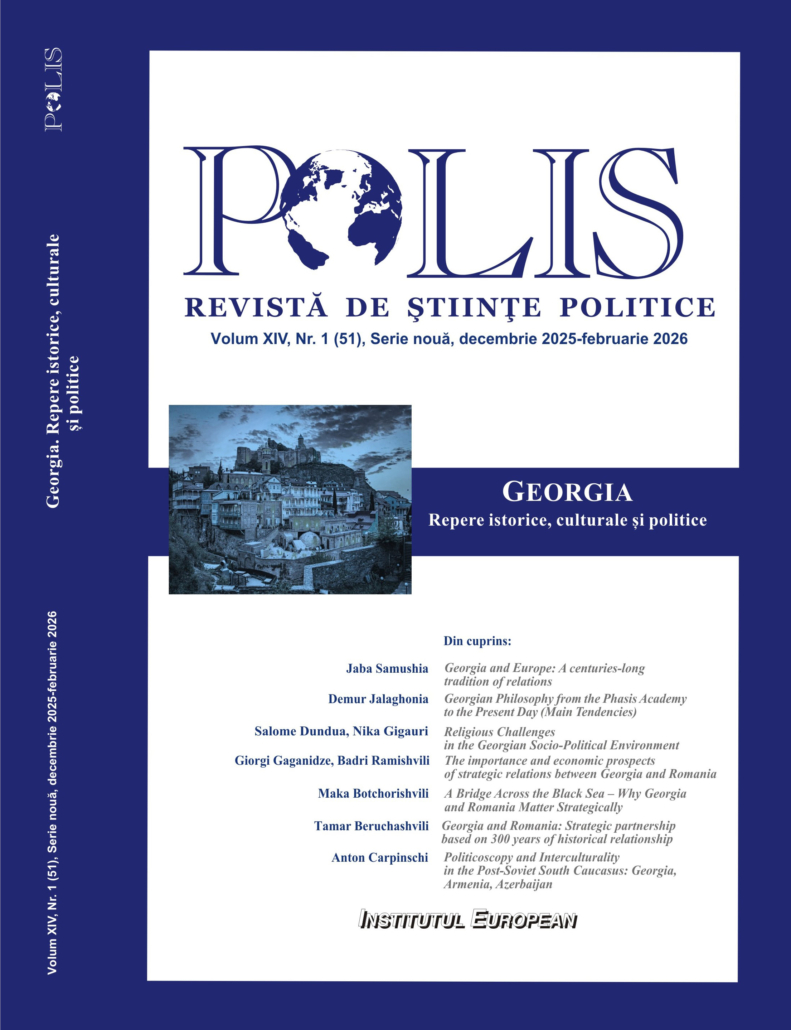
Coordonat de E.S. Tamar BERUCHASHVILI și Sabin DRĂGULIN
Volum XIV, Nr. 1 (51), Serie nouă, decembrie 2025-februarie 2026
Two Important Episodes from the History of Relations Between the Georgian and Romanian Orthodox Churches
Mikheil KARTVELISHVILI
Eter BOKELAVADZE
Abstract: Georgian-Romanian political and ecclesiastical relations have a history spanning many centuries. The distinguished public and ecclesiastical figure, Anthimos the Iberian, stands at the origins of these relations, representing a personality of multifaceted interest and significance for both Georgia and Romania. The particular importance of this individual is confirmed by the fact that the Romanian Orthodox Church canonized him as a saint in 1992. The goal of our article is to study the lesser-known episodes of Romanian-Georgian relations, which have not yet been the subject of dedicated scientific research; consequently, the views presented in it represent a scholarly novelty. The subject of our research is the visit of the Patriarch of the Romanian Orthodox Church, Justinian, to Georgia in 1948, and the resulting relations, as well as the visit of the delegation of the Georgian Orthodox Church to Romania in 1986. It should also be noted that representatives of these two churches jointly participated in a number of peace conferences, which further strengthened the benevolent relationship between them. These events are studied and analyzed based on a review of the broad political-historical context. The paper is based on primary sources concerning the issue (archival documents, press materials, memoirs) and relevant scientific literature.
Keywords: Romania, Georgia, Patriarchates, Orthodox churches, Soviet regime, Church Diplomacy
Introduction
Throughout its existence, the Georgian Orthodox Church has never been isolated from public life. It has historically had close ecclesiastical, diplomatic and cultural relations with Christian churches, as well as with other confessions, their leaders and individual representatives.
From a historical perspective, the 20th century is not an exception; although this period is truly unique and interesting with its complexity and multifacetedness, the Georgian Orthodox Church and its leaders have never chosen isolation, but rather, within their capabilities, have always tried to convey their message to other churches and establish the closest possible ties with them.
This is also confirmed by the fact that in 1917, after the restoration of autocephaly, the newly – elected Patriarch Kyrion II, in order to establish close church diplomatic relations, sent letters as Patriarch of Constantinople. Germanus V, Pope of Rome1. It is clear that the desire of the Georgian Patriarch was to achieve real autocephaly of the Georgian Church and to escape from the centuries-old isolation in which our Church was under Russian occupation. Unfortunately, his desire and goal remained unfulfilled at that stage. The patriarchs who followed him found themselves in an even more difficult situation, as they were forced to work first under the strictly secular policy of the Democratic Republic of Georgia, and then during the atheistic period of the Soviet Union. In this regard, the improvement of the situation is actually related to the relatively loyal church policy of the Soviet government, which was a direct result, on the one hand, of the restoration of the Patriarchal Throne in the Russian Church, and, on the other hand, of the recognition of the autocephaly of the Georgian Church by the latter.
Romanian-Georgian political and church relations have a centuries-old history. At the origins of these relations stands the prominent public and church figure Anthimoz Iveri, who is an interesting and important person in many ways, both for Georgia and Romania. The special significance of this person is confirmed by the fact that in 1992 the Romanian Orthodox Church canonized Anthimoz Iveri as a saint.
The aim of our paper is to study two little-known episodes of Romanian-Georgian relations, which, as far as we know, have not been the subject of special scientific research to date. The present paper aims to raise the issue, we do not exclude that a more detailed study of the scientific problem will reveal new historical sources that will make the mentioned relations even more interesting, which is why we have decided to study this problem in more detail.
Relations between the Georgian and Romanian Orthodox Churches in the late 1940s
It is a generally accepted fact that in the middle of World War II, Joseph Stalin changed his policy towards the Orthodox Church. In particular, if before the Soviet government had aggressively fought against any manifestation of religiosity, considering it a “bourgeois remnant” that should have been completely destroyed over the years, now the communist state has somewhat renewed its attitudes, which had many manifestations: for example, representatives of the Russian Church were allowed to elect a patriarch, the Orthodox Church was granted the right to legal existence, and previously closed churches and monasteries began to be opened.
It is quite obvious that the Soviet government did not intend to grant the church any kind of autonomy with these steps, but rather decided to turn one of the most powerful religious institutions into its ally. This process took on a more intense character, since among religious institutions, the Martyrdom Church became a state institution, and if before it was perceived as a force opposed to the government in the eyes of the local and international community, this –time it appeared as a state policy implementer.
In the reality that in the Soviet Union there was almost no normal approach to cooperation between the state and the church, it was necessary to find a form that would ensure its regulation in such a way that both sides would be more or less satisfied with the cooperation. That is why in 1943 the central government created a new body in order to better exercise control over the church – the Council for the Affairs of the Russian Orthodox Church under the Council of People’s Commissars of the USSR. G. Karpov was appointed chairman of the counci2.
In parallel with this, religious life began to revive in Georgia. The Russian Orthodox Church officially recognized the autocephaly of the Georgian Church, and representatives of the Georgian Church renewed church diplomatic relations, which were almost impossible under the conditions of Soviet isolation. The scientific literature expresses the opinion that “His Holiness Callistrates established friendly relations with the Romanian Patriarch Justinian”3.
A particularly important event in the history of the Georgian Church in the late 1940s was the visit of representatives of Orthodox churches to Georgia in 1948.
The point is that in 1948, representatives of the Orthodox Churches were in Moscow, where the 500th anniversary of the adoption of autocephaly by the Russian Church was celebrated on a large scale. This fact should be considered a truly significant event for that period. Moreover, the idea of unifying the Orthodox world of Eastern Europe was expressed by the Soviet government and the Russian Orthodox Church, which was directly subordinate to it, which naturally considered itself the leader of this religious unity. All this was a process initiated in opposition to the ecumenical movement, which ultimately ended with the adoption of a joint resolution in 1948, where the heads of the churches subordinate to the Soviet system refused to have relations with the ecumenical movement. The signatories of this resolution include the patriarchs of both the Georgian and Romanian Orthodox churches.
In this article, we are interested in the feasibility of rapprochement between the Romanian Orthodox Church and the Georgian Churches. Several important factors should be taken into account here. In particular, before his arrival in Georgia in 1948, the Romanian Patriarch Justinian had just been enthroned and, accordingly, he needed to look for allies. Given the current political situation, when the socialist system in Romania was newly formed, it is natural that it is unlikely that he would have found an ally in the West. It is also worth considering the fact that under communist rule he would have had fewer freedoms, which meant significant pressure and restrictions from his government. On the other hand, the Georgian Orthodox Church was isolated as a result of the abolition of autocephaly by Russia (1811) and then the Soviet occupation. It had only fragmentary relations with other churches. During World War II, Stalin’s change in church policy brought about, among other things, the recognition of the autocephaly of our Church by the Russian Church, which practically ended its isolation. Although in the Soviet totalitarian system, where absolutely everything was controlled by the central government, there was no need for any kind of full freedom, the fact that the Georgian Church was able to present itself to a greater or lesser extent already meant a lot. It is a noteworthy fact that the reports of representatives of the Georgian Church at various peace conferences always began with an introduction to the centuries-old history of the Georgian Church. It was precisely these interests that led to the close contact between these two ancient Churches.
The fund of the Office of the Trustee for Religious Affairs of the Archives of Recent History of the National Archives of Georgia, along with many other interesting documents, preserves the report of Catholicos-Patriarch of All Georgia Kalistrate Tsintsadze for 1948 entitled “Report to the Orthodox Church of the Catholicosate in 1948”, which was submitted to the Trustee of the Council of Ministers of the Georgian SSR for the Affairs of the Georgian Orthodox Church, V. Bujiashvili. The mentioned document describes in detail the domestic situation of the Georgian Orthodox Church. In addition, the document reads:
“This year, a remarkable event took place in the life of the Georgian Church. In July of this year, the Russian Orthodox Church celebrated the 500th anniversary of its autocephaly. All Orthodox (including Georgian) Church leaders were invited to this celebration. After the celebration in Moscow, some delegations wished to visit the capital of Georgia. Their wish was gladly granted by the Catholicos-Patriarch, and on July 27, Patriarch Justinian of Romania, accompanied by six delegates (emphasis ours); Metropolitan Stephen, Exarch of Bulgaria, accompanied by five delegates, 4 Czech delegates (unfortunately, their leader, Metropolitan Elefther, was left behind on the way), and the head of the Albanian delegation, Bishop Pais of Korça, 5 accompanied by a delegate and the head of the Polish delegation, Archbishop Timothy of Białystok, accompanied by 4 delegates.
The foreign delegates from the Moscow Patriarchate were accompanied by Archbishop Pitirim of Minsk, Bishop Nicholas of Orlov, and Archpriests Solertovsky and Kolesnikov.
The guests were accompanied by Sergei Konstantinovich Belyshev, Assistant to the Plenipotentiary of the Council of Ministers of the USSR for Church Affairs. The guests were accompanied from Moscow by the cinematographer E. P. Yatsuni, a total of 34 people.
The centuries-old Church of Georgia is often visited (individually) by the Eastern Patriarchs and their representatives, but they have come to us for material assistance, not as guests and friends. This year’s selfless visit with such a large contingent is all the more remarkable.
The guests, as far as their time allowed (they stayed only 4 days), got acquainted with the picturesque nature of our country, the faith of its people, worship, readings and chants, morality, historical monuments (Svetitskhoveli, Samtavro, Sioni, Kvasveti), operating churches, the hometown of the proud son of Georgia, I. B. Stalin and the former residence of the leader, objects reflecting modern cultural and scientific achievements, and more.
According to the letters that the Catholicos-Patriarch received, the guests were very satisfied with their stay in Tbilisi”4.
Unfortunately, in the personal archive of Catholicos-Patriarch of All Georgia Kalistrate Tsintsadze, which is kept at the Korneli Kekelidze National Center of Georgian Manuscripts, no information can be found about the aforementioned visit or any letters from the patriarchs.
The Soviet press responded to the visit. In particular, the official publication of the Central Committee of the Communist Party of Georgia, the newspaper “Communist”, dedicated a special article to the visit. Although it was only informative, it is quite obvious that the fact attracted attention and even the pages of the communist publication were devoted to it5. Unfortunately, the information we have about the visit is very scarce.
The visit of Orthodox churches to Georgia was also covered in the Moscow Patriarchate magazine, where a very interesting and informative article, “Visit of Delegations of Autocephalous Orthodox Churches to Tbilisi,” was published by Archpriest Giorgi Novak. It describes in detail the rich impressions that the clergy who arrived in Georgia received, with particular emphasis on the Georgian church architecture, which impressed foreign clergy6.
We make a cautious assumption that the relations between the Georgian and Romanian churches would have continued. The basis for this is the letter sent by the Patriarch of Romania, Justinian, to the Catholicos-Patriarch of Georgia, Kalistrates Tsintsadze, dated April 1951, which is an Easter greeting. It clearly shows the mutual goodwill and special respect between these two clerics7. Unfortunately, the information at our disposal does not allow us to make any further judgments. We do not rule out the possibility that after some time, new materials will emerge that will make the history of these relations even more interesting.
Relations between the Georgian and Romanian Orthodox Churches in the 1980s
An equally interesting period in the history of the Orthodox Churches of Georgia and Romania is the 1980s. This is mainly a period of great “transformation” in the communist world, which had its impact on the state of the churches of the Soviet Union and the socialist camp.
Mikhail Gorbachev’s “religious perestroika” initially affected only the Russian Orthodox Church. If before that, religion and religious organizations were considered one of the main opponents of the atheist government, from now on he decided to formally recognize the positive historical role of the church in the unity of society and the state and make the main church of the USSR his ally in neutralizing the compromising materials of Western states and balancing relations with them. The release of those imprisoned for their faith began. The Russian Church returned the confiscated churches and monasteries; in 1988, the Soviet Union celebrated the 1000th anniversary of the Christianization of Russia on a large scale.
It should be said that the “religious transformation” had a segregative character, since at the first stage it affected non-Russian and non-Orthodox churches to a lesser extent. The churches of Georgia, Ukraine, Latvia, and Lithuania could not enjoy the opportunities and rights that the Russian Patriarchate had. Naturally, this had its reasons. We have in mind the particularly negative attitude of the Soviet government towards Catholic and Protestant organizations, which it unequivocally perceived as “satellites” of the Western world. In addition, they were in a long-standing conflict with the Russian Orthodox Church over theological and jurisdictional issues. As for the Georgian Apostolic Church, although it did not have a theological or legal-jurisdictional dispute with the Russian Church during this period, it did have nationalist positions, which made it an undesirable institution for the government, and naturally, it was not in the latter’s interests to strengthen it.
Until the end of the 80s, the Georgian Patriarchate did not have a residence (after the Sovietization, the Georgian Church was deprived of its residence, which was purchased during the Exarchate with funds collected by the Georgian clergy); a Theological Academy; a theater, a concert hall, a workshop, a bathhouse, a bakery and other institutions were located in the Georgian church-monastery part (obviously, without the permission of the Georgian Patriarchate). However, in parallel with this pressure, the government allowed the Georgian Church to open a department for external relations back in 1978, obviously for its own interests, however, the Georgian clerical hierarchy used this opportunity well to reintegrate the Georgian Church and the Georgian people, who had been in long-term isolation, with the outside world. And in this process, one of the most important places was occupied by relations with the Orthodox Churches. The Georgian Church was able to restore relations with the ancient patriarchates (of Constantinople, Alexandria, Antioch, Jerusalem) and other Orthodox churches. It also established contacts with Catholic and Protestant religious organizations, which, in turn, was facilitated by its participation in the activities of the World Council of Churches and the work of Patriarch Ilia II of Georgia as one of the presidents of the Council.
The double standard of the communist government’s religious policy also extended to the Romanian Orthodox Church. Although the church was not officially separated from the state and the clergy received their salaries from the state budget, this did not alleviate the situation of the church. It remained under strict government control. There were demolitions of churches and monasteries, arrests of clergy for anti-communist positions, etc.8. The church could not resist the communist dictatorship.
As we can see, the situation of the Orthodox churches of the socialist camp did not change dramatically under the conditions of the “transformation” that began in the Soviet Union in the 1980s. Along with the facade of cooperation with religious institutions, the communist government still maintained control over them and, in the face of a potential threat to the regime, did not shy away from repression. The strengthening of non-Russian churches whose worldview was connected with national ideology was fundamentally unacceptable for the Soviet government, since any manifestation of national identity was considered “ugly” and “harmful nationalism,” which hindered the development of Soviet society. Local governments of the USSR and the countries of the socialist camp were also obliged to follow the directives of the center. Although individual rulers achieved a certain degree of freedom, a single standard operated throughout the entire Union system.
Given the current situation, it was of particular importance for the non-Russian churches of the socialist camp to draw closer together and maintain close ties, as well as to gain the support of the West and the entire Christian world, since this could create a kind of immunity against the totalitarian regime.
In November 1986, His Holiness Patriarch Theoctist (1986-2007) was enthroned on the patriarchal throne of the Romanian Orthodox Church. It is his name that is associated with the renewal of contacts between the Romanian and Georgian churches in the 1980s.
In the National Archives of Georgia, a document dated November 3, 1986, which is a letter from the representative of the Council for Religious Affairs under the Council of Ministers of the USSR, A.N. Tsiklauri, addressed to the Council, has been preserved. The representative informs the Council that the Patriarch of Georgia, Ilia II, received an invitation from Romania to send representatives of the Georgian Orthodox Church to attend the enthronement of the new Patriarch of Romania on November 16 of the current year. The Patriarch recommended Bishop of Tsilkani and Urbnisi Zosime (Shioshvili) and Dean Elguja Losaberidze to attend the ceremony9. The document does not contain any other additional information, however, a second source preserved in the same archive provides us with relatively extensive information about the visit of the Georgian delegation to Romania. Namely, a letter/report from Bishop Zosime (Shioshvili) himself entitled “Celebration in the Romanian Church”. The Patriarch writes: “On November 15… in the afternoon, the new head of the Romanian Church, His Beatitude Patriarch Theoctist, received a delegation of the Georgian Church at the Patriarchal Residence. The meeting was attended by the Chairman of the Foreign Department of the Romanian Patriarchate – Archbishop Niphon and other officials. The head of the Georgian Church delegation, Bishop Zosime, conveyed to the Romanian Patriarch on his enthronement the congratulations and good wishes of the Catholicos-Patriarch of All Georgia, Ilia II. He also noted that fraternal relations have existed between the Georgian and Romanian Churches since ancient times, a clear expression of which is Bishop-Martyr Anthimose of Iveria, who, with his sublime activity, left an indelible mark in the history of the Romanian and Georgian peoples”10. From the document we learn that Patriarch Theoctist expressed great satisfaction with the participation of representatives of the ancient Georgian Church in the celebration of the Romanian Church. On the same day, the Georgian delegation visited the higher and secondary theological schools of Bucharest, the temple founded by Saint Anthimos of Iveria, where Georgian clergy were specially introduced to the gathered parishioners. Bishop Zosime describes how the Romanians expressed respect and love for the Georgians. The guests visited the ancient printing house next to the temple, where Saint Anthimos printed church books in the Romanian language11.
The enthronement of Patriarch Theoctist took place on November 16 in the main cathedral of Bucharest, dedicated to the Holy Apostles Constantine and Helen. In addition to representatives of the Georgian Church, it was also attended by Patriarch Dorotheos of Jerusalem, Patriarch Maxim of Bulgaria, as well as delegations of other churches around the world and representatives of the Romanian government.
The enthronement of the Romanian Patriarch is reflected in the official journal of the Georgian Patriarchate, “Cross of the Vine”, whose second issue of 1986 devotes a special place to the chronicle of the enthronement of the new Patriarch of the Romanian Church and the visit of the Georgian Church delegation to Bucharest, although the information in the chronicle mainly repeats the information in the archival document of Bishop Zosima12. Archbishop Zosima himself tells us much more about the visit in his memoir collection “I Praise the Lord with My Life,” published in 2008, where he describes in detail the visit to Bucharest and his impressions. The memories are extremely positive, which was largely due to the warm hospitality of the Romanian Church and the Romanian people and the visits to the sights associated with the name of the great Georgian saint (Anthimos the Iverian). Regarding the pilgrimage to the Church of St. Anthimos, the Archbishop writes: “When the parishioners were specially told that I was from the land of the great Anthimos – from Iveria, and I saw with what respect and modesty the people treated me, I was very moved… As happens when meeting someone very dear and close… Here, where I did not have a single acquaintance, they met me as if I were a relative and one of their own”13. At the end of the memoirs, the archpriest writes: “A few years later, we learned that the Romanian Orthodox Church had canonized Anthimos of Iveria, which was very joyful for us. He will truly be a great intercessor before God for the Georgian and Romanian peoples14.
The October-November issue of Romanian Orthodox Church News, the official publication for external relations of the Patriarchate of Romania, was dedicated to the enthronement of the Romanian15 Patriarch, stating that the historic event was attended by many clergy, including Bishop Zosime of Tsilkene, a representative of the Catholicos-Patriarch of All Georgia, and Archpriest Elguja Losaberidze.
The presented sources show that the church diplomatic relations between the Georgian and Romanian Orthodox Churches, which began in the late 1940s, were followed by a suitable continuation in the second half of the 1980s, which represented an attempt to renew historical contacts and create future prospects, which could play an extremely positive role in the life of both churches. As we mentioned above, both churches needed an ally, first of all, in the struggle to preserve their existence under the conditions of a totalitarian atheistic regime and, at best, to escape from the communist yoke, and at the same time, for the unity of the Orthodox Churches in world ecumenical processes, which in turn faced many challenges. In addition, the name of Saint Anthimos of Iveria was of particular importance for the Georgian and Romanian churches, which not only in the 17th-18th centuries and the 20th century, but also at the modern stage closely connects the theological, scientific and cultural circles of the two countries. The efforts of the churches have yielded the desired results. Renewed contacts under the totalitarian regime continue intensively in the post-Soviet period and play an important role in the relations between the two states and societies.
Notes
- Epistle of the Catholicos-Patriarch of All Georgia, Kirion II, ¬to the Patriarchs of the Eastern Slavs, Epistle of the Catholicos-Patriarch of All Georgia, Kirion II, to the Pope of Rome, Journal Svetitskhoveli, 4. Tbilisi, 1917, pp. 4-5.
- Daniel H. Shubin, A History of Russian Christianity, Vol IV, Tsar Nicholas II to Gorbachev’s Edict on the Freedom of Conscience, Algora Publishing, New York, 2006, pp. 152-153; Merab Vachnadze, Vakhtang Guruli, History of the Russian Church (lecture course), Part Three (1900-2001), Section One (1901-1945), “Artanuji”, Tbilisi, 2008, p. 83. А. Б. Онищенко, „О роли и значении Совета по делам Русской Православной Церкви в 1943-1953 годах”, Церковь и время, №2 (55), 2011, pр. 133-158. Sergo Vardosanidze, The Georgian Church in the 50s-70s of the XX Century .¬ History Without Beautification, Ed. Roin Metreveli, Sergo Vardosanidze, Tbilisi, 2014, pp. 43-44.
- Sergo Vardosanidz, Book II. Patriarch Callistrates, Patriarch Melchizedek III, Tbilisi, 2013, p. 77.
- National Archives of Georgia, Archive of Contemporary History, Note for orthodox church of Georgia in 1948, Fund 1879, Record N1, Case 14, pp. 1-2.
- „Delegations of autocephalous Orthodox churches arrived in Tbilisi”, Newspaper Communist, 30. 07. 1948, #150 (8194), p. 4.
- Протоиерей Новак, „Поездка церковных делегаций в Тбилиси”, Журнал Московской Патриархии, №9 Сентябрь, 1948, pр. 33-35.
- Korneli Kekelidze National Center for Manuscripts, Kalistrate Tsintsadze Foundation, Case No. 155.
- Stan, L. Turcescu, „The Romanian Orthodox Church and Post-Communist Democratisation”, Europe-Asia Studies, Vol. 52, No. 8 (Dec., 2000), p. 1469; Published by: Taylor & Francis, Ltd.. Stable URL: http://www.jstor.org/stable/155705.
- Central Archive of Recent History, Letter from A.N. Tsiklauri, Commissioner of the Council for Religious Affairs under the Council of Ministers of the USSR, to the Council, Fund 1880, Record No. 1, File 549, Sheet 78.
- Idem, Bishop Zosime, Celebration in the Romanian Church, Fund 1880, Record N1, Case 546, p. 80.
- Ibidem, pp. 80-81.
- Journal “Cross of the Vine”, 1986, No. 2, p. 22.
- Archbishop Zosime, I Praise the Lord with My Life, Tbilisi, 2008, pp. 170-171
- Ibidem, p. 172
- The new patriarch of the Romanian Orthodox Church: his beatitude Teoctist Arapasu. Romanian Orthodox Church News October-December, No. 4, 1986, p. 16, 45.
Bibliography
Archives
National Archives of Georgia, Archive of Contemporary History, Note for orthodox church of Georgia in 1948, Fund 1879, Record N1, Case 14, pp. 1-2.
IDEM, Bishop Zosime, “Celebration in the Romanian Church”, Fund 1880, Record N1, Case 546, pp. 80-81.
IDEM, Letter from A.N. Tsiklauri, Commissioner of the Council for Religious Affairs under the Council of Ministers of the USSR, to the Council. Fund 1880, Record No. 1, File 549, Sheet 78.
Korneli Kekelidze National Center for Manuscripts, Kalistrate Tsintsadze Foundation, Case No. 155.
Books
SHUBIN D. H, A History of Russian Christianity. Vol IV. Tsar Nicholas II to Gorbachev’s Edict on the Freedom of Conscience. New York, 2006.
VACHNADZE, M. Guruli, V. History of the Russian Church (lecture course). Part Three (1900-2001), Section One (1901-1945), “Artanuji”, Tbilisi, 2008 (in Georgian).
VARDOSANIDZE, S. The Georgian Church in the 50s-70s of the XX Century .History Without Beautification, Edited by Roin Metreveli, Sergo Vardosanidze, Tbilisi, 2014 (in Georgian).
VARDOSANIDZE, S. Patriarchs. Book II. Patriarch Callistrates, Patriarch Melchizedek III, Tbilisi, 2013 (in Georgian).
ARCHBISHOP Zosime. “I Praise the Lord with My Life”, Tbilisi, 2008 (in Georgian).
Studies and articles
Delegations of autocephalous Orthodox churches arrived in Tbilisi. Newspaper “Communist”, 30. 07. 1948, #150 (8194), p. 4.
Epistle of the Catholicos-Patriarch of All Georgia, Kirion II, ¬to the Patriarchs of the Eastern Slavs, Epistle of the Catholicos-Patriarch of All Georgia, Kirion II, to the Pope of Rome, Journal. “ Svetitskhoveli “, No. 4. Tbilisi, 1917, pp. 4-5.
НОВАК, Протоиерей, „Поездка церковных делегаций в Тбилиси”, Журнал Московской Патриархии. №9, 1948, Сентябрь, pр. 33-35.
Journal “Djvari vazisa”, 1986, No. 2, p. 22.
ОНИЩЕНКО. А. Б,. „О роли и значении Совета по делам Русской Православной Церкви в 1943-1953 годах”, Церковь и время, №2 (55), 2011, pр. 133-158.
STAN L., TURCESCU L., „The Romanian Orthodox Church and Post-Communist Democratisation”, Europe-Asia Studies, Vol. 52, No. 8 (Dec., 2000), pp. 1467-1488.
The new patriarch of the Romanian Orthodox Church: his beatitude Teoctist Arapasu, Romanian Orthodox Church News October-December, No. 4, 1986, pp. 16, 45.