


Coordonatori: E.S. Ihor PROKOPCHUK, Sabin DRĂGULIN și Sorin BOCANCEA
VVolum XIV, Nr. 3 (53), Serie nouă, iunie-august 2026
Ukraine: At the Forefront of a Changing World
Sorin BOCANCEA
Abstract: The world is undergoing a transition from unipolarity to multipolarity. Such a shift is a source of crises, as alliances are formed and dissolved, and new guarantees and strategic positions are sought for the coming decades. It was during this period that the war in Ukraine broke out – a conflict that had been smoldering for a long time and was ignited by Russia’s refusal to accept that Ukraine has the right to choose its own allies and political model. Thus, a historical conflict became a catalyst for history, as the change that had been unfolding at a steady pace suddenly accelerated. By defending its territory and its own cause, Ukraine immediately found itself on the front lines of defending the democratic values of the Western political system against the violence of authoritarian regimes. A regional conflict has gone global, with the world’s reconfiguration taking place against the backdrop of events in Ukraine. This situation has made the war more difficult, but it has also presented opportunities for Ukraine, as its cause is now embraced at the Euro-Atlantic level. And by embracing the Ukrainian cause, European leaders have revitalized the European project – which had been in a crisis of narrative for some time – and are preparing new alliance systems with “middle powers” to counterbalance the influence of the great powers in the future multipolar world.
Keywords: authoritarianism, democracy, globalization, the European Union, Russia, Ukraine.
Introduction
The world is undergoing a period of crisis according to all the criteria by which this phenomenon is described in the political science literature. We are emerging from a unipolar world order – in which the United States served as the hegemon for over three decades – and moving toward multipolarity. And this change – which some call a transition and others a rupture – has brought with it the outbreak of conflicts that had previously been kept at low levels of tension or frozen.
One such war is the one in Ukraine. The breakup of the USSR brought Ukraine independence, a development that did not please Russia, which had always regarded Ukraine as a vassal state. For this reason, post-Soviet “brotherly relations” were marked by pressure and blackmail from Moscow, which had always sought to maintain control over Kyiv. This strained friendship would come to an end when Ukraine chose the path of integration into Euro-Atlantic structures. Few imagined that a war would break out in Europe in the 21st century, and once it did, it was clear that it would not remain a conflict between just two countries.
One year after the Russian Federation’s invasion of Ukraine and eight years after the annexation of Crimea, I edited a collection of essays titled The War in Ukraine: A Regional Conflict with Global Implications1. I felt the title was appropriate because I was convinced that this conflict would not remain an isolated one, for at least three reasons: in an interdependent world – and all the more so in one shaped by Western civilization – any conflict spreads beyond the borders of the belligerent parties; the significance of the actors involved was bound to have global repercussions; the conflict was not merely between two countries, but between two models of political organization: the democratic model (supported by NATO and EU member states) and the authoritarian model (supported by Russia, China, and Iran).
For centuries, Ukrainians have repeatedly paid the price for their desire for an independent country, and this war came at a time of global tension, so that their struggle became a pretext for the geostrategic realignment of the world. The change that everyone sensed lacked a catalyst, AND that catalyst came with the Russian invasion. Thus, Ukraine became the front line of global reconfiguration.
In what follows, I will outline Ukraine’s evolution from a post-Soviet country to one engaged in the dramatic process of achieving true independence and membership in the Euro-Atlantic political sphere. I will begin with the historical, cultural, and political premises of the Russian-Ukrainian war and continue with the propaganda war that Russia is waging in the West to thwart Ukraine’s accession to Euro-Atlantic structures. Finally, I will describe the reality that awaits Ukraine after its victory, because the world it will find itself in will be different from the one it knew when it chose this path.
From the Ashes of the Empire
Although the open conflict between the Russian Federation and Ukraine began in 2014 with the invasion of Crimea, the world only truly took notice eight years later, following the large-scale invasion of Ukraine that began on February 24, 2022. Until then, at least the Western world viewed the two countries as similar, with a shared past, somewhere within the Slavic world alongside Belarus. Few were aware of the differences between Russia and Ukraine, as public perception was dominated by the image of a coexistence dictated by history and the norms of the Slavic world. Former Ukrainian President Leonid Kuchma says that the West viewed Ukraine through the lens of Russia because Moscow used its size and natural resources to “hypnotize” and “deceive” Western leaders2. I think this observation is correct.
The collapse of the USSR led to a return to history, as Ukrainians – like the other former Soviet republics – had the opportunity to dispel the false history that the Tsarist and Bolshevik regimes had imposed on the region. The years spent in the Soviet Union convinced Ukrainians of the truth of the Orwellian maxim: “Who controls the past controls the future; who controls the present controls the past.” Beginning in the Tsarist era, the Russian writing of Ukrainian history continued into the Soviet period; this amounted, in effect, to a theft of history, through which the idea was imposed that Russia is the legitimate successor to Kievan Rus’, holding preeminence over its younger sisters: Ukraine and Belarus. From this position, Russia has always treated its other “sisters”: the “little one” (Ukraine) and the “white one” (Belarus).
The 1991 referendum in which Ukrainians voted for independence was the political act that paved the way for Ukraine’s current path. It was the first blow – necessary but not sufficient – struck against the Russian Federation’s claims to preserve the empire, even in the form of the Commonwealth of Independent States. For without Ukraine, the Russian imperial project is impossible.
The Ukrainians’ desire to become independent would take the apparatchiks by surprise, including Gorbachev, who stated in 1995: “The Soviet Union – or, so to speak, Greater Russia – developed as a single country. We had come to the conclusion that the Soviet Union was a single country and not a classical empire with a metropolis and colonies. That is why we believed that its destiny would not follow the fate of other empires”3. That is how he saw things from the Kremlin, with falsified history and propaganda imposing this perception. From there, one could no longer see the “metropolis’s” arbitrary treatment of the “colonies”; one could no longer see the Holodomor, the deportations, or the filling of technical and leadership positions in the “sister” republics with ethnic Russians. Yet the colonies did not forget all this, and at the first opportunity, they demanded their independence.
Even after five centuries of mythology surrounding Russia’s Kievan origins, one cannot speak of Ukraine as merely another name for Russia or claim that Ukrainians, Belarusians, and Russians are “the same people,” as Putin asserts today. We cannot say that the current occupant of the Kremlin is consistent with Gorbachev, because the Soviet leader was speaking about the conclusion he had reached, whereas Putin wants to impose this idea as a historical reality. Yet Ukraine and Belarus were subjugated or kept in subordination by Russia and not treated as equals, as different countries of the same people. It was Russia’s policy of force and terror alone that wrote the falsified history of the “younger sisters,” not any sense of their belonging to the same people.
Three years after Ukraine declared its independence, Zbigniew Brzezinski expressed the following view: “Without Ukraine, Russia ceases to be an empire, but with Ukraine subjugated and then subordinated, Russia automatically becomes an empire”4. Commenting on the events of 1991, historian Serhii Plokhy noted: “Neither Gorbachev nor Yeltsin could imagine the Soviet Union without its second-largest republic, a key element of Russian and Soviet imperial history and mythology. The restoration of the imperial project in any form depended on Russia’s ability to bring Ukraine back into its fold”5. Although, “within Russia,” Ukraine never allowed itself to be assimilated, the awareness of its difference from its “big sister” persisting despite the Russian policy of assimilation that began in the time of Ivan the Great. Even Lenin was forced to acknowledge this reality, a fact that underpinned the decision to grant Ukraine and Belarus the status of republics rather than regions of Russia.
Brzezinski noted that “The loss of Ukraine served not only as a pivot but also as a political catalyst. Ukraine’s actions – the declaration of independence in December 1991, the insistence… that the USSR be replaced by a less rigid Commonwealth of Independent States, and especially the sudden, coup-like imposition of Ukrainian command over Soviet army units stationed on Ukrainian territory – were what prevented the CIS from becoming merely a new name for a more confederal USSR. Ukraine’s political self-determination stunned Moscow and set an example that the other Soviet republics – though more hesitant at first – later followed6”.
Moscow would eventually overcome its state of shock and reaffirm its long-standing desire for dominance. The Western model does not suit it, a fact that Putin would go on to state in 2000: “Russia cannot become a version of the United States or Great Britain, for example, where liberal values have deep historical roots. In our country, the state, its institutions, and its structures have always played an extremely important role in the life of the country and its people. For Russians, a strong state is not an anomaly to be discarded. On the contrary, it is a source of order… Modern Russia does not equate a strong and efficient state with a totalitarian state”7. Historian Martin Sixsmith assessed Russia as follows: “The Russian model, with the exception of a few brief, recurring periods of radical experimentation, has always been the opposite [of the Western model – ed.]: autocracy places those in power above the law; they rule by divine right or through the ‘dictatorship of the people,’ but almost always with the aid of brute force. Those who regard Russia as a proto-European nation miss the point. Russia looks in two directions: toward the democratic, law-governed traditions of the West, but at the same time – and with an extra dose of this type of DNA inherited in its very makeup – toward the Asian forms of government from which it drew sustenance at the dawn of its history, what the Russians call silnaia ruka, the iron fist of centralized power”8.
Ukraine no longer wanted this model of government; instead, it sought a state that served its citizens and was democratically controlled, as evidenced by the balance of power between the president and parliament over more than three decades of independence. According to Lucan Way, “Ukraine’s striking pluralism has its roots in underdeveloped ruling parties, a weak authoritarian state, and national divisions between eastern and western Ukraine.”9. These “weaknesses” were the strengths that made today’s democracy in Ukraine possible. Historian Serhii Plokhy reinforces this observation and points out that “no political party or regional elite was strong enough to take control of parliament and impose its will or political vision on the entire country.” Compromise seemed to the elites to be the only viable way to resolve their differences and to accommodate the interests of both sides. This unwritten law of Ukrainian politics was not to change with the succession of power brokers. […] The crucial issue at stake in Ukrainian politics became not economic reform, but nation-building and relations with the former imperial master, Russia. In Ukraine, unlike in Russia, the communists and nationalists were divided and at odds with one another, with the nationalists being pro-Western and pro-reform, and the communists being anti-reform and pro-Russian. The country’s regional and cultural diversity – a legacy of the long-standing domination exercised throughout history by foreign empires and states – has contributed enormously to the political pluralism of Ukrainian society”10.
This reality was finally understood by Leonid Kuchma as well, who – after several attempts to impose the Russian model – acknowledged his failure in his book, whose title is telling: Ukraine Is Not Russia11. One month after Russia’s invasion of Ukraine, Kuchma wrote a message to his compatriots, in which he reiterated the idea: “Ukraine is not Russia. And it will never become Russia. I can’t wait. We are already winning. And it won’t stop.” And to the Russian Federation, I will only say that I join my compatriots in saying with one voice: To hell with you! Glory to Ukraine! Glory to the Ukrainians!12”.
In an interview with The Guardian, Kucima states that “Russians are not Ukrainians. They have a different mentality.” Russians think like the Mongols who ruled early Moscow, whereas Ukraine has its origins in Kievan Rus’, whose legacy is being wrongfully claimed by Putin13.
While Russia managed to maintain a certain degree of control through some of Ukraine’s presidents, it was difficult to achieve this at the parliamentary level, and at the societal level, a process of Europeanization took place that brought with it the desire to break away from what Russia has meant and continues to mean. Ukrainians broke free from Russia faster than the political class, and their choice opened a new chapter in European history. On February 20, 2014, during the Euromaidan protests, I wrote: “Twenty-five years ago, Germany was the country between the two Europes (the democratic one and the communist bloc). Back then, there was also a clearly drawn border. Now, Ukraine is the country between two Europes facing off within the same borders: one democratic, embodying the values of the European Union, and the other a Soviet-style post-communist state, where the practices of those in power have remained the same as during the Soviet era. Unlike Germany, in Ukraine there is no physical wall, nor is there a border separating two parts of the same country with different regimes. The wall of fire erected in Kyiv stands between the population, which wants Western values, and the government, which perpetuates Soviet practices and seeks a possible Eurasian union”14. As we know, following the rigged elections, Russia’s man was forced into exile, and it seemed that nothing would stand in Ukraine’s way on its path toward Europe.
However, Russia immediately retaliated against the Euromaidan’s victory by invading Crimea and unleashing a hybrid war in the Donbas. The stakes were clear: any border dispute would eliminate Ukraine’s chance of joining NATO. The same tactic had been used in 2009 against Georgia (which had been invited, along with Ukraine, to the 2008 NATO summit in Bucharest), whose accession was derailed by the invasion of Abkhazia and South Ossetia. Now it was Ukraine’s turn.
Crimea was the bone of contention in Russia’s post-Soviet relationship with Ukraine. Because its geographical location made it difficult for the Russian Soviet Federative Socialist Republic (RSFSR) to administer the peninsula, the Council of Ministers of that republic requested that the Supreme Soviet transfer it to the Ukrainian Soviet Socialist Republic (USSR). Thus, on February 5, 1954, the Presidium of the Supreme Soviet of the RSFSR approved the transfer resolution, and on February 19, 1954, the Presidium of the Supreme Soviet of the USSR adopted the decree implementing the transfer, which stated: “Taking into account the common economy, territorial proximity, and close economic and cultural ties between the Crimean region and the Ukrainian SSR, the Presidium of the Supreme Soviet of the Union of Soviet Socialist Republics resolves: To approve the joint resolution of the Presidium of the Supreme Soviet of the RSFSR and the Presidium of the Supreme Soviet of the Ukrainian SSR regarding the transfer of the Crimean region from the Russian Soviet Federative Socialist Republic to the Ukrainian Soviet Socialist Republic”15. Thus, the transfer was carried out by decision of the RSFSR leadership and not through any arbitrary act by the Ukrainian SSR.
This transfer was also carried out under a propaganda guise. As historian Serhii Plokhy shows us, it was orchestrated by Khrushchev: “Officially, the ‘gift’ marked the 300th anniversary of the Treaty of Pereyaslav in 1654, which had brought Cossack Ukraine under Moscow’s control, constituting the ‘reunification of Ukraine and Russia,’ as Soviet propaganda hailed it”16. This is how Russia got rid of an administrative problem, presenting it as a gift to celebrate the treaty that Hetman Khmelnytsky had concluded with Muscovy to protect himself from the Poles. What was not mentioned was that this treaty marked the beginning of the violation of the Cossacks’ rights by their new allies, until Peter I subjugated the Cossacks. Thus, in the time-honored tradition of falsifying history, the invasion was presented as a reunification, and the resolution of an administrative issue – as a gift intended to strengthen this “reunification.”
Even if the false history imposed by the Russians were true, the Russian Federation had no right to invade Crimea, because it is a signatory to international treaties and treaties with Ukraine. An inventory of the international documents brutally violated by the Russian Federation since 2014 is compiled by Serhii Hakman in the study already cited17.
Russia has always had problems with geography – believing it can expand wherever it pleases – and with history, which it has falsified to suit the interests of the moment. To appear greater, it has presented itself as older by stealing Ukraine’s history, which it has supplemented with new, convenient fabrications. As the Marquis de Coustine said, “For Russians, words are more important than reality” – a fact that the world has witnessed right up to today’s propaganda.
After the collapse of the Soviet Empire, the former member states were left to foot the bill for a flawed political system that had failed to keep pace with the postwar technological revolution. Mikhail Gorbachev described the atmosphere in the Kremlin upon Brezhnev’s death as follows: “Members of the Soviet leadership proved incapable of responding to the challenges of the times. Clinging to outdated norms and ideas, they ignored the emergence of profound changes in science and technology, in the living and working conditions of people, countries, and regions, and in the international community – changes that marked the birth of a new civilization”18. The benefits of the spoils of World War II had become obsolete, and the USSR failed to keep pace with technological developments. Gorbachev was unable to bring about significant change due to resistance from the neo-Stalinists. As a result, the Russian Federation inherited the USSR’s debts, bad practices, and administrative apparatus – a damaging legacy.
After the collapse of the USSR, Brzezinski saw Russia’s only alternative as joining the EU and NATO. But was Russia ready for that – that is, ready to democratize? The former political elite had become a new oligarchy reluctant to embrace democratization, and the population had never experienced democracy for long enough to see its benefits. That is why Russian society is impervious to democracy and favors authoritarianism; this is its cultural matrix.
The 1990s were a time when the West opened up to Russia, culminating in the Partnership for Peace, of which Russia was a part until it invaded Ukrainian territories, at which point it was no longer possible to speak of a partnership between Russia and NATO. Brzezinski said in 1997: “Europe and America are no threat to a Russia that is a non-expansionist, national, and democratic state. They have no intention of making territorial claims against Russia – claims that China might one day make – nor do they have insecure and potentially violent borders… As a result, Russia faces the dilemma that choosing Europe and America – from which it would derive concrete benefits – requires, first and foremost, a clear renunciation of its imperial past and, second, no hesitation regarding the expansion of Europe’s political and security ties with America. The first requirement means coming to terms with the geopolitical pluralism that has come to dominate the territory of the former USSR. Such accommodation does not preclude economic cooperation… but it cannot include limitations on the political sovereignty of the new states – for the simple reason that they do not want such limitations. Even more important in this regard is the need for Russia to clearly and unambiguously accept Ukraine’s separate existence, its borders, and its distinct national identity”19. Russia refused to meet these conditions necessary for membership in the Euro-Atlantic political community, choosing instead to remain mired in its old geopolitical obsessions.
History has provided Russia with examples of the reconfiguration of old empires into nation-states: Austria, Turkey, Spain, France, Great Britain, and others. But Russia has never been willing to accept that the same process of imperial disintegration would happen to it as well. It believed that the others had made a mistake in losing their empires and that, through the very same means by which it had built its empire – lies, force, and terror, for Russia has brought no civilizational enlightenment wherever it has left its boot prints – it could also perpetuate it. Indeed, as Brzezinski said, “No Russian Atatürk has yet emerged”20. Gorbachev was a more liberal apparatchik, but he still wanted a Soviet Union rather than nation-states; Yeltsin took the step toward a nation-state but could not break away from the claim to control the other former Soviet states, even within the more relaxed framework of the CIS; Putin wanted a direct return to Stalinism, to brutal control over the states of the former USSR and the former sphere of influence of the Soviet empire.
Russia is today out of step with the spirit of the times: it behaves like an old thug surprised that one of its victims is fighting back. It has grown accustomed to instilling fear and now does not understand why Ukraine is looking it in the eye and standing up to it. Instead of questioning its own legitimacy, it doubles down on the old justifying lies: Ukrainians and Russians are one people, Russia is always the liberator, and so on. We have seen what “liberating Russia,” “Russky Mir,” or “Russism” means in Chechnya, Transnistria, South Ossetia, and Abkhazia. In 1995, Chechen leader Dzhokhar Dudaev said: “Everyone has seen what the ‘Russian world’ and Russification mean and how dangerous they are to people. They kill unprotected civilians – they come and kill them with artillery and aircraft – and then they go into those towns and start looting and raping. They take everything, right down to the dirty laundry in the house. Russism is worse than fascism, Nazism, and all ideologies”21.
Not long after the atrocities committed in Chechnya, the world saw what “Russism” meant in Georgia. And few people thought in 2009 that Ukraine – which they all considered Russia’s closest sister – would be next. But Dudaev, who knew both the Russians and the Ukrainians well, warned of what was to happen much later: “Ukraine and Russia will eventually clash under irreconcilable conditions. As long as Russian imperialism exists, it will never give up its ambitions. They hide this behind the pretext of the Slavic world, just as they did before with Ukraine and Belarus, in order to take them over. No one wants to have anything to do with Russia – not militarily, not economically, and not politically. Just as the world fought against fascism, so will it fight against Russism. And this war will escalate”22.
Today we are witnessing what Dudaev said in 1995. The Chechen leader accurately described both the Russians and the Ukrainians (in his book, The Attack of the Icikerian Wolf, published in [year], about which he said: “The biggest mistake is to underestimate the Ukrainians, to consider them weak, to insult them. Never insult the Ukrainians. They are not as weak as you might think… May Allah the Almighty forbid that anyone should drive the Ukrainians away or take anything from them by force. The Ukrainians always return to what is theirs. And when they do, they do not know how to gauge their strength or use it proportionately. They will destroy everything in their path. Do not insult the Ukrainians. Otherwise, when the Ukrainians return to the land where their ancestors are buried, those who live on this land will envy the dead.”23. The Russians weren’t interested in getting to know the Ukrainians, but only in subjugating them, and now they don’t understand what’s happening to them.
Russia chose the anti-European path because it wanted to become an empire again at any cost. And if the Ukrainians wanted to remain separate, the Russians declared them to be Russian, because the new nation – which would have actually comprised three nations (Russia, Ukraine, and Belarus) – had to possess the size and strength of the former empires, the Tsarist and the Soviet. Without Ukraine, as Yeltsin repeatedly stated, Russia would have been in the minority within a union of non-Slavic Muslim states24.
Putin’s national project was conceived as an imperial one, and if the Russian nation was not large enough, it had to grow. The breakup of the USSR had left him with a situation that could provide a starting point for this growth: the ethnic Russians remaining in the former Soviet republics. Gorbachev was the first to voice concern for them: “For centuries, Russia has developed expansively, concentrically, intersecting with other cultures and civilizations. […] In my opinion, it was extremely difficult to try to split the country. Seventy-five million people – one-third of the Soviet Union’s population – lived outside their ethnic republics. If we separated, all of them would have become foreigners overnight”25. However, Putin was not interested in all foreigners in the post-Soviet countries, but only in the Russians living in those countries: “We must acknowledge that the collapse of the Soviet Union was the greatest geopolitical catastrophe of the century. For its people, it became a true tragedy. Dozens of our compatriots found themselves outside Russian territory. The epidemic of disintegration has also spread to Russia”26. That is why Russia has taken on the mission of protecting ethnic Russians everywhere. It then stated that any Russian speaker is considered Russian. Recently, Russia has been implementing a policy of issuing passports to citizens of Transnistria, without requiring them to be Russian or to speak Russian, with the goal of creating a separatist republic similar to those in the Donbas. Thus, the definition of “Russian” has expanded from ethnic Russian to Russian-speaking and is now tending toward anyone holding a Russian passport. This is how post-imperial Russia seeks to establish itself: as an empire with citizens everywhere Russia has interests, ready to form a separatist republic.
Has Russia succeeded in protecting its ethnic Russians, as it claims daily in propaganda designed to portray its aggression as a humanitarian action? To what extent has Russia protected “foreign” Russians in Ukraine since 2014? According to the 2021 census, the situation of the Russian minority in Ukraine was as follows27: Donetsk – 38.2%, Luhansk – 39.0%, Crimea – 58.3%, Sevastopol – 71.6%, Kharkiv – 25.6%, Zaporizhzhia – 24.7%, Odessa – 20.7%, Dnipropetrovsk – 17.6%, and Kherson – 14.1%. Certainly, Russian missiles did not target victims based on ethnicity or their knowledge of the Ukrainian language, but it is easy to deduce that the death toll in these regions was distributed proportionally across ethnic groups. I have not found a breakdown of victims by this criterion to show how the Russians saved ethnic Russians from Ukrainian “fascist” occupation.
While Ukraine has managed to seize the initiative on the front lines and there is every chance that victory will come within a year, the battle that will last longer will be fought in the realm of propaganda, which Russia dominates. This realm was built over time precisely within the world that Ukraine wishes to be a part of: the Western world.
Perceptions of Russia in the West
Russia has always excelled at propaganda, a weapon in which it invests little (compared to military hardware), yet yields significant results over time. And the resources it employs “behind the lines” are what Lenin called “useful idiots.” Whether out of idealism or stupidity, a sufficient number of individuals in the West act as propagandists for Russia. The rest are interested.
In the West, there is still a perception that Russia means Dostoevsky, Tchaikovsky, Yesenin, Tolstoy, the anti-fascist struggle, and the balalaika. But this is the Russia of the showcase – just like Moscow and St. Petersburg – because the real Russia is one of poverty and violence. For Eastern Europeans who have experienced the “Russian boot,” Russia means murder, deportations, rape, and theft. In the East, Russia did not come with libraries and symphony orchestras, but with tanks and commissars; not with Dostoevsky, but with Kalashnikovs.
The propaganda that idealizes Russia – supported in the West primarily by communist parties and current nationalist parties – has been joined by anti-Western propaganda, which has become very active since 2014. Its central theme is that Russia is merely reacting to the West’s hostile actions, with Ukraine serving as a proxy through which the West acts against innocent and pacifist Russia. This mantra, repeated by Putin in all his public appearances, is amplified by the West’s media outlets.
In 2016, the book *Putinofobia* by journalist Giulietto Chiesa was published in Italy; it will be translated into Romanian in 2017. The author describes his work as “a collection of charges against the West,” which has hurled invectives at Russia, a peaceful country that has gone about its own business without bothering anyone. In the opinion of the journalist, who has spent far too much time in Moscow, the Russians are not aggressors; what they possess today is the result of natural processes: “Russia’s size (I am referring to its physical dimensions) was due rather to the colossal vortex produced by the immense void that opened up to the east before the new Russian state, in the centuries following the great retreat of the Tatars. It was a ‘natural’ effect, so to speak: the result of major events and collective migrations, rather than the product of human or ethnic will… Some peoples expanded due to natural factors, their geographical and climatic conditions. Sometimes they are a nuisance to their neighbors. And others, which for various reasons were pushed into a corner, remained small, and had to endure the might of others. […] I believe that this accumulation of confusion and ambiguities, mixed with the West’s instinct for conquest, is the underlying reason why these “natural” versions of history have been almost entirely overlooked by most Western researchers”28. We can imagine how, as they calmly tended their herds, the Crimean Tatars were suddenly caught up in a vortex that expelled them from the peninsula, where – torn from their tranquility – they found themselves brought before the Russians. Not even the tsars were able to resist this natural force. Phenomenal! What Chiesa learned during his long stay in Moscow was a blatant lie, paralyzing in its enormity.
What happened after World War II? Once again, an impersonal force dictated the course, and Russia had to follow the established path: “The outcome of World War II allowed Russia to occupy all of Eastern Europe: a domination that lasted throughout the Cold War, which ended in defeat on all fronts and marked the end of the ‘communist’ regime and the Soviet state. And as a harbinger of that defeat, Russia’s only postwar imperial venture took place: the military intervention in Afghanistan”29. How easy it is to blame everything on the Easterners! It wasn’t the Bolsheviks who decided – it was the outcome of the war; what could the Bolsheviks have done – oppose such a force of nature?!
In Chiesa’s view, the decadent West, envious of Russia, has launched a smear campaign that is truly astonishing, since people who behaved only naturally are being accused of aggression: “To insist on Russia’s ‘aggression’ in the face of this ostentatious Western display of the will to dominate and achieve supremacy is truly baffling: how is it possible that European public opinion (and its leaders) would accuse the lamb downstream of muddying the water that the wolf drinks upstream?”30. For this journalist, Russia’s aggression against Moldovans, Chechens, Georgians, and Ukrainians does not exist. In the time since the breakup of the USSR, Russia has adopted a contemplative attitude: “It has been preoccupied with looking inward, at its own crisis, and asking questions about its nature and history. Meanwhile, its very democratic elites did nothing but copy the West. So nothing that is laid at Russia’s door actually belongs to it. Rather, we are witnessing a kind of outpouring of frustration on the part of the West, which sees that – despite its passivity, insecurity, and silence – Russia remains immune to attempts to subjugate it”31. And here comes Putinism’s favorite refrain: “The West, in obvious decline (even if the man on the street is convinced otherwise), unable to grasp how things really are, blinded by pride, needs a crushing victory to regain its prestige and power”32.
Chiesa’s entire argument is proof of his mastery of the “mirror-image” technique, so familiar to Russians! He attributes to the West exactly the actions committed by Russia. Putin will do the same in his famous speech at the Valdai Forum in October 2022: “Did we stage a coup there, which led to a series of tragic events, including our special military operation? No, we didn’t. But it doesn’t matter; what matters is that tectonic shifts are taking place and will continue to take place. Our actions have nothing to do with this. Yes, indeed, the unfolding events simply highlight more clearly and accelerate certain processes that are beginning to develop, perhaps faster than before. But, in general, they are inevitable, and this would happen regardless of how Russia acts with regard to Ukraine”33. No decision is at stake here, but rather a natural process of tectonic shifts caused, of course, by the West. Why? Because “world domination is exactly what the so-called West has staked in its game.” But this game is certainly dangerous, bloody, and, I would say, dirty. It denies the sovereignty of countries and peoples, their identity and uniqueness, and takes no account of the interests of other states.” And he continues with the paralyzing lie: “Unlike the West, we do not intrude into someone else’s backyard”34. In the post-Soviet era, the Russians invaded four countries and claim they did not set foot on anyone’s territory, and in the midst of the invasion of Ukraine, Lavrov asserted that Russia is not at war with anyone. He employs the well-known tactic of blocking dialogue by making an obviously false statement.
One author who has had a highly successful career during this period is John J. Mearsheimer, who, in 2014, published the article “Why the Ukraine Crisis Is the West’s Fault” in Foreign Affairs35, in which he argued that responsibility for Russia’s invasion of Crimea – which he euphemistically refers to as a “crisis” – lies with the U.S. and its allies: “The root of the problem is NATO’s expansion, the central element of a broader strategy to remove Ukraine from Russia’s sphere of influence and integrate it into the West. Putin’s firm response should not have come as a surprise to anyone. After all, the West has encroached on Russia’s ‘backyard,’ threatening its fundamental strategic interests… American and European leaders made a serious mistake by attempting to turn Ukraine into a Western outpost on Russia’s border”36.
Only at first glance does the error in assessing the situation catch our attention: it was not the U.S. and its allies who wanted to create an anti-Russian stronghold in Ukraine, but rather Ukraine itself that sought to join NATO – just like all the states of the former communist bloc – precisely to protect itself from the Russian threat. The author insultingly refers to Ukraine as “Russia’s backyard,” an expression that aligns with how Putin himself views Ukraine: not as an independent state, but as part of Russia.
Furthermore, the author makes a false claim, because not all European leaders wanted Ukraine to join NATO; Angela Merkel and Emmanuel Macron opposed it. He does mention this, two paragraphs later, but without seeming bothered by the contradiction he has created.
Moving forward in the text, we find that the author drew his information exclusively from Moscow, noting that the new government installed in Kyiv after Yanukovych’s flight included four “high-ranking members who could rightly be labeled as neo-fascists”37. He doesn’t tell us how he reached this conclusion or what it’s based on. He simply makes labels without offering any arguments.
I won’t dwell any further on the fallacies in this text, because many of them will be addressed in the article “Who Started the War in Ukraine?”38, which I will discuss below, as that article brings the issue up to date.
As he states at the beginning of the text, J. Mearsheimer seeks to refute the “dominant view in the West,” which he articulates as follows: “Vladimir Putin is responsible for starting the war in Ukraine. It is claimed that the invasion was aimed at conquering all of Ukraine and integrating it into an expanded Russia. Once this objective was achieved, the Russians would have moved on to creating an empire in Eastern Europe, similar to the one established by the Soviet Union after World War II. Therefore, Putin ultimately poses a threat to the West, one that must be firmly countered. In short, Putin is an imperialist with a well-defined strategic plan that fits perfectly into a long-standing Russian tradition.”
Don’t bother looking, because you won’t find this opinion expressed by any Western political leader. What is accurate in Mearsheimer’s statement? Only the assertion that “Vladimir Putin is responsible for starting the war in Ukraine,” based on a fact, on compelling evidence. Otherwise, no Western leader has claimed that the invasion of Ukraine aimed to “conquer all of Ukraine and integrate it into an expanded Russia,” or that this would have been followed by the building of an empire in Eastern Europe. For example, President Biden stated, seven months after the invasion of Ukraine, that “this war aims to extinguish Ukraine’s right to exist as a state, quite simply, and Ukraine’s right to exist as a people”39, and in 2023 he said that Russia had failed in its attempt to “subjugate” Ukraine40. These statements follow up on what Putin had said in Bucharest in 2008 during his discussion with G. W. Bush Jr. – and which Mearsheimer himself mentioned in his 2014 article: “A Russian newspaper reported that Putin, in his discussion with Bush, ‘very clearly suggested that if Ukraine were accepted into NATO, it would cease to exist’41.
On September 22, 2022, Emanuel Macron42 described Moscow’s actions as “aggression, invasion, and annexation,” and in 2025 said that Putin’s goal is “to conquer as much territory as possible, to weaken Ukraine, and to ensure that Ukraine is either unable to survive on its own or is integrated into Russia’s sphere of influence”43. And the examples go on.
In conclusion, as John Mearsheimer also understands, attacking a people’s right to exist (through statements and military actions that have largely targeted civilians), aggressing, invading, and intending to annex are different from the conquest and integration of one state into another. The terms used by Western leaders are clear. The former Soviet states and those of the former communist bloc were not integrated into Russia, but rather annexed or brought into Russia’s sphere of influence (or “orbit”).
Finally, it has been said that Putin is a threat to the West because the Kremlin leader himself has issued threats against certain Western states and declared that the West is Russia’s enemy. And the West has taken note. It is also true that Putin is an imperialist who follows a Russian tradition – a claim based on his efforts to rehabilitate historians such as Ilin and political leaders such as Stalin, as well as on the fact that he supports Aleksandr Dugin’s political project aimed at creating a Eurasian political union under Russian leadership.
Thus, in a manipulative manner, J. Mearsheimer mixes, within what he calls “the dominant view in the West,” real events (the invasion of Ukraine and Putin’s stated intention to restore Russia’s sphere of influence from the Soviet era) with fabrications that he attributes to Westerners. After going to the trouble of slipping his own fabricated projection (the conquest and integration of Ukraine into Russia) into the “dominant view,” he proceeds to dismantle it, so that its invalidation would also invalidate the true facts included in the “dominant view.” In other words, if it turns out that Putin did not intend to conquer and integrate Ukraine into Russia, then the entire “dominant narrative” is invalidated, including the claim that Putin did not start the war and that he has no imperialist ambitions. Therefore, if Putin did not start the war with the West (even though he is the only one who has spoken of the war in Ukraine as, in fact, a war with the West), then it logically follows that the West started the war. An obvious fallacy for any individual with average judgment.
Thus, Mearsheimer argues, against the evidence, that “the United States and its allies provoked the war…; its main cause was NATO’s decision to integrate Ukraine into the alliance, a move perceived by nearly all Russian leaders as an existential threat that must be eliminated.” NATO expansion, however, is part of a broader strategy aimed at transforming Ukraine into a Western bastion on Russia’s border. Kiev’s integration into the European Union (EU) and the promotion of a ‘color revolution’ in Ukraine – the transformation of the country into a pro-Western liberal democracy – are the other two components of this policy”44. So far, nothing new and no deviation from Putin’s oft-repeated mantra. And, to reinforce this point, Mearsheimer points out that Putin’s position is further supported by two other prominent leaders: Donald Trump and Nigel Farage. There could be no better way to strengthen the argument than by citing two opponents of NATO, two Putinists embedded in the West.
Mearsheimer lists seven reasons for rejecting the “conventional thesis” – that is, the obvious truth. Although it is tedious to come up with counterarguments to unfounded and even fanciful claims, I have decided to do so out of a need to refute propaganda lies wherever they appear. A principle of propaganda is to repeat a falsehood until it becomes the truth. That is why I believe falsehoods must be refuted so they remain what they are. Here are J. Mearsheimer’s “seven dwarfs”!
- “There is no evidence prior to February 24, 2022, to show that Putin wanted to conquer Ukraine and incorporate it into Russia.” False! The facts show exactly the opposite.
As I have already pointed out, the author wrongly conflates two issues into one: the conquest and the incorporation of Ukraine into Russia. Putin did not want to conquer Ukraine, but rather to install a pro-Russian government in Kyiv that would prevent Ukraine from joining European institutions. He could not conquer or annex Ukraine; rather, he merely wanted it to be part of his Eurasian Union project and a tool to block NATO expansion. The fact that he did not explicitly state that he wanted to conquer and annex Ukraine is part of the state-sponsored lies that Putin perpetrates, claiming that the war is a “special operation.” He did not say what would have convinced Mearsheimer that he wanted to conquer Ukraine, but he acted accordingly: he reclaimed Tuzla Island in 2003, and in 2014 he invaded Crimea and launched a hybrid war in the Donbas, which resulted in the declaration of the separatist republics of Donetsk and Luhansk. What proves Putin’s intent: his explicit statement or his actions? Putin’s actions against Ukraine were attacks on its independence, aimed at returning the country to the position it held in the USSR – as a vassal of Russia. Each action constituted a casus belli provoked by Russia.
The failure of the 2014 elections did not justify the invasion of Crimea and the Donbas. It is pointless for the author to keep insisting on proving that Russia did not intend to conquer, because that is not the issue. In this case, we are dealing with an invasion, not merely an intention to conquer. Is merely announcing an intention or invading the territory a casus belli?
I must make the following clarification: all statements by European leaders regarding Putin’s intentions were made after the invasion of Ukraine in February 2022. Until then, between 2014 and 2022 – from the invasion of Crimea to the full-scale invasion – Western leaders made no statements regarding Putin’s imperial ambitions. With their eyes on the Russian gas pipeline, European leaders waited for the two countries to reach an agreement. The fact that none of the accusations – which Mearsheimer manipulatively framed as part of the “dominant view” – existed before 2022 does not mean that Putin’s actions did not take place, but the West had hoped for a return to normalcy through negotiation, as evidenced by the Minsk agreements (which were disadvantageous to Kyiv, since they recognized the existence of the separatist republics created by Putin on Ukrainian territory), which Putin immediately violated until he eventually denounced them.
- “There is no evidence that Putin was setting up a puppet government for Ukraine or promoting pro-Russian leaders in Kyiv”.
False! Putin supported Yanukovych in rigging the elections – a fact that was later proven – and then offered him political asylum. And on March 17, 2014, Putin demanded, in a document posted on the Foreign Ministry’s website – which he also sent to Washington and European chancelleries – that Yanukovych be reinstated as president, that Ukraine’s status be changed to that of a politically and militarily neutral federal state in which regions could establish foreign relations, and that Russian be declared an official language in Ukraine. In effect, Ukraine would cease to function as a sovereign state45. What other statement did Mearsheimer want Putin to make to reveal his intentions toward Ukraine?
- “Putin did not have nearly enough troops to conquer Ukraine.” Partially true. The balance of power between the two sides favored Russia in terms of air power. The fact that the Ukrainians were better prepared and that the Russians did not use their air force are separate issues. Of course, we can also discuss the quality of the military equipment Putin sent to the front and the misinformation coming from his officers. The important point is that the Russians went to war believing they had enough troops to bring Ukraine to its knees, not to conquer it and incorporate it into Russia. Because, I repeat, Putin did not want conquest or annexation – as the author keeps insisting to the contrary – but obedience. He wanted to capture Kyiv and install a government obedient to Russia, one that would block Ukraine’s path to Europe. At the time of the invasion, the Russian army held the upper hand, but the Ukrainians were better prepared, and the Russians proved to be outmatched in both strategic and tactical organization.
- “In the months leading up to the start of the war, Putin tried to find a diplomatic solution to the looming crisis”. And, without realizing the comical situation he has put himself in, Mearsheimer cites as evidence the letter sent by Putin on December 17, 2021, to President Joe Biden and NATO Secretary General Jens Stoltenberg.
What did the “pacifist” Putin demand in that letter? Just three things: that Ukraine not join NATO, that no offensive weapons be stationed near Russia’s borders, and that NATO troops and equipment deployed in Eastern Europe after 1997 be withdrawn to Western Europe. I’m surprised he didn’t demand the dissolution of NATO and the EU. These absurd demands can only be considered diplomatic solutions by a fanatical Putinist like Medvedev or Lavrov, because they were not made to avoid war, but to provoke it. Nothing gave Putin the right to demand NATO’s withdrawal from the East. The independent states wanted this and had no obligation to ask Putin for permission.
There was a Biden-Putin conversation regarding that letter (on December 30, 2021), but it yielded no results, followed by discussions among representatives of the U.S., Russia, NATO, and Ukraine, which led to a single conclusion: no external power can dictate which countries may join NATO46. Putin single-handedly set the terms and demanded that others comply with them. This is not the way to seek “diplomatic solutions.”
- “Immediately after the war began, Russia contacted Ukraine to initiate negotiations aimed at ending the conflict and establishing a modus vivendi between the two countries.”
Negotiations under rocket fire? Russia and Ukraine had signed two agreements in Minsk, which Russia violated and then unilaterally denounced. And we know that at all the meetings, Russia demanded recognition of the situation on the front lines – that is, Ukraine’s surrender of the occupied territories – and everything else demanded in the absurd letter discussed above. Russia’s absurd demands were merely tactics designed to ensure the failure of any negotiations. Who would have accepted a modus vivendi with the Russian boot on their neck?
- “Leaving Ukraine aside, there is not the slightest evidence that Putin had any plans to conquer other countries in Eastern Europe.” No, as I have shown, he could not possibly have wanted that (which Mearsheimer claims Westerners believe he did), but rather to bring them back into Russia’s sphere of influence.
- “Almost no one in the West claimed that Putin had imperial ambitions during the period between his rise to power in 2000 and the outbreak of the crisis in Ukraine on February 22, 2014. At that moment, he suddenly became an imperial aggressor. Why? Because Western leaders needed a reason to blame him for provoking the crisis”.
First of all, what does “almost” mean to the theorist Mearsheimer? Second, the statement is false. On July 16, 2009, following the invasion of Georgia, a group of former European political leaders and cultural figures wrote a letter to President Obama in which they warned that “Russia has once again become a revisionist power pursuing a 19th-century agenda using 21st-century tactics and methods. Globally, Russia has, in many respects, become a status-quo power. But, regionally and in relation to our nations, it is increasingly acting as a revisionist force: it challenges our right to our own historical experiences, claims a privileged position when it comes to determining our security choices, and uses both overt and covert means of economic influence, ranging from energy blockades and politically motivated investments to bribery and manipulation of the media in order to advance its interests and counter the transatlantic orientation of Central and Eastern Europe”47. And we’ve already discussed the West’s complicit silence following the invasion of Crimea.
Anyway, I don’t understand what Mearsheimer doesn’t understand: that Putin began to be seen as an imperial aggressor after the 2022 invasion. What’s the problem? Putin should have been seen as an imperial aggressor as early as 2014, but because of Russian energy resources, the West refrained from doing so. Or shouldn’t he have been seen that way after the invasion? But what was he supposed to be seen as – a peacemaker, while killing Ukrainian civilians on a daily basis? Putin’s actions are sufficient to view him as an imperial aggressor, and the West doesn’t need to invent reasons to blame Putin for starting the war. They are plain for all to see – except for those like J. Mearsheimer.
Aside from contradictions and falsehoods – as if dictated by the Kremlin – the text also contains utterly hilarious rhetorical flourishes: “Is it any surprise that this image of Putin has gained even more traction since Russia’s invasion of Ukraine on February 24, 2022?” I must admit that the author here is downright comical, to put it politely. He might as well have said: Is it any surprise that a criminal is seen as a criminal after committing a crime? Because the seven “arguments” did not seem sufficient to him, Mearsheimer offers three more to support the idea that NATO’s expansion triggered the war. Although we have already established his ideological stance, for the sake of a comprehensive analysis, I will also address these points.
- “Russian leaders, at all levels, repeatedly stated before the war began that they viewed NATO’s expansion into Ukraine as an existential threat that had to be eliminated.” So what if they viewed it that way? It was their right to view it however they wanted, but they should have also shown us the reasons behind this “view.” Since, for Mearsheimer, explicit statements are the only arguments that matter, I ask him: Was there any statement by NATO leaders that explicitly expressed the intention to attack Russia? No. And since, for me, facts matter, I ask him: Was there any NATO action that violated Russian territory? No. Therefore, the mere impression of certain leaders cannot justify invading a country whose independence they had pledged to guarantee. And Russia already shared a border with NATO to the north. It wasn’t so much the border with NATO – which had extended by 1,300 km without bothering it all that much – that interested Russia, but Ukraine, which it wanted to be part of its Eurasian project.
Furthermore, the Ukrainian military was not trained by NATO, but by NATO member countries. NATO’s reluctance to get involved in the Russian-Ukrainian conflict is well known. If the Russians say that NATO is attacking them, that doesn’t mean we have to believe them. That requires evidence, and so far, we’ve seen that only Russia has violated the land borders and airspace of NATO countries – not the other way around. Russia is the aggressor crying out that it fears a possible attack by its victims.
A joke that circulated at the start of the invasion of Ukraine describes the situation very well: a Russian astronaut left years ago on a space mission. Returning after several years, he asks what has happened while he was away and is told that Russia has gone to war with NATO. “What are the casualties?” the astronaut asks. “Russia has lost a million people, several tens of thousands of tanks, hundreds of planes, and so on,” he is told. “And NATO?” “NATO hasn’t arrived yet.”
Without realizing the contradiction, Mearsheimer rightly asserts that after the invasion of Crimea – which he repeatedly refers to as “the 2014 crisis” – Ukraine’s chances of joining NATO were minimal. Yes, that is true; the very purpose of the invasion was to thwart Ukraine’s chance of joining NATO? Because, given this state of affairs, it is not reality that matters, but the perceptions of the Russians: “This is not how Putin and other Russian leaders view NATO, and it is their opinion that matters,” Mearsheimer declares.
- “A significant number of influential and respected figures in the West recognized, even before the war, that NATO expansion – particularly into Ukraine – would be perceived by Russian leaders as an existential threat and would ultimately lead to disaster.” So what if they said that? Was that a reason to deny an independent country the right to join whatever organization it chooses? The Russians’ objections are compounded by those of certain Westerners, which carry just as little weight. Eastern Europeans, too, were angered by Russia’s abuses, yet their grievances carried no weight in international relations, for such relations are devoid of sentimentality.
- “The central nature of Russia’s deep-seated fear of Ukraine’s accession to NATO is illustrated by two developments that have occurred since the start of the war”: Russia demanded Ukraine’s neutrality and that it renounce NATO membership. So what? By what right does Russia make such demands? By what right does it brutally intervene in the affairs of a country that has never attacked it? Mearsheimer invokes a fear without feeling obliged to verify whether it is justified. Neither NATO nor Ukraine has ever attacked Russia. Russia has attacked both Ukraine and NATO member states. In this situation, which matters more: Russia’s unfounded fears (on the basis of which it demands that NATO not expand), or Ukraine’s justified fears, as it seeks to protect itself from Russian violence by joining NATO? Of course, the question is rhetorical, since we can guess Mearsheimer’s answer.
Those who have followed Russian-Ukrainian relations in recent years do not rely on conventional theories, but on fact-based arguments. Yet, by assuming the existence of a “conventional theory,” Mearsheimer attacks it with wild, empty gestures, because it is based on fabrications. What we do know is that Ukraine is an independent state, whose independence was supposed to be guaranteed by Russia, the U.S., the U.K., and France – at least according to the Budapest Memorandum. We also know that every independent state has the right to join whatever international organization it chooses. We also know that Ukraine has never threatened Russia’s independence or territorial integrity.
- Mersheimer is a theorist belonging to the school of offensive realism, which is based on the premise of anarchy in international relations – a situation in which any state is justified in taking actions that increase its power relative to others, with the goal of becoming a hegemon. According to this conception, states are aggressive by nature due to the anarchy of international relations. Of course, here we must consider which concept of anarchy the author is using. As we can see, it is the one described in Hobbes’s state of nature, his bellum omnium contra omnes. However, in reality, although there is no central power to regulate international relations, anarchy does not truly reign in the strict sense of the term; rather, there is decentralization.
The very system of international law to which the Russian Federation is a party is proof that we cannot speak of anarchy. We are not in a state of nature, because this international system exists, however imperfect it may be. An entire legal framework governs relations between states. Only Putin speaks of Russia’s evolution as a natural process; only in his view do things simply happen, unprompted by political leaders and without regard for those “artificial realities” that are legal norms and treaty obligations.
As Goldstein & Pevehouse show us, “international anarchy does not mean the absence of order, structure, and rules. In many respects, actors in international society currently collaborate just as actors in national society do – even better than in certain national societies. The most violent conflicts today are civil wars, not interstate wars; this shift reflects the overall success of international norms, organizations, and laws – along with the balance of power – in maintainning peace among states”48. States cede part of their authority to international institutions and laws.
When we use the term “anarchy” in the analysis of international relations, we must clarify that what is actually at issue is a decentralization of law compared to national law. According to Hans J. Morgenthau, “the decentralized nature of international law is the inevitable result of the decentralized structure of international society. […] International law owes its existence and operation to a combination of factors, both of which are decentralized in nature: the identical or complementary interests of states and the distribution of power among them”49.
And Russia is a full-fledged member of the international community. Although it presents itself as a natural entity that is accountable to no one for its development – much like a plant – Russia is part of the system it helps to create, because, as Morgenthau also states, “the principal means by which international law is created is the international treaty”50. However, Russia has entered into treaties and has violated treaties. And violating a treaty does not mean being placed outside the scope of international law, but rather being subject to the sanctions provided for by it. The “natural violence” of states is, however, constrained by the norms to which they contribute and to which they adhere.
Russia, too, is a party to international institutions and norms and is not permitted to act on a whim by unilaterally drawing “red lines.” It signed treaties with Ukraine, which it unilaterally violated; it signed a commitment with its Western partners guaranteeing Ukraine’s independence and territorial integrity in exchange for its nuclear arsenal. And it unilaterally violated this commitment. The reason for the violation was not included in the Budapest Memorandum but emerged afterward: opposition to Ukraine’s integration into Euro-Atlantic structures. And this is where a whole web of lies began, spun by Putin and repeated by Russian propaganda outlets everywhere.
I will not conclude this chapter without addressing a well-known fact that is constantly denied or distorted by Putinist propaganda: the issue of NATO expansion after 1990. Putin constantly invokes an alleged promise made by the Americans regarding NATO expansion – a myth passed off as truth. In reality, things turned out differently. In 1990, in the context of German reunification, U.S. Secretary of State James Baker asked Gorbachev whether he would prefer a unified Germany outside NATO or one within NATO, with assurances that NATO’s jurisdiction would not expand eastward. Gorbachev opposed NATO expansion, but Czechoslovakia, Poland, and Hungary voiced such strong criticism of this position that President Bush did not support the proposal put forward by Backer51. Putin keeps clinging to that proposal by Backer – which President Bush never endorsed – as if it were a decision by the U.S. president.
Gorbachev told us more about the discussions he had at that time with another Western leader. At their meeting on July 15, 1990, Chancellor Kohl told him: “The idea of a Soviet-German treaty will also have a favorable effect on other ongoing processes, particularly on the process of establishing cooperation between NATO and the Warsaw Pact under the auspices of the CSCE”52. Kohl also emphasized the need to discuss “the future of Soviet units in Germany, the unified Germany’s membership in NATO, and the size of the future German army”53. Gorbachev tells us that he noticed NATO was changing the nature of its activities, referring to the declaration issued at the eleventh NATO meeting (London, July 5–6, 1990), when it was stated that the conflict with the Warsaw Pact was a thing of the past, and he made the following demand: “On the current territory of the GDR, there should be no de facto NATO troops after unification. I am referring to the transition period; after that, the issue will lose its significance. It will indeed be a transitional period, characterized by the fact that Germany, although legally a member of NATO, will see its eastern part fall within the sphere of influence of the Warsaw Pact”54. Kohl agreed, on the condition that the transition period last no more than four years, for which a separate agreement would be concluded regarding the terms of the Soviet military presence in the GDR.
In February 1995, during a discussion with Margaret Thatcher, François Mitterrand, and George Bush, Mikhail Gorbachev said that for the U.S., the key issue in 1989 was the future of NATO. “Today, seeing how NATO’s expansion takes precedence over the process of building common institutions, we understand why the interest was so great. […] And at Camp David in 1990, I supported the Soviet position, namely that a unified Germany should remain neutral between the two pacts. And during the talks in Vienna, I noticed that the Soviet Foreign Minister, Eduard Shevardnadze, was the only one in favor of neutrality. We agreed then, at Camp David, that everyone would state their position, but that the decision would rest with the German people. A unified Germany decided to become a member of NATO, and we accepted this reality”55. And in October 2014, Gorbachev told Kommersant: “The issue of ‘NATO expansion’ was never discussed; it was not raised during those years. I say this with full responsibility. No country in Eastern Europe raised the issue, not even after the Warsaw Pact ceased to exist in 1991”56.
Consequently, Putin is peddling a brazen lie, which useful idiots uncritically accept and amplify. No one promised Russia that NATO would not expand. Moreover, it was none of Russia’s business what the states that had just emerged from its criminal hegemony would do.
In conclusion, the war in Ukraine was provoked by Russia, which did not want to join the European family – which would have meant democratization and the rule of law – but rather to consolidate its Asian-style authoritarian regime. Unfortunately, it sought to include Ukraine in this project as well, but Ukraine wanted a European future. In response, Russia launched the invasion, while simultaneously fabricating narratives to legitimize its criminal actions. The story about the promise of NATO non-expansion is one of them.
Russia is waging a cognitive war in the West at all levels – from academia to social media posts – and substantial support comes from certain adherents of political realism who tell us that outrage over Putin’s crimes is a sign of ignorance and a failure to understand a complex phenomenon. The Russian invasion of Ukraine appears to them as a natural reaction by Russia to a non-existent aggression by the West. As Mearsheimer put it, it is the opinion of Putin and Russian leaders that matters.
If we were to embrace the idea of structural realists – an idea also espoused by Mearsheimer – that states possess a natural propensity for violence as a result of anarchy, and that this explains Russia’s actions, we would have to judge the actions of the U.S. and its allies by the same standard. They, too, operate within anarchy and under the influence of the inherent violence it generates. Yet we observe that, for Mearsheimer, only the violence of the West is to blame – not that of Russia.
Unfortunately, there are many authors like Chiesa and Mearsheimer, and the Western media propagates their ideas. Conversely, as I was saying, these explanations – which become justifications – must be refuted, because they absolve criminal leaders like Putin of responsibility by presenting their actions as natural manifestations or as natural reactions to real or fabricated events. Realism can offer an explanation for a political act or phenomenon, but understanding should not automatically imply acceptance – and certainly not legitimization – when people’s lives are at stake. For, “at whatever level it may be, politics is the result of decisions that certain leaders and their propagandists present as interventions by a higher power or natural laws. Divinity and nature are their excuses, their way of shirking responsibility. For those of us who understand the role of human decision-making in history, reality is more complicated. We understand the trends; we understand the interests; yet our conclusions differ from those of these realists: they do not legitimize the right of force expressed as a form of legitimacy, because political reality is one generated by the decisions of individuals and, therefore, cannot escape the axiological framework translated into legal principles”57.
The war on the home front will end, but for Ukraine, the war on the western front will continue – a front where Russian propaganda narratives have created a false perception that is harmful to Ukraine’s Euro-Atlantic integration. Every day, new narratives of this kind emerge, which Ukraine and its allies must debunk, as they portray Ukraine’s integration not as a benefit, but as yet another major problem added to the West’s real challenges.
Towards which West?
Like the countries of the former communist bloc, Ukraine has dreamed of and is making dramatic efforts to integrate into the West. But there, too, history has run its course, and the West it dreamed of is different from the real one it has discovered since 2014: a West that, although it had guaranteed Ukraine’s territorial integrity, remained silent in the face of Russian aggression that began in 2014, yet trained its army; a West that promised more aid than it provided but which, in the end, did not abandon it and is supporting it more and more; a West torn by structural changes and geopolitical realignments; a West that made its admission into the club conditional and for which it now represents the front line in the geopolitical realignments that will define the coming decades.
The conflict between Russia and Ukraine erupted during a period of profound global transformation, marked by the transition from unipolarity to multipolarity. There was talk for a time of bipolarity – with the United States and China as the poles this time – but, given the U.S.’s actions over the past year, I believe we are moving toward multipolarity.
Three decades ago, in the context of unipolarity, Brzezinski stated that “in the event of a deliberate or unintended abdication by America, the only real alternative to global supremacy, in the foreseeable future, is international anarchy.” In this regard, it is accurate to say that America has become, as President Clinton put it, an ‘indispensable nation’ to the world”58. Today, we are witnessing what Brzezinski had mentioned only in passing: America’s abdication of its status as a hegemon.
The U.S. has shown signs of fatigue or selective engagement in defending democratic values as early as 2009, after Russia invaded Abkhazia and South Ossetia, when the appeal by European leaders went unheeded. Washington’s silence encouraged Russia to impose its will in the region, as seen in its interference in the 2014 elections in Kyiv and its invasion of Crimea after its preferred candidate – Yanukovych – failed to win the presidency. Over time, there were signs that Russia was preparing a larger-scale operation in Ukraine, but even Ukrainian leaders, including President Zelensky, doubted until the very last moment that the Russians would actually invade. There had been several discussions prior to that point, but they ended in failure, and the U.S. withdrawal from Kyiv in February 2022 – accompanied by a statement that they would not intervene – sounded like an invitation to invade.
President Biden would try to make up for his mistakes from those days by very actively supporting Ukraine in the first months after the invasion, when European countries were very reluctant to provide support to a country whose resistance they did not count on. The Europeans had two reasons for their reluctance: like the Americans, they feared that their weapons might fall into Russian hands, and they were dependent on fuel imports from Russia. It was not easy to take radical measures in support of Ukraine. Let us recall the humiliating meetings President Macron had with Putin in an attempt to stop the war and his concern not to “humiliate” Russia. In the end, the Europeans became convinced that the Russians did not want to negotiate anything, that they wanted things to go only their way – an unacceptable option for the allies.
Things would have been much better on the front lines in Ukraine if Donald Trump hadn’t returned to the White House. Having left his first term amid an attempted coup (the storming of the Capitol), Trump returned to the presidency carrying a huge burden of frustration and a vindictive attitude. We are not concerned here with the domestic measures he has taken, but rather with the actions that have radically altered U.S. foreign policy.
Three decades ago, Brzezinski wrote: “America’s global supremacy is unique in its scope and character. It is a new kind of hegemony that reflects many of the features of the American democratic system: it is pluralistic, permeable, and flexible. Achieved in less than a century, the main geopolitical manifestation of this hegemony is the unprecedented role played by America throughout continental Eurasia, hitherto the birthplace of all previous aspirants to world power”59. Today’s America bears little resemblance to the America of that time.
There were many signs that that era was coming to an end. To those listed above, we can add the mistake known as the “Arab Spring,” with its severe consequences for European countries (I am referring here to the waves of migration), and the embarrassing manner in which the withdrawal from Afghanistan took place. But the official document that brought it to an end was the National Security Strategy60, launched in November 2025. Right from the introduction, its authors point out that previous strategies were merely “long wish lists” and “vague platitudes” and that their predecessors believed that “permanent American dominance over the entire world was in our country’s best interest. However, the affairs of other countries are our concern only if their activities directly threaten our interests” (p. 1). Consequently, the U.S. is set to shift its focus to the Western Hemisphere and the Indo-Pacific, while noting that Europe remains “strategically and culturally vital to the United States” (p. 26).
This seems like a welcome idea, but our enthusiasm quickly fades when we read that the U.S. wishes to support its allies “in preserving Europe’s freedom and security, while at the same time restoring Europe’s civilizational self-confidence and Western identity” (p. 5). What self-confidence – supposedly now lost and in need of “restoration” – are we talking about? We find out immediately: “The fundamental political unit of the world is and will remain the nation-state. It is natural and just for all nations to put their interests first and defend their sovereignty. From here on, no: “We support the sovereign rights of nations, against the encroachments of transnational organizations that undermine sovereignty, and for the reform of these institutions so that they assist, rather than hinder, individual sovereignty and promote American interests” (p. 9). As we continue reading the document, it becomes clear that the European Union also falls into the category of transnational organizations that undermine national sovereignty; its name is mentioned only once in the entire document, and even then in a negative context, cited as a cause of declining GDP: “Among the major problems facing Europe are the activities of the European Union and other transnational bodies that undermine political freedom and sovereignty, migration policies that are transforming the continent and creating conflicts, censorship of free speech and the suppression of political opposition, the declining birth rate, and the loss of national identities and self-confidence. […] We want Europe to remain European, to regain its civilizational self-confidence, and to abandon its failed focus on suffocating regulation.” (p. 25).
The attack on the European Union does not stop here, but will continue on the topic of the war in Ukraine: “The Trump administration is at odds with European officials who have unrealistic expectations for the war, based on unstable minority governments, many of which are trampling on the basic principles of democracy to suppress the opposition” (p. 26). It is clear that the authors of the document are unfamiliar with the mechanisms of representative democracy, in which even a minority government possesses legitimacy. But from the perspective of MAGA populists, legitimacy is sustained daily through “likes” on social media. But less important than this misunderstanding is the intention to interfere in the politics of European countries: “America encourages its political allies in Europe to promote this revival of spirit, and the growing influence of European patriotic parties truly offers grounds for great optimism. Our goal should be to help Europe correct its current course” (p. 26).
The intention to support European populist parties, as Putin does, was immediately understood by the President of the European Council, Antonio Costa, who responded: “What we cannot accept is this threat of interference in Europe’s political life. The United States cannot take the place of European citizens in choosing between good and bad parties”61. Despite this response, Washington supported Moscow’s “Trojan horse” in the EU, Viktor Orbán, during his campaign by having Vice President J. D. Vance visit Budapest before the election. The fact that this was in vain proves that Europeans know what they’re up against.
Another attack on the EU is the phrasing of the cooperation objective “with aligned countries that wish to restore their former greatness” (p. 26). The pre-EU “greatness” of European countries is well known: the endless conflicts that made Europe the bloodiest continent in human history. The current U.S. administration’s intention to apply the principle of “divide and conquer” in its relationship with Europe is evident. Fortunately, only Viktor Orbán went along with this approach, but that is now history.
As for global security, the Strategy states that “The days when the United States upheld the entire world order, like Atlas, are over. Among our many allies and partners are dozens of wealthy and sophisticated nations that must assume primary responsibility for their regions and contribute far more to our collective defense” (p. 12). It also states that the U.S. government will set tasks, in its capacity as a “convener and enabler,” given that “in the long term, it is more than plausible that, in at least a few decades, certain NATO members will become predominantly non-European.” In this context, European countries should “function as a group of aligned sovereign nations,” because one of the U.S.’s objectives is “to foster resistance to Europe’s current trajectory among European nations” (p. 27).
One gets the impression that the MAGA authors consulted with Putin while drafting this document. Antonio Costa even commented ironically: “As Moscow says, I largely share the United States’ vision of Europe. This should raise questions for us. And, in fact, when we read the passages about Ukraine carefully, we understand why Moscow shares this vision. Because the goal of this strategy is never peace. It should be about just and lasting peace. But it’s only about ending confrontations and ensuring stable relations with Russia”62.
We know what followed in Trump’s career: the meeting with Putin in Alaska, the blocking of funding and arms supplies to Ukraine, the attempt to undermine the UN Security Council by establishing his own council, the absurd claims regarding Greenland, the meeting with Xi Jinping (much to the bewilderment of the Taiwanese, Japanese, Indonesians, and Vietnamese), the deterioration of relations with Japan and Indonesia, the cultivation of ties with the dictator in Pyongyang, the utterly absurd intervention in Iran (which depleted U.S. weapons reserves without any results), the making of false and offensive statements about Europeans, the economic war with Canada, and so on. Trump has ruined relations with all of the U.S.’s traditional allies in order to embrace its traditional adversaries.
If the U.S. deems it necessary and in its own interest, it can withdraw from Europe. However, even though their interests have not been harmed so far, we see that they do not want to withdraw before spewing all their insults at the Europeans. Trump does not just want to withdraw the U.S. from Europe, but to storm out, slamming the door behind him after a string of curses, to please his idol in the Kremlin, with whom he shares obvious elective affinities. A sexual abuser (as determined by the court) feels a kinship with a thug (as Putin has presented himself). Unfortunately, these sinister figures lead two great nations that are proving incapable of responding. I stand by what I’ve said on another occasion: “No matter how hard we try to distinguish between Trump and the U.S., we find that, for now, the U.S. acts as Trump decides, and the world’s flagship democracy has fallen in line with the path laid out by the former ‘axis of evil,’ which has now become a model for MAGA governance.” So, out of respect for representative democracy, we will have to stop making such a sharp distinction between Trump and the U.S. The Americans elected him (twice, no less!), he is theirs, he represents them, they continue to support him, and they cheer him on. This is America today”63.
Trump’s decisions today will create a new reality that America will no longer be able to change after he leaves office. Nothing will ever be the same again; the world will view the U.S. through the lens of the president’s actions today. Setting out from the Atlantic, the U.S. has no guarantee that it will reach the Pacific, especially after straining its relations with traditional allies in the region and putting the country in a vulnerable position. The U.S. may end up falling between two stools. As General Alexandru Grumaz warns, “The issue is not whether the United States will abandon Europe, but how many major crises Washington can handle simultaneously with the same stockpiles of missiles, air defense systems, ships, aircraft, intelligence, and political resources.” Iran is tying down U.S. forces and ammunition in the Middle East, China is testing the limits of Washington’s alliance system in the Indo-Pacific, and Russia has every reason to closely watch for the moment when this dispersion begins to create vulnerabilities on NATO’s eastern flank”64. Trump’s decisions are causing serious problems for allies, and this will leave its mark on the future world order.
What is happening in the European Union? It has weathered the economic crisis, the migrant crisis, the series of terrorist attacks, Brexit and Grexit, the leadership crisis, and the pandemic with dignity, and now it faces the most significant consequence of these crises: the rise of populist parties. In a study published in British Journal of Political Science65, it is shown that these parties “have significantly increased their share of the vote, from approximately 12% in the early 1990s to approximately 32% in 2022. In particular, the electorates of parties that combine a far-left or far-right ideology with populism have grown in size.” Their evolution is shown in the following graph:
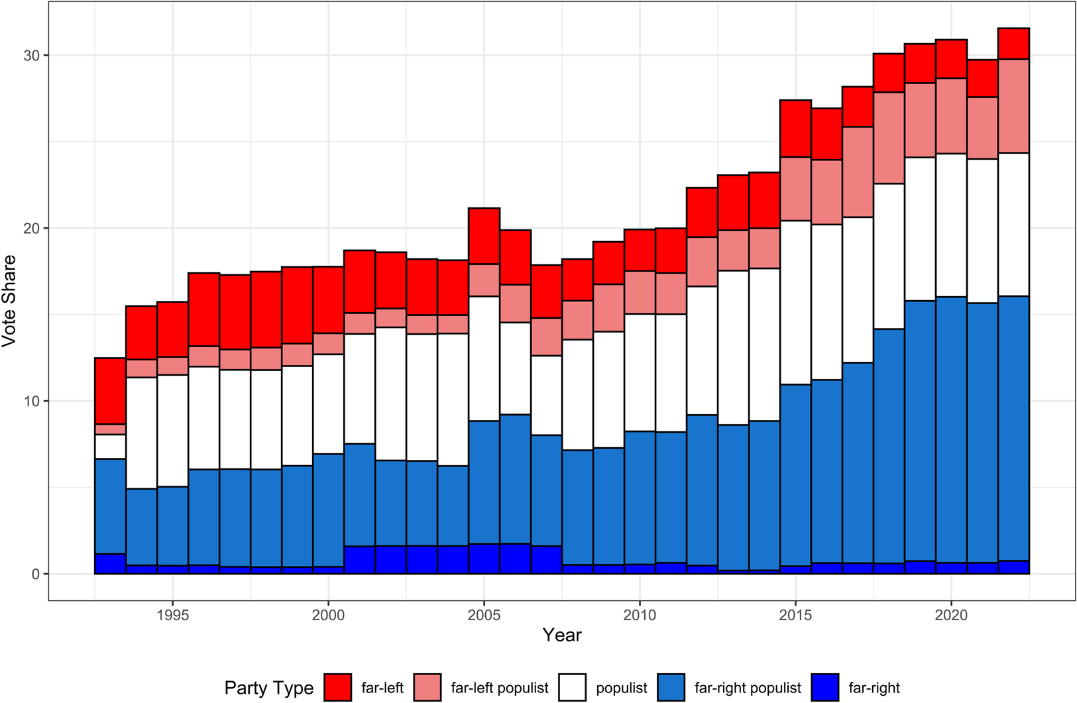
Graph: The share of the vote for (1) far-left parties, (2) far-left populist parties,
(3) populist parties, (4) far-right populist parties, and (5) far-right parties
The EU faces a significant set of challenges, which we see reflected in the issues that populist parties use to shape their messages and fuel Europeans’ fears: global big business, migration, environmental policy, LGBTQ policy, and the bureaucracy in Brussels, which is seen as the root cause of all these ills. Immediate solutions are demanded for all of these issues, just as they are under authoritarian regimes.
The phenomenon of populism is amplified by social media platforms, the regulation of which European institutions have only just begun to implement. In 2017, we warned that “the technocratization of governance – its depoliticization – paves the way for populism. Just as the possession of technical means by as many individuals as possible in democratic societies makes it possible to create alternative information networks to the traditional press – which is often accused of political maneuvering – so too can ‘peoples’ form on social media platforms, groups that assert “we are the people,” proposing all manner of anti-democratic measures. And since the political arena is never left vacant, their leaders will also emerge, at which point the situation will become more complicated. This is a time when democratic political leaders must step into the public square and re-politicize civic life. Because, otherwise, a propaganda technique will drive them from the place where classical democratic mechanisms led them to believe they were eternal”66.
All fears stemming from real or imagined dangers are countered with narratives about a golden age from which Europeans have fallen: either the age of nations (idealized even in U.S. strategy) or the communist era (evoked by anti-Europeans in former communist countries). Classical conservatives observed that nostalgia arises in society after periods of revolution and upheaval, because society feels the need to return to a past that is, more often than not, idealized. However, sometimes the pasts invoked are not those that actually existed, but rather ones that have been constructed. Svetlana Boym67 distinguishes between reflective nostalgia – for a past that actually existed – and restorative nostalgia, which constructs the past and invents myths that it presents as the real past. European populists operate precisely through this restorative nostalgia, which goes hand in hand with conspiracy theories, providing imaginary causes for the ills of the present and for its deviation from the exemplary path of the imagined past.
Those who believe that society’s course has been derailed by various causes or agents (immigrants, the capitalist elite, Soros supporters, etc.) feel excluded, renounce the rules of civilization, or, in the words of Oliver Nachtwei, “become uncivilized” and embark on a quest to restore their self-esteem by seeking authoritarian solutions: “As individuals cut off from society, no longer subject to social control (much less on the internet) and no longer accountable for their hateful messages, they give free rein to their prejudices. Ultimately, we find them in the various emotional coalitions of the resentful: in the AfD, at Trump’s rallies, or at those of Marine Le Pen. What unites these groups is precisely the practical rejection of civilization in the name of an illusory Western civilization”68.
EU member states must take firm action in the areas exploited by populists, because not everything they accuse is false. There is a grain of truth to it. The uncontrolled migration of 2015 created a mass of over one million people whom Germany has failed to integrate and who fuel the AfD’s rhetoric, and the influx of immigrants into Europe has not ended (see the recent cases in Spain and Italy). Furthermore, the import of egalitarian or progressive ideologies – which have led to absurdities such as “woke culture” or “gender choice” – and the excesses of green policies are sources of frustration for most citizens, which populists exploit.
Added to these real problems is Russia’s intervention, which uses Europeans – and, above all, their own people – as fodder for its propaganda. It suffices to mention the European political leaders who are known, have been exposed, or are under investigation for being or allegedly being in Moscow’s pay: Gerhard Schröder; Marine Le Pen; Karin Kneissl, former Austrian foreign minister; Nathan Gill, vice president of Farage’s Reform UK party, who received money from Moscow (for which he was sentenced to ten years in prison); Latvian MEP Tatjana Ždanoka; German MEP (AfD) Petr Bystron; AfD politician Maximilian Krah; Matteo Salvini in Italy; and others from various networks69. Added to these are those loyal to Russia and its interests, such as Viktor Orbán and Robert Fico, as well as the “useful idiots” at various levels of society. But aside from proven instances of funding for European “nationalist” or “sovereignist” politicians, there are others still awaiting confirmation, about which only preliminary information has emerged – as is the case with the 2024 presidential election in Romania.
As I have said on another occasion, the solution to this state of affairs lies in “repoliticizing the relationship between the political elites and the citizens – a way out of the inertia into which politicians have fallen after a long period without challenge, which has led to a challenge to the democratic system itself”70. And the conflict in Ukraine offers an opportunity to break out of inertia – a fact we can observe among current European leaders, who are mobilizing to build the European Union’s defense capabilities.
The European Union is under attack from two fronts: a traditional adversary, Russia, and a traditional ally, the U.S. I agree with Slavoj Žižek’s observation: “Both Trump and Putin supported Brexit; both are adherents of the extremist conservative-nationalist ‘America/Russia First’ movement, for which a united Europe is the greatest enemy – and in this they are not mistaken. Europe must remain faithful to this legacy, which is under threat from the furious onslaught of conservative populism, and the first thing it must do is examine the root causes of Trump’s success”71.
I stand by what I’ve said before, that “Trumpism is the American face of Putinism”: “Both the Russian Federation and the Trump Administration want the EU to dissolve because it is easier for them to deal with competing European nation-states than with a powerful regional entity. The EU gets in everyone’s way: Putin’s, Trump’s, and Xi’s. And not just for economic reasons, but because the EU represents a different ideology, situated between the extreme individualism of the West and the extreme collectivism of the East”72.
Russia and the U.S. are losing the positions they have held on the global stage because, amid the world’s great transformation, they have failed to look toward the future. The former has attacked its historic vassal, without which it can no longer hope to maintain a position of strength; the latter is gradually abandoning its old allies in order to replace liberal ideals with a pragmatism that is proving counterproductive. In its desire to sell its product at a high price, the U.S. has destroyed it. In the transition toward multipolarity, Putin and Trump did not look to the future, but to the past: the former sought to restore the sphere of influence from the days of the USSR, while the latter returned to the Monroe Doctrine, which he renamed the “Donroe” because he added a corollary: “We will deny competitors from outside the hemisphere the ability to position forces or other threatening capabilities, or to possess or control strategically vital assets in our hemisphere.” I ask again: “How does Trump think he can buy and sell nations according to his own interests, that global political actors will ‘fall in line’ to satisfy his grand ambitions? Trump has replaced ‘wish lists’ and ‘boring platitudes’ [as he labels his predecessors’ strategies] with the fantasies of a narcissist. I understand that the U.S. no longer wants to shoulder the burden of the world order, but the documents show that they intend to trample it underfoot.73”
Through its new strategy, the U.S. has decided that it is dispensable, that it no longer wants to guarantee anything. I believe that “there are two sources of power: fear and admiration. Russia and the USSR built their power on fear; the U.S., on admiration, serving as a model for nations that aspired to be powerful. Today, Russia no longer inspires fear, and America is admired only in the mind of the man in turmoil at the White House, because America has renounced what made it admirable in the death certificate it wrote for itself: its security strategy. America has decided it wants to make money, to take over one hemisphere even as it attacks the other, abandoning what truly made it great – namely, an offer of destiny for its allies and for those who aspired to that status. The great power has become a company that sells, not one that offers. […] America ceased to be a promise of destiny with the ideological madness of the far left, which has been replaced by that of Trumpism. From the place everyone once dreamed of reaching, America has, over the past decade, become the place from which those who desire a free life leave, and those who remain are threatened with deportation by ICE teams. Russia no longer inspires fear, and America no longer wants to inspire admiration. Two gods in twilight”74.
As a proponent of unipolarity, Brzezinski predicted that America’s withdrawal would lead to anarchy, because only its power guaranteed respect for and enforcement of the principles of international law. I do not share this view because I believe that the new reality will mean a new balance of power: the U.S. withdrawal from Europe will not leave a vacuum, since European states have begun to make up for what they will no longer have – the American military presence. As Morgenthau tells us, aside from armament, there are other methods of balancing power, one of which is the formation of alliances75.
I consider the speech delivered by Canadian Prime Minister Mark Carney at the opening of the Davos Forum on January 20, 2026, to be crucial for understanding what lies ahead. In that speech, he pointed out that the order shaped by American hegemony has provided public goods but has also led to discrepancies between rhetoric and reality. That is why, he announced, “we are in the midst of a rupture, not a transition.” Citing the waning power of international institutions such as the WTO and the UN, he noted that “middle powers… are not powerless. They have the capacity to build a new order that embodies our values, such as respect for human rights, sustainable development, solidarity, and the sovereignty and territorial integrity of states… If the great powers abandon even the pretense of respecting rules and values in order to pursue their power and interests unhindered, the gains from ‘transactionalism’ become harder to replicate. Hegemons cannot continually monetize their relationships. Allies will diversify to protect themselves against uncertainty. They will buy insurance. They will expand their options. This rebuilds sovereignty. […] Collective investments in resilience are cheaper than each country building its own fortress. Common standards reduce fragmentation. Complementarities are a positive-sum game. […] Our new approach is based on what Alexander Stubb called “values-based realism”… Middle powers must act together, because if you’re not at the table, you’re on the menu. Great powers can afford to act alone. They have the market size, military capability, and leverage needed to dictate terms. Middle powers do not. […] In a world of great-power rivalry, middle powers have a choice: to compete with one another for favors or to unite to create a third way that makes a difference. […] Instead of waiting for the old order to be restored, let us create institutions and agreements that function as described… The old order will not return. We should not mourn it. Nostalgia is not a strategy. But from this rupture, we can build something better, stronger, and more just. This is the task of the middle powers, which have the most to lose in a world of fortresses and the most to gain in a world of genuine cooperation. The powerful have their power. But we, too, have something – the ability to stop pretending, to call reality by its name, to build our strength at home, and to act together”76. I have quoted large excerpts from the speech because I consider it a response to Trump’s strategy and a programmatic document for what is to come in the world.
Even though the principles of international law have been applied so far (selectively, of course) as a result of a military power like the U.S., they will continue to be applied from now on because they will be enforced by strong alliances of middle-power states. The realignments have already begun. Europe is arming itself, not by purchasing weapons from the U.S., but by producing them itself, and Canada has joined the European SAFE armament program; The U.S. is no longer honoring its arms supply contracts because it needs the weapons for itself in the war with Iran, and Saudi Arabia no longer trusts U.S. protection (and with good reason) and has signed a mutual defense treaty with Turkey and Pakistan; Ukraine has gone from being a player “with no cards in hand” to a provider of drone expertise for the Americans, and the United Kingdom is offering it the blueprints for manufacturing long-range missiles. The games are still being played, and the space will not remain empty or anarchic in the strict sense of the term. All this turmoil is typical of any major change. As Gramsci said, “The crisis consists precisely in the fact that the old is dying and the new cannot be born: the most varied morbid forms appear in this interregnum”77. The war in Ukraine is the most tragic development of the current crisis.
Amid all the Western commotion, China remains calm and accustomed to acting according to very long-term strategies. China patiently waits for the corpse of its enemy – now declared a friend – to float down the river: Russia. China doesn’t have to do much, because the U.S. and Russia make mistakes that work in its favor day after day. Let’s return to Brzezinski: “Russia without Ukraine can still aspire to imperial status, but it would then become a predominantly Asian imperial state, liable to be drawn into conflicts – which would weaken it – with the newly independent Central Asian states, which at that time would be full of resentment over the loss of their recent independence and would be supported by the southern states, which are Islamic like them. It is also possible that China would oppose any restoration of Russian dominance over Central Asia, given its growing interest in the new independent states there”78. Brzezinski also said: “Ukraine’s choice in favor of Europe will catalyze Russia’s decision regarding the next stage in its history: either to become part of Europe as well [it doesn’t want to, as we’ve seen – S. B.], or to become a Eurasian outcast, belonging neither truly to Europe nor to Asia, and mired in its conflicts with the ‘near abroad”79.
Once Russia loses the war with Ukraine – and it will lose it – I believe its current and former vassals will break away; after Lukashenko, Belarus will want a European way of life, and Russia will no longer be able to stop it; at their last meeting, the President of Kazakhstan spoke to Putin with such insolence that it made him look down at the tips of his shoes; Armenia has just announced that it will apply for membership in the European Union; Georgia is welcoming Russians who do not want to go to war during the next mobilization; Azerbaijan is working on the oil pipeline project to Europe. What can we say about the countries that will matter in the future order of things? Turkey supports Ukraine because it wants as little Russian presence as possible in the Black Sea, while China has an open path to cheap Russian natural resources and will consider it a shame for such a vast territory in the Russian Far East – which once belonged to it – to remain uninhabited.
Because its politicians have mismanaged its development as a nation-state, Russia will cement the status defined for it by U.S. Senator John McCain: “a gas station masquerading as a country.” Or the Venezuela of Asia.
For the European Union, the war in Ukraine and the U.S. withdrawal from the region present an opportunity to launch a project that has been postponed for over seven decades: the creation of the European Defense Community. In 1952, upon stepping down as Commander of NATO forces, General Eisenhower said: “Europe, as a whole, must ultimately ensure its own security. The U.S. can participate and, through its psychological, intellectual, and leadership capabilities, as well as its material resources, contribute to the production of weapons, the organization of units, and the building of trust, all of which will help Europe resolve its problems. In the long run, it will not be possible – and certainly would not be desirable – for Europe to remain an occupied territory, defended by legions brought in from abroad, much as the territories under Roman occupation tried, unsuccessfully, to ensure their security many hundreds of years ago.” The general was right, but Gaullist nationalism led to the failure of such a community.
Now, mobilization through SAFE could be the first step toward that community, which has every chance of being a formidable one, and the Ukrainian army will play an important role in it. Mobilization by Europeans to defend the EU is an opportunity to revitalize the European project, which has suffered for many years from a lack of mythological inspiration.
Conclusions
Ukraine’s war of liberation – which is part of the process of integrating into political and military structures that will guarantee its independence and sovereignty – is taking place during a period of major global change. This situation is characterized by a low degree of predictability regarding the actions of both adversaries and allies. In a rapidly changing world, previously unthinkable alliances are being formed, and alliances that once seemed indestructible are falling apart. The most stable factor in this situation has been a nation’s determination to see its national project through to the end, at any cost.
Ukraine’s desire to integrate into Euro-Atlantic structures met with opposition from Russia, which evolved from attempts to impose favorable governments through election fraud, to bribing traitors, and ultimately to military action. The significance of Ukraine’s choice lay both in its role within Russia’s desired imperialist project and in the fact that its position serves as an example for other states of the former USSR.
Ukraine started this conflict at a significant disadvantage, stemming from how it is perceived by the society into which it seeks to integrate. It has always been viewed through Russia’s narratives, appearing as an appendage or as Russia’s “backyard.” It is difficult to make allies when the world perceives you as lacking your own gravitational pull.
Another major drawback was that those who had pledged to guarantee its independence in exchange for the surrender of its nuclear arsenal had, to a certain extent, colluded with its aggressor for various reasons. And their shift in support came after a period during which their primary concern was not to upset the aggressor, rather than to support the victim they had pledged to defend.
Finally, Donald Trump’s return to the White House was another stroke of bad luck for Ukraine, which, fortunately, has begun to turn into an opportunity, because his attitude toward European allies has fostered their solidarity with Ukraine’s cause, which they now consider a European cause. The war in Ukraine and the U.S. withdrawal from the region were pivotal in launching the program to arm EU member states, which is a necessary step toward establishing the European Defense Community. And Ukraine will play a very important role in this new framework.
So today, when we speak of Ukraine’s European path, we are speaking of the relaunch of the European project through the rearmament program and of what will happen on a global scale: the transition from a unipolar world to a multipolar one. Although the great powers continue, out of inertia, to behave as they have until now, we are seeing a rapid shift in attitude among the “middle powers” – those that, lacking military strength, will compensate for this shortfall in the balance of power through alliance systems.
The Russian-Ukrainian war is not yet over, and Ukraine has already transitioned from being a post-Soviet country to one in the process of joining Euro-Atlantic structures. Once the territories have been recovered, the arduous path of peacekeeping and reconstruction will follow, and Euro-Atlantic partners will need to stand by the country that was on the front lines of reshaping the world.
Notes
- Sorin Bocancea (coord.), The War in Ukraine: A Regional Conflict with Global Implications, published by the European Institute, Iași, 2022, and Polis Books, 2023; https://polisbooks.ro/ produs/razboiul-din-ucraina-un-con-flict-regional-cu-efecte-globale/. In this study, I will cite from the electronic version published by Polis Books.
2 Luke Harding, „US will ‘lose face before world’ if it abandons Kyiv, says ex-Ukraine president”, in The Guardian, 11.12. 2023, available at https://www.theguardian.com/world/2023/dec/11/us-will-lose-face-before-world-if-it-abandons-kyiv-says-ex-ukraine-president, (consulted on 22.08.2026).
- Nathan Gardels, Schimbarea ordinii globale văzută de marii lideri ai lumii, trans. Marius Conceatu, Antet Publishing House, Bucharest, 2001, p. 100.
4 Zbigniew Brzezinski, „The Premature Partnership”, in Foreign Affairs, 1.03.1994, https://www.foreignaffairs.com/articles/russian-federation/1994-03-01/premature-partnership, (consulted on 13.08.2026).
- Serhii Plokhy, Războiul ruso-ucrainean. Întoarcerea istoriei, trans. Gabriel Tudor, Trei Publishing House, Bucharest, 2023, p. 25.
- Zbigniew Brzezinski, Marea tablă de șah. Supremația americană și imperativele sale geostrategice, trans. Aureliana Ionescu, Univers Enciclopedic Publishing House, Bucharest, 2000, pp. 108.
- Martin Sixsmith, Un mileniu de istorie, trans. Eugen Popa and Justina Bandol, Humanitas Publishing House, Bucharest, 2016, p. 532.
- Ibidem, p. 11.
- Lucan Way, Pluralism by Default: Weak Autocrats and the Rise of Competitive Politics, Johns Hopkins University Press, Baltimore, 2015, p. 43, apud Serhii Plokhy, cit., p. 60.
- Serhii Plokhy, cit., p. 65.
- Leonid Kucima, Ukraina – ne Rosssiia, Moscow, 2023.
12 Alexandra Ionescu, „The former Ukrainian president published a speech addressed to his fellow citizens: “Ukraine is not Russia. And it will never become Russia,” on Antena3CNN, March 10, 2022, https://www.antena3.ro/externe/fostul-presedinte-ucrainean-discurs-conce-tateni, (consulted on 22.08.2026).
13 Luke Harding, „US will ‘lose face before world’ if it abandons Kyiv, says ex-Ukraine president”, în The Guardian, 11.12. 2023, available at https://www.theguardian.com/world/2023/dec/11/us-will-lose-face-before-world-if-it-abandons-kyiv-says-ex-ukraine-president, consulted on 22.08.2026.
- Sorin Bocancea, „Zidul Kievului”, in Adevărul, 20.02.2022, available at https://adevarul.ro/blogurile-adevarul/zidul-kievului, accessed on 22.08.2026.
- О. В. Марусяк, „Кримський трансфер 1954 р.: формально-юри-дичний аспект”, în Буковинський вісник, http://buk-visnyk.cv.ua/nau-kova-dumka/620, apud Serhii Hakman, „Războiul ruso-ucrainean. Aspecte de drept internațional în războiul hibrid”, in Sorin Bocancea (coord.), Războiul din Ucraina…, ed. cit., pp. 374-400; pp. 391-392,.
- Serhii Plokhy, cit., p. 41.
- Serhii Hakman, cit., pp. 375-383. Also, to see how many international regulations Russia has violated through this conflict, I recommend Cristi Danileț’s study, “From Peace to War: International Regulations and Institutions,” in Sorin Bocancea, The War in Ukraine…, ed. cit, pp. 342-373.
- Mihail Gorbaciov, Viața mea înainte și după perestroika, trans. Iustina Bandol, Litera Publishing House, Bucharest, 2013, p. 297.
- Zbigniew Brzezinski, Marea tablă de șah…, cit., p. 135.
- Ibidem, p. 136.
- Cosmin Stăniloiu, „The war between Russia and Ukraine, predicted 29 years ago by Chechnya’s first president: “Russism is worse than fascism, Nazism, and all ideologies,” in Libertatea, August 23, 2024, https://www.libertatea.ro/stiri/razboiul-dintre-rusia-si-ucraina-prezis-acum-29-de-ani-de-primul-presedinte-al-ce-ceniei, consulted on 22.08.2026.
23 George-Andrei Cristescu, „Former Chechen leader Dzhokhar Dudaev on Ukrainians: “It’s a big mistake to think of them as weak,” in Adevărul, March 15, 2022, available at https://adevarul.ro/stiri-externe/euro-pa/fostul-lider-cecen-djohar-dudaev-despre-2155698.html, (consulted on 22.08.2026).
- Serhii Plokhy, cit., p. 46.
- Nathan Gardels, cit., p. 100.
- Steven Lee Myers, Noul țar, trans. Lidia Grădinaru, Corint Publishing House, Bucharest, 2016, p. 387.
- С.А. Тархов, „Итоги переписи населения Украины 2001 года”, in Demoscope Week, 24.10. 2021,
https://www.demoscope.ru/weekly/ 20-04/0173, (consulted on 21.08. 2026).
- Giulietto Chiesa, Rusia contemporană și angoasele Occidentului, trans. Gianina Tidvă, Corint Publishing House, Bucharest, 2017, pp. 69-70.
- Ibidem, p. 73.
- Ibidem, p. 74.
- Ibidem, 90-91.
- Ibidem, p. 93.
- Sorina Matei, „Putin’s speech to the entire world at the Valdai Club. “The era of the West’s undivided dominance is coming to an end,” Mediafax.ro, Oct. 27, 2022, available at https://www.mediafax.ro/externe/ discursul-lui-putin-in-fata-intregii-lu-mi-la-clubul-valdai, (consulted on 17.08.2026).
- John J. Mearsheimer , “Why the Ukraine Crisis Is the West’s Fault. The Liberal Delusions That Provoked Putin”, in Foreign Affairs 93 (5), 2014, pp. 77-89, https://ius.bg.ac.rs/ wp-content/uploads/2023/03/5.-John-J.-Mearsheimer-Foreign-Affairs-201-4-2022.pdf, (consulted on 16.08. 2026.).
Ibidem, p. 1.
- Ibidem.
- Ibidem, p. 3.
38 John J. Mearsheimer, Who Caused the Ukraine War?, in John’s Substack, 5 august 2024, available at https://mearsheimer.substack.com/p/who-caused-the-ukraine-war?, (consulted on 16.08.2026).
- Joseph R. Biden, Addresses the general debate of the 77th Session of the General Assembly of the United Nations, 20-26.09.2022, available at https://www.youtube.com/watch?, (consulted on 23.08.2026).
- Administration of Joseph R. Biden, Jr., The President’s News Conference With President Volodymyr Zelenskyy of Ukraine, 12.12.2023, available at https://www.govinfo.gov/content/pkg/, (consulted on 23.08.2026).
- John J. Mearsheimer, cit., p. 2
- Emmanuel Macron, „Speech by the President of the French Republic at the United Nations General Assembly”, 20.09.2022, available at https://www.elysee.fr/en/emmanuel-macron/2022/09/20, (consulted on 23.08.2026).
43 Emmanuel Macron, „Meeting in Washington alongside President Zelensky”, 18.08.2025, https://www.elysee.fr/en/emmanuel-macron/2025/08/19, (consulted on 23.08.2026).
- John J. Mearsheimer, cit.
- Serhii Plokhy, cit, p. 132.
- Ibidem, p. 155.
- Valdas Adamkus, Martin Butora, Emil Constantinescu, Pavol Demes, Lubos Dobrovsky, Matyas Eorsi, Istvan Gyarmati, Vaclav Havel, Rastislav Kacer, Sandra Kalniete, Karel Schwarzenberg, Michal Kovac, Ivan Krastev, Alexander Kwasniewski, Mart Laar, Kadri Liik, Janos Martonyi, Janusz Onyszkiewicz, Adam Rotfeld, Vaira Vike-Freiberga, Alexandr Vondra, Lech Walesa, An Open Letter To The Obama Administration From Central And Eastern Europe, 16.07.2009, https://www.rferl.org/a/An_Open_Letter_To_The_Obama_Administration_From_Central_And_Eastern_Europe/1778449.html, (consulted on 10.08. 2026).
- Joshua S. Goldstein & Jon C Pevehouse, Relații internaționale, trans Ioana-Andreea Cozianu, Elena Farca and Adriana Ștaub, Polirom Publishing House, Iași, 20008, p. 335.
- Hans J. Morgenthau, Politica între națiuni. Lupta pentru putere și lupta pentru pace, trans. Oana Andreea Bosoi, Alina Andreea Dragolea and Mihai Vladimir Zodian, Polirom Publishing House, Iași, 2007, p. 301.
- Ibidem, p. 303.
- Serhii Plokhy, cit., p. 92.
- Mihail Gorbaciov, Memorii, trans. Radu Pontbriant, Nemira Publishing House, Bucharest, 1994, p. 123.
- Ibidem, p. 125.
- Ibidem, p. 129.
- Nathan Gardels, cit., pp. 95-96.
56 Mike Eckel & Dora Vulcan, „The Myth of NATO’s Non-Expansion. Did the West promise Moscow – or not – that the alliance would not expand?”, în Europa liberă, 21.05. 2021, https://romania.europalibera.org/ a/mitul-non-extinderii-nato-i-a-prom-is-vestul-sau-nu-moscovei, (accessed on 22.08.2026).
- Sorin Bocancea, „Consecința înțele-gerii. Acceptare sau revoltă?”, în Ziariștii, 8.02.2026, https://ziaristii.com/consecinta-inte-legerii-acceptare-sau-revolta/, (con-sulted on 22.08.2026).
- Zbigniew Brzezinski, Marea tablă de șah…, ed. cit., p. 216.
- Ibidem, p. 215.
- White House, National Security Strategy of the United States of America, November 2025, https://www.whitehouse.gov/wp-content/uploads/2025/12/2025, (consulted on 23.08.2026).
- ***, „“European Council President Delivers a Harsh Response to the Americans on Security Strategy: ‘We Will Not Accept This Threat,’” in Euronews, Dec. 8, 2025, https://www.euronews.ro/articole/presedintele-consiliului-european-le-da-un-raspuns-dur-americanilor, (consul-ted on 9.12.2025).
- Sorin Bocancea, „Amurgul zeilor”, în Ziariștii, 5.04.2026, https://ziaristii.com/ amurgul-zeilor/, (consultated on 24. 08.2026).
- Alexandru Grumaz, „Capcana celor două fronturi: Iranul drenează resursele SUA, China testează Pacificul”, în Național, 08.2026, https://national.ro/editorial/alexandru-grumaz/capcana-celor-doua-fronturi, (consulted on 24.08.2026).
- [1] Matthijs Rooduijn, Andrea L.P. Pirro, Daphne Halikiopoulou, Caterina Froio, Stijn van Kessel, Sarah L. de Lange, Cas Mudde and Paul Taggart, „The PopuList: A Database of Populist, Far-Left, and Far-Right Parties Using Expert-Informed Qualitative Comparative Classification (EiQCC)”, in British Journal of Political Science, Cambridge University Press, Sep-tember 2023, pp. 1-10, https://www.cambridge.org/core/journals/british-journal-of-political-scie-nce/article/populist-a-database-of-populist, (consulted on 21.08.2026).
- Sorin Bocancea, „Populismul – o tehnică de propagandă”, în Polis, Volume V, No. 4(18), New Series, September – November 2017, pp. 5-22, p. 18.
- Svetlana Boym, The Future of Nostalgia, Basic Books, New York, 2016, apud Anne Appelbaum, Amurgul democrației. Seducătoarea atracție a autoritarismului, trans. Cora Radulian, Litera Publishing House, Bucharest, 2021, pp. 62-63.
- Oliver Nachtwei, „Decivilizarea – despre tendințele regresive ale democrației vestice”, trans. Iulian Bocai, in Heinrich Geiselberger (coord.), Marea regresie…, cit., pp. 202-219, pp. 218-219.
- Martin Laine, Cecilia Anesi, Lorenzo Bagnoli and tatiana Tkachenko, „Kremlin-Linked Group Arranged Payments to European Politicians to Support Russia’s Annexation of Crimea”, in OCCRP, 3.02.2023, https://www.occrp.org/en/investigation/kremlin-linked-group-arranged-payments, (consulted on 24.08.2026).
- Sorin Bocancea, „Uniunea Europeană între putinism și trumpism”, in Polis, Volume XIII, No. 4 (50), New Series, September – November 2025, pp. 183-208, p. 191.
- Slavoj Žižek, „Tentația populismu-lui”, trans. Ioana Miruna Voiculescu, in Heinrich Geiselberger (coord.), Marea regresie: de ce trăim un moment istoric, Art Publishing House, Bucharest, 2017, pp. 279-299, p. 285.
- Sorin Bocancea, Uniunea Europeană între putinism și trumpism, cit., p. 203.
- Ibidem, p. 202.
- Sorin Bocancea, Amurgul zeilor, cit..
- Hans J. Morgenthau, op. , pp. 213-228.
- Mark Carney, „Declarații la Davos, 2026”, in Euronews, 21.01.2026, https://www.youtube.com/watch?v=rbscJ-36Ioc, (consulted on 24.08.2026).
- Antonio Gramsci, Caietele din închisoare, 1, Book 3, note 4, Coordinated by Sabin Drăgulin, Ioana Cristea-Drăgulin and Angelo Chielli, Timpul Publishing House, Iași, 2025, p. 295.
- Zbigniew Brzezinski, Marea tablă de șah…, cit., p. 59.
- Ibidem, p. 138.
Bibliography
Documents
Administration of Joseph R. Biden, Jr., The President’s News Conference With President Volodymyr Zelenskyy of Ukraine, December 12, 2023.
BIDEN, Joseph R., Addresses the general debate of the 77th Session of the General Assembly of the United Nations, September 20-26, 2022.
Books
APPELBAUM, Anne, Amurgul democrației. Seducătoarea atracție a autoritarismului, Editura Litera, București, 2021.
BOYM, Svetlana, The Future of Nostalgia, Basic Books, New York, 2016.
BRZEZINSKI, Zbigniew, Marea tablă de șah. Supremația americană și imperativele sale geostrategice, trad. Aureliana Ionescu, Editura Univers Enciclopedic, București, 2000.
CHIESA, Giulietto, Putinofobia. Rusia contemporană și angoasele Occidentului, trad. Gianina Tidvă, Editura Corint, București, 2017.
GARDELS, Nathan, Schimbarea ordinii globale văzută de marii lideri ai lumii, trad. Marius Conceatu, Editura Antet, București, 2001.
GOLDSTEIN, Joshua S. & Jon C. Pevehouse, Relații internaționale, trad. Ioana-Andreea Cozianu, Elena Farca și Adriana Ștaub, Editura Polirom, Iași, 20008.
GORBACIOV, Mihail, Amintiri. Viața mea înainte și după perestroika, trad. Iustina Bandol, Editura Litera, București, 2013.
IDEM, Memorii, trad. Radu Pontbriant, Editura Nemira, București, 1994.
Gramsci, Antonio, Caietele din închisoare, Vol.1, Caietul 3, nota 4, Ediție îngrijită de DRĂGULIN, Sabin, DRĂGULIN- Cristea Ioana și CHIELLI, Angelo, Editura Timpul Iași, 2025.
KUCIMA, Leonid, Ukraina – ne Rosssiia, Moscova, 2023.
MORGENTHAU, Hans J., Politica între națiuni. Lupta pentru putere și lupta pentru pace, trad. Oana Andreea Bosoi, Alina Andreea Dragolea și Mihai Vladimir Zodian, Editura Polirom, Iași, 2007.
NACHTWEI, Oliver, „Decivilizarea – despre tendințele regresive ale democrației vestice”, trad. Iulian Bocai, în Heinrich Geiselberger (coord.), Marea regresie: de ce trăim un moment istoric, Editura Art. București, 2017.
PLOKHY, Serhii, Războiul ruso-ucrainean. Întoarcerea istoriei, trad. Gabriel Tudor, Editura Trei, București, 2023.
SIXSMITH, Martin, Rusia. Un mileniu de istorie, traducere Eugen Popa și Justina Bandol, Editura Humanitas, București, 2016.
WAY, Lucan, Pluralism by Default: Weak Autocrats and the Rise of Competitive Politics, Johns Hopkins University Press, Baltimore, 2015.
Articles and studies
Bocancea, Sorin, „Populismul – o tehnică de propagandă”, în Polis, Volum V, Nr. 4(18), Serie nouă, septembrie-noiembrie 2017, pp. 5-22.
IDEM, „Uniunea Europeană între putinism și trumpism”, în Polis, Volum XIII, Nr. 4 (50), Serie nouă, septembrie-noiembrie 2025, pp. 183-208.
Danileț, Cristi, „De la pace la război: reglementări și instituții internaționale”, în Sorin Bocancea (coord.), Războiul din Ucraina…, ed. cit, pp. 342-373.
HAKMAN, Serhii, „Războiul ruso-ucrainean. Aspecte de drept internațional în războiul hibrid”, în Sorin Bocancea (coord.) Războiul din Ucraina…, ed cit., pp. 374-400.
ŽIŽEK, Slavoj, „Tentația populismului”, trad. Ioana Miruna Voiculescu, în Heinrich Geiselberger (coord.), op. cit., pp. 279-299.
Online resources
BOCANCEA, Sorin, „Amurgul zeilor”, în Ziariștii, 5 aprilie 2026, https://ziaristii.com.
IDEM, „Consecința înțelegerii. Acceptare sau revoltă?”, în Ziariștii, 8.02.2026, https://ziaristii.com.
IDEM (coord.), Războiul din Ucraina. Un conflict regional cu efecte globale, Editura Institutul European, Iași, 2022 și Editura Polis Books, 2023, https://polisbooks.ro.
IDEM, „Zidul Kievului”, în Adevărul, 20 februarie 2022, https://adevarul.ro.
Brzezinski, Zbigniew, „The Premature Partnership”, in Foreign Affairs, 1 March, 1994, https://www.foreignaffairs.com.
CARNEY, Mark, „Declarații la Davos, 2026”, în Euronews, 21 ianuarie 2026, https://www.youtube.com.
CRISTESCU, George-Andrei, „Fostul lider cecen Djohar Dudaev, despre ucraineni: «Este o mare greşeală să-i consideri slabi»”, în Adevărul, 15.03.2022, https://adevarul.ro.
ECKEL, Mike & Dora Vulcan, „Mitul non-extinderii NATO. I-a promis Vestul sau nu Moscovei că alianța nu se va extinde?”, în Europa liberă, 21 mai 2021,
https://romania.europalibera.org.
GRUMAZ, Alexandru, „Capcana celor două fronturi: Iranul drenează resursele SUA, China testează Pacificul”, în Național, 11.08.2026, https://national.ro.
HARDING, Luke, „US will ‘lose face before world’ if it abandons Kyiv, says ex-Ukraine president”, în The Guardian, 11.12. 2023, https://www.theguardian.com.
IONESCU, Alexandra, „Fostul președinte ucrainean a publicat un discurs adresat concetățenilor: «Ucraina nu este Rusia. Și nu va deveni niciodată Rusia»”, în Antena3CNN, 10.03.2022, https://www.antena3.ro.
LAINE, Martin; Cecilia Anesi; Lorenzo Bagnoli and Tatiana Tkachenko, „Kremlin-Linked Group Arranged Payments to European Politicians to Support Russia’s Annexation of Crimea”, in OCCRP, 3.02.2023, https://www.occrp.org/en.
LEE MYERS, Steven, Noul țar, trad. Lidia Grădinaru, Editura Corint, București, 2016.
MACRON, Emmanuel, „Meeting in Washington alongside President Zelensky”, August 18, 2025, https://www.elysee.fr/en
IDEM, „Speech by the President of the French Republic at the United Nations General Assembly”, 20 september 2022, https://www.elysee.fr/en.
МАРУСЯК, O. B., „Кримський трансфер 1954 р.: формально-юридичний аспект”, în Буковинський вісник, http://buk-visnyk.cv.ua.
MATEI, Sorina, „Discursul lui Putin în fața întregii lumi, la Clubul Valdai. «Perioada de dominație nedivizată a Occidentului se apropie de sfârșit»”, Mediafax.ro, 27 octombrie 2022, disponibiul la
https://www.mediafax.ro.
MEARSHEIMER, John J., “Why the Ukraine Crisis Is the West’s Fault”, in Foreign Affairs 93 (5), 2014, pp. 77-89.
IDEM, Who Caused the Ukraine War?, in John’s Substack, 5 august 2024, https://mearsheimer.substack.com
ROODUIJN, Matthijs; Andrea L.P. Pirro; Daphne Halikiopoulou; Caterina Froio; Stijn van Kessel; Sarah L. de Lange; Cas Mudde and Paul Taggart, „The PopuList: A Database of Populist, Far-Left, and Far-Right Parties Using Expert-Informed Qualitative Comparative Classification (EiQCC)”, in British Journal of Political Science, Cambridge University Press, September 2023, pp. 1-10, https://www.cambridge.org.
SMITH, Nicolas Ross & Grant Dawson, „Mearsheimer, Realism, and the Ukraine War”, in De Gruyter Brill, August 24, 2022, Mearsheimer, Realism, and the Ukraine War.
Stăniloiu, Cosmin, „Războiul dintre Rusia și Ucraina, prezis acum 29 de ani de primul președinte al Ceceniei: «Rusismul e mai rău decât fascismul, nazismul și toate ideologiile»”, în Libertatea, 23.08.2024, https://www.libertatea.ro.
TARCHOV, С. А., „Итоги переписи населения Украины 2001 года”, în Demoscope Week, 24.10. 2021, https://www.demoscope.ru.
VALDAS, Adamkus, MARTIN, Butora, Emil Constantinescu, Pavol Demes, Lubos Dobrovsky, Matyas Eorsi, Istvan Gyarmati, Vaclav Havel, Rastislav Kacer, Sandra Kalniete, Karel Schwarzenberg, Michal Kovac, Ivan Krastev, Alexander Kwasniewski, Mart Laar, Kadri Liik, Janos Martonyi, Janusz Onyszkiewicz, Adam Rotfeld, Vaira Vike-Freiberga, Alexandr Vondra, Lech Walesa, An Open Letter To The Obama Administration From Central And Eastern Europe, July16, 2009, https://www.rferl.org.
WHITE, House, National Security Strategy of the United States of America, November 2025, https://www.whitehouse.gov.
***, „Președintele Consiliului European le dă un răspuns dur americanilor privind strategia de securitate: «Nu acceptăm această amenințare»”, în Euronews, 8.12.2025,
https://www.euronews.ro.