


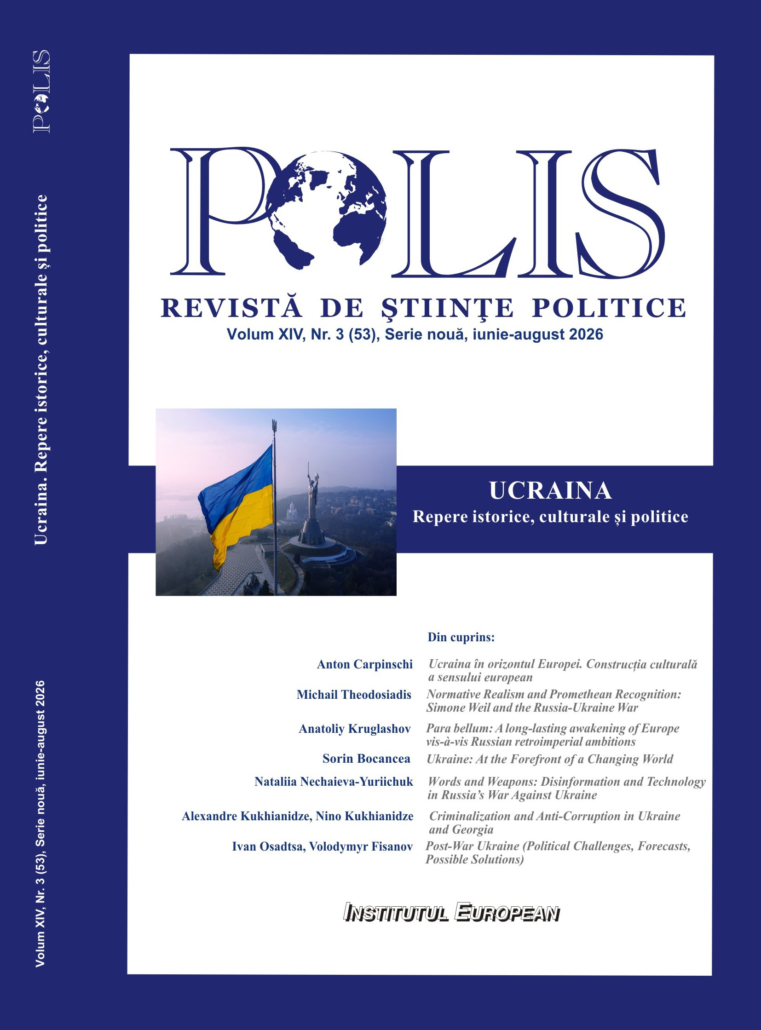
Coordonatori: E.S. Ihor PROKOPCHUK, Sabin DRĂGULIN și Sorin BOCANCEA
Volum XIV, Nr. 3 (53), Serie nouă, iunie-august 2026
INTERVIU
Ukraine: the state that has withstood and the European future it is building
H.E. Mr. Ihor Prokopchuk, Ambassador Extraordinary and Plenipotentiary of Ukraine to Romania
Ioana Cristea Drăgulin: Mr. Ambassador, you have been in our country for four years, during a very difficult period for Ukraine – I am referring here to the outbreak of Russia’s war of aggression. Over these years, you have had the opportunity to understand Romanians and become familiar with the institutional mechanisms of the Romanian state. Bilateral relations have not always been very close. What do you think should be done to strengthen bilateral ties in the areas of investment, the economy, industry, trade, connectivity, etc.? What could the authorities in Kyiv and Bucharest do better? And what about civic actors, civil society, and ordinary citizens?
E.S. Ihor Prokopchuk: Ukraine and Romania have a unique opportunity today to elevate our relations to a new level. Russia’s large-scale aggression has demonstrated just how closely interconnected the security, economy, energy, transportation, and development of our countries are. In recent years, we have grown considerably closer, and now it is important to transform this solidarity into a long-term strategic partnership that will yield concrete, practical results for both countries.
An important milestone on this path was the official visit of the President of Ukraine to Romania in March 2026. Following this visit, Presidents Volodymyr Zelenskyy and Nicușor Dan signed the Joint Declaration on the Establishment of the Strategic Partnership between Ukraine and Romania. The document sets out the priority areas for cooperation in the fields of political dialogue, defense and security, European integration, regional cooperation, trade, transportation, infrastructure, agriculture, and environmental protection. In addition, framework agreements on cooperation in the energy sector and a joint declaration on Ukrainian-Romanian defense production on Romanian territory were signed. Our task now is to give practical substance to this Strategic Partnership and to transform the agreed-upon understandings into concrete projects that will strengthen both countries.
In this context, the Carpathian Integration Initiative – a new format for interregional cooperation proposed by Ukrainian President Volodymyr Zelenskyy – is of particular importance. Its aim is to bring together Ukrainian and European regions in the Carpathian region and to create a practical platform for cooperation in the fields of the economy, infrastructure, logistics, investment, energy resilience, tourism, environmental protection, and community development. In this context, Romania is one of Ukraine’s natural and key partners. We see opportunities for implementing joint cross-border projects, developing border infrastructure, creating new transportation links, developing tourist routes, and attracting European investment. The Carpathian Integration Initiative can also become an important tool for Ukraine’s practical integration into the European economic area. It is important for Ukraine that this initiative not remain merely a political framework, but quickly translate into practical projects. We would like to see active participation by Romania’s regions and business community in its implementation, as this involves creating a new space for cooperation, in which the Carpathians do not separate Ukraine from the European Union but, on the contrary, connect them. It is precisely through such regional and economic ties that we can create new opportunities for Ukraine’s development today, without waiting for the war to end.
One of the key areas must be the reconstruction of Ukraine. And here I would like to emphasize in particular: we must not wait for the war to end before we begin working in Ukraine. Ukraine needs investment, technology, production partnerships, and modern infrastructure today. Romania, thanks to its geographic location, transportation capabilities, and proximity to the Ukrainian market, can serve as one of the main logistical and economic hubs for Ukraine’s reconstruction. This includes construction, transportation, energy, agricultural processing, machinery manufacturing, digital technologies, and the defense industry. We must create the conditions now that will allow Romanian companies to enter the Ukrainian market, invest, and implement joint projects. At the same time, we must continue to support Ukraine, because it is precisely Ukraine’s resilience and its ability to resist Russian aggression that are prerequisites for secure, long-term investments.
A particularly important area is connectivity in transportation and logistics. Ukraine and Romania already have a positive track record of cooperation within the framework of the “Solidarity Routes.” Following the outbreak of Russia’s large-scale aggression, Romania’s transportation infrastructure – and, in particular, its ports on the Danube – have become essential for Ukrainian exports. Of particular importance is the export of Ukrainian grain and other agricultural products through Romania’s ports to global markets. Our task now is to increase the transport capacity of these routes, develop rail, road, and river connections, open new border crossing points, and eliminate logistical bottlenecks. This also means continuing to support Ukraine in ensuring its access to global markets, despite Russia’s systematic attacks on Ukraine’s port and transportation infrastructure.
Another strategic area is energy. Ukraine and Romania have significant potential for deepening the integration of their energy systems, including through the development of power interconnectors. This is important for Ukraine’s energy resilience in the face of Russia’s constant attacks on energy infrastructure, but it also represents a long-term opportunity for the integration of the Ukrainian and European energy markets. The development of such projects will strengthen the energy security of both countries and the entire region. That is why we are counting on Romania’s continued support and on accelerating the implementation of joint energy projects.
And, finally, the Strategic Partnership is not limited to matters related to intergovernmental agreements. The business community, local communities, civil society, universities, and ordinary citizens can all play a huge role. The more direct contacts there are between the people, companies, and regions of our countries, the stronger Ukrainian-Romanian relations will be. Today, Ukraine is defending not only its own territory but also the security of all of Europe against Russia’s war of aggression. That is why Romania’s continued support for Ukraine – military, political, economic, and humanitarian – remains extremely important. At the same time, it is precisely our joint efforts today that will allow us to transform the current challenges into a foundation for a strong, mutually beneficial, and long-lasting Ukrainian-Romanian strategic partnership.
Ioana Cristea Drăgulin: The war launched by the Russian Federation against Ukraine constitutes a flagrant violation of all rules of international law. The war has been ongoing for more than four years. What is the mood among Ukrainian citizens? How does Ukraine assess the international community’s political response, including military and economic assistance? What more should we do to pressure Russia to engage in good-faith negotiations?
E.S. Ihor Prokopchuk: First and foremost, we must understand that Russia’s war against Ukraine has been ongoing since 2014, when it illegally occupied the Ukrainian region of Crimea. Today, Russia continues its terror against Ukraine, and every day Ukrainians pay the highest price for it – with the lives of civilians and military personnel, and with the destruction of homes, businesses, hospitals, and energy and transportation infrastructure. At the same time, Ukraine is in a much stronger position today than in previous years. We have held our ground; we have preserved our state, our military, our economy, and our ability to defend ourselves. Russia has not achieved its main strategic objectives and has failed to break Ukrainian society. At the same time, the situation remains very difficult, particularly on certain sectors of the front, where Russia is attempting to exploit its advantage in terms of manpower and continues its offensive operations.
For Ukrainians, this war has become part of everyday reality. People are tired of the war, of the constant air raid alerts, of the losses, and of the uncertainty. But fatigue does not mean a willingness to give up freedom or to accept the aggressor’s terms. Ukrainian society remains extremely resilient. Our main desire is to end this war and achieve peace, but it must be a sustainable, just, and lasting peace that guarantees Ukraine’s security, sovereignty, and territorial integrity and does not create conditions for a new aggression.
Ukraine has consistently demonstrated its willingness to engage in diplomacy and negotiations. We are coordinating our efforts with the United States and our European and Euro-Atlantic allies, and we are prepared to work with all partners who genuinely seek an end to the war. Recent diplomatic contacts, in which the U.S. side participated, show that the door remains open for a negotiation process. But negotiations must be a tool for achieving peace, not a means of giving Russia time to regroup and prepare for a new aggression. That is precisely why Ukraine insists on a concrete outcome – a cessation of hostilities, solid security guarantees, and conditions that prevent a repeat of Russian aggression.
The daily Russian attacks unfortunately demonstrate why diplomatic efforts must be accompanied by increased pressure on Russia. Russia continues to launch massive missile and drone attacks on Ukrainian cities and critical infrastructure. We are seeing attacks on energy facilities, transportation networks, logistics centers, ports, and other targets on which people’s daily lives depend. These attacks have not only a military effect but also a clear terrorist effect – Russia is attempting to wear down Ukrainian society and force it to accept peace on terms dictated by a terrorist state.
Therefore, the international community’s response must be a comprehensive one. Ukraine must continue to receive military assistance, primarily air defense and missile defense systems, ammunition, unmanned aerial vehicles, and other capabilities necessary to protect its people. At the same time, it is necessary to intensify sanctions pressure on Russia, limit its ability to finance its war machine, and block channels for circumventing sanctions. The European Union has already demonstrated its willingness to support Ukraine and to intensify pressure on Russia, but it is essential that we maintain this unity and not ease the pressure until Russia ceases its aggression and agrees to substantive negotiations.
The coming winter poses a particular challenge. Russia has repeatedly used attacks on energy infrastructure as a weapon of war. Ukraine is preparing for a difficult winter and needs additional air defense systems, energy equipment, generators, transformers, and other resources to help ensure the stability of its energy system. That is precisely why support from our partners ahead of winter is particularly important. A strong Ukrainian energy system means, above all, protecting millions of people from the consequences of Russian terror.
And here I would like to address not only governments, but also citizens, the business community, civil society organizations, and local communities. Support for Ukraine is not exclusively a matter of state policy. Every humanitarian initiative, every aid project, the support provided to Ukrainians who have found refuge in Romania, the assistance offered to hospitals, children, military personnel, and affected communities – all of this matters. For Romania, supporting Ukraine also means supporting the security of its own country, the Black Sea region, and all of Europe.
Ioana Cristea Drăgulin: Fate has brought our countries together as neighbors sharing a common border. Our countries have significant interests in the Danube Delta and the Black Sea. What do you believe should be the key areas of bilateral cooperation in the interest of both sides?
E.S. Ihor Prokopchuk: I believe that today Ukraine and Romania bear a special responsibility for security and stability in the Black Sea and Danube regions. We are bound not only by a shared border, but also by common interests – Black Sea security, freedom of navigation, and the development of trade, transportation corridors, the energy sector, and border infrastructure. That is why our partnership must be as practical as possible and focused on implementing concrete joint projects.
First and foremost, this concerns the security of the Black Sea. Russian aggression has fundamentally altered the security situation in the region. Russia is systematically attacking Ukrainian ports, civilian vessels, and energy and transportation infrastructure, and is attempting to turn the Black Sea into a zone of instability. It is essential for Ukraine and Romania that the Black Sea remain open and safe for international navigation. There is a need for closer coordination, information sharing, the development of capabilities to protect critical infrastructure, and joint cooperation with EU and NATO partners. And, of course, continued support for Ukraine is one of the key elements in ensuring the security of the entire region.
The second area is the Danube. In recent years, we have seen just how strategically important it is for both our countries. Following the outbreak of Russia’s large-scale aggression, the Danube ports of Ukraine and Romania have become one of the main routes for Ukrainian exports. But our goal is much broader than simply ensuring grain exports. We must transform the Danube into a long-term European transport and logistics corridor connecting Ukraine with Romania and the European Union’s internal market. To achieve this, we need to develop port infrastructure, rail and road connections, and multimodal transport; increase the transit capacity of border crossing points; and eliminate existing logistical bottlenecks. This will benefit both Ukraine and Romania.
The third area is energy. We already have a very concrete agenda for deepening the integration of the Ukrainian and Romanian energy systems. This involves, in particular, the development of power interconnectors, which will strengthen the resilience of the Ukrainian energy system and, at the same time, create new opportunities for electricity trade between Ukraine and the European Union. Given Russia’s constant attacks on Ukraine’s energy infrastructure, this is of direct importance to people’s safety. At the same time, it is a long-term investment in Ukraine’s integration into the European energy market. Here, too, we need Romania’s continued support and the accelerated implementation of joint projects that have already been agreed upon, as well as new projects.
The fourth area is the development of border and transportation infrastructure, as well as economic cooperation. We must turn the border between Ukraine and Romania not into a barrier, but into a driver of growth. This means new and modernized border crossings, the development of road and rail infrastructure, the simplification of freight traffic, the expansion of opportunities for the business community, and the creation of new production and logistics chains. Romania can play a special role in this process as an EU member state that shares a direct border with Ukraine and has access to the Black Sea and the Danube.
In this context, it is also worth highlighting the special regional cooperation format – the Odessa Triangle – which brings together Ukraine, Romania, and the Republic of Moldova. Established in 2022, this framework gained new momentum with the establishment of the Strategic Partnership between Kyiv and Bucharest. Currently, it is developing at the level of the heads of state of the three countries, national parliamentary committees, and relevant ministries, with an emphasis on trilateral cooperation in the areas of energy security, transportation, and infrastructure, as well as combating disinformation.
Ioana Cristea Drăgulin: On June 15, the 27 EU member states officially opened the first round of accession negotiations with Ukraine and the Republic of Moldova. What is the impact on Ukraine’s domestic and foreign policies? Are there Member States that are concerned about a number of issues related to the rule of law or the pace of reforms in certain areas, such as the fight against corruption? What additional concrete efforts should Ukraine make?
E.S. Ihor Prokopchuk: The launch, on June 15, of the first cluster of negotiations on Ukraine’s accession to the European Union marks a historic milestone for our country. For Ukraine, this signifies a shift from the political prospect of accession to practical, systematic work carried out in accordance with the rules and standards of the European Union. The first cluster – “Fundamental Values” – addresses fundamental issues: the rule of law, the functioning of democratic institutions, public administration, and other foundational elements upon which the European legal and political system is built.
For Ukraine, European integration is not merely a foreign policy direction. It is a process of internal transformation of the state. We aim to build institutions that are efficient, democratic, and accountable to citizens; to ensure the rule of law, the independence of the judiciary, and predictable rules for citizens and the business community. That is precisely why the reforms necessary for EU accession are, first and foremost, in Ukraine’s own interest.
We are aware that we still have a lot of work ahead of us. Our European partners have their own expectations regarding the pace and quality of reforms, and Ukraine must meet these expectations with concrete results. This is not just a matter of adopting the necessary laws, but, above all, of implementing them in practice and strengthening state institutions. We are prepared to continue this work, despite the extremely difficult conditions of full-scale war.
At the same time, the war cannot be used as an excuse to postpone reforms. On the contrary, Ukraine’s ability to reform even amid Russia’s war of aggression is a testament to our country’s resilience. Strong democratic institutions, an efficient public administration, and the rule of law are elements of national resilience just as important as a strong military and a strong economy.
I am also convinced that this process must be a joint effort by Ukraine and the European Union. Ukraine must fulfill its commitments and demonstrate real progress, and our European partners must maintain their political support for Ukraine and help it navigate this difficult path. Romania plays a special role here, as our neighbor, an EU member state, and a country that fully understands the strategic importance of Ukraine’s European integration.
We are not asking for a fast track to the European Union. Our goal is to become a full-fledged member of the EU, one that shares its values, respects its rules, and contributes to Europe’s common security and prosperity. Ukraine is already defending Europe’s future today – not only for itself but for the entire continent – and our integration into the EU also represents a contribution to a stronger and safer Europe.
Ioana Cristea Drăgulin: In recent years, I have observed an increase in Russian disinformation and propaganda across all media outlets. This affects Ukraine and Romania as sovereign states, but it can also influence bilateral relations. What do you think the authorities in Kyiv and Bucharest should do to limit the impact of this aspect of asymmetric warfare? How can we take proactive measures against these disinformation campaigns?
E.S. Ihor Prokopchuk: Russian disinformation and propaganda are not merely an informational problem today – they are full-fledged instruments of Russia’s war against Ukraine and components of its hybrid aggression against European states. Their goal is not only to spread false information but also to undermine citizens’ trust in state institutions, democratic processes, the media, and international partnerships. It is particularly dangerous when such campaigns seek to sow distrust between Ukraine and Romania or exploit sensitive issues in our bilateral relations.
In this context, we already have a good example of practical cooperation. On July 5, 2024, in Chișinău, the foreign ministers of Ukraine, Romania, and the Republic of Moldova signed a Memorandum of Understanding on combating information manipulation and foreign interference. In other words, we have already laid the political foundation for coordination in this area. I believe that today we must move on to the next stage – to intensify the exchange of information, experience, and expertise; to jointly analyze new information threats; and to coordinate our response to them. This trilateral format can be very useful precisely because Ukraine, Romania, and the Republic of Moldova face numerous similar challenges from Russia.
At the same time, it is important to strengthen the internal resilience of each state. For Romania, this means continuing to strengthen its own mechanisms for combating disinformation and foreign interference, developing media literacy skills, and enhancing the resilience of society and the capacity of state institutions to respond quickly to manipulation campaigns. During the years of large-scale war, Ukraine has gained extensive practical experience in countering Russian information operations. We are ready to share this expertise with Romania – both at the level of state institutions and with the media, the expert community, and civil society.
Ioana Cristea Drăgulin: During this war, the Romanian state has demonstrated that it is one of Ukraine’s most loyal friends. However, there is not 100% support for this policy among the domestic public; dissenting voices are also being heard. One of the issues raised by critics of Romania’s policy of supporting Ukraine is the status of the Romanian minority in Ukraine – more specifically, how Ukraine is fulfilling its international obligations regarding the protection and promotion of the rights of persons belonging to the Romanian minority. What can you tell us about this argument, and how should the Ukrainian side communicate to clarify these issues? How valid are these concerns?
E.S. Ihor Prokopchuk: First of all, I would like to once again express my gratitude to Romania and Romanian society for the constant support they have provided to Ukraine. We greatly appreciate this, especially in light of Russia’s ongoing war of aggression.
The issue of the rights of the Romanian national minority in Ukraine, as well as those of the Ukrainian national minority in Romania, has been and continues to be an important part of the bilateral agenda since the very beginning of diplomatic relations between our countries. Ukraine fulfills its international obligations regarding the protection of national minority rights, including the commitments it has undertaken under European conventions and other international documents. The Romanian community in Ukraine enjoys extensive opportunities to preserve its language, culture, and identity.
Young Romanian speakers in Ukraine have the opportunity to receive an education in their mother tongue while also studying the official language. Ukraine supports the operation of schools where instruction is conducted in Romanian and has no plans to reduce their number. Ukraine has an extensive network of educational institutions offering instruction in Romanian, and the Ukrainian Ministry of Education and Science continues to approve curricula for classes taught in Romanian, including for upper secondary education. In 2026, for example, a new framework curriculum titled “Ukrainian Language for Classes Taught in Romanian” was approved for grades 10–12.
There are other positive examples as well. Ukraine recently officially established Romanian Language Day, and the education system ensures the opportunity to study Romanian language and literature as the language of a national minority.
We remain ready to engage in concrete discussions with the Romanian side regarding practical issues related to education and the cultural rights of the Romanian community in Ukraine. At the same time, we must also discuss issues concerning the Ukrainian national minority in Romania, as well as how its educational, linguistic, religious, and other needs are met.
It is important to adhere to the principle of “reciprocity” in our approaches, as well as to well-established European standards and international obligations. As strategic partners, we must be prepared to discuss all current issues in a spirit of mutual respect and trust. It is precisely this direct and constructive Ukrainian-Romanian dialogue that must help dispel the myths and artificial stereotypes that, unfortunately, continue to exist.
Ioana Cristea Drăgulin: In closing, I would like to return to the topic of cultural diplomacy as a means of promoting our countries’ cultural heritage. For the first time in the history of political culture in Romania, an academic journal is publishing a series of articles and studies by scholars from Ukraine as a form of intercultural dialogue. The goal of this cultural project is to bring us ever closer together as peoples and nations. How can we expand the channels of bilateral intercultural exchange so that the sharing of ideas and historical experiences brings us closer together within a culture and civilization founded on rights and dialogue?
E.S. Ihor Prokopchuk: Cultural diplomacy is an area where we have already achieved many concrete results and where we can do much more. I am convinced that bringing our societies closer together is achieved not only through political decisions or economic projects, but above all through people – through culture, education, science, historical memory, and direct communication.
An important example of global cultural diplomacy projects is the initiatives of Ukraine’s First Lady, Olena Zelenska. The Ukrainian-language audio guide project has already become a global network: as of August 2026, 125 Ukrainian-language audio guides are in operation across 59 countries worldwide. In Romania, the first such audio guide was launched at the “Grigore Antipa” National Museum of Natural History in Bucharest, and in August 2026, the Ukrainian language was also introduced at the Peleș National Museum.
This is a very simple yet important tool for cultural diplomacy – Ukrainians can discover Romania’s cultural heritage in their native language.
Another important aspect of this initiative is the “Ukrainian Bookshelf.” Today, Ukrainian books are already available in several libraries in Romania, including the National Library.
Academic diplomacy is of particular importance. The accession of three Romanian universities to the Global Coalition for Ukrainian Studies opens up new opportunities for the systematic study of Ukraine in Romania – its history, culture, language, politics, and contemporary development.
We are also interested in expanding interuniversity contacts, student and faculty exchanges, joint scientific research, conferences, and programs under Erasmus+ and other European initiatives.
In this context, the first official visit of Romania’s First Lady, Mirabela Grădinaru, to Kyiv on August 24, 2026, at the invitation of Olena Zelenska, held particular symbolic significance. Her participation in the 6th Summit of First Ladies and First Gentlemen was an important expression of Romania’s human and humanitarian solidarity with Ukraine.
Another important outcome of this initiative was the Global Dictionary of Resilience, presented at the 6th Summit of First Ladies and First Gentlemen in Kyiv. It brought together the experiences of 38 countries and illustrates how different societies find their own responses to crises and challenges.
It is particularly important to us that this dictionary also highlights Romania’s experience. This is a good example of how we can not only share the Ukrainian experience of resilience with the world, but also gain a better understanding of our partners’ experiences.
Interview conducted
by Ioana CRISTEA DRĂGULIN
Translation from Romanian to English by Cătălin DRĂCŞINEANU