


Coordonat de E.S. Gudsi Dursun oglu OSMANOV și Sabin DRĂGULIN
Volum XIII, Nr. 3 (49), Serie nouă, iunie-august 2025
Senator Lawyer Cristian-Augustin Niculescu-Țâgârlaș: „Azerbaijan is an essential partner in a world that is reconfiguring itself”
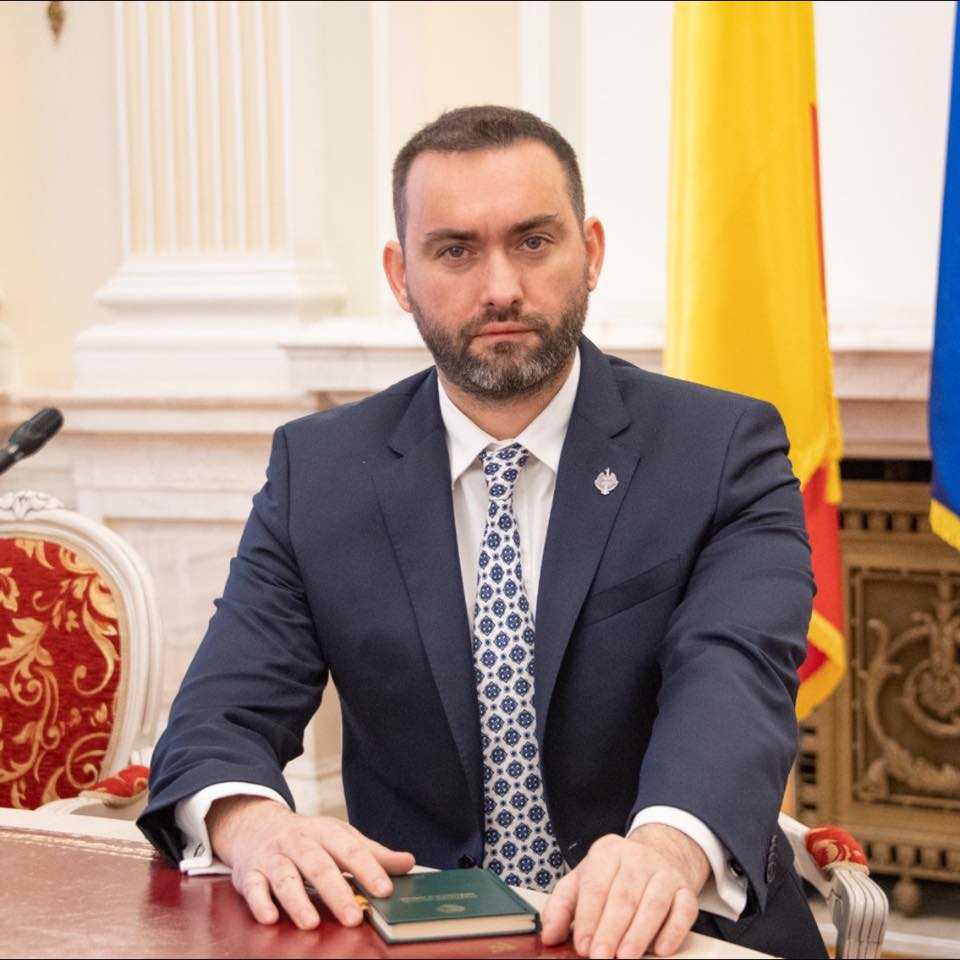 Cristian-Augustin Niculescu-Țâgârlaș is a senator of Romania, president of the Committee on Culture and Media of the Romanian Senate and a prominent member of regional initiatives on the rule of law, the protection of legal professions and the strengthening of cultural cooperation. He recently paid an official visit to Azerbaijan as part of a parliamentary mission dedicated to promoting the Middle Corridor. In the interview below, he offers a profound vision on bilateral cooperation, post-conflict reconstruction and a geopolitics based on balanced partnerships and shared values.
Ioana Cristea Drăgulin & Petronela Adiaconiței: Mr. Senator, how do you assess Azerbaijan’s positioning in the current geopolitical context, starting from the hypothesis that the process of reconfiguring the South Caucasus region and the consolidation of the Middle Corridor transform this country into a pole of stability and a factor of strategic resilience for Eurasian relations?
Senator Cristian-Augustin Niculescu– Țâgârlaș: Azerbaijan is no longer a mere regional actor, it is a strategic node of the Eurasian geopolitical reconfiguration, with a pivotal role in the Middle Corridor, between Central Asia, the Caucasus and Europe.
For Romania, as a member state of the European Union and NATO, the partnership with Azerbaijan is part of a logic of strategic interdependence. This cooperation strengthens not only energy security and the diversification of supply routes, but also the ability to build bridges of stability in a region at the confluence of the interests of the great powers.
Equally, Azerbaijan demonstrates a rare ability to combine institutional and economic modernization with a firm anchoring in its own historical and cultural identity. This synthesis of tradition and modernity generates a balanced development model, which can also inspire other neighboring states. From this perspective, Azerbaijan is not just a conjunctural partner, but a benchmark of geopolitical resilience, with a long-term strategic value for Romania and the Euro-Atlantic community.
Beyond these dimensions, we found in Azerbaijan a partner deeply connected to the values of dialogue, stability and modernization, a country that is building its future with a clear vision, but anchored in its own identity.
Ioana Cristea Drăgulin & Petronela Adiaconiței: You recently visited Azerbaijan, as part of a mission dedicated to the Middle Corridor. What were the conclusions of this visit?
Senator Cristian-Augustin Niculescu– Țâgârlaș: Our visit was both strategic and symbolic. On the ground, in Baku and Hankendi, we saw a reality in motion, with impressive reconstruc-tion works in liberated areas, but also with visible traces of suffering and destruction. The Middle Corridor is more than a transport route, it is a project of regional reconnection, peace, economic and cultural partnership.
Azerbaijan today is the image of a state that transforms suffering into construction, and the imprint of war is being replaced, step by step, by the contours of peace. Regions such as Karabakh and Hankendi, which I had the honor of visiting, are emblematic of this metamorphosis.
What deeply impressed me was the contrast between the scars left by the conflict – ruins, collapsed buildings, lands marked by destruction – and the visionary force of reconstruction. Schools, cultural centers, modern roads are being built. It is a renaissance in the truest sense.
At the same time, Azerbaijan is increasingly asserting itself as a pillar of stability and dialogue in a complex region, with an increasingly articulate voice in the international geopolitical concert.
I had fruitful meetings with Azerbaijani officials, including from the legal system and the legal profession, who expressed their support for the signing and ratification of the European Convention on the Protection of the Profession of Lawyer, a document actively promoted by Romania. In parallel, we have strengthened parliamentary, cultural and educational cooperation, with an emphasis on university exchanges and media initiatives.
Ioana Cristea Drăgulin & Petronela Adiaconiței: Romania and Azerbaijan collaborate in the field of energy, but what other dimensions of the bilateral partnership do you consider need to be developed?
Senator Cristian-Augustin Niculescu– Țâgârlaș: Our partnership has a solid energy core, but it must be expanded to dimensions such as education, culture, tourism, digital infrastructure and justice. Romania can become a gateway for Azerbaijan to the EU, and Azerbaijan a gateway to Asia for Romania.
On the legal front, we can develop a common platform for the liberal professions, especially for lawyers, notaries, mediators and jurists, to strengthen professional dialogue, exchange of best practices and protect the values of the rule of law. On the cultural front, we have the opportunity to create joint events, exhibitions, media initiatives, which will bring to the fore the traditions, art and history of the two peoples.
Ioana Cristea Drăgulin & Petronela Adiaconiței: You have been involved in numerous international missions. What differentiates Azerbaijan from other states in the region?
Senator Cristian-Augustin Niculescu– Țâgârlaș: Azerbaijan is distinguished by strategic clarity and a balance between accelerated modernization and respect for heritage. Also, the way the state manages the reconstruction process in post-conflict areas is impressive, new buildings, infrastruc-ture, restorations are proof of a deep commitment to the future.
It is a country that combines oriental hospitality with mature diplomacy, which understands its role as a bridge between diverse cultural, religious and geopolitical spaces. This makes it a reliable partner in an increasingly fragmented world.
Ioana Cristea Drăgulin & Petronela Adiaconiței: You mentioned earlier about the European Convention on the Protection of the Profession of Lawyer. How does Azerbaijan relate to this initiative?
Senator Cristian-Augustin Niculescu– Țâgârlaș: Azerbaijan is a member of the Council of Europe and a state that has undertaken important legal reforms. During the official meetings, the Azerbaijani partners expressed a clear openness to signing and ratifying the Convention on the Protection of the Profession of Lawyer, a document that Romania actively supports.
It is a signal that Azerbaijan wants to consolidate its status as a modern state of law, where legal professions enjoy respect, protection, and independence.
Ioana Cristea Drăgulin & Petronela Adiaconiței: Do you think that the model of post-conflict reconstruction in Azerbaijan can inspire other re-gions affected by war?
Senator Cristian-Augustin Niculescu– Țâgârlaș: Yes, without a doubt. What we have observed in Azerbaijan, in the regions affected by the Karabakh conflict, represents a coherent, stra-tegic and deeply rooted model in local realities, which can be reproduced – with the necessary adaptations – in other post-conflict spaces in the world.
The success of reconstruction does not consist only in the construction of buildings, roads or technical infrastructure. What makes the Azerbaijani model remarkable is the simultaneous integration of several dimensions: technological, identity, symbolic, legal and community.
The reconstruction of the liberated regions is not left to chance. The Azerbaijani government has implemented a model of effective governance, with clear objectives, smart prioritization of investments, and rigorous quality and impact control. In parallel, opportunities have been created for the return of residents, for local investment, and for the restoration of social networks destroyed by the war.
In Azerbaijan, reconstruction is accompanied by the restoration of the historical, religious and cultural heritage, not only of the majority, but also of all the communities that lived in the region. It is a powerful message: peace does not mean forgetting, but recognition and continuity, in a new architecture of coexistence.
In this sense, the Azerbaijani model becomes an important precedent for all regions that need to heal historical wounds without rewriting identities. It is a reconstruction of memory, not just territory.
Ioana Cristea Drăgulin & Petronela Adiaconiței: What message would you convey to Azerbaijani citizens, especially young people?
Senator Cristian-Augustin Niculescu– Țâgârlaș: I would just say this: don’t be afraid to build bridges. In a world marked by isolation and conflict, those who unite are the ones who will shape the future.
Young people must be the leaders of this change, through education, initiative, creativity and dialogue.
Romania is and will be a loyal friend of Azerbaijan, and I, personally, will continue to be involved in promoting projects that bring us closer: through law, through culture, through people.
Building bridges means guaranteeing peace. And the Middle Corridor is, above all, a corridor of hope.
Interview conducted by Ioana CRISTEA DRĂGULIN & Petronela ADIACONIȚEI