


Coordonat de E.S. Gudsi Dursun oglu OSMANOV și Sabin DRĂGULIN
Volum XIII, Nr. 3 (49), Serie nouă, iunie-august 2025
Cultural Roots – Atashgah Zoroastrian Fire Temple, Baku
Nicoleta ZAGURA
Abstract: This study examines the Absheron Peninsula and Baku as spaces where natural phenomena, history, and religion converge. Known for its eternal flames, Absheron inspired the fire cults of Zoroastrianism and sustained the Atashgah temple in Surakhani, later a centre of Zoroastrian, Sikh, and Hindu worship. Ancient authors such as Strabo, Pliny the Elder, and Herodotus, alongside medieval observers including al-Istakhri and Marco Polo, attest to the continuity of fire veneration in the region. Central to this tradition were the Magi, Zoroastrian priests who maintained sacred flames, interpreted cosmic order, and performed apotropaic rituals linking humanity with the divine. By tracing the symbolism of fire as both material resource and spiritual mediator, the paper situates Absheron as a cultural crossroads between East and West. Today, the Atashgah temple, preserved as a UNESCO World Heritage site, stands as a monument to humanity’s enduring reverence for fire as purity, wisdom, and eternal light.
Keywords: Cultural Heritage, History of Absheron, UNESCO conventions.
I invite you on an imaginary journey into a land of fire and of passions sung in Mugam1. A mysterious land, where the four winds never tire, their force keeping alive the flame of the ancient sages, and the sails upon the masts are forever ready for departure.
Absheron, or the Absheron Peninsula together with the city of Baku, lies in the east of the Republic of Azerbaijan and stretches into the Caspian Sea, forming a strategic promontory that has played a major role in the region’s development throughout history. The name “Absheron” comes from Persian roots and means “the place of salty water” or “the land rich in salt”, a feature closely linked to the natural resources of the area.
The soil, covered in a grey dust – a mixture of salt and impurities – recalls the harsh aridity of the steppe. At the same time, Absheron is renowned for its natural wealth: oil, natural gas, native oil springs rising to the surface, and therapeutic muds. These resources turned the region into one of the world’s most important oil centres as early as the nineteenth century.
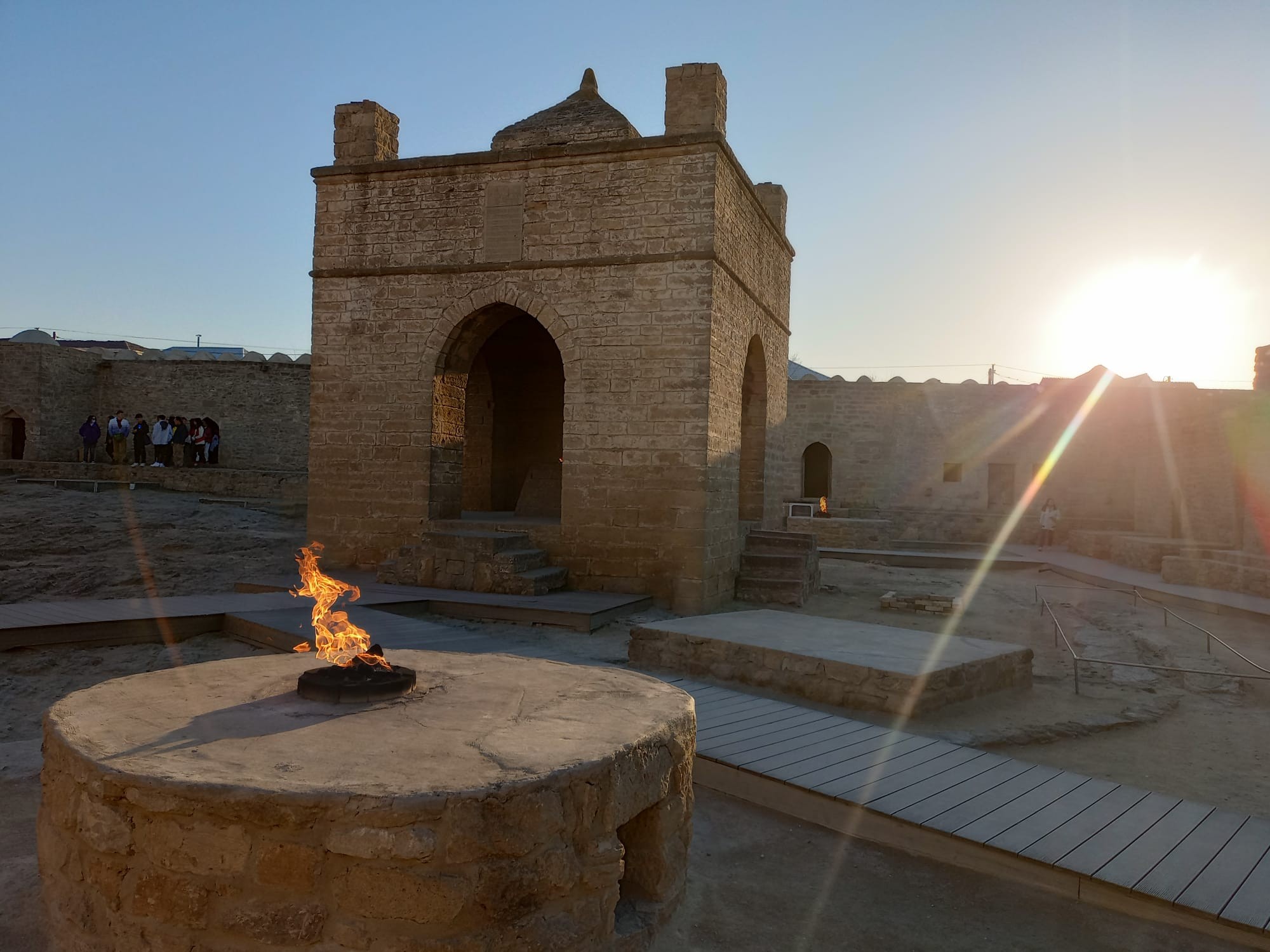
A particular aspect of the peninsula is the presence of natural fire phenomena. Because of the gases seeping to the surface, in many places the earth appears to burn perpetually. The famous Yanar Dag (“Burning Mountain”) is a spectacular testimony of these “eternal flames”, which, over time, inspired the cult of fire and the Zoroastrian religion. In this context, the Absheron Peninsula is also home to the Atashgah Temple in Surakhani, an important place of worship for Zoroastrians, Sikhs and Hindus, active between the seventeenth and nineteenth centuries and today transformed into a museum.
At the heart of the peninsula rises Baku, the capital of Azerbaijan, a port city with a history of over a millennium. Mentioned in Arabic and Persian chronicles as early as the eighth and ninth centuries, Baku developed as a fortress and an important commercial hub on the Silk Road. The old city, known as Icherisheher, now included in the UNESCO World Heritage List, preserves its medieval walls, the Palace of the Shirvanshahs, and the famous Maiden Tower (Qız Qalası), the city’s emblem2.
From the cool gardens of Icherisheher, I invite you to a short journey towards Surakhani, the place where fire manifests its creative passions for beauty and the sublime – Atashgah.
The Atashgah Temple is a unique monument on the universal map of sacred spaces. The natural gas phenomena that in antiquity and the Middle Ages sustained eternal flames transformed the region into a centre of fire worship, associated both with Zoroastrianism and with the priestly traditions of the Magi. Evoked in ancient and medieval sources, the site became a symbol of the sacredness of fire and of man’s relationship with the divine through it.
The Greek geographer Strabo (c. 64 BC – AD 24), describing Caucasian Albania, writes: “Near the shores of the Caspian Sea there are places where the ground burns; there, fire springs continuously from the soil”3.
This observation he associates with the rituals of the Zoroastrian priests, for whom fire was a sacred element, attributing to it both a purifying role and the dimension of a cosmic oracle.
Pliny the Elder (AD 23–79), in his Naturalis Historia, records:
“On the shores of the Caspian Sea, fires burn without being lit, and the flames arise from the very earth itself.”
This description corresponds to the natural gas phenomena of Absheron, confirming the Roman perception of the “miracle of eternal fires”4.
Herodotus (5th century BC), in his histories, does not mention Atashgah, but he does describe the role of the Magi:
“They raise no altars and light no fires without the Magi, for only they know how the flames must be honoured.”
This passage attests to the importance of the Magi in preserving the fire cult, which makes the link with Atashgah plausible.
The Magi are mentioned by both Herodotus and Xenophon. They were Zoroastrian priests, servants of Ahura Mazda, entrusted with tending the sacred flames in temples (atashkadeh). Their cultic, cosmological and astrological functions explain why, in the Christian tradition, they appear as the “Magi from the East” (Matthew 2:1–12)5.
Atashgah, thanks to the phenomenon of eternal flames, may well have been a privileged place where the Magi safeguarded the bond between man and the divine. The phenomenon was also observed in the Middle Ages by geographers and travellers:
Al-Istakhri (10th century) mentions “the land of Shirvan where fires burn forever, and people pray around them”6.
Marco Polo (13th century) writes: “In Shirvan there is a flame that burns without ceasing, and people look upon it with great wonder ”7.
Hamdallah Mustawfi (14th century) recalls Zoroastrian communities in Shirvan that preserved the “religion of fire”8.
The Magi (Greek μάγοι, Latin magi, from Old Persian maguš) were a sacerdotal caste of Median and Persian origin, with a central role in the Zoroastrian religion. They were not only officiants of the cult but also guardians of sacred knowledge, of the ritual calendar and of magico-religious protective techniques, holding essential apotropaic functions. In pre-Islamic times, the Avestan tradition circulated mainly through oral transmission, and the Magi were responsible for conserving and correctly reciting hymns and prayers. They possessed knowledge of astrology and the observation of the stars, being recognised in Greek sources for their interpretation of celestial phenomena9.
In Persian thought, cosmic order (Aša) was reflected in the movement of the stars, and the task of the Magi was to decipher the divine signs. They also combined medicine, divination and purification rituals, making use of formulas, plants and incantations with apotropaic and healing value10.
In Zoroastrian cosmology, the world was the stage of the confrontation between Aša (Truth, Order, the principle of Ahura Mazda) and Druj (Lie, Chaos, the principle of demons). The Magi had the mission of protecting communities and kings from demonic influences. Thus, they officiated rituals against the demons (daēva) through fire, water and the recitation of Avestan formulas (manthra), and they tended the sacred fire, considered the strongest apotropaic force, a symbol of divine light repelling darkness11.
The Magi practised the recitation of the Ahuna Vairya prayer, seen as a “shield” against demons, and used ritual objects such as the barsom; they prepared the sacred plant haoma, pure water and perfumes (incense, resins) as instruments of purification. They were experts in the protection of kingship, since the king was regarded as chosen by Ahura Mazda, and the Magi ensured the oaths, consecrations and exorcisms necessary for his protection12.
Strabo highlights their ethical and philosophical role, stating that their doctrine even influenced Greek thought13.
Pliny the Elder associates them with the origins of magic, attributing to them the power to conjure spirits and banish diseases14.
After the Islamic conquest, some of their practices were reinterpreted or absorbed into popular tradition, where the term “magus” came to mean “magician”. Yet their fundamental role as guardians of cosmic order and protectors against evil remained central in cultural memory.
These historical sources confirm the continuity of the tradition of the sacred fire on the Absheron Peninsula – the continuity of a cosmic religion in which fire is the mediator between man and the divine, a meeting space between East and West, recalled by Greeks, Romans, Arabs, Persians and Europeans alike.
Today, Atashgah remains a UNESCO landmark, a living monument of humanity’s connection with fire as a symbol of spirit, purity and eternal light.
Warming my palms at the Sacred Flame of Atashgah, I offered four pomegranates on the altar as a homage to the winds of Absheron. I cast cinnamon sticks and frankincense into the temple’s fire, and I imagined how the Three Magi set forth in search of the star that heralds the birth of a Sage destined to replace a religion in which Good fights Evil with a religion of Eternal Love – for humankind and for this imperfect world.
Notes
- https://ich.unesco.org/en/projects/national-action-plan-for-the-safeguarding-of-the-mugam-of-azerbaijan-0-0054. Stil de muzică azer, introdus în lista Patrimoniului Imaterial.
- https://en.unesco.org/silkroad/silk-ro-ad-themes/world-heritage-sites/walle-d-city-baku-shirvanshahs-palace-and-maiden-tower. Orașul vechi este înscris pe lista Patrimoniului Mondial UNESCO.
- Strabo, Geographica, XI.13.7, Loeb Classical Library, Cambridge, 1924.
- Plinius Secundus, Naturalis Historia, II.109, II.236, ed. Loeb Classical Library, Cambridge, 1938.
- (“When Jesus was born in Bethlehem of Judea in the days of King Herod, behold, wise men from the East came to Jerusalem, asking, ‘Where is the newborn king of the Jews?’”, Ev. Matei 2, 1-12 | Doxologia, (acces 31.08.2025).
- Al-Istakhri, Kitab al-Masalik wa al-Mamalik, ed. M.J. de Goeje, Leiden, 1870.
- Marco Polo, Il Milione, Milano, 1999.
- Hamdallah Mustawfi, Nuzhat al-Qulub, trad. G. Le Strange, London, 1919.
- Mary Boyce, Zoroastrians: Their Religious Beliefs and Practices, London: Routledge & Kegan Paul, 1979, pp. 19-22.
- Albert de Jong, Traditions of the Magi: Zoroastrianism in Greek and Latin Literature, Leiden: Brill, 1997, pp. 58-64.
- James Darmesteter (trad.), The Zend-Avesta, Part I: Vendidad, Oxford: Clarendon Press, 1880, p. 189.
- Pierre Briant, From Cyrus to Alexander: A History of the Persian Empire, Winona Lake: Eisenbrauns, 2002, pp. 216-218.
- Strabon, Geographica, XI.14.3.
- Plinius Secundus, Naturalis Historia , XXX.2-3
Bibliography
Sourses
HERODOT, Istorii, I.132, trad. G. Călinescu, București, 1961.
PLINIUS Secundus, Naturalis Historia, II.109, II.236, ed. Loeb Classical Library, Cambridge, 1938.
STRABO, Geographica, XI.13.7, Loeb Classical Library, Cambridge, 1924.
Books
AL-ISTAKHIRI, Kitab al-Masalik wa al-Mamalik, ed. M.J. de Goeje, Leiden, 1870.
Boyce, Mary, Zoroastrians: Their Religious Beliefs and Practices, London: Routledge & Kegan Paul, 1979.
BRIANT, Pierre, From Cyrus to Alexander: A History of the Persian Empire, Winona Lake: Eisenbrauns, 2002.
DARMESTETER, James (trad.), The Zend-Avesta, Part I: Vendidad, Oxford: Clarendon Press, 1880.
de JONG, Albert, Traditions of the Magi: Zoroastrianism in Greek and Latin Literature, Leiden: Brill, 1997.
MUSTAWFI, Hamdallah, Nuzhat al-Qulub, trad. G. Le Strange, London, 1919.
POLO, Marco, Il Milione, Milano, 1999.
Online sourses
https://ich.unesco.org/en/projects/national-action-plan-for-the-safeguarding-of-the-mugam-of-azerbaijan-00054.
https://en.unesco.org/silkroad/silk-road-th-emes/world-heritage-sites/walled-city-baku-shirvanshahs-palace-and-maiden-tower.