


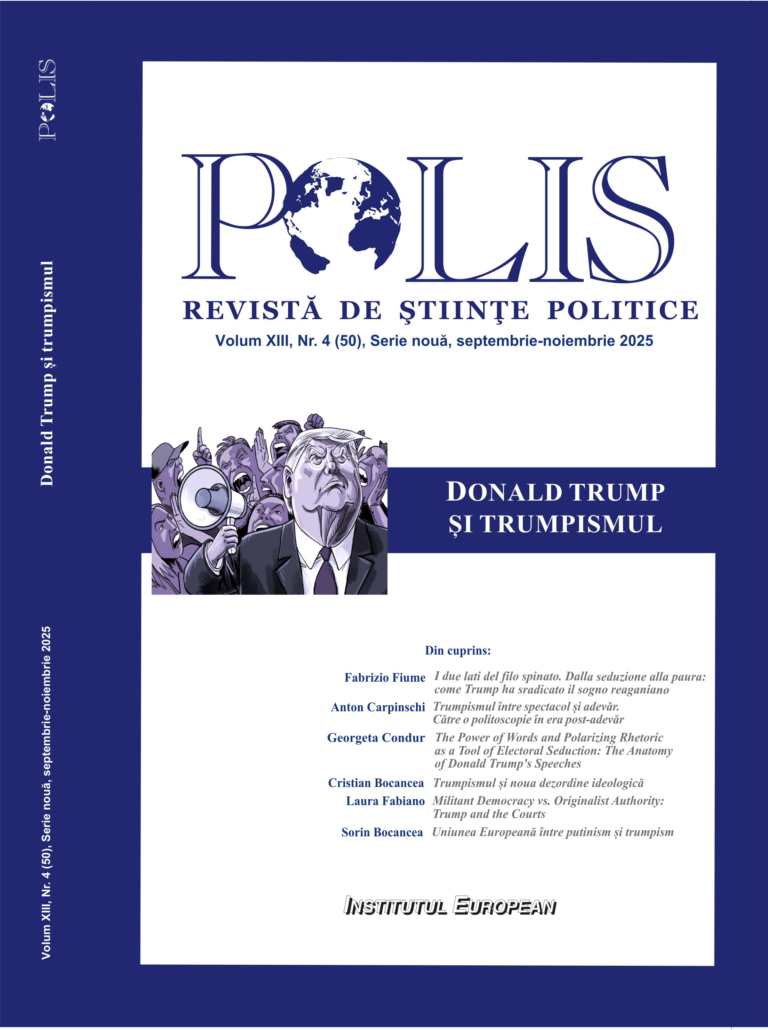
Coordonat de Sabin Drăgulin și Angelo Chielli
Volum XIII, Nr. 4 (50), Serie nouă, septembrie – noiembrie 2025
Trump: The Psychology of the Rise or Decline of an Empire/Empires.
Psychological, Political Science and Philosophical Perspectives
Lavinia Maria PRUTEANU
Teodora Liliana PRELIPCEAN
Abstract: This paper explores the political figure of Donald J. Trump from an integrative perspective, combining the psychological analysis of his personality with the political, political science, and philosophical implications of his presidential mandate. It investigates the relationship between personality traits, leadership style, and public rhetoric, as well as the ways in which these dimensions influence the dynamics of global power. The study also compares Trump’s psychological and discursive profile with those of Volodymyr Zelensky and Vladimir Putin in order to offer a perspective on different models of leadership in contexts of geopolitical crisis.
Keywords: Trump, political psychology, political science, world leaders, empire, decline, Zelensky, Putin
Introduction
The political rise of Donald J. Trump led to a profound transformation of the United States between 2016 and 2025. As an unconventional leader, Trump reshaped American political discourse, challenging the traditional rules of diplomacy, transatlantic relations, and even the core values of liberal democracy. This paper aims to analyze this political figure from a multidisciplinary perspective -psychological, political science, and philosophical -seeking to answer the question of whether the Trump era marks a rise or a decline of the “American empire”.
Theoretical Framework
The analysis builds upon established psychological theories: the Big Five Model[i][ii][1], the concepts of cognitive bias and fast/slow thinking formulated by Daniel Kahneman[2] , and the framework of emotional intelligence defined by Daniel Goleman[3].
In the political and political science domain, the study engages with theories of hegemony and imperial decline formulated by Toynbee[4], Huntington[5], and Nye[6], complemented by Fukuyama[7]’s perspective on the fate of the liberal order.
Gramsci[8] introduces the concept of cultural hegemony, emphasizing that power is maintained not only through coercion but also through the construction of cultural consensus. In the Trump era, media polarization and the redefinition of national narratives illustrate this theory vividly.
Chomsky[9] offers a radical critique of the structure of power in the United States, highlighting the role of political discourse and mass media in the “manufacturing of consent”[10], thereby sustaining hegemony through the manipulation of public opinion.
Psychological Dimensions of Political Leaders: Trump, Zelensky and Putin
A comparative assessment of the psychological profiles of the three leaders, viewed through the lens of the Big Five model, reveals a set of characteristics marked by strong contrasts:
| Big Five Dimension | Donald Trump | Volodymyr Zelensky | Vladimir Putin |
| Extraversion | Very high – dominates the social space; constant search for attention; energized by mass interactions | High – strong stage presence, direct communication, public visibility | Low–controlled – limited public exposure, oriented toward authority and control |
| Agreeableness | Low – confrontational style, strong competitiveness, low tolerance for criticism | High – empathy, cooperation, constructive interpersonal engagement | Low – toughness, social distance, dominance orientation |
| Conscientiousness | Moderate – tactical discipline during campaigns, but impulsivity in communication and decision-making | High – organization, strategic rigor, coherence in actions | High – procedural discipline, incremental planning, operational rigor |
| Emotional Stability | Fluctuating – heightened emotional reactivity in critical contexts | High – calm, efficient emotional regulation, crisis resilience | High – flat affect, marked self-control, reduced reactivity |
| Openness to Experience | Moderate–selective – rhetorical innovation, yet skepticism toward technical expertise | High – strategic flexibility, rapid integration of expert knowledge | Low – preference for traditional paradigms and tested strategies |
The analysis of the personalities of these contemporary political leaders requires integrating validated models from personality psychology and political psychology, as well as assessing traits associated with the so-called “Dark Traits”. Recent studies[11] [12] [13]emphasize that political leaders display varying combinations of narcissism, Machiavellianism, and subclinical psychopathy—traits that significantly influence their decision-making style and public behavior.
According to the scientific literature, high levels of narcissism are associated with a strong need for validation and with narrative self-centrality [14]. Machiavellianism correlates with strategic manipulation and the instrumentalization of others[15], while subclinical psychopathy is linked to emotional coldness and moral disengagement[16].
Donald Trump’s personality has been described in numerous studies as displaying strongly extraverted traits and a high level of openness to new experiences, as well as impulsivity and low frustration tolerance. Within the Big Five framework, his profile is characterized by high extraversion, low agreeableness, moderate conscientiousness, low emotional stability, and moderate openness to unconventional ideas.
Several studies[17] [18] confirm the presence of pronounced narcissism in Trump’s personality, mainly expressed through a constant need for validation, a tendency to dominate public discourse, and an intolerance to criticism. Çifci[19] suggests that the origins of this narcissistic structure may be linked to early family patterns of validation and competition. This trait correlates strongly with his decision-making style and his polarizing rhetorical strategies.
His Machiavellianism is assessed as moderate, evident in his aggressive negotiation tactics and polarizing communication. Subclinical psychopathic traits are limited, manifested primarily through harsh rhetorical expressions rather than through stable, clinically relevant behavioral patterns[20].
Volodymyr Zelensky’s psychological profile emerges as emotionally and cognitively distinct, characterized by high emotional intelligence[21], empathy, cooperation, and elevated agreeableness, as well as a high openness to diverse perspectives. His leadership style is defined by transformational crisis leadership, critical thinking, and a logical, well-structured discourse, coupled with resilience and highly effective strategic communication within a military context.
His Machiavellianism is low, and psychopathic traits are minimal. Zelensky is distinguished by strong empathy and a prosocial orientation, as highlighted by rhetorical studies published in the past three years. Research on his wartime rhetoric (2023–2025) demonstrates an effective use of moral and democratic storytelling.
Putin presents a profile characterized by high emotional stability and strong affective control, high conscientiousness, pronounced Machiavellianism[22] [23], strategic narcissism[24] and a marked orientation toward control and order. His cognitive style is strongly ideological, filtering information through securitarian paradigms, and his leadership is authoritarian-strategic in nature.
García-García[25] identifies elements of the “hubris syndrome” in Putin’s behavior, defined by an exaggerated confidence in one’s historical mission and by the belief that one is indispensable to the destiny of the nation. Machiavellianism is high, observable in his incremental geopolitical strategies and in the instrumental use of coercion. Subclinical psychopathic traits are moderate, reflected in a high tolerance for instrumental violence [26].
Analysis of Discourses, Cognitive Styles, and Leadership
Trump employs a simplified, polarizing discourse, grounded in slogans and appeals to primary emotions (“Make America Great Again”). Zelensky adopts a mobilizing, narrative-driven discourse addressed to the international community and to democratic values. Putin uses an ideological, justificatory discourse anchored in themes of national security.
From Chomsky’s perspective, Trump employs classic techniques of “distraction and simplification,”[27] transforming political debate into a media spectacle and reducing the complexity of political issues to binary solutions.
Goleman[28] defines emotional intelligence (EI) as the ability to perceive, use, and manage emotions. In the behavior of political leaders, EI influences rhetorical style, mobilization capacity, and affective regulation in situations of crisis. Trump employs an intuitive form of social EI orientated toward mass persuasion, but with inconsistent affective regulation, marked by reactivity and emotional polarization[29].
Zelensky exhibits high EI, characterized by emotional attunement to diverse audiences and by the ability to transform collective emotions into moral action[30]. This form of EI contributes to the legitimacy of his transformational leadership.
Putin, by contrast, stands out through cold affective control, typical of authoritarian leaders, and by strict emotional regulation. His empathy is largely confined to a narrow circle of loyalty, while emotions are used strategically to reinforce national identity [31].
According to Kahneman[32], cognitive style is influenced by heuristics, biases, and internalized mental structures. Trump adopts an intuitive and rapid cognitive style, dependent on “gut feeling,” characterized by confirmation biases and excessive simplification[33].
Zelensky employs an analytic–narrative style, integrating data, technical consultation, and logical justification[34]. His dominant bias is strategic optimism, which is useful for mobilization but potentially risky in protracted crises.
Putin operates with a calculated and ideological cognitive style, grounded in a relatively fixed mental paradigm. His dominant bias is systemic confirmation, amplified by his near-total control over internal information flows[35].
The analysis of the critical thinking styles of the three leaders reveals major differences in how they process information and make decisions. Trump exhibits a confrontational form of critical thinking, one that is more deconstructive than constructive. His ability to challenge the status quo and dismantle institutional narratives demonstrates a reactive critical thinking style, yet one frequently filtered through confirmation bias and a tendency to oversimplify complex issues. His use of arguments is often selective and orientated toward the emotional mobilization of the electorate.
Zelensky demonstrates a structured and adaptive form of critical thinking, capable of rapidly integrating information from military, diplomatic, and social domains.
His speeches follow a coherent argumentative logic, closely aligned with the Toulmin model (claim → data → warrant), which indicates a high level of critical reasoning. Through his communicative strategy, Zelensky succeeds in building international consensus and mobilizing the support of the global community.
Putin demonstrates sophisticated, long-term strategic thinking, yet one strongly influenced by his own ideological framework and by the strict control of information. Critical thinking is present at a tactical level but is partially inhibited by mechanisms of information filtering and by systemic confirmation bias, which can lead to a distorted perception of international reality.
The three major categories of leadership identified in the scholarly literature—namely populist, transformational, and authoritarian-strategic[36] [37] can be correlated in the following way: Trump exemplifies the populist-charismatic type, orientated toward spectacle and polarization; Zelensky embodies crisis-driven transformational leadership, capable of generating meaning, cohesion, and resilience; and Putin represents the authoritarian-strategic model, characterized by discretion, incrementalism, and an emphasis on coercion.
Studies on political leadership[38] [39] show that deep-seated motivations shape public behavior. Thus, Trump is orientated toward status, prestige, and validation, with values centered on loyalty and competition. Zelensky’s motivations are directed toward public service, solidarity, democratic values, and freedom, whereas Putin is driven by the restoration of imperial status, and by values related to sovereignty, tradition, and security.
From the perspective of risk tolerance and decision-making, the three leaders can be characterized as follows: Trump exhibits a high appetite for risk, with a reactive evaluation of consequences[40]; Zelensky demonstrates calculated risk-taking, with constant consultation of experts and gradual adjustment[41]. Putin engages in hard-calculated risk, yet his decisions are affected by overconfidence due to unilateral access to information[42].
Table 2. Cognitive Styles
| Leader | Openness to Opposing Perspectives | Logical Coherence | Use of Data | Dominant Cognitive Bias | Level of Critical Thinking |
| Donald Trump | Low | Medium | Selective | Confirmation bias | Medium–Low |
| Volodymyr Zelensky | High | High | High | Strategic optimism bias | High |
| Vladimir Putin | Low | High (ideological) | High, but filtered | Systemic confirmation bias | Medium |
Analysis of Strengths and Vulnerabilities
Analyzing the psychological strengths and vulnerabilities, we can observe that Donald Trump demonstrates a remarkable capacity for emotional mobilization of the public, supported by high social energy and by a form of narcissistic resilience that enables him to maintain his identity narrative even in contexts of intense contestation. These characteristics enhance his effectiveness in persuasive communication and in consolidating electoral loyalty.
However, his behavior is marked by impulsive decision-making, pronounced emotional reactivity, and a persistent tendency toward polarization—elements that may limit strategic coherence and amplify both domestic and international political tensions.
Volodymyr Zelensky stands out through a high level of empathy, a morally grounded legitimacy perceived both domestically and internationally, and a rapid adaptive capacity that enables him to respond effectively to major crisis situations. These competencies contribute substantially to the effectiveness of his transformational leadership model. His vulnerabilities stem primarily from strategic optimism bias, which may lead to overestimations of external support or available resources, as well as from the risk of decision fatigue in the context of an already prolonged crisis.
Vladimir Putin exhibits psychological discipline, strategic patience, and a high degree of consistency in pursuing his objectives—traits that support a systematic approach to governance and to the projection of international power. These elements are characteristic of authoritarian-strategic leadership. On the other hand, his profile is affected by ideological rigidity, which limits decision-making flexibility, as well as by an “echo-chamber” information ecosystem, resulting from strict domestic media control. This environment reduces access to critical feedback and can lead to strategic miscalculations.
Table 3. Integrated Psychological Profile of the Leaders (Big Five, Dark Triad, Strengths & Vulnerabilities)
| Dimension | Donald Trump | Volodymyr Zelensky | Vladimir Putin |
| Extraversion (Big Five) | Very high; social dominance, attention-seeking | High; direct communication, strong public presence | Low–controlled; calculated public exposure |
| Agreeableness (Big Five) | Low; confrontational, highly competitive | High; empathy, cooperation | Low; social distance, dominance orientation |
| Conscientiousness (Big Five) | Moderate; tactical discipline, impulsivity | High; strategic rigor and consistency | High; long-term planning |
| Emotional Stability (Big Five) | Fluctuating; high reactivity | High; calm and affective control | High; flat affect, external emotional regulation |
| Openness (Big Five) | Moderate–selective; media innovation, skepticism toward expertise | High; rapid integration of expert input | Low; strategic traditionalism |
| Narcissism (Dark Triad) | High; need for validation, narrative self-centrality | Low–moderate; “healthy agentic” narcissism | Moderate–high; self-image as an “indispensable leader” |
| Machiavellianism (Dark Triad) | Moderate; hard negotiation, political instrumentalization | Low; collaborative orientation | High; cold calculation, instrumental use of resources |
| Subclinical Psychopathy (Dark Triad) | Low–moderate; harsh rhetoric, impulsivity | Very low; high empathy | Moderate; moral disengagement in hard decisions |
| Strengths | Emotional mobilization; social energy; narcissistic resilience | Empathy; moral legitimacy; rapid adaptation; transformational leadership | Discipline; strategic patience; consistency; methodical planning |
| Vulnerabilities | Impulsivity; reactivity; polarization; risk of strategic incoherence | Strategic optimism; decision fatigue in prolonged crises | Ideological rigidity; “echo-chamber” informational ecosystem; risk of strategic miscalculation |
Political Science and Philosophical Perspectives on the Trump Era
Political science and political philosophy provide a robust analytical framework for understanding the structural tension between the will to power, political legitimacy, and the reconfiguration of hegemony during the Trump era. Beyond the individual traits of the leader, this period can be conceptualized as a crisis of the liberal political order, characterized by the contestation of institutions, social polarization, and the emergence of post-truth discourse.
From a philosophical standpoint, the analysis may begin with Friedrich Nietzsche’s perspective, according to which leaders such as Donald Trump can be understood as manifestations of an unfiltered will to power, orientated toward self-assertion, domination, and the continual reenactment of power relations[43]. In this interpretation, Trump emerges as a political actor operating within a primordial register of competition, positioning himself outside the traditional norms of political morality.
In a different interpretive key, Oswald Spengler would regard Trump’s rise as a symptom of a Western civilization in its phase of “Caesarism”, a late stage of cultural decline marked by the emergence of authoritarian, charismatic, and voluntaristic leaders who assume control amid institutional fatigue and the disintegration of shared values[44]. This analytical framework suggests that the Trump era is not an anomaly but rather a structural outcome of the evolutionary trajectory of Western civilization.
In contrast, Jürgen Habermas would critique this period from the perspective of communication theory. For him, the Trump era exemplifies a profound erosion of rational dialogue, the undermining of the public sphere, and the proliferation of post-truth—a phenomenon in which factual discourse is replaced by emotional assertions, slogans, and affective polarization[45]. Thus, the central problem is Adopting a deeper socio-political orientation, Antonio Gramsci would interpret the Trump era as a genuine “hegemonic crisis”, in which the liberal cultural consensus becomes insufficient to sustain the existing political order[46]. During such a period, the old hegemony is no longer legitimate, while a new hegemony has not yet consolidated its authority. The emergence of populist-charismatic leaders thus reflects an interregnum in which “the old is dying and the new cannot yet be born”, not merely the leader himself, but the deterioration of the deliberative infrastructure of democracy.
From the perspective of media critique, Noam Chomsky provides additional arguments for understanding the Trump era as a consequence of the concentration of economic and political power, the corporate influence over institutions, and the mechanisms of “manufacturing consent” [47] [48]. For Chomsky, the rise of a populist leader is not a historical accident but rather a symptom of the dysfunctions of a democratic system increasingly captured by private interests. This perspective draws attention to the ethical and structural dimensions underlying the functioning of American democracy.
Thus, the integration of these philosophical and political science interpretations outlines a complex image of the Trump era: a period marked by tensions between the individual will to power, the institutional crises of liberal democracy, and the reconfiguration of global hegemony.
The World in the Era of Trump, Zelensky, and Putin: Geopolitical Reconfigurations and Perspectives from Political Psychology
The era shaped by the leadership of Donald Trump, Volodymyr Zelensky, and Vladimir Putin represents one of the most intense periods of geopolitical realignment since the end of the Cold War. Beyond their political actions, their distinct leadership styles — populist-disruptive (Trump), crisis-driven transformational (Zelensky), and authoritarian-strategic (Putin) — produce systemic effects on the international architecture, the distribution of global power, and the collective imaginaries of the “contemporary world”.
From a geopolitical perspective, the United States has remained the primary global hegemon; however, during the Trump administration, visible tendencies toward strategic retrenchment emerged, subsumed under the doctrine of “America First”. This involved the tightening of relations with NATO and explicit demands for increased financial contributions from member states; the renegotiation of major trade agreements, such as the transformation of NAFTA into USMCA, in line with an economic protectionist logic[49]; and the redefinition of relations with the European Union, increasingly perceived as an economic competitor rather than as a strategic partner. These shifts have been interpreted as part of a tactical reorientation aimed at conserving hegemony by withdrawing from commitments deemed unprofitable[50].
The Russian invasion of Ukraine in 2022 marked the emergence of a new type of leadership embodied by Volodymyr Zelensky — a leader who operates simultaneously across military, diplomatic, psychological, and symbolic registers[51]. Under his influence, the world has witnessed a moral repoliticization of geopolitics, in which values such as democracy, freedom, and solidarity become strategic instruments; the consolidation of European unity, accompanied by an acceleration of common defense policies[52]; and the emergence of a new form of political communication—existential storytelling—through which a nation articulates its right to survive in both emotional and juridical terms[53]. Thus, Zelensky becomes not merely a national leader but a global symbol of democratic resilience, generating an unprecedented form of transnational solidarity[54].
Conclusions: The World Between Hegemony, Resistance, and Revisionism
The Trump–Zelensky–Putin era highlights a fragmented global landscape positioned at the intersection of competing dynamics:
- the relative disengagement of the American hegemon from certain areas of global responsibility;
- the emergence of a new model of empathetic–transformational leadership with broad moral and geopolitical impact;
- the reactivation of authoritarian–revisionist ideologies that heighten international instability.
Overall, the world is likely in a transitional period marked by volatility, strategic interdependence, and the continual redefinition of power centers.
Bibliografie
Cărți
BORRELL, Josep, Discursuri și analize asupra politicii de apărare europene, 2023.
CHOMSKY, Noam, Consequences of Capitalism: Manufacturing Discontent and Resistance, Haymarket Books, Chicago, 2021.
CHOMSKY, Noam, HERMAN, Edward S., Manufacturing Consent: The Political Economy of the Mass Media, Pantheon Books, New York, 2002.
COSTA, Paul T., McCrae, Robert R., Revised NEO Personality Inventory (NEO-PI-R), Psychological Assessment Resources, Odessa, 1992.
FUKUYAMA, Francis, Liberalism and Its Discontents, Farrar, Straus and Giroux, New York, 2022.
GOLEMAN, Daniel, Emotional Intelligence, Bantam Books, New York, 1995.
GRAMSCI, Antonio, Selections from the Prison Notebooks, International Publishers, New York, 1971.
KAHNEMAN, Daniel, Thinking, Fast and Slow, Farrar, Straus and Giroux, New York, 2011.
NIETZSCHE, Friedrich, Beyond Good and Evil, Macmillan, New York, 1990 (ediția originală 1886).
NYE, Joseph, Soft Power: The Means to Success in World Politics, PublicAffairs, New York, 2004.
SPENGLER, Oswald, The Decline of the West, Oxford University Press, Oxford, 1991 (ediția originală 1918).
TOYNBEE, Arnold, A Study of History, Oxford University Press, Oxford, 1947.
Articole și studii
BROWN, Gregory, “National Narcissism and Support for Putin”, International Review of Social Psychology, 2024.
Çifci, Yüksel, “Child, Family, and Narcissistic Political Leadership: A Comparison of Hitler, Putin, and Trump”, Frontiers in Psychology, Lausanne, 2025.
GARCIA-García, J., “Hubris Syndrome in Political Decision-Making”, Political Psychology, 2024.
GOLDSMITH, Benjamin; Moen, Lars, “Personality Characteristics of Donald Trump’s Most Loyal Supporters”, Political Psychology, 2025.
MACKIN, Michael et al., “Dark Triad Predictors of Offensive Political Expression”, Journal of Research in Personality, Elsevier, Amsterdam, 2024.
McADAMS, Dan P., “The Mind of Donald Trump”, The Atlantic, Washington, 2016.
NAI, Alessandro, “Populism and Dark Triad Traits”, Personality and Individual Differences, Elsevier, Amsterdam, 2022.
IDEM, “Leader Dark Traits and Affective Polarization”, European Journal of Political Research, 2025.
PRUSIK, Marta, “Dark Traits Attribution to Political Leaders”, Journal of Research in Personality, Elsevier, Amsterdam, 2025.
WANG, Liang, “Zelenskyy’s Wartime Communication Strategy”, Frontiers in Communication, Lausanne, 2024.
ZELENSKYY Rhetoric Studies, “Rhetorical Analyses of Wartime Addresses (2023–2025)”, Journal of Nationalism, Memory & Language Politics, 2023–2025.
[1] Paul T. Costa, Robert R. McCrae, Revised NEO Personality Inventory (NEO-PI-R), Psychological Assessment Resources, Odessa, 1992.
[2] Daniel Kahneman, Thinking, Fast and Slow, Farrar, Straus and Giroux, New York, 2011.
[3] Daniel Goleman, Emotional Intelligence, Bantam Books, New York, 1995.
[4] Arnold Toynbee, A Study of History, Oxford University Press, Oxford, 1947.
[5] Samuel Huntington, The Clash of Civilizations and the Remaking of World Order, Simon & Schuster, New York, 1996.
[6] Joseph Nye, Soft Power: The Means to Success in World Politics, PublicAffairs, New York, 2004.
[7] Francis Fukuyama, Liberalism and Its Discontents, Farrar, Straus and Giroux, New York, 2022.
[8] Antonio Gramsci, Selections from the Prison Notebooks, International Publishers, New York, 1971.
[9] Noam Chomsky, Consequences of Capitalism: Manufacturing Discontent and Resistance, Haymarket Books, Chicago, 2021.
[10] Noam Chomsky, Edward S. Herman, Manufacturing Consent: The Political Economy of the Mass Media, Pantheon Books, New York, 2002.
[11] Alessandro Nai, “Populism and Dark Triad Traits”, Personality and Individual Differences, Elsevier, Amsterdam, 2022.
[12] Marta Prusik, “Dark Traits Attribution to Political Leaders”, Journal of Research in Personality, Elsevier, Amsterdam, 2025.
[13]Yüksel Çifci, “Child, Family, and Narcissistic Political Leadership: A Comparison of Hitler, Putin, and Trump”, Frontiers in Psychology, Lausanne, 2025.
[14] Dan P. McAdams, “The Mind of Donald Trump”, The Atlantic, Washington, 2016.
[15] Alessandro Nai, “Populism and Dark Triad Traits”, Personality and Individual Differences, Elsevier, Amsterdam, 2022.
[16] Mackin et al., “Dark Triad Predictors of Offensive Political Expression”, Journal of Research in Personality, Elsevier, Amsterdam, 2024.
[17] Dan P. McAdams, “The Mind of Donald Trump”, The Atlantic, Washington, 2016.
[18] Marta Prusik, “Dark Traits Attribution to Political Leaders”, Journal of Research in Personality, Elsevier, Amsterdam, 2025.
[19]Yüksel Çifci, “Child, Family, and Narcissistic Political Leadership: A Comparison of Hitler, Putin, and Trump”, Frontiers in Psychology, Lausanne, 2025.
[20]Yüksel Çifci, “Child, Family, and Narcissistic Political Leadership: A Comparison of Hitler, Putin, and Trump”, Frontiers in Psychology, Lausanne, 2025.
[21]Liang Wang, “Zelenskyy’s Wartime Communication Strategy”, Frontiers in Communication, Lausanne, 2024.
[22] Alessandro Nai, “Populism and Dark Triad Traits”, Personality and Individual Differences, Elsevier, Amsterdam, 2022.
[23] Gregory Brown, “National Narcissism and Support for Putin”, International Review of Social Psychology, 2024.
[24]Yüksel Çifci, “Child, Family, and Narcissistic Political Leadership: A Comparison of Hitler, Putin, and Trump”, Frontiers in Psychology, Lausanne, 2025.
[25]J. García-García, “Hubris Syndrome in Political Decision-Making”, Political Psychology, 2024.
[26] Gregory Brown, “National Narcissism and Support for Putin”, International Review of Social Psychology, 2024.
[27] Noam Chomsky, Consequences of Capitalism: Manufacturing Discontent and Resistance, Haymarket Books, Chicago, 2021.
[28] Daniel Goleman, Emotional Intelligence, Bantam Books, New York, 1995.
[29] Dan P. McAdams, “The Mind of Donald Trump”, The Atlantic, Washington, 2016.
[30] Liang Wang, “Zelenskyy’s Wartime Communication Strategy”, Frontiers in Communication, Lausanne, 2024.
[31] Gregory Brown, “National Narcissism and Support for Putin”, International Review of Social Psychology, 2024.
[32] Daniel Kahneman, Thinking, Fast and Slow, Farrar, Straus and Giroux, New York, 2011.
[33] Dan P. McAdams, “The Mind of Donald Trump”, The Atlantic, Washington, 2016.
[34] Liang Wang, “Zelenskyy’s Wartime Communication Strategy”, Frontiers in Communication, Lausanne, 2024.
[35] Alessandro Nai, “Leader Dark Traits and Affective Polarization”, European Journal of Political Research, 2025.
[36] Alessandro Nai, “Populism and Dark Triad Traits”, Personality and Individual Differences, Elsevier, Amsterdam, 2022.
[37] Yüksel Çifci, “Child, Family, and Narcissistic Political Leadership: A Comparison of Hitler, Putin, and Trump”, Frontiers in Psychology, Lausanne, 2025.
[38] Alessandro Nai, “Populism and Dark Triad Traits”, Personality and Individual Differences, Elsevier, Amsterdam, 2022.
[39] Marta Prusik, “Dark Traits Attribution to Political Leaders”, Journal of Research in Personality, Elsevier, Amsterdam, 2025.
[40] Dan P. McAdams, “The Mind of Donald Trump”, The Atlantic, Washington, 2016.
[41] Liang Wang, “Zelenskyy’s Wartime Communication Strategy”, Frontiers in Communication, Lausanne, 2024.
[42] J. García-García, “Hubris Syndrome in Political Decision-Making”, Political Psychology, 2024.
[43] Friedrich Nietzsche, Beyond Good and Evil, Macmillan, New York, 1990 (1886).
[44] Oswald Spengler, The Decline of the West, Oxford University Press, Oxford, 1991 (1918), op. cit.
[45] Francis Fukuyama, Liberalism and Its Discontents, Farrar, Straus and Giroux, New York, 2022, op. cit.
[46] Antonio Gramsci, Selections from the Prison Notebooks, International Publishers, New York, 1971, op. cit.
[47] Noam Chomsky, Edward S. Herman, Manufacturing Consent: The Political Economy of the Mass Media, Pantheon Books, New York, 2002.
[48] Noam Chomsky, Consequences of Capitalism: Manufacturing Discontent and Resistance, Haymarket Books, Chicago, 2021.
[49] Francis Fukuyama, Liberalism and Its Discontents, Farrar, Straus and Giroux, New York, 2022, op. cit.
[50] Joseph Nye, Soft Power: The Means to Success in World Politics, PublicAffairs, New York, 2004, op. cit.
[51] Liang Wang, “Zelenskyy’s Wartime Communication Strategy”, Frontiers in Communication, Lausanne, 2024.
[52] Josep Borrell, Discursuri și analize asupra politicii de apărare europene, op.cit., 2023.
[53]Zelenskyy Rhetoric Studies, “Rhetorical Analyses of Wartime Addresses (2023–2025)”, Journal of Nationalism, Memory & Language Politics, 2023–2025.
[54]J. García-García, “Hubris Syndrome in Political Decision-Making”, Political Psychology, 2024.