


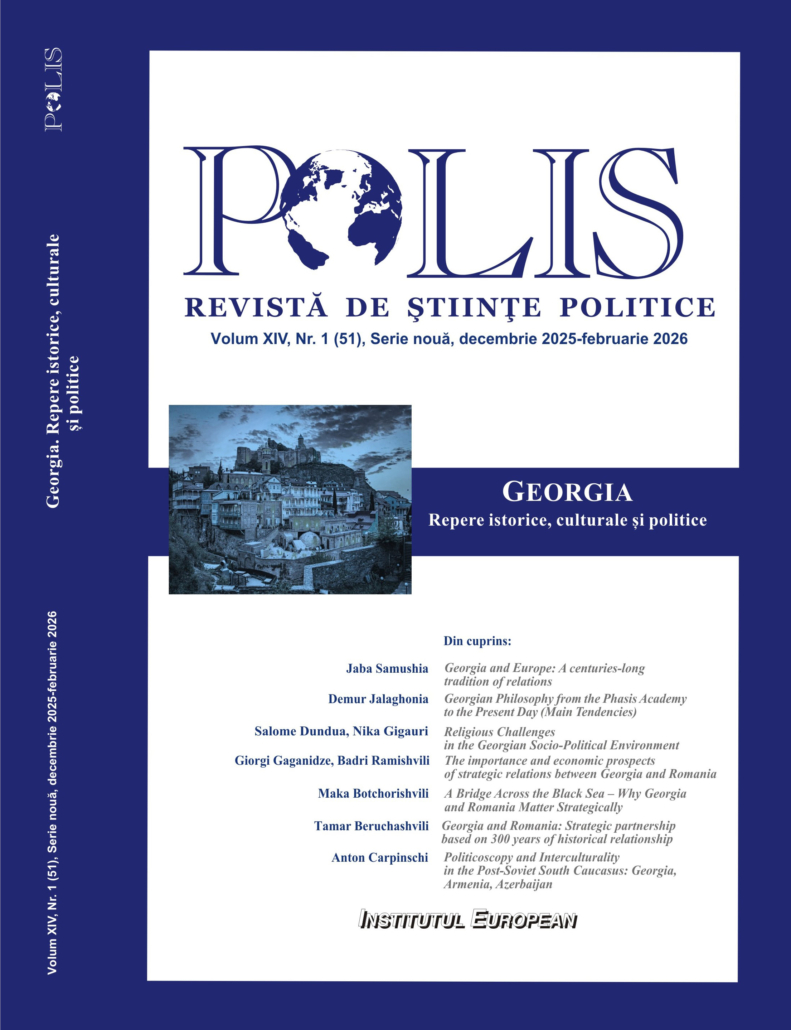
Coordonat de E.S. Tamar BERUCHASHVILI și Sabin DRĂGULIN
Volum XIV, Nr. 1 (51), Serie nouă, decembrie 2025-februarie 2026
Slipping and Sliding Between Formalities and Informalities: Lobbying, Interest Groups and Democratic Governance in Georgia
Nino MACHURISHVILI
Irakli SAMADALASHVILI
Abstract: This article examines the complex interplay between formal regulatory frameworks and informal political practices through the lens of lobbying in Georgia. As a pioneer among post-Soviet states with its 1998 Law on Lobbying Activities, Georgia presents an instructive case study for analyzing the challenges of institutionalizing transparent interest representation in transitional democracies. Through a synthesis of neo-institutional theory, elite analysis, and comparative policy examination, this study explores the relationship between imported formal institutions and established informal norms. The analysis moves beyond empirical case data to engage in a theoretical and desk-research based investigation of how formal lobbying mechanisms, designed to ensure transparency and accountability, can remain underutilized or bypassed in political cultures where influence is traditionally mediated through personal networks and informal channels. By situating Georgia’s experience within broader scholarly debates on post-Soviet democratization, institutional development, and hybrid governance, the paper examines the systemic conditions that can lead to differences between legal design and political practice. It concludes with a discussion of the implications for democratic consolidation and offers a framework for considering how formal and informal systems of influence might be aligned to strengthen governance.
Keywords: Political Lobbying, Democratization, Georgia, Post-Soviet Politics, Interest Groups.
Introduction: The Difference Between Institutional Design and Political Practice
The process of democratic consolidation in transitional societies is frequently characterized by observable differences between newly established formal institutions and resilient informal practices that shape the actual exercise of power. This dynamic is demonstrated in the domain of political lobbying and interest representation, where laws designed to ensure transparency and equitable access often coexist with, and are sometimes bypassed by, networks of influence that operate less visibly1. This article investigates this phenomenon through a theoretical and comparative analysis of lobbying in Georgia, a country that established a comprehensive legal framework for lobbying activities in 1998, yet whose political system continues to be analyzed through the prism of informal governance.
The central inquiry of this study is theoretical and systemic in nature: What does the development and implementation (or limited implementation) of formal lobbying regulation reveal about the nature of institutional change, power distribution, and state-society relations in a post-Soviet transitional democracy? Rather than focusing on the specific outcomes of a single law, the analysis seeks to understand the broader conditions under which formal democratic institutions develop or face challenges in taking root, and how informal practices persist or adapt. This approach allows for an examination of systemic features, historical legacies, and structural factors.
The investigation is guided by three interconnected analytical questions derived from theoretical literature:
- How can neo-institutional theories, particularly historical and sociological institutionalism, explain the persistence and adaptation of informal influence channels alongside new formal regulatory structures?
- What are the common structural and procedural features that can affect lobbying legislation effectiveness, as observed in various transitional contexts, and how might these be identified in institutional design?
- What are the broader implications of differences between formal transparency mechanisms and informal political practice for key democratic principles such as accountability, pluralism, and public trust?
The conceptual framework for this analysis is drawn from two complementary theoretical traditions. Neo-institutional theory provides tools for understanding why informal norms and practices demonstrate such remarkable resilience, continuing alongside new formal rules through processes like decoupling, layering, and symbolic adoption. Elite theory offers insights into the incentives and strategies of powerful actors who may find advantages in maintaining less visible channels of influence, thereby continuing arrangements that ensure their continued access and influence. Methodologically, this research employs a desk-based approach, synthesizing existing academic literature, comparative policy analysis of regulatory models (notably the Georgian and European Union frameworks), and theoretical development to construct a nuanced understanding of the issue.
Georgia’s early adoption of lobbying legislation, followed by scholarly observations of its limited practical uptake, serves as a relevant case for examining these theoretical questions and puzzles. The country’s post-independence trajectory-marked by aspirations for Euro-Atlantic integration, repeated reform efforts, and a complex Soviet legacy-creates a rich context for analyzing how formal democratic designs interact with informal political realities. This study contributes to the literature on post-Soviet democratization and hybrid regimes by providing a focused, theoretical exploration of one arena where the rules on paper may diverge from the rules in use. It examines this divergence not merely as a technical matter of regulatory compliance but as central to how political power is constituted, contested, and legitimized in transitional settings.
Theoretical Framework: Formal Rules, Informal Power, and Institutional Change
Neo-Institutional Theory: The Continuity of Informal Norms
Neo-institutional theory posits that institutions-defined broadly as the formal rules, informal norms, and established procedures that structure political, social, and economic life-are powerful and significant determinants of behavior and outcomes2. This perspective is particularly illuminating in transitional societies where new, often externally inspired, democratic institutions are superimposed upon deeply embedded informal practices. The result is frequently notable differences between formal prescriptions and actual behavior, differences that can themselves become established over time.
Historical institutionalism emphasizes the substantial influence of legacy and path dependence. It demonstrates that profound institutional change is rarely an abrupt break but occurs through extended processes of layering (adding new rules alongside existing ones), drift (changing impact of existing rules due to shifting circumstances), and conversion (redirecting existing institutions to new purposes)3. In the post-Soviet context, this theoretical framework means that networks of personal loyalty, reciprocal exchange (blat), and clan-based politics that characterized the late Soviet bureaucracy did not simply disappear with independence and new legislation. Instead, they evolved and embedded themselves within the new state apparatus, often providing the operational framework for formal institutions. Political and economic elites who successfully navigated the Soviet system through personal connections are unlikely to abandon strategic approaches that continue to yield results, simply because a formal lobbying registry now exists in legislation.
Sociological institutionalism contributes the important concept of isomorphism or institutional convergence-the observable tendency for organizations and states to adopt similar formal structures to gain legitimacy in their environment, rather than because those structures represent functionally optimal solutions4. This logic of appropriateness helps explain why a state like Georgia might adopt a Western-style lobbying law that remains underutilized: the legislation serves important symbolic and legitimizing functions, both domestically and internationally, signaling commitment to democratic norms and European integration even if it does not substantially alter underlying behavioral patterns. The potential decoupling of formal structure from actual practice is thus a predictable outcome when institutions are adopted for legitimacy rather than functional efficiency.
Elite Theory: Power, Access, and the Characteristics of Limited Transparency
If neo-institutional theory explains how formal rules can be bypassed, elite theory helps identify who might find advantages in such patterns and what their strategic incentives are. Classical elite theorists, from Pareto to Mosca, argued that regardless of a political system’s formal design, power inevitably tends to concentrate within a small, organized minority5. Modern scholarship refines this analytical view, examining how elites in democracies and transitional systems adapt their strategies to maintain influence within changing institutional landscapes6.
In transitional settings like Georgia, established political and economic elites-whether stemming from the Soviet nomenklatura, post-independence privatization processes, or newer oligarchic groups-often maintain influence through dense, interlocking networks. When formal channels like a public lobbying registry are perceived as less effective, cumbersome, or-significantly-as imposing unwanted transparency, these elites may rationally choose to rely on familiar, trusted mechanisms: personal relationships, discreet consultations, and less visible arrangements that have historically served them well. This dynamic can foster networks whose influence spans political, economic, and media spheres, potentially making formal democratic institutions less central to where substantive decisions are actually made7.
From this analytical perspective, the underuse of a formal lobbying system is not necessarily a failure but can be a rational outcome for those already possessing privileged access. Formalization raises transaction costs, creates public records, and could empower additional groups by leveling the informational playing field. Therefore, limited engagement with a transparency mechanism can occur when influential actors see greater advantages in existing arrangements, regardless of the technical merits of the formal system.
Lobbying and Interest Representation in Comparative Perspective
The scholarly literature on interest group politics in transitional and post-authoritarian states provides essential context, suggesting that Georgia’s hypothesized experience reflects recognizable regional and theoretical patterns. Research across Central and Eastern Europe has consistently highlighted the prevalence of less transparent or shadow lobbying in contexts characterized by developing state capacity, institutional change, and varying levels of public trust8. This often involves a complex mix of legitimate advocacy, various forms of influence, and media campaigns, creating situations where lines between different forms of influence become less distinct9.
Studies reveal observable patterns of captured liberalization or elite capture, whereby democratic reforms and new institutions are influenced by incumbent powerful interests and transformed into tools for rent-seeking or legitimization, rather than genuine democratization10. The remarkable resilience of informal institutions based on kinship, regional affiliation, and patron-client relationships is particularly pronounced in the Caucasus and Central Asia regions. Ethnographic and political science work demonstrates that these informal systems often operate alongside or interact uneasily with formal democratic procedures, creating distinct hybrid political orders11.
This comparative body of scholarly work strongly suggests that challenges in implementing a transparent lobbying system are not unique but are a specific manifestation of a broader, systemic post-Soviet challenge: the difficulty of building impersonal, rule-based institutions in a social and political context long characterized by personalism, informal reciprocity, and variable levels of trust in state institutions.
Analytical Methodology: A Desk-Based Synthesis
This research is grounded in a qualitative, desk-based methodology specifically designed to facilitate theoretical exploration and comparative policy analysis without reliance on original empirical data collection. The methodological approach is structured around three interconnected analytical components:
Theoretical Analysis and Literature Synthesis
The foundation of the study is a comprehensive review and application of relevant theoretical frameworks. This involves a systematic engagement with neo-institutional theory (encompassing historical, rational choice, and sociological strands) and elite theory to construct a robust conceptual lens. Furthermore, a wide-ranging review of academic literature on lobbying, interest groups, and civil society in transitional democracies-with a particular focus on post-Soviet and Eastern European contexts-serves to situate the Georgian case within broader scholarly debates. This synthesis identifies key concepts, theoretical areas for further exploration, and analogous cases, informing the analysis of how formal and informal lobbying dynamics interact.
Comparative Legal-Institutional Policy Analysis
A core component is the detailed, systematic examination and comparison of legal and institutional frameworks specifically designed to regulate lobbying activities. This analysis focuses on two primary models:
The Georgian Framework: A detailed analysis of the Law of Georgia on Lobbying Activities (1998) is conducted based on its legislative text and existing legal commentary. This examination focuses on its stated objectives, key provisions (definitions, registration procedures, ethical standards, transparency measures, and designated venues for lobbying), and its embedded incentives and disincentives. Particular analytical attention is paid to identifying potential structural features, regulatory elements, and the adequacy or inadequacy of envisioned enforcement mechanisms as presented in the law itself.
The European Union Model: As a benchmark representing an evolving, complex supranational system, the EU’s approach embodied in the EU Transparency Register and associated codes of conduct is examined. This analysis focuses on its governing principles, registration mechanics (including its conditionally mandatory nature), disclosure requirements, and enforcement protocols. The comparison with the Georgian framework is not meant to suggest a direct template for adoption, but to highlight differing philosophical and practical approaches to managing transparency, access, and accountability in pluralistic systems.
Contextual and Systemic Analysis
Moving beyond the letter of the law, this analytical component involves analyzing the broader political, historical, and social context in which lobbying regulations are meant to function. This includes considering:
Historical Legacies: The substantial impact of Soviet-era practices of informal networking and the absence of a tradition of independent, transparent interest group pluralism.
Political Culture: Prevailing attitudes towards the state, public trust in institutions, and norms governing relationships between business and politics.
State Capacity and Institutional Stability: The ability of state institutions to consistently implement and enforce complex regulations over extended time periods.
Civil Society Landscape: The strength, independence, and resource base of non-governmental organizations and business associations that would be potential natural users of a lobbying system.
This multi-pronged, desk-based methodology allows for a holistic and theoretically informed analysis of why formal lobbying institutions might face challenges in becoming operational, focusing on systemic and design factors rather than specific political events or individual actors.
Comparative Institutional Analysis: The Georgian Framework in Theoretical Perspective
This section provides a detailed analytical overview of the Georgian legal framework for lobbying and situates it within a comparative discussion, drawing primarily on the EU model for instructive contrast. The purpose is not to conduct a forensic audit of implementation but to structurally analyze the design of the framework itself and the systemic environment it exists within.
Georgia’s Legal Framework: An Early Innovation
Georgia’s Law on Lobbying Activities, adopted in 1998, was a pioneering piece of legislation in the post-Soviet space. Its enactment so soon after independence signaled an ambitious intent to move away from less transparent Soviet governance traditions and to establish transparent, rules-based interactions between society and the state. On paper, the law established a comprehensive system. It provided a broad definition of lobbying, established formal registration procedures for advocates, set qualification criteria, and outlined ethical expectations. It required contracts for lobbying assignments, designated permissible venues for lobbying activities (Parliament, government bodies, municipal councils), and significantly, enshrined the principle of public access to lobbying reports12.
A theoretical analysis of the law’s design, however, reveals potential considerations from a neo-institutional perspective. Firstly, the law can be seen as a classic candidate for isomorphic mimicry-adopting the form of a modern transparency institution to gain external legitimacy, potentially without the concomitant internal drivers or enforcement capacity to make it operational13. Secondly, the literature on policy implementation suggests that laws which impose costs (registration, disclosure) without providing clear, commensurate benefits to users are likely to experience lower levels of compliance. If the formal channel is not perceived as an effective pathway to influence, or if informal channels remain more efficient, rational actors will utilize alternative systems.
Furthermore, the effectiveness of any transparency mechanism is heavily dependent on the enforcement capacity-the monitoring and enforcement capability of the state, and the existence of meaningful sanctions for non-compliance. A law that lacks robust, independent oversight and clear consequences for operating outside its provisions may create a formal shell that is more easily bypassed. The resilience of informal networks, as highlighted by elite theory, means that without a concerted effort to shift the cost-benefit calculation for actors with influence, the existing patterns of operating are likely to persist.
The European Union’s Evolving Ecosystem: Integration, Incentives, and Enforcement
The European Union’s approach to regulating interest representation offers a contrasting model that has evolved substantially through practice and experience. The EU Transparency Register, a joint initiative of the Parliament, Commission, and Council, represents a system built on integration, pragmatic incentives, and graduated enforcement mechanisms14.
A key distinguishing difference lies in the linkage between registration and access. While formally voluntary, registration in the EU system functions as a de facto requirement for meaningful engagement with institutions. It is tied to practical benefits like obtaining access badges to parliamentary buildings or securing meetings with high-level officials. This creates a powerful functional incentive for compliance that goes beyond mere legal obligation. The system also demands detailed disclosure about an organization’s objectives, funding, and legislative interests, fostering a culture of transparency and accountability.
Perhaps most importantly, the EU framework is supported by a detailed Code of Conduct and an enforcement mechanism. Violations can lead to the suspension of access privileges or removal from the register-consequences that carry real professional and reputational significance. This structure reflects an understanding that transparency systems require not just rules, but also a credible threat of consequence for those who would undermine them.
Analysis of Divergent Approaches
The comparison reveals more than merely technical differences; it highlights divergent approaches to institutional design. The EU system attempts to create an ecosystem where transparency and rule-following provide tangible benefits, facilitating access and lending credibility. It is integrated into the daily workings of the institutions. The Georgian law, as analyzed in theory and context, appears more as a standalone construct-a formal structure that may not be well-integrated into the operational realities and incentive structures of the political system it seeks to regulate.
From an institutionalist viewpoint, the EU model has undergone a process of gradual layering and adaptation based on accumulated experience. The Georgian law, introduced early in the state-building process, may not have had the time or the supportive ecosystem to undergo a similar process of organic development and integration. The result, as suggested by scholarly commentary on such contexts, can be an institution-present in legal code but less present in political practice, its potential underutilized because the informal rules of the game remain more determinative.
Systemic Implications: When Formal Channels Are Underutilized
The hypothetical or observed scenario where formal lobbying channels remain underutilized, while informal networks continue to thrive, has profound systemic implications for democratic governance. This section explores these implications theoretically, drawing on the literature concerning institutional effectiveness, political equality, and democratic legitimacy.
The Challenge to Transparency and Accountability
The primary purpose of lobbying regulation is to provide visibility into the process of influence, allowing citizens to see who is seeking to shape policy and on behalf of which interests. When this process operates primarily in the informal sphere, transparency is fundamentally affected. Decisions may appear to emerge from technocratic or political deliberation, while their true origins in less visible consultations or private negotiations remain unclear. This limited visibility makes it exceptionally difficult to hold power accountable. Conflicts of interest can be concealed, and the public cannot fully assess the arguments of different interests because only the outcomes, not the deliberative process, are visible.
The Continuation of Elite Advantage and Differentiated Access
Informal networks are, by their very nature, selective and exclusive. Access is granted based on personal connections, kinship, shared experience, or patronage-not necessarily on the merit of an argument or the representativeness of a constituency. This creates different tiers of political engagement. Well-established elites, business figures with close ties to power, and insiders with the appropriate connections enjoy more direct pathways to influence. In contrast, newer societal actors, grassroots movements, smaller businesses, and groups advocating for diffuse public interests (like consumers or environmental protection) may find themselves with fewer opportunities and marginalized. They may lack the social capital to access informal circles and the formal channel is perceived as less effective. This dynamic can perpetuate and can even exacerbate existing patterns of access, which may not align with the democratic principle of pluralism where diverse voices should have the opportunity to be heard15.
The Effect on Institutional Legitimacy and Public Trust
When citizens perceive that formal, democratic institutions are not tal political processes, seeing participation as less meaningful or even futile, or they may seek alternative, sometimes destabilizing, avenues to express concerns or discontent. The health of a democracy relies fundamentally on belief in its procedures; when those procedures are seen as disconnected from the actual exercise of power, that belief can weaken substantially.he primary arenas where real decisions are made, the legitimacy of those institutions can be significantly corroded. If laws exist but are bypassed by influential actors, it can breed widespread cynicism and a sense that the system does not function as designed. This decoupling can erode public trust, which is the bedrock of a stable democracy. Citizens may disengage from form
The Instability of Policy Outcomes
Policies secured through informal arrangements and personal patronage can be inherently less stable. They are tied to specific individuals, relationships, and political moments. When a patron loses power, when a coalition shifts, or when a personal relationship changes, the policy outcomes can be swiftly reversed. This contrasts sharply with change achieved through more formal, transparent processes, where public debate, recorded arguments, and institutional buy-in can provide greater stability and continuity over time. An over-reliance on informalism thus contributes to policy volatility and short-termism, as arrangements are made for immediate advantage rather than long-term public benefit.
The Challenge to Democratic Consolidation
For a transitional democracy like Georgia, the persistence of a robust informal sphere that operates alongside, and sometimes instead of, formal institutions represent a significant consideration for consolidation. Democratic consolidation requires that the rules of the game become internalized by major political actors-that they habitually turn to democratic procedures to resolve conflicts and advance interests. If influential actors consistently bypass these procedures because they find them less efficient or advantageous, the democratic system may remain less developed. It risks becoming a hybrid regime, maintaining the external forms of democracy while operating on patterns of personalism and less visible power that are more characteristic of different systems. This can affect the development of a genuinely pluralistic and accountable political culture.
Conclusion and Pathways for Scholarly and Policy Reflection
This theoretical and comparative analysis has explored the complex interplay between formal lobbying institutions and informal political practices in transitional democracies, using Georgia’s early regulatory framework as a focal point for discussion. The investigation underscores that the creation of formal legal structures-while a necessary first step-is insufficient to guarantee transparent and equitable interest representation. The vitality of such institutions depends profoundly on the broader ecosystem in which they are embedded: the incentives for compliance, the capacity for enforcement, the resilience of competing informal norms, and the genuine commitment of political and economic elites to a rules-based system.
The Georgian case, as analyzed through the lens of theory and comparative practice, illustrates a broader challenge in post-Soviet and transitional contexts: the difficulty of introducing formal democratic institutions into a social and political context still deeply influenced by legacies of informality, personalism, and variable levels of trust16. Neo-institutional theory helps explain the persistence of these informal practices, while elite theory illuminates the rational incentives that actors may have to maintain less visible channels of influence. The observed or potential differences between law and practice is thus not an anomaly but a predictable outcome of specific historical, structural, and strategic conditions.
Implications for Democratic Theory and Practice
This analysis holds several important implications for both scholarly understanding and practical efforts at democratic development. Firstly, it reinforces that institutional design should be context-sensitive and tailored. Laws and regulations cannot be mere technical blueprints imported from other democracies; they should be crafted with deep understanding of the local political culture, power structures, and state capacity. Design should consider not only the rules themselves but also the incentive structures needed to encourage their use and the enforcement mechanisms required to deter bypassing.
Secondly, it highlights that building effective formal institutions is a long-term process of integration and acculturation, not a one-time legislative event. It requires persistent, sustained effort to align the formal rules on paper with the rules in use. This may involve complementary reforms in areas like judicial independence, civil service professionalism, media freedom, and anti-corruption efforts-all of which contribute to an environment where transparency is valued and limited transparency carries meaningful risks.
Thirdly, the analysis suggests that external actors supporting democratic development should look beyond the mere adoption of legislation as a measure of success. Support might be more effectively directed toward building the infrastructure of transparency-such as independent monitoring bodies, investigative journalism, and a vibrant civil society capable of using disclosure tools-and toward fostering a cultural shift where open, rules-based engagement is seen as a source of legitimacy and effectiveness for both advocates and decision-makers.
Avenues for Future Research
This desk-based study opens several productive avenues for future empirical and comparative research:
Comparative Studies: Systematic comparison of lobbying regulation outcomes across multiple post-Soviet states (e.g., Ukraine, Moldova, Armenia, Baltic states) could identify the specific factors-political competition, civil society strength, EU integration pressure-that correlate with more effective institutionalization of transparent lobbying.
Ethnographic and Network Analysis: Qualitative research into the actual practice of influence in Georgia and similar contexts, mapping the informal networks and strategies used by different types of actors (business, NGOs, diaspora groups), would provide a richer, ground-level understanding of how the formal-informal interplay works in daily practice.
Longitudinal Analysis: Tracking the evolution of interest representation over time in Georgia could reveal whether and under what conditions formal channels begin to gain utilization. Are there tipping points related to political alternation, generational change, or deepening integration with international systems?
Experimental and Survey Research: Investigating the attitudes and preferences of potential users of a lobbying system (business associations, NGOs, professional groups) through surveys or experimental designs could reveal the specific conditions under which they would be willing to utilize formal channels, informing more effective policy design.
Concluding Reflections
The journey from informal, personalized politics to formal, institutionalized pluralism is a central narrative of democratization. The regulation of lobbying sits at the very heart of this transition, as it directly governs how societal interests interact with state power. Georgia’s experience, as examined here, offers a valuable window into the dynamics inherent in this process. It demonstrates that the passage of a law is a declaration of intent, but its realization depends on a confluence of factors: design craftsmanship, enforcement will, elite commitment, and cultural change.
Ultimately, the goal is not the elimination of informal networks, which exist in all political systems, but the establishment of a dominant formal institutional framework that is perceived as the primary, legitimate, and effective arena for political contestation and interest aggregation. Achieving this in transitional democracies remains a formidable but essential task for building governments that are truly transparent, accountable, and responsive to their citizens. The scholarly and policy challenge is to better understand the pathways that can lead from democratic form to democratic function.
Notes
- Guillermo O’Donnell, „Illusions about Consolidation”, Journal of Democracy, 7, no. 2 (1996), pp. 34-51.
- C. North, Institutions, Institutional Change and Economic Performance, Cambridge University Press, Cambridge, 1990.
- Streeck & K. Thelen (Eds.), Beyond Continuity: Institutional Change in Advanced Political Economies, Oxford University Press, 2005.
- J. DiMaggio & W. W. Powell, „The iron cage revisited: Institutional isomorphism and collective rationality in organizational fields”, American Sociological Review, 48(2), 1983, pp. 147-160.
- John Higley and Michael G. Burton, Elite Foundations of Liberal Democracy (Lanham: Rowman & Littlefield, 2006).
- Higley, & M. G. Burton, Elite Foundations of Liberal Democracy, Rowman & Littlefield, 2006.
- W. Mills, The Power Elite, Oxford University Press, 1956.
- Beyers, R. Eising & W. Maloney, „Researching interest group politics in Europe and elsewhere: Much we study, little we know?”, West European Politics, 31(6), 2008, pp. 1103-1128.
- Frank Goldberg, “Corruption and Lobbying: Conceptual Differentiation and Gray Areas”, Crime, Law and Social Change 70, no. 5 (2018), pp. 539-556.
- S. Hellman, „Winners take all: The politics of partial reform in postcommunist transitions”, World Politics, 50(2), 1998, pp. 203-234.
- V. Ledeneva, „Can Russia Modernise? Sistema, Power Networks and Informal Governance”, Cambridge University Press, 2013. G. Helmke & S. Levitsky, „Informal institutions and comparative politics: A research agenda”, Perspectives on Politics, 2(4), 2004, pp. 725-740.
- Law of Georgia on Political Lobbying, No. 1656-IIs, 1998.
- Andrews, The Limits of Institutional Reform in Development: Changing Rules for Realistic Solutions, Cambridge University Press, 2013.
- EU Transparency Register, “Transparency Register”, https://transparency-register.europa.eu.
- Robert A. Dahl, Democracy and Its Critics, Yale University Press, New Haven, 1989.
- Alena V. Ledeneva, Can Russia Modernise? Sistema, Power Networks and Informal Governance, Cambridge University Press, Cambridge, 2013.
Bibliography
Legal act
Law of Georgia on Political Lobbying, No. 1656-IIs, 1998.
Books
ANDREWS, M., The Limits of Institutional Reform in Development: Changing Rules for Realistic Solutions, Cambridge University Press, 2013.
DAHL, Robert A., Democracy and Its Critics, New Haven: Yale University Press, 1989.
HIGLEY, J., & Burton, M. G., Elite Foundations of Liberal Democracy, Rowman & Littlefield, 2006.
LEDENEVA, A. V., Can Russia Modernise? Sistema, Power Networks and Informal Governance, Cambridge University Press, 2013.
MILLS, C. W., The Power Elite. Oxford University Press, 1956.
NORTH, D. C., Institutions, Institutional Change and Economic Performance, Cambridge University Press, 1990.
STREECK, W., & THELEN, K. (Eds.), Beyond Continuity: Institutional Change in Advanced Political Economies, Oxford University Press, 2005.
Articles and studies
BEYERS, J., Eising, R., & MALONEY, W., „Researching interest group politics in Europe and elsewhere: Much we study, little we know?”, West European Politics, 31(6), 2008, pp. 1103-1128.
DIMAGGIO, P. J., & POWELL, W. W., „The iron cage revisited: Institutional isomorphism and collective rationality in organizational fields”, American Sociological Review, 48(2), 1983, pp. 147-160.
GOLDBERG, F., “Corruption and Lobbying: Conceptual Differentiation and Gray Areas,” Crime, Law and Social Change 70, no. 5 (2018), pp. 539-556.
HELLMAN, J. S., „Winners take all: The politics of partial reform in postcommunist transitions”, World Politics, 50(2), 1998, pp. 203-234.
HELMKE, G., & Levitsky, S., „Informal institutions and comparative politics: A research agenda”, Perspectives on Politics, 2(4), 2004, pp. 725-740.
O’DONNELL, G., “Illusions about Consolidation,” Journal of Democracy 7, no. 2 (1996), pp. 34-51.
Web page
EU Transparency Register, “Transparency Register,” https://transparency-regist-er.europa.eu.