


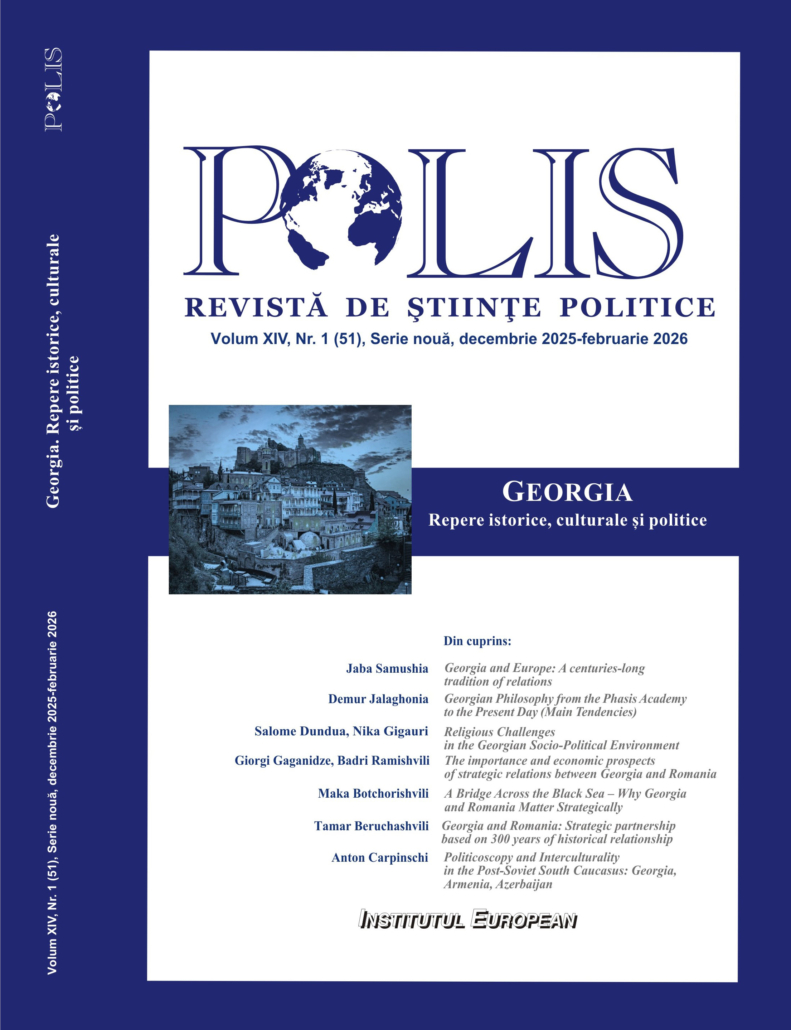
Coordonat de E.S. Tamar BERUCHASHVILI și Sabin DRĂGULIN
Volum XIV, Nr. 1 (51), Serie nouă, decembrie 2025-februarie 2026
Georgia. Historical, cultural and political landmarks
Tamar BERUCHASHVILI
Sabin DRĂGULIN
Abstract: The editorial staff of the science journal Polis, from Iași, has decided to continue its research activity by hosting an issue dedicated to Georgia in its pages. The initiative is part of a broader project that aims to present to readers and interested specialists articles and studies signed by university professors and researchers from Georgia and Romania. The collapse of the USSR in 1991 allowed the opening to the world of cultural spaces that for a long time were closed or at best semi-open. Georgia is a country that in its multi-millennium history came into direct contact with the great Greco-Roman culture and civilization, which left visible traces in the mythology, archaeology and culture of the Georgian people. Together with these elements of antiquity, Christianity represents the fundamental identity element of the Georgian nation. Due to its geographical position, Georgia is a gateway for the European Union to Asia. In this context, Georgia can become a multidimensional and multifunctional regional centre fundamental for connecting the middle corridor with Europe.
Keywords: Georgia, history, statehood, Christianity, continuity.
Georgia – a three-millennium history of statehood
Georgia, a country with a 3,000-year history, stands as a testament to the resilience and pride of its people. Nestled in the heart of the South Caucasus, Georgia is a cradle of ancient civilization, boasting a unique alphabet, language, and a Christian tradition that spans 17 centuries. Throughout its past, Georgia has managed to preserve its cultural identity, traditions and national character, despite centuries of invasions and conflicts.
Georgia’s strategic location has shaped country’s history and culture and continues to play an important role in the geopolitical context.
The nation’s history is a chronicle of struggle and survival, with its people fiercely protecting their homeland against invaders. Yet, amidst the turmoil, Georgia’s cultural environment has always been distinguished by exceptional humanism, tolerance and compassion. The country’s rich cultural heritage is reflected in its unique polyphony, national traditions and epic literature, such as Shota Rustaveli’s XII century epic poem „The Knight in the Panther’s Skin,” a masterpiece that embodies the spirit of Georgian culture.
Georgia’s European future starts with Georgia’s European past based on shared history, cultural roots and most importantly, shared values.
Since the beginning, Georgia has shared the three pillars considered to be at the foundation of Europe’s civilization: Greek and Roman heritage and Christianity. Antique Greco-Roman civilization has left its influence and visible marks in our mythology, archaeology, and culture. Christianity has been central to our identity as a Nation. As the kingdom converted to Christianity in 326, Georgia has been fighting for centuries to preserve its faith and identity against numerous empires and invaders. All along, on the Eastern shores of the Black Sea, it has served as a small Christian outpost facing the empires of Asia. This common heritage has influenced our core values. Among them, tolerance, protection of minorities, and human rights have been most significant. The capital city, Tbilisi’s architecture is a true testimony to this history: mosques, synagogues, Christian churches of various denominations, and even Zoroastrian sites coexist side by side. This long-standing tradition of peaceful coexistence between religions and cultures is best symbolized by more than 26 centuries of Georgians and Jews living together, free of any repression or discrimination. Today, 13,2% of Georgia’s population is of Armenian, Azeri descent, Osetian, Ukrainian, Greek, Kurdish or Yezidi heritage, maintaining the old tradition of hospitality that has reached well beyond our borders. As to gender equality, this very modern notion stands at the core of the national epos when Shota Rustaveli in the XII century already said: “ლეკვი ლომისა სწორია ძუ იყოს, თუნდაც ხვადია” (Lions cubs are equal, be they female or male). This again notion was also reflected in the role that women have played throughout our history: in the IV century, St Nino converted the Georgian state; Queen or as she was called, King Tamar reigning (1184-1213) over Georgia’s golden Age; or in 1919, the first Democratic Republic of Georgia giving women both the right to vote and be elected.
Today, as an EU candidate country since 2023, Georgia remains committed to the process of European integration that is our civilizational choice enshrined in the Georgian Constitution.
In a time marked by uncertainty, meaningful dialogue and close cooperation remain indispensable. Therefore, Georgia is committed to dialogue, peace and stability in the region. Amidst global challenges like conflicts, climate change, and humanitarian crises, Georgia contributes to transforming the South Caucasus and wider Black Sea region into a space of dialogue and economic prosperity. Drawing from our own bitter experience of the Russian invasion in 2008, the Georgian government supports initiatives like the US President Donald Trump’s efforts to end the Russia-Ukraine war as well as his peace deal between Armenia and Azerbaijan. Despite 20% of Georgia’s territory (historic regions of Abkhazia and Tskhinvali) remain under Russian occupation, we continue to pursue development and progress with great energy and determination. Georgia is stanch supporter of the UN principles and a multipolar international order, aiming to ensure global peace and stability. The Georgian government prioritizes peace and economic growth, improving the quality of life for its citizens despite external challenges.
Georgia’s strategic location, as the EU’s gateway to Asia, offers the shortest alternative route connecting Europe and Asia. In addition, important projects like the Middle Corridor, the Black Sea submarine electricity cable, and the Caspian-Black Sea-Green Energy Corridor provide opportunities for enhanced connectivity and energy security. The country is emerging as a multidimensional and multifunctional regional hub, actively modernizing its infrastructure, including roads, rail, sea and air transportation.
I would like to mention that the preparation of this editorial coincided with the important and highly symbolic event for my country: the inclusion of Georgian wheat culture traditions and rituals in the UNESCO List of the Intangible Cultural Heritage of Humanity! This fact inspired me to share the stories of the five elements of Georgian intangible heritage recognized by UNESCO as examples of traditions that define the identity of my country and people. These are: Georgian polyphonic singing, Ancient Georgian traditional Qvevri wine-making method, Living culture of three writing systems of the Georgian alphabet, Chidaoba – wrestling in Georgia and Georgian wheat culture: traditions and rituals.
Georgian polyphonic singing (in the UNESCO list since 2008) is a long-standing secular tradition that has helped preserve the country’s identity through centuries of foreign domination and cultural pressure, holds a special place in Georgian culture. There are three main styles of Georgian polyphony. The first is complex polyphony, found mainly in the mountainous region of Svaneti. The second, common in eastern Georgia’s Kakheti region, features a vocal dialogue built over a deep bass line. The third style, typical of western Georgia, is contrasted polyphony, with three vocal parts that allow a degree of improvisation. Many of these songs are connected to ancient rituals, such as the cult of the grapevine, and some can be traced back as far as the eighth century. Traditionally, polyphonic songs accompanied every aspect of daily life. They were sung while working in the fields, as in the Naduri songs that echo the rhythms of physical labour, as well as in healing rituals and Christmas carols known as Alilo. Georgian polyphony also influenced Byzantine liturgical hymns, becoming an important element of religious musical expression.
One well-known example of the Georgian polyphony is song Chakrulo, which was one of 29 musical compositions included in the Voyager Golden Records that were sent by NASA into space in 1977. Although Georgian traditional music survived the constraints of socialist cultural policies, it continues to require careful presservation. The Georgian State provides various programs aimed at safeguarding, studying and promoting this unique cultural heritage.
Archaeological evidence suggests that wine was first produced in Georgia around 8,000 years ago, earning it the title of the “cradle of wine.” Qvevri winemaking (in the UNESCO list since 2013) is practiced across Georgia, especially in village communities where distinctive local grape varieties are grown.
Georgian grape names are nearly always descriptive of their appearance or flavour, reflecting the historic widespread viticulture of the country. Georgia has at least 500 native varieties. Among them, around 45 varieties are commercially produced today, but the Georgian state is on a mission to save and reintroduce the old grapes. A Qvevri is a large, egg-shaped clay vessel used to make, age and store wine. The skills and knowledge involved in creating Qvevri and producing wine are passed down through generations, shared among families, neighbours and friends who come together during the grape harvest and wine-making season. After the grapes are pressed, the juice, along with the skins, stems and seeds, is poured into the Qvevri. The vessel is then sealed and buried underground, where the wine ferments for five to six months before it is ready to drink. This method of winemaking is still widely used in Georgia. Qvevri winemaking is more than a technique: it shapes the way of life of local communities and is an essential part of their cultural identity and heritage. Wine and grapevines appear frequently in Georgian songs, stories, and oral traditions, reflecting their deep-rooted significance in Georgian culture. Wine plays an important role in both religious and secular celebrations and rituals. Wine cellars are traditionally regarded as the most sacred space in the family home.
Living culture of the three writing systems of the Georgian alphabet (in the UNESCO list since 2015).
The Georgian alphabet is considered one of the 14 truly unique writing systems in the world. Over time, Georgia’s written language has developed three distinct alphabets: Mrgvlovani, Nuskhuri, and Mkhedruli. All three are still in use today. Mrgvlovani was the earliest form, from which Nuskhuri later evolved, followed by Mkhedruli. Each alphabet has its own cultural and social role, and together they reflect the richness and diversity of Georgian identity. Their continued use also gives communities a strong sense of historical continuity. Mrgvlovani and Nuskhuri are mainly practised and passed on within the Georgian Apostolic Autocephalous Orthodox Church. These alphabets appear in religious texts such as psalms and hymns, as well as in inscriptions on church objects, including icons. In addition, some theological schools, universities and scholars, including linguists and historians, continue to study and teach them. Mkhedruli, on the other hand, is the alphabet used in everyday life and forms the basis of Georgia’s education system. It is taught in primary and secondary schools and is also passed down informally within families, from older to younger generations.
Chidaoba, a traditional form of wrestling (in the UNESCO list since 2018), is one of Georgia’s oldest martial arts and is practiced widely across the country. It is popular among men of all ages and is carried on by young people, city residents, sports clubs, schools and amateur groups in both rural and urban communities.
Chidaoba is more than a sport. It brings together wrestling techniques with music, dance, and distinctive traditional clothing known as the chokha. Originally developed for combat purposes, Chidaoba gradually evolved into a public and ceremonial sport by the late Middle Ages. The sport follows a strong code of honour and fair play. At times, wrestlers even leave the arena by performing a Georgian folk dance, highlighting the close connection between physical skill and cultural expression. The specific fresco depicting wrestling was discovered in the Alaverdi Cathedral in the Kakheti region of Georgia. This medieval wall painting, dating back to the 11th century, shows two men engaged in a wrestling match and is one of the earliest known visual representations of Georgian wrestling.
Georgian wheat culture: traditions and rituals (in the UNESCO list since 2025) is built around the cultivation and use of local, endemic varieties of wheat, along with traditional tools such as stone mills and hand-made bread ovens. For local communities, wheat symbolizes life, growth, and abundance. Families and villages follow time-honoured customs for planting and harvesting, saving the best grains for special occasions, including ritual meals and religious holidays. Wheat culture fosters cooperation, hospitality, and respect, and the tradition of baking and sharing ceremonial bread remains a powerful symbol of prosperity and fertility. Typically, men take care of the fieldwork, while women manage the wheat stores and bake bread for ceremonies. Knowledge and skills are passed down through participation in family and community events such as births, weddings and funerals. Of the 27 cultivated and wild wheat species recognized worldwide today, 14 are found in Georgia, among them, 5 are endemic. Certain varieties of wheat that are evolutionarily close to wild species have been preserved exclusively in Georgia, such as Zanduri, Kolkuri Asli and Makha. Archaeological studies conducted on Georgian sites have uncovered wheat remains dating back to the 6th millennium BC, confirming that for 8,000 years – parallel to the ancient tradition of winemaking, the cultivation and sowing of Georgian wheat has continued uninterrupted.
All five elements of Georgian intangible heritage are deeply interconnected and together form a coherent cultural system that shapes Georgia’s national identity. Rather than standing alone, they reinforce one another through shared values, social structures and symbolic meanings. Continuity and resilience unify these elements. The Georgian alphabet preserved language and knowledge through centuries of foreign domination, just as polyphonic singing and ritual practices safeguarded cultural memory. All five elements embody a distinct Georgian worldview – one that values harmony (in music), balance (between nature and human labour), honour and discipline (in wrestling), spirituality and literacy (in the alphabets) and abundance shared through hospitality (in bread and wine). Together, they tell a single story: of a nation whose identity is not defined by borders or monuments alone, but by living traditions that continue to shape everyday life.
Finally, it could be said, that the Georgia’s story is one of resilience, cultural richness, and a deep commitment to peace and cooperation. With its rich history, cultural heritage and commitment to peace, Georgia stands ready to engage in dialogue on global and regional issues as the world navigates pivotal moments. There is a strong willingness to overcome challenges and unlock opportunities for future generations for a more stable and prosperous future in the Black Sea region and beyond.
As the country looks to the future, it does so with a sense of pride in its past and a vision for more harmonious tomorrow.
Cultural diplomacy
and political science magazine Polis, from Iași
The aim of the coordinators of this issue of the political science journal Polis is to bring to the attention of the interested public at home and abroad a series of articles and scientific studies aimed at illustrating significant episodes in the history of Georgia. Located on the other side of the Black Sea, Georgia is an emblematic example of a country whose people, and later the nation, have manifested a constant European vocation over the millennia. It has been in direct contact with European civilization and culture, whether in its Greco-Roman, Byzantine or Western forms, but which, as a result of its geographical position, has been attracted in different historical periods also to the sphere of oriental culture and civilization.
Of course, this latter space also experienced remarkable cultural and civilizational values, superior in certain historical eras to those of Europe. However, the emergence and development of humanism and the Enlightenment led, in Europe, to the configuration of a type of modernity that raised the individual to a new level of political and social existence, that of “citizen”. Within a society characterized by a special cultural wealth, at the level of Georgian thought, an aspiration emerged over time that, at certain historical moments, transformed into necessity and political will: that of breaking away from a model of thinking perceived as excessively restrictive for the ideal of personal liberation.
In this sense, assuming the inherent limits of the knowledge of a cultural and civilizational space of particular complexity, spread over several millennia and marked by diverse historical experiences, one can identify a state of mind that explains why a significant part of the citizens of contemporary Georgia express their desire for integration into the European Union. The European space of thought, which was the basis for the establishment of nation-states and transformed the status of the individual from that of subject to that of member of a nation of citizens, has exerted a constant attraction on the peoples located on its borders. It is a reference model to which individuals animated by the desire for freedom and civic participation aspire.
Romanians and Romania have had a similar historical experience, facilitated by a geographical context that favored a closer proximity to Western Europe compared to Georgia. However, beyond the differences in context, what remains fundamental, regardless of the era, vicissitudes or difficult geopolitical circumstances, is the maintenance of this permanent thirst for freedom.
In the view of the members of the editorial board of Polis magazine, dialogue – in this case a cultural and scientific dialogue – represents one of the most effective ways of mutual knowledge. Only through knowledge can stereotypes generated by ignorance be overcome. Culture, regardless of its forms of expression, constitutes an essential tool for opening a dialogue that will facilitate, over time, a substantial political and economic integration.
The corpus dedicated to the history and culture of Georgia brings together 18 contributions, of which 15 come from the Georgian academic environment and 3 from the Romanian one. The approaches are diverse and cover fields such as historiography, philosophy, diplomacy, economics, geopolitics, bilateral relations Romania-Georgia, minority issues, religion, as well as other related areas. The ordering of the articles and studies was carried out according to chronological and thematic criteria.
The thematic issue dedicated to Georgia opens with the contribution of Professor Jaba Samushia, Doctor of History and Rector of the Ivane Javakhishvili State University in Tbilisi. Right from the title – Georgia and Europe: A centuries-long tradition of relations – Georgia’s aspiration to join the European family is explicitly formulated. This option, the author emphasizes, is anchored in a long historical process, shaped by factors such as geography, culture, religion and security imperatives. The geopolitical position of the Georgian state, located at the crossroads of Europe and Asia, has over time constituted a space of interaction between Eastern and Western civilizations; however, Georgia has constantly identified with the Western cultural and political sphere. Even though the same geographical position attracted periods of foreign domination, which determined a temporary distance from the European cultural and civilizational space, the European vector remained a central element of Georgian statehood. The conclusion of the article is that Georgia’s contemporary approach to European integration represents the continuation of a deeply historically anchored civilizational choice.
Professor Demur Jalaghonia, PhD in Philosophy, is distinguished by an exceptional institutional career, among the positions held, the one of director of the Department of Political Philosophy is worth mentioning. His contribution, entitled „Georgian Philosophy from the Phasis Academy to the Present Day (Main Tendencies)”, highlights the fact that Georgian philosophy benefits from a long and consistent tradition, which extends over fifteen centuries, starting with the 4th century. This tradition reached remarkable levels in the 11th, 12th, 19th and, later, in the 20th century. Georgian thinkers often familiarized themselves, even simultaneously, with the philosophical heritage of Antiquity, the Middle Ages and the modern era, interpreting, translating and elaborating original works. Through these efforts, they integrated themselves into the dominant intellectual paradigms of their eras and actively contributed to addressing and developing fundamental issues of philosophy. The author’s conclusion is that this multi-century tradition provides a solid basis for speaking, with full legitimacy, about the existence of a “Georgian philosophy”.
Professor and historian Dimitri Shvelidze proposes an article entitled „Diplomatic Structures of the Democratic Republic of Georgia (1918-1921)”, the subject addressed being in full accordance with his specialization in the modern and contemporary history of Georgia. The study is structured around three main thematic directions. The first one aims at the establishment of the Ministry of Foreign Affairs of the Democratic Republic of Georgia and its activity in the direction of establishing diplomatic relations with as many states as possible. The second theme analyses the network of embassies and consulates opened by foreign states on the territory of Georgia. The third research direction focuses on the identification and description of Georgian diplomatic missions abroad in the period 1918-1921. The author demonstrates that the young and still insufficiently recognized Democratic Republic of Georgia managed, despite the difficult international context, to establish contacts and diplomatic relations with numerous countries. Its independence was recognized de jure only on January 27, 1921, just a few weeks before the invasion of Georgia by Soviet Russia.
Lela Tsiphuria, PhD in Arts, screenwriter, producer and film director, signs the article entitled „Becoming from Real Story in Surrealist Feature Film in the Most Anti-Soviet Film, in Tengiz Abuladze’s “Repentance””. This contribution provides access to a moment of political dissidence manifested in the midst of the Soviet period. Specialists consider the film Repentance, made in 1984 by Tengiz Abuladze, to be one of the most anti-Soviet cinematographic productions in the former Soviet Union. Although Soviet censorship was still extremely severe during the years the film was made, it was the first not only in Georgia, but in the entire USSR space, to openly and critically address the issues of Soviet totalitarianism and the Great Purge.
A landmark contribution, which makes the transition from the communist to the post-communist period, is the study signed by professor and economist Avtandil Silagadze, entitled Contemporary Trends in the Georgian Economy. The author is, among others, a member of the National Academy of Sciences of Georgia and the International Academy of Sciences, Education, Industry and Arts of the United States of America. The paper analyzes the main contemporary trends of the Georgian economy, systematically examining the evolution of economic growth, the current state of various economic sectors, the dynamics of employment and unemployment, foreign investment flows, trade-related challenges, the level of international reserves, external public debt, remittance patterns, inflation, poverty, as well as other relevant aspects. According to the study’s conclusions, the Georgian economy is on a positive growth trajectory in the post-pandemic period.
Tengiz Pkhaladze is a prominent political scientist and public opinion leader with extensive experience in governance, diplomacy, civil society, academia, and think tanks. His areas of expertise include foreign and security policy, geopolitics, Russia and the post-Soviet space, the Eastern Partnership, and European and Euro-Atlantic integration processes. His contribution, titled „Ideological Foundations of Russian Aggression in Georgia (August 2008)”, analyses the Russian Federation’s military aggression against Georgia in August 2008 as a watershed moment in the post-Soviet international order. The author highlights that this episode marked the first open, large-scale use of the regular armed forces of the Russian Federation beyond its national borders for offensive military purposes, leading to the illegal occupation of parts of the internationally recognized territory of a neighbouring state. Another dimension of the analysis concerns the role of Eurasianist, understood both as a long-standing intellectual tradition and as a contemporary political discourse, in shaping the way Russian political elites interpreted Georgia, the Caucasus, and Russia’s regional role. The author’s position is that the 2008 aggression translated Eurasianist narratives into concrete political practice, through mechanisms of discursive legitimation, spatial reimagining, and symbolic restoration. In this sense, the Georgian case anticipated Russia’s annexation of Crimea in 2014, as well as the large-scale military intervention in Ukraine, launched in 2022.
Professors Giorgi Gaganidze, Dean of the Faculty of Economics and Business, and Badri Ramishvili, both prestigious economists, sign the article entitled „The Importance and Economic Prospects of Strategic Relations between Georgia and Romania”. The central theme of the study consists in the analysis of the historical relations between Georgia and Romania, based on cultural-religious and commercial ties. The first element highlighted is represented by an emblematic figure that connects the two cultural spaces: Saint Antim the Ivirian, born in Georgia, who later became a major spiritual and cultural personality in Romania. The second element refers to the commercial dimension of bilateral relations. In the authors’ view, economic cooperation between Romania and Georgia is based on solid foundations and is in an upward trend, especially in the field of trade and emerging strategic projects.
Professor Ketevan Khutsishvili proposes the article entitled „The Strategies on Cultural Heritage: Challenges and Discourses in Urban Environment (The Case of Georgia)”. Although this contribution may seem, at first glance, atypical within the thematic corpus, it brings a particularly relevant angle of analysis to the issue of cultural heritage in Georgia and the challenges specific to the contemporary urban environment. In the context of modern Georgia, the theme of cultural heritage protection gains increased importance, and the proposed analysis pertinently complements the historical, political and economic perspectives brought together in this file.
The contribution entitled „Religious Challenges in the Georgian Socio-Political Environment” is signed by Professors Salome Dundua and Nika Gigauri. Salome Dundua is, among others, Dean of the Faculty of Social and Political Sciences, within the Department of Political Science of the Ivane Javakhishvili State University of Tbilisi. Nika Gigauri is an Assistant Professor at GIPA – Georgian Institute of Public Affairs and Manager of the Quality Assurance Service.
The study aims to analyse a sensitive issue of contemporary Georgian society, that of religious conflicts. In this regard, the authors aim to identify the factors that generate tensions between Georgian Muslim communities and Orthodox Christians, as well as to assess the effectiveness of the state response in the process of managing and resolving these conflicts. The conclusion of the research is that state institutions demonstrate a limited capacity to act as an “arbitrator” in the regulation of religious conflicts, and public policies are oriented more towards conciliating conflict situations than towards addressing the structural causes that led to their emergence.
Professor Otar Janelidze is a leading figure in the field of Georgian history and culture. A doctor of history, specializing in the history of Georgia, the history of Georgian emigration and the relationship between history and politics, he signs the article entitled „The Issue of National and Religious Minorities in the Democratic Republic of Georgia”. Although the Democratic Republic of Georgia existed for only three years, the author emphasizes that it constituted a notable precedent in modern political history, being the first case in which a government was led by a social-democratic party.
The central theme of the article is the analysis of the policies applied towards national and religious minorities during the existence of the Democratic Republic of Georgia. According to the author, the religious policy of the state leadership was characterized by tolerance, and minorities enjoyed the right and the effective opportunity to participate in political, economic and cultural life. Their rights were guaranteed by a coherent legislative framework, which included the Law on the State Language, the Regulation on Citizenship and the Constitution.
The article entitled „Quota-Based Approaches to Ethnic Minority Integration in Higher Education: The Case of Georgia” concludes the series of three contributions dedicated to the issue of minorities. Signed by Tamar Karaia and Lika Kvinchia, the study approaches the integration of ethnic minorities in Georgia from the perspective of education and civic identity formation. Tamar Karaia is a doctor in political science, with specializations in the politics of memory, archival politics, social movements, identity transformation and civic education. Lika Kvinchia is a lecturer in political science at the Ivane Javakhishvili State University of Tbilisi and holds a master’s degree in public administration and public policy, as well as a bachelor’s degree in political science.
The article analyses the integration of ethnic minorities in Georgia through the lens of language education and strengthening civic identity, focusing on educational initiatives aimed at enhancing social cohesion. The authors argue that learning the official language and foreign languages by minority students is not only an educational process, but also an identity-forming one, which facilitates the promotion of a common civic identity, without affecting the cultural distinctiveness of these communities. Strengthening these dimensions contributes to building a more united and inclusive society in Georgia.
The article entitled “Two Important Episodes from the History of Relations between the Georgian and Romanian Orthodox Churches” is signed by historians Mikheil Kartvelishvili and Eter Bokelavadze.
Mikheil Kartvelishvili is a specialist in the history of religions, historiography and international politics, and Eter Bokelavadze is a researcher and guest lecturer at the Faculty of Psychology and Educational Sciences of the Ivane Javakhishvili State University of Tbilisi. The article signed by the two authors aims to analyse lesser-known episodes of Romanian-Georgian relations, which have not been the subject of dedicated scientific research to date. The subject of the study is the visit of the Patriarch of the Romanian Orthodox Church, Justinian, to Georgia in 1948, and the ecclesiastical relations generated by it, as well as the visit of the Georgian Orthodox Church delegation to Romania in 1986, in the context of a long history of Georgian-Romanian political and religious relations, which extends over several centuries.
Rozeta Gujejiani is an Associate Professor of Ethnology-Anthropology at the Institute of Ethnology-Anthropology of the Ivane Javakhishvili State University of Tbilisi. Her study explores two exemplary theological and moral approaches to repentance, reflected in the lives and writings of two major figures of Georgian and Romanian spirituality: Saint King David IV of Georgia, known as David the Builder, and Saint Antim the Ivirian, a hierarch of the Romanian Orthodox Church. Although they lived in different historical eras, the analysis highlights the fact that both thinkers belong to the same conceptual and intellectual tradition. In their view, repentance is not reduced to simple remorse for sin, but constitutes a conscious act of spiritual reorientation, an authentic return to God. Through their teachings, the two saints encourage constant examination of one’s own life, the practice of moral self-evaluation, and the relentless search for divine guidance.
In a complementary perspective, Professor Anastasia Zakariadze proposes the article entitled “The Beginning of Renewed Life – A Code of Repentance (Saint David the Builder and Saint Anthim the Iberian)”. The author is, among others, the director of the Scientific Research Center for Philosophy and Theology “Antim Ivireanul” within the Institute of Philosophy. Her contribution discusses the correlation between traditional lifestyles and religious beliefs, while analyzing the social interactions associated with sacred places and sacred objects, in the context of religious practices and community identities.
Continuing the presentation of Antim Ivireanu’s personality, the contribution of researcher Nicoleta Zagura, who built a career at the intersection of academic research, cultural management and heritage diplomacy, entitled “Constantin Brâncoveanu and Antim Ivireanul – Culture as a Strategy of Resistance in the Orthodox World under Ottoman Domination”, is presented.
The author brings together two great Christian, Orthodox personalities of the first half of the 18th century; Constantin Brâncoveanu and Antim Ivireanu, who died as martyrs in 1714 and 1716. The work of these cultural personalities moved towards a theological and historical model of resistance based on faith, education and dignity. The Brâncoveanu era thus appears not only as a political episode, but as a fundamental moment in the articulation of Orthodox culture as a strategy of survival and resistance under Ottoman domination.
The last part of the thematic section, which addresses topics regarding politics, geopolitics, democratic governance, power and interest groups, etc., includes three articles.
The first of these is entitled “Slipping and Sliding Between Formalities and Informalities: Lobbying, Interest Groups, and Democratic Governance in Georgia” and is signed by Nino Machurishvili and Irakli Samadalashvili.
Nino Machurishvili is an Associate Professor at European University, Tbilisi, and works at the Ministry of Education, Science and Youth of Georgia.
Irakli Samadalashvili, an Ph.D. candidate, is a political scientist specializing in governance, political systems, and institutional dynamics in post-Soviet contexts. The article analyses the complex interaction between formal regulatory frameworks and informal political practices through the lens of lobbying in Georgia.
The analysis documents how formal lobbying mechanisms, designed to ensure transparency and accountability, may remain underutilized or bypassed in political cultures where influence is traditionally mediated through personal networks and informal channels.
Anton Carpinschi is Professor Emeritus of the “Alexandru Ioan Cuza” University of Iași and Doctor Honoris Causa of the “Petre Andrei” University of Iași. His study, entitled „Politicoscopy and Interculturality in the Post-Soviet South Caucasus: Georgia, Armenia, Azerbaijan”, is an essay in applied political philosophy, which proposes a critical analysis of multiculturalism and interculturality in the post-Soviet South Caucasus, using an integrated theoretical framework of political analysis and comparative cultural studies. The central argument argues that the limits of interculturality in Georgia, Armenia and Azerbaijan cannot be explained exclusively by institutional or geopolitical constraints, but must also be understood as the result of a specific configuration of cultural values, collective cognitive representations and political strategies oriented towards the securitization of difference.
The last contribution of the file belongs to two Romanian researchers in the field of sociology; Ciprian Iftimoaei is a sociologist and professor at the “Petre Andrei” University of Iași and Vicențiu-Robert Gabor is a statistician and assistant professor at the Faculty of Geography and Geology of the “Alexandru Ioan Cuza” University of Iași and presents us with the contribution entitled „Geopolitical risks and insecurity in the South Caucasus. The role of geographical constraints in the case of Georgia”.
In the authors’ opinion, the South Caucasus region is characterized by a high level of geopolitical instability, determined by the overlapping of frozen conflicts, the competition between regional and extra-regional actors and the structural vulnerabilities of the states in the area. In this context, the article analyses the role of geographical constraints in generating and perpetuating insecurity, taking Georgia as a case study. The premise from which the analysis starts is that geography is not a simple passive framework of international relations, but an essential explanatory variable that shapes the strategic choices, foreign policy behaviour and security vulnerability of small states.
Instead of conclusions
The intention of the coordinators of this issue was to identify specialists from various fields, capable of covering, through their contributions, a broad period of Georgian history and culture. In this endeavour, the role of Ambassador Tamar Beruchashvili was essential1. The difficulties inherent in approaching a history that spans several millennia are obvious, and the present issue of Polis magazine did not aim to provide an exhaustive treatment of this vast thematic field, but rather to outline relevant analytical benchmarks and stimulate interdisciplinary academic dialogue. Through the 18 articles, studies and essays signed by professors and researchers with solid academic experience, the reader has access to relevant fragments of the history of Georgia. The history of a people, a nation or a state cannot be contained within the limits of a single issue of a magazine, and the intention of the coordinators of this thematic file was not, as previously stated, an exhaustive one. The intended approach was to open a broad perspective on a historical, cultural and political space insufficiently known in Romania, in an intellectual context often dominated by ethnocentric and Eurocentric landmarks.
Note
- The Romanian coordinator of this issue would like to thank Ms. Mariam Tsereteli ( Minister Extraordinary and Plenipotentiary of the Embassy of Georgia to Romania), for the support she provided during its editing.