


Coordonatori: Sabin Drăgulin, Sorin Bocancea și Angelo Chielli
Volum XIV, Nr. 2 (52), Serie nouă, martie-mai 2026
Young Researchers’ Perception in Romania on Involvement in Democratic Life – Methodological Perspectives
Mirela-Emilia MIRONIUC
Abstract: This paper aims to analyze the perceptions of young people in Romania regarding the instruments of participation in democratic life in the period 2020-2024. The research problem in the field of international relations is represented by the low involvement of young people, a significant category of society, in democratic life, which exacerbates the democratic deficit. The research question that we will try to answer is the following “How do we streamline the process of using instruments of involvement in democratic life so as to reduce the democratic deficit?”. The purpose of the paper is to bring a range of theoretical contributions and a contribution to the specialized literature and the academic environment regarding the assessment of the level of awareness and knowledge of young people about democracy. The research method used in the data collection process will be a mixed method, this means the use of both quantitative and qualitative analyses. First, we will select the Eurobarometers from the period 2020-2024 and look at how they target the instruments of involvement in democratic political life and what is the level of knowledge and existence of a security culture. Second, we will conduct 50 semi-structured interviews with young researchers from Romania who study or are graduates of the field of political science, international relations, European studies and security studies. The data analysis method is a mixed one, being both qualitative and quantitative. We will use multiple regression to analyze the Eurobarometers and deductive thematic analysis to analyze the semi-structured interviews. At the end of the paper, we are surprised by the fact that improving the efficiency of the use of democratic participation instruments among young people to reduce the democratic deficit can be achieved through a series of strategies and measures. Among these, the integration of civic education into the school and university curriculum, the organization of information and awareness campaigns, or even the simplification of participation procedures stand out.
Keywords: European citizenship, Europeanization, democratic deficit and intentional political socialization.
Introduction
The European Union represents a main pillar internationally through the principles of peace, respect for citizens’ rights and freedoms, promotion of the rule of law and democracy1. The notion of “being European” is mainly understood in an abstract sense rather than as a “strong sense of identity and shared belonging”2. Precisely for this reason, it is desired to draw guidelines between being European and feeling European, knowing one’s rights and activating one’s European citizenship. In a representative democracy, the form of government derives its power from the participation of citizens in the political decision-making process3. Democratic renewal represents a main pillar in the international agenda in a continuous process of metamorphosis. Dynamism and innovation are just some of the mechanisms through which citizens bring new ideas and innovative approaches that can reinvigorate democratic processes.
From the general spectrum of the term citizens, we identify a category that often identifies itself as open to change and more receptive to new technologies, which can modernize and make democratic systems more efficient. Young people represent the future generations and it is essential that the concerns, needs and voice of their generation, but also of future ones, are integrated into current policies. The involvement of young people ensures a greater diversity of opinions and perspectives in public debates and the decision-making process. In addition, active participation in democratic life helps them to better understand political processes and become informed and responsible citizens.
Young researchers represent an important category of society in terms of involvement in the valorization of a democratic culture, respect for the rights and freedoms of citizens and in the process of reducing the democratic deficit. The research problem in the field of international relations is represented by the low involvement of young people, a significant category of society, in European democratic life, which exacerbates the democratic deficit. This paper does not aim to measure the involvement or lack of involvement of young people, but rather to analyze their perceptions of the instruments offered by the European institutions and the mechanisms underlying their use or non-use.
This paper aims to analyze the perceptions of young researchers in Romania regarding the instruments of participation in European democratic life, during the period 2020-2024. This period captures a series of changes on the national and international agenda, such as the Covid-19 pandemic, vaccination, the onset of waves of Euroscepticism and the rise of parties with nationalist and populist visions. The research question we will try to answer is the following: “How do we streamline the process of using the tools so that there is greater involvement in European democratic life?” The research hypotheses, consisting of variables, set and which, following the research, will be validated or not, are the following: “The level of awareness, lack of information and the perception of ineffectiveness of the instruments exacerbate the democratic deficit”, “Adequate civic education and an active civic family environment positively influence the perceptions of young people.” At least one should be validated
The objectives of the research are multiple, but the general objective captures the analysis of the perceptions of young people in Romania on the instruments available for participation in European democratic life. This is joined by a series of specific objectives, as follows: Assessing the level of awareness and knowledge of young people about European democratic instruments; Identifying the motivations and barriers for the participation or lack of participation of young people in European democratic processes; Analyzing the influence of the educational and family environment on the perceptions of young people. The purpose of the paper is to analyze the new generation of young people studying Political Science or related fields, aged between 18-35. Moreover, the paper aims to launch a series of contributions to the specialized literature, in the academic environment, a range of theoretical aspects and a contribution to the specialized literature on the democratic participation of young people in the European context.
At the same time, it also presents a practical component regarding the assessment of the level of awareness, knowledge and improvement of the methods by which young people use European democratic instruments, which would lead to the improvement of the democratic participation of young researchers in Romania. The relevance of the theme is provided by the importance of the subject, in particular, the involvement of young people, who represent an extremely important category of active citizens in European democratic life, in academic writing. The importance of the theme is also provided by contemporary society, the dynamics of events, political metamorphoses and the totality of events regarding the era of globalization and interdependence in which we find ourselves. The motivation for choosing this theme lies in the lack of identification of a specialized literature that would present the perceptions of young people in Romania about European democratic life, being collaborated primary data from the Eurobarometers and the conduct of related interviews.
Theoretical chapter
Literature review
In the following, we will try to present a brief review of the existing literature on the topic of youth participation in European democratic life and to highlight the gaps in knowledge, especially those related to Romania. Participation in civic and political initiatives develops important skills, such as leadership, negotiation and communication4. Involving young people in the democratic process can increase their trust in political institutions and contribute to their legitimacy. Promoting youth involvement contributes to the consolidation of a more cohesive and inclusive society, in which all citizens feel represented and valued5. By actively participating in European democratic life, they can contribute to the consolidation of the European project and the promotion of common European values. Young people can bring Romania’s specific problems to the attention of European institutions, thus ensuring that their country’s interests are taken into account in decisions taken at the European Union level. The involvement of young people in Romania in European democratic life is vital for the health and evolution of democracy, both at national and European level6. It is a process that benefits not only young people, but the whole society, contributing to the development of a robust, inclusive and adaptable democracy to future challenges 7.
Analytical framework
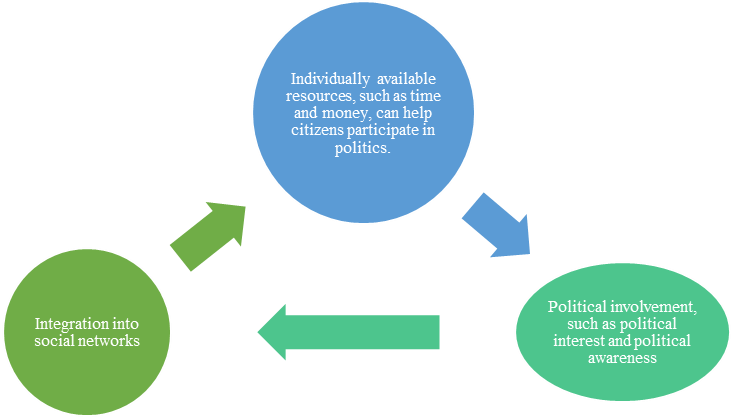
Individually available resources, such as time and money, can help citizens participate in politics. Political involvement, such as political interest and political awareness, can be classified as a second explanatory factor. Integration in social networks is the third explanatory factor. This determines whether citizens are confronted with details about participation opportunities8. All of these are influenced by the age, gender, sex, education, occupation and social experiences of young people.
Methodological chapter
Case selection
Romania can be classified, according to the specialized literature and methodological patterns, as a deviant case, being a young democracy, accession to the EU having taken place recently, more precisely on January 1, 20079. Accession to the European Union represents only one pillar and a true argument for Romania’s positioning as a young democracy. To these can be added a series of internal problems, institutional inefficiencies, the cumbersome construction of a vibrant civil society. Democracy in Romania has undergone a wide range of metamorphoses, presented gaps and has been subject to internal and external risks, threats and vulnerabilities due to institutional inefficiencies, but also to the lack of civic involvement. While some commentators speak of a crisis of democracy, others refer to a “fear of politics” or a “democracy deficit”10. This period captures a series of changes on the national and international agenda, such as the Covid-19 pandemic, vaccination, the onset of waves of Euroscepticism, and the rise of parties with nationalist and populist visions.
Elements/pillars such as civic education, civic culture, civic spirit in Romania, knowledge of civil rights and freedoms, engagement in civic activities, vibrant civil society or not are the subject of extensive debates in the public space. The lack of the above-mentioned brings with it the exacerbation of the democratic deficit, respect for the rule of law, alignment with European standards and the emancipation of citizens in the process of forming a political culture. Their implementation leads to the nuance of an intentional political socialization in which either through institutional factors such as state bodies or educational units, or with the help of society, family and groups of friends, young people are informed, aware and learn/acquire democratic values.
Romania’s internal architecture, democratic political regime, semi-presidential republic form of government, influence/importance of state institutions in disseminating information about European democratic life, creating dialogue between them and young people. Significant democratic risks at the societal level, the growth of liberal policies brings with it social and income inequalities. Europe has entered a “democratic recession” in which new and old democracies alike have fallen victim to a “strong authoritarian countercurrent”11. Youth in Romania are facing one of the most difficult transitions from education to working life among all EU member states.
After going through the entire process of construction, architecture and policies, in symbiosis with the research subject, Romania, it is necessary to focus our attention on the knowledge, awareness and activation of civil rights and freedoms at the level of Romania among young people, a category that represents the target citizens of the study. Young people represent a significant category of Romanian society, and their actions and beliefs are reflected on their existence and society. Since there are considerable challenges in defining what we understand by the term “youth” how it relates to “maturity” and what the implications are in delimiting the allocation of rights.
Knowing today’s young people and how they perceive the world around them, in this case European politics and democratic life, means crossing some guidelines regarding “tomorrow’s history”. Young people are a social category with specific needs, but who, for various reasons, are not as active in the electoral process compared to the rest of the citizens with the right to vote, they have a predisposition to criticize the system, but they do not get involved in implementing reforms. Representing a small electoral mass, politicians will focus on creating a political program that respects the needs and desires of their main political clientele, thus, young people end up being neglected and treated superficially. The antagonism between young people and the political field, whether at an internal or external level, seems to be, upon a first reading of a certain part of the specialized literature or upon listening to the various voices in society, quite pronounced. However, the ways of interaction and involvement of young people in democratic life seem to have changed in recent years, starting from conventional forms of participation, such as voting, and ending with activation in specialized non-governmental organizations. Young people are not disinterested, they look at politics and get involved in other ways.
In this context, we propose to analyze the mechanisms for involving young people in European democratic life12. Moreover, since the aim is not to quantitatively analyze their use or non-use, we will focus on perceptions of the instruments that European institutions make available to citizens and the efficiency of their functioning. The socioeconomic level of young people, as they develop, is one of the most important factors in describing their economic, social and political development throughout their lives13.
What does youth political involvement depend on? It is a common rhetorical question. Socio-economic status , individually available resources such as time and money are just a few of the factors that can help citizens participate in politics. Political involvement, such as political interest and political awareness can be classified as a second explanatory factor. Integration in social networks is the third explanatory factor. This determines whether citizens are confronted with details about participation opportunities14. All of these are influenced by the age, gender, sex, education, occupation and social experiences of young people. Labor market insertion of young people in Romania.
The category of young people in Romania, which represents the target group of the research, includes citizens aged 18-35 who are studying or have graduated in the field of political science, international relations, European studies and security studies. The young people interviewed are representatives of each region in the country, as follows: Transylvania; Oltenia; Muntenia; Moldova; Bucovina; Dobrogea; Crișana; Banat; Maramureș. Similar to the data specified above, the young people come from a balanced rural area in a percentage of 50% and urban in a percentage of 50%. The selection of the gender of the respondents was also fair, 25 respondents being female and the remaining 25 being male. At the level of education and profession, young people come from different categories : students, university graduates, while the occupation varies from students, master’s students, doctoral students, teachers, doctors, administrative staff and even unemployed.
Following consultation of the Eurobarometers covering the years 2021, 2022, 2024 and the identification of values that highlight the use of three instruments of involvement in European democratic life, such as European parliamentary elections, participation in demonstrations and activation in NGOs (each of them oscillatory, but being the most usable), we will try, with the help of interviews, to explain the choices behind the numbers and to understand young people’s perception of the instruments made available by European institutions and to observe their efficiency and effectiveness or even the opposite.
Data collection method
The data collection method itself exemplifies the mechanism by which we reach the information we need to conduct research15. An important point that we need to reach from the beginning of the work is the choice of a method by which we reach the notions we need16. Whether we are talking about specialized works that we find at the level of books, articles, collective volumes, or whether we refer to official websites of institutions that present information of public interest, speeches of certain personalities, images, ethnographies, netnographies or interviews and questionnaires, each reprints an efficient working method with the help of which we reach the stage of knowledge on different issues and specific contexts. In the research we are conducting, a rather comprehensive approach is considered appropriate. More than the complex nature, it is necessary to collect and subsequently analyze the data from a looser perspective, which will give us the opportunity to study in depth the perceptions of young people in Romania.
The research method used in the data collection process will be mixed method, meaning the use of both quantitative and qualitative analyses. First, we will select the Eurobarometers from the period 2020-2024 and look at how they target the instruments of engagement in democratic political life. Second, we will conduct 50 semi-structured interviews (the number may vary) to find out the motivations behind the answers provided and to identify the factors that influence the perceptions of young people. The sample includes young people aged between 18 and 35 from Romania. This will be a representative one, with the aim of including various social and educational backgrounds.
Data collection is par excellence a defining stage in research, being the basic point of the entire analysis that I am about to carry out. The data collection method itself exemplifies the mechanism by which we reach the information we need to carry out the research. An important point that we need to reach from the beginning of the work is the choice of a method by which we reach the notions we need. Whether we are talking about specialized works that we find at the level of books, articles, collective volumes, or whether we refer to official websites of institutions that present information of public interest, speeches of certain personalities, images, ethnographies, netnographies or interviews and questionnaires, each reprints an efficient working method with the help of which we reach the stage of knowledge on different issues and specific contexts.
In the research I am conducting, I have considered a more comprehensive approach appropriate. More than the complex nature, I tend to collect and subsequently analyze data from a looser perspective, which would give me the opportunity to study in depth the perceptions of citizens regarding freedom of movement, their experiences, the feelings they have experienced and all the other issues they have encountered. Thus, the most appropriate and appropriate method that I have identified and with which I will collect the data I need in the analysis is the interview. The motivations underlying the choice of qualitative research over quantitative one refer to the fact that qualitative research is an umbrella term for a wide variety of approaches and methods found in the mysteries of life and social sciences. The information or data collected and analyzed is primarily (but not exclusively) non-quantitative in nature, consisting of textual materials such as interview transcripts, field notes, and documents.
EUROBAROMETER
There is a bidirectional relationship between research questions, theoretical approaches and related methods. The dependent variable is what is being studied, in this case, European democratic life, while the independent variables are factors that affect the dependent variable, namely time and money, political involvement and integration into social networks. The Eurobarometers that we will use and refer to as primary data cover the period 2020-2024.
The first instrument of interest for research and which we will analyze is the participation of young people in the European parliamentary elections. Year 2021 – 49%, year 2022-35%, year 2024-35%, which highlights a downward trend in the participation of young people in the European parliamentary elections, which obviously did not take place every year, but our study does not analyze the number of young voters, in concreto, but the perception of the instruments, as stated at the beginning of the thesis. The second form of manifestation of interest for young people in European democratic life, according to the Eurobarometer, is participation in protests and public demonstrations. Year 2021 – 35%, year 2022 – 21%, year 2023 – 13%, a downward trend can also be identified. The third instrument refers to the registration and activation of young people in non-governmental organizations whose objective is to promote European values and norms. Year 2021 – 17%, year 2022 – 31%, year 2023 – 16%, a substantial increase of 14% is noted between 2021 and 2022, then an equally significant decrease of 15% between 2022 and 2023, and the causes need to be identified and analyzed.
| Year | European Parliament elections | Participation in protests and demonstrations | Activation in NGOs |
| 2021 | 49% | 35% | 17% |
| 2022 | 35% | 21% | 31% |
| 2024 | 35% | 13% | 16% |
SEMI-STRUCTURED INTERVIEW
Data collection is par excellence a defining stage in research, being the basic point of the entire analysis that I am about to carry out. The data collection method itself exemplifies the mechanism by which we reach the information we need to carry out the research17. An important point that we need to reach from the beginning of the work is the choice of a method by which we reach the possession of the notions we need. Whether we are talking about specialized works that we find at the level of books, articles, collective volumes, or whether we refer to official websites of institutions that present information of public interest, speeches of certain personalities, images, ethnographies, netnographies or interviews and questionnaires, each reprints an efficient working method with the help of which we reach the stage of knowledge on different issues and specific contexts18.
In the research I am conducting, I have considered a more comprehensive approach appropriate. More than the complex character, I tend to collect and subsequently analyze data from a looser perspective, which would give me the opportunity to study in depth the perceptions of citizens regarding freedom of movement, their experiences, the feelings they have experienced and all the other issues they have encountered. Thus, the most appropriate and appropriate method that I have identified and with the help of which we will collect the data I need in the analysis is the interview. The motivations underlying the choice of qualitative research over quantitative one refer to the fact that qualitative research is an umbrella term for a wide variety of approaches and methods found in the mysteries of life and social sciences19. The information or data collected and analyzed is primarily (but not exclusively) non-quantitative in nature, consisting of textual materials such as interview transcripts, field notes, and documents20.
The interview is one of the main data collection methods used by social researchers, offering the opportunity for direct interaction between the researcher and the research participants21. An interview is a social relationship that involves the researcher in an immediate and interpersonal relationship with an individual who becomes both the object of research and the subject of interaction22. Sylvain Laurens describes how, in “asking difficult questions”, it can be useful to introduce other modes of inquiry during the interview, such as archives or the pretext of a questionnaire that the researcher must complete for statistical purposes23. In addition to cases where it is necessary, such as analyzing a person’s speech, a recording is often desirable. Indeed, it allows researchers to become more involved in the relationship with the respondent, freeing them from the concentration required by note-taking, to reproduce more faithfully what is said and to facilitate reflective work when listening to the recording24. In addition to the attention paid to the context (place, surroundings, people who may be present) there is also the awareness of non-verbal communication (non-answers, irony, sighs, smiles, tensions, silence, etc.). These data may be necessary for the interpretation of interviews, hence the importance of favoring direct face-to-face interactions25.
List of interviewees
This study has as research subjects young people in Romania between the ages of 18 and 35. This is the most representative sample for the category of young people, because first of all they are at the legal age at which they have the right to vote in the European parliamentary elections, and not only. Second, people in this category are those who participate in social movements, whether we are referring to demonstrations, protests, petitions. Last but not least, they are actively involved in non-governmental organizations, promoting volunteering and charitable acts in accordance with democratic practices and European values.
The young people interviewed are representatives of each region in the country, as follows: Transylvania; Oltenia; Muntenia; Moldova; Bucovina; Dobrogea; Crișana; Banat; Maramureș. Similar to the data specified previously, the young people come in a balanced way from rural areas in a percentage of 50% and urban areas in a percentage of 50%. The selection of the gender of the respondents was also fair, 25 respondents being female, and the remaining 25 being male. At the level of education and profession, the young people come from different categories: high school graduates, students, university graduates, while the occupation varies from pupils, student teachers, doctors, administrative staff and even unemployed.
Data analysis method
The data analysis method is a mixed one, being both qualitative and quantitative. We will use multiple regression to analyze the euobarometers and deductive thematic analysis to analyze the semi-structured interviews.
REGRESSION
Statistical analysis captures causality in terms of conditions and mechanisms24.
DEUTIC THEMATIC ANALYSIS
Qualitative measures involve the assessment of qualities or narratives that are not quantified. Following the data collection process, which took place between November 2025 and present (still ongoing), as previously specified, through the semi-structured interview method, it is imperative to go through the next stage, namely that of identifying and explaining the use of the analysis method. Referring to the data collection method used in my research study, namely the semi-structured interview, I considered it necessary to use the deductive thematic analysis, because the mechanism for obtaining information is much easier. With the help of the interview, a broad framework of openness is provided for the respondent, who has the opportunity to freely express his ideas and feelings.
At the beginning of the analysis, the first stage will be the transcription of the recorded interviews. This leads to a more efficient understanding of the concepts, the creation of sharp analogies, but also the identification of perceptions over time, just as the research study aims to do. In this note, I consider it extremely important to have a material, in concreto, on the basis of which you can carry out your analytical study, specifying that all the personal data of the interviewees will not be found anywhere in the transcriptions, as they are confidential. At first glance, we are presented with a wide range of sequences of ideas, understood or less understood, which accurately reflect the perceptions of citizens, their experiences, but also their knowledge related to topics such as.
At the beginning of the analysis, the first stage will be the transcription of the recorded interviews. This leads to a more efficient understanding of the concepts, the creation of sharp analogies, but also the identification of perceptions over time, just as the research study aims to do. In this note, we consider it extremely important to have a material, in concreto, on the basis of which you can carry out your analytical study, specifying that all the personal data of the interviewees will not be found anywhere in the transcriptions, as they are confidential. Then, we will return to the specialized literature, already coded, and we will observe whether or not there are similarities. “Coding is a heuristic way, that is, of discovering the meanings of individual sections of data”25.
These aspects can be signaled from the moment the researcher notices that the interviewee uses certain terms or emphasizes certain ideas that he or she later notes down. “Just as a title represents and captures a book or the content and primary essence of a film or poem, so too should a code represent and capture the content and essence of a primary data item”26. Following this process, it is imperative to finalize with a series of themes that are reached from all the codings carried out, themes that will reflect the perceptions of citizens, their experiences, but also the knowledge they have about the significant events that they have experienced in different forms. For the research in question, it was considered necessary to use the deductive thematic analysis that refers, in particular, to familiarization with the selected documents and the frames to be analyzed. Following a chronological course of analysis, from the level of coding the specialized literature, we will obtain a series of significant themes that we will later try to identify in the responses provided by the representatives of non-governmental organizations, in concreto, in sentences.
Coding system
| ENCODE | Subject | Sentences |
| Rights, freedoms and obligations at European level | European citizenship | |
| Active involvement and use of European instruments | Participation in democratic life/Participatory democracy | |
| Integration and promotion of European values | Europeanization | |
| The lack of a functioning European democracy | Democratic deficit | |
| Mechanisms for acquiring behaviors that reflect the level of European knowledge and participation | Intentional and unintentional political socialization |
Improving the use of democratic participation tools among young people to reduce the democratic deficit can be achieved through a series of strategies and measures, identified from the responses provided. A first step could be represented by the integration of civic education/civic/legal culture at a more advanced level into the school and university curriculum to inform young people about the importance and mechanisms of democratic participation. Organizing information and awareness campaigns that emphasize the importance of involvement in democratic processes. At the same time, using technology to facilitate young people’s access to democratic participation tools, such as online platforms for petitions, public consultations and electronic voting. Simplifying participation procedures to make them easier to understand and use by young people. Creating opportunities for young people to get involved in community projects and local initiatives. Another track could be represented by the formation of interest groups or youth councils within local and national authorities to provide them with a direct channel of communication and influence. Collaborating with non-governmental organizations that promote youth participation in democratic processes.
Notes
- Mirela-Emilia Mironiuc, “French citizens’ ambivalence regarding European citizenship – pro or anti-European?”, Citizens of the European Union. Status, Identity and Beyond, edited by Lect. Dr. Mihai Alexandrescu, Cluj University Press, Cluj-Napoca, November 2023, pp. 181-182.
- Lynn Jamieson, “Theorising identity, nationality and citizenship: Implications for European citizenship identity.”, Sociológia-Slovak Sociological Review, 6, 2002, pp. 44-45.
- Klaus H. Goetz, and Jan-Hinrik Meyer-Sahling, Political time in the EU: dimensions, perspectives, theories, The EU Timescape, Routledge, 2013, pp. 133-134.
- Attila Ágh, Basic Democratic Values and Political realities in East Central Europe, Társadalom és ekómák Közép-és Kelet-Európában/Society and Economy in Central and Eastern Europe, 1995, pp. 75-94.
- Axel Honneth, “Freedom’s right: The social foundations of democratic life.”, Columbia University Press, 2014, pp. 4-50.
- James Sloam, “Voice and equality’: Young people’s politics in the European Union”, West European Politics,4, 2013, pp. 100-105.
- Özlem Becerik Yoldaş, “Civic education and learning democracy: their importance for political participation of young people.”, Procedia-Social and Behavioral Sciences, 174, 2015, pp. 40-5.
- Ibid., pp. 40-45.
- Constantin Solomon and Cristinel Gheorghe-Aurelian, “Romania’s Accession to the European Union”, Moldoscopy, 74.3 (2016), pp. 175-184.
- Bessant, Farthing R., Watts R., “Co‐Designing a Civics Curriculum: Young People, Democratic Deficit and Political Renewal in the EU”, Journal of Curriculum Studies, 2015, pp. 1‐19.
- Cas Mudde, “Fighting the system? Populist radical right parties and party system change”, Party politics, 20.2, 2014, pp. 217-218.
- Paul Allen Beck, “M. Kent Jennings: an intellectual profile”, PS: Political Science & Politics, 30.3, 1997, pp. 588-589.
- Jorge Benedicto and María Luz Morán., “Another Kind of Politicization? Representations of Collective Life and Civic Engagement Processes of Disadvantaged Youth”, International Journal of Sociology, 72.2, 20, pp. 429-452.
- David Silverman (Ed.), Qualitative Research: Theory, Method and Practice, second end, Sage Publications Ltd, 2004, pp. 40–41.
- Margaretha, Järvinen, and Mik-Meyer Nanna, “Qualitative Analysis: Eight Approaches for the Social Sciences”, Sage, 2020.
- Paul Marc Camic and others, “Qualitative Research in Psychology: Expanding Perspectives in Methodology and Design”, 1 st edn, American Psychological Association, APA, 2003, pp. 200-210.
- David Silverman (Ed.), Qualitative Research: Theory, Method and Practice, second end, Sage Publications Ltd, 2004, pp. 40–41.
- Paul Marc Camic and others, “Qualitative Research in Psychology: Expanding Perspectives in Methodology and Design”, 1 st edn, American Psychological Association, APA, 2003, pp. 200-210.
- Johnny Saldaña, Fundamentals of Qualitative Research, Oxford University Press, 2011, p. 3.
- Ibid., pp. 3-4.
- Robert Matthews and Elizabeth Ross, Research methods: A practical guide for the social sciences, Pearson Education Ltd, 2010., pp. 219-200.
- Guillaume Devin, ed., Resources and applied methods in international relations, Springer, 2017, p. 108.
- , p. 111.
- Audie Klotz, et al., Qualitative methods in international relations, Palgrave Macmillan UK, 2008, p. 23.
- Johnny Saldaña, cit., pp. 96-97.
- Idem, The Coding Manual for Qualitative Researchers, Sage, 2009, p. 3.
Bibliography
Books
ATTILA, Agh, “Basic Democratic Values and Political realities in East Central Europe.” Társadalom és ekómák Közép-és Kelet-Európában/Society and Economy in Central and Eastern Europe, 1995.
CALHOUN, Craig., The democratic integration of Europe, Eurozine Com, 2004.
DUPRAT, Gerard, PARKER, Noel and RIEU, Alain-Marc, “European democratic culture”, Routledge, 2005.
GOETZ, Klaus H., and SAHLING-Jan-Hinrik Meyer, Political time in the EU: dimensions, perspectives, theories, The EU Timescape. Routledge, 2013.
HONNETH, Axel, Freedom’s right: The social foundations of democratic life, Columbia University Press, 2014.
JÄRVINEN, Margaretha, and NANNA, Mik-Meyer, Qualitative Analysis: Eight Approaches for the Social Sciences, Sage, 2020.
KARA, Helen Gergen, KENNETH, J., and GERGEN, Mary M., Creative Research Methods in the Social Sciences: A Practical Guide, Bristol: Policy Press, 2015.
KITANOVA, Magdelina., “Youth political participation in the EU: evidence from a cross-national analysis.”, Journal of Youth Studies, 23.7.2020.
MARCZYK, Geoffrey, R., DeMATTEO, David and FESTINGER, David, Essentials of Research Design and Methodology, Essentials of Behavioral Science Series, 1st edn, John Wiley & Sons, 2005.
SILVERMAN, David, (Ed.), Qualitative Research: Theory, Method and Practice, second end, Sage Publications Ltd, 2004.
Articles and studies
BESSANT, Judith, Rys, Farthing, and Rob, Watts, “Co-designing a civics curriculum: Young people, democratic deficit and political renewal in the EU”, Journal of Curriculum Studies, 48.2, 2016.
CAMMAERTSs, Bart, et al., “The myth of youth apathy: Young Europeans’ critical attitudes toward democratic life” , American Behavioral Scientist, 58.5, 2014.
CAMIC, Paul Marc, and others, “Qualitative Research in Psychology: Expanding Perspectives in Methodology and Design”, 1 st edn, American Psychological Association, APA, 2003.
JAMIESON, Lynn, “Theorising identity, nationality and citizenship: Implications for European citizenship identity”, Sociológia-Slovak Sociological Review, 6, 2002.
MIRONIUC, Mirela-Emilia, “French citizens’ ambivalence regarding European citizenship – pro or anti-European?”, Citizens of the European Union. Status, Identity and Beyond, edited by Lect. Dr. Mihai Alexandrescu, Cluj University Press, Cluj-Napoca, November 2023.
OHME, Jakob, et al., “Anything goes? Youth, news, and democratic engagement in the roaring 2020s.”, The International Journal of Press/Politics, 27.3, 2022.
SLOAM, James., “Diversity and voice: The political participation of young people in the European Union”, The British Journal of Politics and International Relations, 18.3. 2016.
IDEM, “Voice and equality’: Young people’s politics in the European Union”, West European Politics, 36.4. 2013.
SOLOMON, Constantin and Gheorghe-Aurelian Cristinel, “Romania’s Accession to the European Union”, Moldoscopy, 74.3.2016.
VEROVŠEK, Peter J., “The Future of Europe’s Democratic Way of Life”, Modern Intellectual History, 19.2. 2022.
YOLDAȘ, Özlem Becerik, “Civic education and learning democracy: their importance for political participation of young people”, Procedia-Social and Behavioral Sciences,174, 2015.
ZILINSKY, Jan., “Democratic deconsolidation revisited: Young Europeans are not dissatisfied with democracy”, Research & Politics, 6.1, 2019.
Online resources
European Union, Eurobarometer, https://europa.eu/eurobarometer/screen/home , accessed on 10 July 2025.
Appendix 1
Interview grid
- What do you understand by European democratic life?
- What tools/ways of involvement in European democratic life do you know?
- Which of these tools have you used?
- Have you ever voted in the European Parliament elections? If so, how many times?
- Why did you choose to participate in the elections?
- How much did your choice matter?
- Have you participated in social movements (protests, demonstrations)? If so, what was their theme and purpose?
- How could this tool become more usable and effective?
- What is your opinion on non-governmental organizations with the theme of “European democratic life”?
- Have you ever been part of such organizations? If so, what were the motivations?
- What are the strengths/weaknesses of these tools?
- How much time do you devote to assimilating political knowledge? What about practicing/activating it?
- Is this expensive? If so, how much money do you need?
- What are the factors that influenced/created your behavior as a European citizen?
- Do you debate topics about European democratic life? If so, with whom?
- Where do you get information about the work of the European institutions and the tools that you, as European citizens, have at your disposal?
- What recommendations would you have for a more effective use of these aforementioned tools?
Appendix 2
Table containing the list of people interviewed
| Number | Age | Sex | Profession | Residence area | Environment of origin |
| R1. | 25 | Female | Sales agent | Cluj-Napoca | Bucharest – urban area |
| R2. | 23 | Female | Student | Cluj-Napoca | Râmnicu-Vâlcea – rural area |
| R3. | 21 | Male | Student | Cluj-Napoca | Bacau – rural area |
| R4. | 20 | Female | Social worker | Piatra Neamt | Neamț- rural area |
| R5. | 30 | Female | Professor | Bacau | Iași-urban area |
| R6. | 25 | Male | Economist | Bistrita-Nasaud | Bistrița – urban area |
| R7. | 27 | Male | Teacher | Suceava | Ash – rural area |
| R8. | 31 | Female | Cop | Bucharest | Neamț – rural area |
| R9. | 30 | Male | University Assistant | Cluj-Napoca | Câmpulun-Moldovenesc – rural area |
| R10. | 25 | Female | Human Resources Inspector | Turda | Turzii Plain – rural area |
| R11. | 31 | Maculinea | bobby | Cluj-Napoca | Neamț- urban area |
| R12. | 29 | Male | Professor | Oradea | Oradea – urban area |
| R13. | 25 | Maculinea | Pensioner | Cluj-Napoca | Dej – rural area |
| R14. | 23 | Female | Psychologist | Bistrita-Nasaud | Bistrița – rural area |
| R15. | 19 | Female | Student | Piatra Neamt | Neamț- urban area |
| R16. | 33 | Male | Medical assistant | Suceava | Gura-Humorului – urban area |
| R17. | 22 | Female | Student | Cluj-Napoca | Gherla – urban area |
| R18. | 26 | Female | chemist | IASI | Ash – rural area |
| R19. | 30 | Male | Politician | Cluj-Napoca | Turda – urban area |
| R20. | 29 | Maculinea | Border police officer | Timisoara | Suceava – urban area |
*The table will be completed with the data of 30 more respondents and will be attached in the appendix of the paper.