


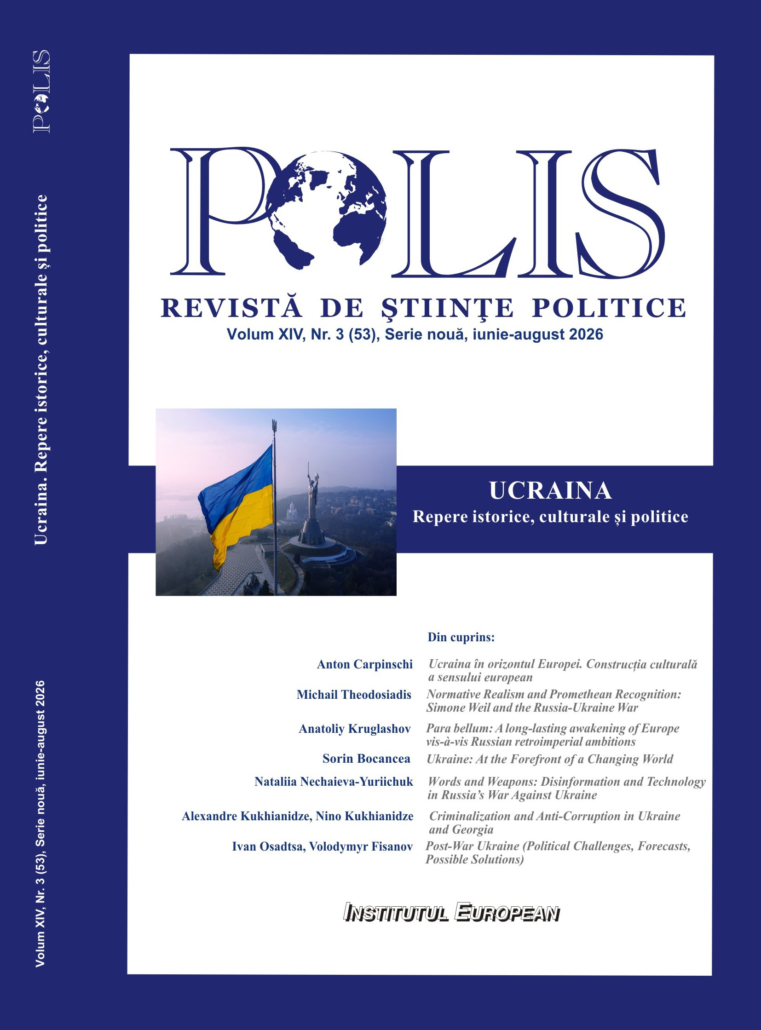
Coordonatori: E.S. Ihor PROKOPCHUK, Sabin DRĂGULIN și Sorin BOCANCE
Volum XIV, Nr. 3 (53), Serie nouă, iunie-august 2026
Ethnic Minorities as Cross-Border Cooperation Actors in Visegrad Group Countries and Ukraine
Myroslava LENDEL
Abstract: This article examines ethnic minorities as actors of cross-border cooperation (CBC) in the Visegrad Group countries and Ukraine. It asks how territorial concentration, institutional frameworks and geopolitical conditions shape minority agency in border regions. The study uses a qualitative comparative design combining demographic evidence, programme-level data from Interreg, analysis of Euroregions and European Groupings of Territorial Cooperation (EGTCs), policy documents and secondary academic literature. Three propositions guide the analysis: territorially concentrated minorities can convert linguistic and social resources into cross-border social capital; EU membership increases the institutionalization of this participation; and wartime conditions simultaneously constrain formal cooperation and increase the value of minority networks for resilience. The findings show that minorities act as cultural mediators, institutional intermediaries, socioeconomic networkers, heritage actors and, in the Ukrainian case, resilience actors. In the Visegrad countries, these functions are more frequently embedded in municipalities, regional authorities, EGTCs, Euroregions and EU-funded programmes, whereas in Ukraine they depend more strongly on universities, civil society, community organizations and informal networks. The article identifies a persistent problem of “institutional invisibility”: minority participation is substantial but rarely recorded as such in programme databases. The comparison demonstrates that the principal difference between the V4 and Ukraine is institutional rather than demographic. Minority communities add value by sustaining trust, continuity of ties, local development and European integration, but their agency is conditioned by administrative capacity, minority policies, kin-state relations and, in Ukraine, war and securitization.
Keywords: cross-border cooperation, ethnic minorities, Visegrad Group, Ukraine, border regions
Introduction
Cross-border cooperation (CBC) has become an important instrument of European territorial integration, especially in regions where economic interdependence, historical legacies and cultural ties intersect. Contemporary CBC is no longer limited to individual projects: it combines territorial cohesion, multi-level governance, mobility and network-based forms of regional development. Border regions therefore function simultaneously as administrative margins and as spaces in which European integration is translated into everyday interaction1.
Ethnic minorities are particularly relevant in this setting. Historical border changes in Central and Eastern Europe left many communities territorially concentrated close to present state borders. Shared language, family ties, cultural institutions and long-term interpersonal networks may reduce the social costs of cooperation and facilitate communication between actors operating in different legal and administrative systems. Yet minority participation is not automatically integrative. Kin-state policies, disputes over language and education, and competing interpretations of sovereignty can politicize the same networks that otherwise support cooperation2.
The Visegrad Group and Ukraine provide a useful comparative setting. Czechia, Hungary, Poland and Slovakia participate fully in EU Cohesion Policy and European Territorial Cooperation, while Ukraine engages through Interreg NEXT and other external-border instruments. The contrast has become sharper since Russia’s full-scale invasion of Ukraine, which has combined stronger border securitization with unprecedented humanitarian, migration and local-government cooperation.
The article addresses the following main question: how do ethnic minorities function as actors of CBC in the Visegrad Group countries and Ukraine, and which institutional conditions enable or constrain their participation? Six operational questions concern their roles, institutional embeddedness, differences between the V4 and Ukraine, the balance between bottom-up and state-mediated action, political and security constraints, and the added value generated for border regions.
Three hypotheses structure the analysis. H1: the relevance of minorities for CBC depends less on their national demographic share than on territorial concentration and the density of cross-border social networks. H2: minority participation is expected to be more strongly institutionalized in the V4 countries than in Ukraine because EU membership provides denser and more stable governance structures. H3: under wartime conditions, minority networks are expected to acquire an enhanced resilience function, even as securitization constrains some forms of cross-border interaction.
Theoretical Framework and State of the Art
The analytical framework combines multi-level governance, transnationalism, territorial approaches to border regions and social-capital theory. Multi-level governance is useful because CBC distributes authority and resources across supranational, national, regional and local levels rather than locating cooperation within a single hierarchy. The development of Euroregions, Interreg and EGTCs illustrates how territorial cooperation has become embedded in governance arrangements that transcend state borders3.
A relational approach complements this institutional perspective. Cross-border regions are produced not only by formal agreements but also by recurrent flows of people, information and resources. Mobility, commuting, education, entrepreneurship and cultural exchange create functional spaces whose intensity cannot be inferred from administrative boundaries alone. Within such spaces, minorities may operate as carriers of transnational social capital: linguistic competence, interpersonal trust and durable cross-border contacts can be mobilized for cooperation4.
This perspective is particularly important because minority agency often remains hidden inside broader institutional categories. Municipalities, schools, cultural centres, universities and NGOs may operate in minority-populated territories without being classified as “minority actors”. Malloy’s analysis of minorities as creators of new political spaces and studies of ethnicity in cross-border regions suggest that minority communities can connect local identities with broader governance networks. Their contribution therefore concerns not only minority rights but also the capacity of border regions to cooperate5.
At the same time, the literature emphasizes ambivalence. Kin-state engagement can provide scholarships, cultural resources and institutional support, but it can also generate political tensions when external support intersects with citizenship, language or sovereignty disputes. The border is thus both an opportunity structure and a mechanism of control. This is especially visible at the EU’s external borders, where asymmetries of funding, administrative capacity and mobility regimes remain significant6.
The existing literature is fragmented in three respects. First, CBC studies still privilege programmes and institutions over socially embedded actors. Second, minority studies focus predominantly on identity, rights and representation rather than on minorities as contributors to territorial cooperation. Third, comparative research covering the V4 and Ukraine remains limited, particularly under wartime conditions. This article links these strands by treating minorities as connective actors situated between formal governance and everyday cross-border practices.
Methodology
The study applies a qualitative comparative case-study design covering Hungary, Slovakia, Poland, Czechia and Ukraine, with particular attention to Zakarpattia. The cases share a Central European historical and geographical context but differ in EU membership, institutional capacity and exposure to war. This most-similar-systems logic allows institutional differences to be assessed against a relatively comparable regional background.
The empirical material combines four groups of sources. First, demographic and mobility data are used to identify territorial concentration and cross-border movement. Second, programme-level evidence from Interreg and Interreg NEXT is used to assess the scale and thematic structure of cooperation. Third, the study examines permanent or semi-permanent institutional forms, including Euroregions, EGTCs, regional authorities, municipalities and development agencies. Fourth, academic studies and policy documents are used to interpret minority participation, kin-state engagement, legal conditions and wartime transformation.
The analysis does not attempt to calculate a precise “minority share” of CBC projects. Such a calculation would be methodologically misleading because programme databases normally classify beneficiaries by legal form, not ethnic affiliation. Instead, minority participation is identified through territorial location, institutional profile, project content and documented links to minority-populated communities. Triangulation is therefore essential.
The main limitation follows from the same data structure: institutional invisibility makes minority participation easier to demonstrate qualitatively than to measure quantitatively. Ukrainian demographic data create an additional limitation because the 2001 census remains the last full census benchmark. The analysis therefore combines official data with more recent sociological and policy evidence and treats demographic estimates cautiously.
Results: Territorial Concentration and Mobility
The evidence supports H1: national-level demographic shares alone provide a poor indicator of minority relevance for CBC. What matters more is spatial concentration in border districts and the persistence of linguistic and social ties across borders. In Slovakia, more than 420,000 people identified as Hungarian in the 2021 census, with the strongest concentration in southern districts adjacent to Hungary. Research using broader indicators of language and secondary identity suggests that the socially Hungarian-affiliated population may be larger than primary census identification indicates. In Hungary, the gap between census declarations and sociological estimates is particularly visible for Roma communities, demonstrating the general methodological limits of ethnicity statistics7,8.
Zakarpattia represents the clearest Ukrainian example. The 2001 census recorded 151,500 Hungarians, or 12.1% of the oblast population, alongside Romanian, Slovak, Roma and other communities. Although these figures are dated, later surveys confirm continued territorial concentration of minority communities in municipalities close to Hungary, Romania and Slovakia. This spatial pattern is more relevant to CBC than the minority share in Ukraine as a whole.
Mobility reinforces these connections. Before 2022, Ukrainian labour migration had already produced dense family and employment networks in Poland, Czechia, Hungary and Slovakia. After the full-scale invasion, mobility acquired a humanitarian dimension and then gradually evolved into a medium-term system of labour-market, educational and municipal integration. By 2026, millions of displaced Ukrainians remained in Europe, while Central European states continued to host particularly large populations relative to their own size. For CBC analysis, this means that border regions are not simply territories adjacent to a line; they are mobility infrastructures in which recurrent movements generate social relationships and institutional demand9.
Roles and Institutional Embeddedness of Minorities
The empirical material identifies five recurring roles of minorities in CBC. First, they act as cultural mediators by sustaining bilingual communication, heritage practices and educational exchange. Second, they operate as institutional intermediaries between local communities and municipalities, regional authorities, Euroregions or project partnerships. Third, they support socioeconomic networking in tourism, local products, labour markets and small-scale entrepreneurship. Fourth, they preserve shared borderland heritage. Fifth, in wartime Ukraine they increasingly function as resilience actors through translation, humanitarian coordination and support for displaced people.
The Slovakia–Hungary border demonstrates how these functions become embedded in mature programme structures. In 2014-2020 the programme supported 167 projects, with EUR 147.30 million in ERDF funding; the largest groups concerned nature and culture, institutional cooperation and employment. These categories do not identify ethnic beneficiaries, yet much implementation occurs in southern Slovakia and northern Hungary, where Hungarian-speaking communities provide linguistic continuity and dense municipal and cultural networks10.
Permanent governance structures deepen this institutionalization. The Ister-Granum and Pons Danubii EGTCs connect municipalities across the Slovak-Hungarian border and create durable platforms for tourism, mobility, local development, services and cultural cooperation. Their importance lies less in being “minority institutions” than in institutionalizing cooperation in territories where minority presence and bilingualism are part of everyday governance. This confirms the broader argument that stable cross-border institutions can convert local social capital into long-term governance capacity11.
Euroregions perform a related but more flexible function. The Carpathian Euroregion, established in 1993, connects territories in Poland, Slovakia, Hungary, Romania and Ukraine. Its project and small-project mechanisms have enabled municipalities, schools, museums, cultural organizations and NGOs to participate in cross-border initiatives even when they lack the capacity for large infrastructure projects. Such mechanisms are particularly relevant for minority associations because they lower entry barriers and support people-to-people cooperation.
The Poland–Ukraine programme shows the scale of contemporary cooperation under wartime conditions. The 2021-2027 programme database listed 79 selected projects and 206 project partners in August 2026, covering environment, health, tourism, cooperation, borders and accessibility. Heritage initiatives inherited from earlier programming periods, including cross-border wooden-architecture and Carpathian cultural projects, demonstrate how local identities can be incorporated into territorial development without projects being formally labelled as minority-oriented12.
The central analytical finding is therefore “institutional invisibility”. Minorities are embedded in CBC, but usually through legal entities categorized as municipalities, universities, schools, NGOs, cultural institutions or regional authorities. Official programme statistics consequently underestimate their social contribution. The evidence supports RQ2 by showing extensive but predominantly indirect institutional embeddedness.
V4–Ukraine Comparison and Bottom-Up Dynamics
The comparison supports H2. Minority participation in the V4 countries operates within a denser institutional ecosystem created by EU membership, long-term Interreg experience, EGTC legislation, regional administrative capacity and diversified access to European funding. These conditions reduce dependence on individual activists or single projects and make cross-border relations more continuous13.
Ukraine participates increasingly in European programmes but remains outside the full Cohesion Policy framework. Decentralization has strengthened municipalities, yet administrative and financial asymmetries remain significant. Minority organizations and smaller communities often depend on intermediary institutions such as universities, development agencies and experienced NGOs to prepare applications and manage international partnerships. The difference is thus not a lack of willingness to cooperate but unequal institutional opportunity structures.
This asymmetry also changes the balance between bottom-up and top-down action. In the V4, bottom-up initiatives are frequently absorbed into formal structures: municipal partnerships, EGTCs, Euroregions, cultural institutions and programme-funded networks. In Ukraine, particularly in Zakarpattia, family ties, minority associations, churches, schools, universities and personal networks play a more visible compensatory role. Small Project Funds and Visegrad Fund grants are important precisely because they connect formal funding with local initiative.
Minority associations illustrate this hybrid model. Organizations representing Hungarians in Slovakia and Zakarpattia, Ukrainians and Lemkos in Poland, and other national communities maintain cultural events, educational exchanges, heritage activities and contacts with kin-state institutions. Their cross-border role cannot be reduced to identity preservation: they also create interpersonal continuity and local knowledge that formal institutions can mobilize. At the same time, bottom-up cooperation should not be romanticized. Without legal frameworks, public funding and administrative support, many initiatives remain temporary and dependent on individual leaders.
The evidence therefore points to a model of co-production. State and EU frameworks create resources, legal opportunities and institutional continuity, while local actors provide trust, legitimacy and the everyday substance of cooperation. The relative weight of these dimensions differs across the cases: formal institutions are more prominent in the V4 countries, whereas socially embedded networks assume greater functional importance in Ukraine, particularly under conditions of institutional asymmetry and war.
Constraints, War and Added Value
Minority agency is constrained by political, legal and security factors. Administrative complexity affects smaller organizations across the region, but the most sensitive constraints concern the politicization of minority rights and kin-state relations. Hungarian-Ukrainian disputes over language and education demonstrate how local minority questions can become linked to bilateral relations and EU accession. European monitoring has encouraged legislative adaptation in Ukraine while also keeping minority rights within a highly visible political agenda14.
War intensifies these tensions. Border controls, mobilization, demographic displacement and security concerns can reduce mobility and make transnational contacts more politically sensitive. At the same time, the Ukrainian case supports H3: crisis increases the practical value of pre-existing cross-border networks. Research on Ukrainian war migrants in Slovakia shows that municipalities, civil-society organizations and community networks became mutually dependent in humanitarian and integration assistance. Minority-linked linguistic skills and interpersonal contacts can therefore become resources for crisis governance15.
The added value identified in RQ6 operates through four mechanisms. The first is trust-building. Cross-border projects require cooperation across different legal and administrative systems; shared language and repeated interaction can reduce uncertainty and transaction costs. The second is continuity. Minority networks often predate current programmes and can survive interruptions in funding or changes in political leadership. The third is local development: cultural heritage, tourism, education and local-product initiatives transform cultural resources into economic and institutional assets. The fourth is European integration. By connecting municipalities, schools, universities and civil society across borders, minorities contribute to the practical Europeanization of border regions.
This contribution is nevertheless conditional. Minority networks are most productive when they are connected to inclusive public institutions rather than isolated in parallel ethnic structures. Conversely, where minority questions become securitized or instrumentalized by state actors, the same transnational ties can generate distrust. The added value of minorities should therefore be understood as a governance resource that requires supportive institutional conditions.
Discussion
The comparative findings suggest that ethnic minorities should be conceptualized neither as passive beneficiaries of CBC nor as autonomous transnational actors operating outside the state. Their most important function is connective: they link formal institutions with social networks and translate between administrative, linguistic and cultural environments.
This interpretation refines institution-centred approaches to CBC. Interreg, EGTCs and Euroregions remain indispensable because they provide resources and legal continuity, but their effectiveness depends on locally embedded actors. Conversely, social capital alone cannot substitute for administrative capacity. The most resilient border regions combine institutionalized cooperation with dense people-to-people relations.
The V4–Ukraine comparison also demonstrates that institutional strength changes the visibility of minority agency. In the V4, minority participation is often normalized within formal territorial governance and therefore becomes less visible as “minority participation”. In Ukraine, weaker institutionalization and wartime disruption make informal networks more visible and strategically important. This produces a paradox: minorities may be less formally represented in Ukrainian CBC structures while performing more immediately indispensable mediation and resilience functions.
The study therefore supports all three hypotheses, although with important qualifications. Territorial concentration matters when it is accompanied by active cross-border networks; EU membership promotes institutionalization but does not automatically guarantee minority representation; and war simultaneously constrains cooperation and increases the practical value of minority-based networks for resilience. These qualifications reinforce the central argument that minority agency is relational and context-dependent rather than an automatic consequence of ethnic proximity.
Conclusions
The study demonstrates that ethnic minorities are structurally relevant actors of cross-border cooperation in the Visegrad Group countries and Ukraine. Their importance is shaped less by national demographic weight than by territorial concentration, linguistic continuity and the density of social and institutional networks in border regions.
Minorities perform multiple functions: cultural mediation, institutional intermediation, socioeconomic networking, heritage preservation and resilience-building. In the V4 countries these roles are more frequently embedded in mature governance structures, while in Ukraine they remain more dependent on community networks and intermediary organizations. This difference reflects institutional asymmetry rather than a weaker capacity or willingness of Ukrainian minorities to cooperate.
A key methodological conclusion is that existing programme statistics systematically obscure minority participation because beneficiaries are recorded by legal status rather than social identity. Future research should therefore combine programme databases with territorial and organizational mapping and, where possible, interviews with local actors.
For policy, the findings imply that minority inclusion should not be confined to cultural policy. Small Project Funds, capacity-building for local organizations, inclusive regional planning and stronger participation in permanent CBC structures can transform minority social capital into broader territorial benefits. In wartime and post-war Ukraine, these resources are particularly relevant for resilience, reconstruction and European integration.
Notes
- Eduardo Medeiros (ed.), European Territorial Cooperation: Theoretical and Empirical Approaches to the Process and Impacts of Cross-Border and Transnational Cooperation in Europe, Springer, Cham, 2018; Andrea Noferini, Matteo Berzi, Francesco M. Camonita and Antoni Durà, “Cross-border cooperation in the EU: Euroregions amid multilevel governance and re-territorialization”, European Planning Studies, Vol. 28, No. 1, 2020, pp. 35-56.
- Myra A. Waterbury, “Making citizens beyond the borders: nonresident ethnic citizenship in post-communist Europe”, Problems of Post-Communism, Vol. 61, No. 4, 2014, pp. 36-49; Szabolcs Pogonyi, Extra-Territorial Ethnic Politics, Discourses and Identities in Hungary, Palgrave Macmillan, Cham, 2017, and Tove H. Malloy, “Creating new spaces for politics? The role of national minorities in building capacity of cross-border regions”, Regional & Federal Studies, Vol. 20, No. 3, 2010, pp. 335-351; Thomas Faist, The Volume and Dynamics of International Migration and Transnational Social Spaces, Oxford University Press, Oxford, 2000.
- Markus Perkmann, “Cross-border regions in Europe: significance and drivers of regional cross-border co-operation”, European Urban and Regional Studies, Vol. 10, No. 2, 2003, pp. 153–171; Eduardo Medeiros, cit., and Liesbet Hooghe and Gary Marks, “Unraveling the Central State, but How? Types of Multi-level Governance”, American Political Science Review, Vol. 97, No. 2, 2003, pp. 233-243.
- Frédéric Durand and Antoine Decoville, “A multidimensional measurement of the integration between European border regions”, Journal of European Integration, Vol. 42, No. 2, 2020, pp. 163-178; Olle Järv, Håvard W. Aagesen, Tuomas Väisänen and Samuli Massinen, “Revealing mobilities of people to understand cross-border regions: insights from Luxembourg using social media data”, European Planning Studies, Vol. 31, No. 8, 2023, pp. 1754-1775.
- Tove H. Malloy, cit.; Ahmed Bakry and Anna Growe, “Spatial effect of ethnicity on cross-border regions. Comparative analysis for a cultural aspect based on territorial and network perspectives: the cases of the EU Basque and Upper Rhine border regions”, European Planning Studies, Vol. 32, No. 2, 2024, pp. 345-367.
- Myra A. Waterbury, “National mino-rities in an era of externalization: kin-state citizenship, European inte-gration, and ethnic Hungarian minority politics”, Problems of Post-Communism, Vol. 64, No. 5, 2017, pp. 228-241; Szabolcs Pogonyi, cit.
- Gábor Kertesi and Gábor Kézdi, A cigány népesség Magyarországon: Dokumentáció és adattár, Socio-typo, Budapest, 1998.
- Gabriel Harrach, “Main Demographic Characteristics of Hungarians in Slovakia: Insights from the 2021 Census”, Hungarian Journal of Minority Studies, Vol. 7, 2024, pp. 53–89; Alexander Chvorostov, Ladislav Macháček, Hans-Georg Heinrich and Olga Alekseeva, The Hungarian Minority in Slovakia, ENRI-East Research Report No. 13, 2011.
- Eurostat, “4.33 million under temp-orary protection in March 2026”, 8 May 2026, https://ec.europa.eu/euro-stat/web/products-eurostat-news/w/d-dn-20260508-1, (accessed on 30.08.2026).
- Interreg Slovakia–Hungary, “Summary of funded projects / Infographics”, https://www.skhu.eu/ funded-proje-ts/infographics, (accessed on 30.08.2026).
- Markus Perkmann, cit.; Tove H. Malloy, op. cit.
- Interreg NEXT Poland–Ukraine 2021–2027, “Projects database”, https://pl-ua.eu/en/projects-database/, (accessed on 30.08.2026).
- Andrea Noferini et al., cit.; Eduardo Medeiros, op. cit.
- European Commission, Ukraine Report 2024, 30 October 2024, https://enlargement.ec.europa.eu/ukraine-report-2024_en (accessed on 30 August 2026); Venice Commission, Opinion on the Law on National Minorities (Communities) of Ukraine, CDL-AD (2023) 021, 12 June 2023, https://www.venice.coe.int/webforms/documents/default.aspx?pdffile=CDL-AD%282023%29021-e (accessed on 30 .08.2026).
- Volodymyr V. Hnatiuk, “Ukrainian war migrants in Slovakia: the experience of civil society-local government cooperation in providing humanitarian and integration assistance 2022-2025”, Ukrainskyi Sotsium, No. 4(95), 2025, pp. 163-188.
Bibliography
Books
ALLMENDINGER, Philip, HAUGHTON, Graham, KNIELING, Jörg, OTHENGRAFEN, Frank (eds.), Soft Spaces in Europe: Re-negotiating Governance, Boundaries and Borders, Routledge, London, 2015.
FAIST, Thomas, The Volume and Dynamics of International Migration and Transnational Social Spaces, Oxford University Press, Oxford, 2000.
KERTESI, Gábor; KÉZDI, Gábor, A cigány népesség Magyarországon: Dokumentáció és adattár, Socio-typo, Budapest, 1998.
MEDEIROS, Eduardo (ed.), European Territorial Cooperation: Theoretical and Empirical Approaches to the Process and Impacts of Cross-Border and Transnational Cooperation in Europe, Springer, Cham, 2018, DOI: 10.1007/978-3-319-74887-0.
POGONYI, Szabolcs, Extra-Territorial Ethnic Politics, Discourses and Identities in Hungary, Palgrave Macmillan, Cham, 2017.
Articles and studies
BAKRY, Ahmed; GROWE, Anna, “Spatial effect of ethnicity on cross-border regions. Comparative analysis for a cultural aspect based on territorial and network perspectives: the cases of the EU Basque and Upper Rhine border regions”, European Planning Studies, Vol. 32, No. 2, 2024, pp. 345-367, DOI: 10.1080/09654313.2022-.2120764.
CHVOROSTOV, Alexander; MACHÁČEK, Ladislav; HEINRICH, Hans-Georg; ALEKSEEVA, Olga, „The Hungarian Minority in Slovakia”, ENRI-East Research Report No. 13, 2011.
DECOVILLE, Antoine; DURAND, Frédéric, “Exploring cross-border integration in Europe”, European Urban and Regional Studies, Vol. 26, No. 2, 2019, pp. 134-157.
DURAND, Frédéric; DECOVILLE, Antoine, “A multidimensional measurement of the integration between European border regions”, Journal of European Integration, Vol. 42, No. 2, 2020, pp. 163-178, DOI: 10.1080/07036337.2019.1657857.
HARRACH, Gabriel, “Main Demographic Characteristics of Hungarians in Slovakia: Insights from the 2021 Census”, Hungarian Journal of Minority Studies, Vol. 7, 2024, pp. 53-89, DOI: 10.62152/hjms.2024.hg.
HOOGHE, Liesbet; MARKS, Gary, “Unraveling the Central State, but How? Types of Multi-level Governance”, American Political Science Review, Vol. 97, No. 2, 2003, pp. 233-243, DOI: 10.1017/S000305-5403000649
JÄRV, Olle; AAGESEN, Håvard W.; VÄISÄNEN, Tuomas; MASSINEN, Samuli, “Revealing mobilities of people to understand cross-border regions: insights from Luxembourg using social media data”, European Planning Studies, Vol. 31, No. 8, 2023, pp. 1754-1775, DOI: 10.1080/ 09654313.2022.2108312.
HNATIUK, Volodymyr V., “Ukrainian war migrants in Slovakia: the experience of civil society-local government cooperation in providing humanitarian and integration assistance 2022–2025”, Ukrainskyi Sotsium, No. 4(95), 2025, pp. 163-188, DOI: 10.15407/socium2025.04.163.
MALLOY, Tove H., “Creating new spaces for politics? The role of national minorities in building capacity of cross-border regions”, Regional & Federal Studies, Vol. 20, No. 3, 2010, pp. 335-351.
NOFERINI, Andrea; BERZI, Matteo; CAMONITA, Francesco M.; DURÀ, Antoni, “Cross-border cooperation in the EU: Euroregions amid multilevel governance and re-territorialization”, European Planning Studies, Vol. 28, No. 1, 2020, pp. 35–56.
PERKMANN, Markus, “Cross-border regions in Europe: significance and drivers of regional cross-border co-operation”, European Urban and Regional Studies, Vol. 10, No. 2, 2003, pp. 153-171.
SCOTT, James W., “Bordering, Border Politics and Cross-Border Cooperation in Europe”, in Filippo Celata and Raffaella Coletti (eds.), Neighbourhood Policy and the Construction of the European External Borders, Springer, Cham, 2015, pp. 27-44, DOI: 10.1007/978-3-319-18-452-4_2.
WATERBURY, Myra A., “Making citizens beyond the borders: nonresident ethnic citizenship in post-communist Europe”, Problems of Post-Communism, Vol. 61, No. 4, 2014, pp. 36-49.
WATERBURY, Myra A., “National minorities in an era of externalization: kin-state citizenship, European integration, and ethnic Hungarian minority politics”, Problems of Post-Communism, Vol. 64, No. 5, 2017, pp. 228-241.
Online Resources
EUROPEAN COMMISSION, Ukraine Report 2024, https://enlargement.ec.europa.eu/ukraine-report-2024_en
EUROSTAT, 4.33 million under temporary protection in March 2026, https://ec.europa.eu/eurostat/web/products-eurostat-news/w/ddn-20260508-1.
INTERREG SLOVAKIA–HUNGARY, Summary of funded projects / Infographics, https://www.skhu.eu/ funded-projects/ infographics
INTERREG NEXT POLAND–UKRAINE 2021-2027, Projects database, https://pl-ua.eu/en/projects-database/.
VENICE COMMISSION, Opinion on the Law on National Minorities (Communities) of Ukraine, CDL-AD (2023)021, https://www.venice.coe.int/webforms/documents/default.aspx?pdffile=CDL-AD%282023%29021-e