


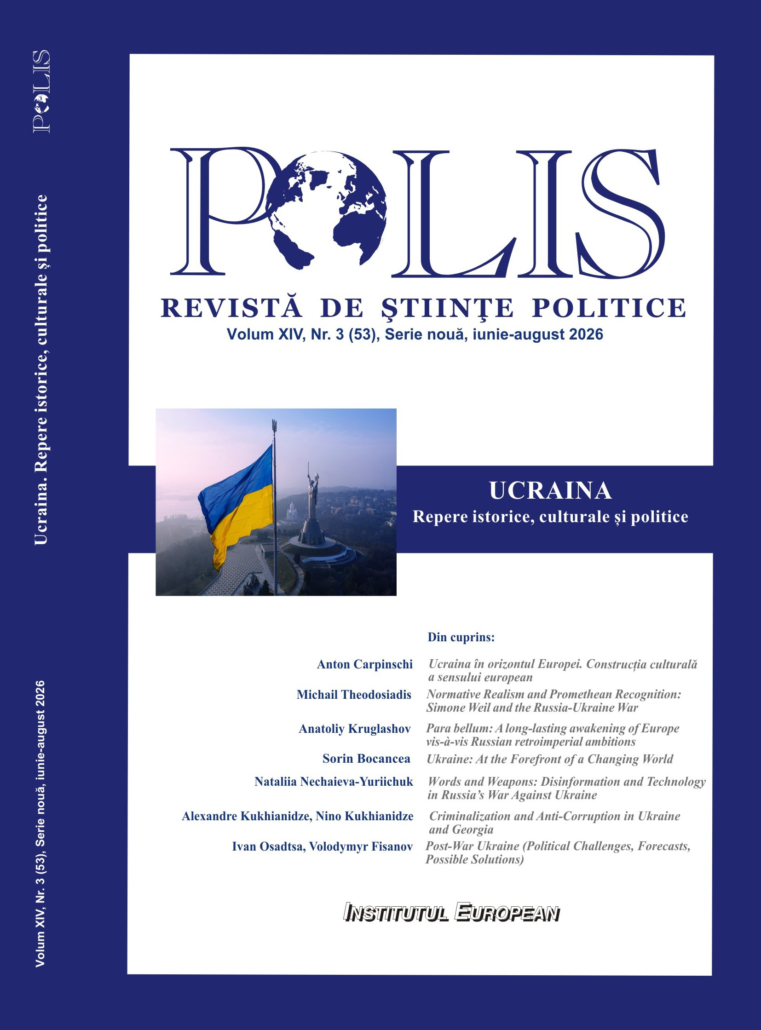
Coordonatori: E.S. Ihor PROKOPCHUK, Sabin DRĂGULIN și Sorin BOCANCEA
Volum XIV, Nr. 3 (53), Serie nouă, iunie-august 2026
Para bellum: A long-lasting awakening of Europe vis-à-vis Russian retroimperial ambitions
Anatoliy KRUGLASHOV
Abstract: Russia under Putin’s leadership has chosen rebirth and the restoration of its imperial might and strength, along with aggressive policies applied both domestically and internationally. That was no secret for neighbors and the larger world; still, warning messages were directly underestimated or, even worse, overtly ignored. Regional conflicts involving Azerbaijan and Armenia, Georgia, and Moldova were considered of minor importance to the EU and NATO. That unwise stance encourages the Kremlin to regard Western countries as posing no barrier to Russia’s further expansion and movement. The turning point in the exercise of hard and sharp power came during the Russo-Georgian War in August 2008. Finally seeing no strong and consolidated reaction from the global community, International organizations, V. Putin had decided to attack Ukraine. The Russian-Ukrainian war began in February 2014 with Crimea’s illegal annexation and a war in Donbas. Again, the confrontation from the west seemed inconsistent and posed no real barrier to further aggravation of the security situation. We have a situation of shaky balance of the hybrid and conventional war on the Eastern flank of NATO, directly threatening the EU member states, first, Poland, Estonia, Latvia, Lithuania, and Romania. The list is not exhaustive, however.
Now the EU and NATO look around to secure not only Ukraine’s vulnerability but also themselves. Many factors demand that Europe be fully aware of the Russian retroimperial threat and act as a single actor now. Still, some factors undermine the required solidarity and unity, making them less solid and effective. The article considers key Russian threats to Ukraine and Europe and offers proposals to overcome the weaknesses and setbacks in European and Euro-Atlantic solidarity.
Keywords: Russia’s aggression, war in Ukraine, European and Euroatlantic solidarity, retroimperial policy.
Introduction
First, I would like to start with an uneasy question: do we witness a new rise or the dawn of Europe? The issue is important to consider as part of the discussion on the future of Europe, its chances of avoiding a disastrous war, and preventing its disintegration into clusters of weaker, rivalrous, and even hostile states. Is it a united, strong force, or just a crumbling and vanishing force? Another question, a very important one for further research and public debates, concerns Russian attempts to claim that “we threaten neither the EU nor NATO.” So, is the Russian threat real, or is it mistakenly treated purely as a propaganda matter for the West? Finally, should we consider Ukraine a keystone of European security and defense, despite some of its weaknesses and limitations in its capacity to fight successfully and achieve a decisive victory, or at least to defend itself against the ongoing Russian aggression?
Let’s begin by recalling the previous security situation after the Cold War. Lost time, wonderful inspiration, and enthusiasm. That period of global change and hope ended the world’s bipolar division and opened new possibilities for peaceful and fruitful international cooperation. Changes were fundamental and hardly predictable for too many. However, they were compounded by some profound strategic mistakes and misjudgments on the part of the triumphant West. Just for instance and in brief. What was wrong with the slogan and expectations regarding “Go West,” of course, from the Western part? The famous and popular song, “Go West,” reflects the hopes and spirit of the time. The West expected Russia, as a core country in the post-communist and post-Soviet world, to be a reliable and trustworthy part of the new global order. The latter would be more comfortable, secure, and cooperative. They held that after the collapse of the USSR and the Soviet bloc, not only would a liberal democracy and market economy emerge as the pattern and true goal for those countries, but also for Russia, first and foremost.
Transformation processes have changed in many countries. Some succeeded in overcoming the legacy of communism and previous authoritarian regimes. Some did not. Democratic transit failed not only in Russia, for sure. Instead of moving steadily toward liberal democracy and the rule of law, Russia very soon underwent a backslide from what we might call façade democracy, a kind of hybrid regime under Borys Yeltsin, towards autocracy. Initially, a very manipulative and limited democracy, so-called managed democracy, as V. Putin himself said, then consolidated autocracy. Now Russia is building up a neo-totalitarian regime, at the very least. Therefore, could this country be a reliable partner? Could it be a good counterpart for building a new, secure world?
Deconstructing post-Cold War illusions
After 1989, the West emerged triumphant, because it regarded the end of the Cold War as a unilateral victory over the East1, so to speak, Russia and the Soviet bloc, controlled tightly by Moscow. However, it turned out not to be just that way, because many in Russia’s leadership and society, including Putin himself, regarded this as a retreat, a temporary defeat, and felt a strong urge to take revenge by any means2. Russia, under Putin’s leadership, has chosen to reverse course from a Western and European orientation and restore its imperial might, strength, and policy, applying them both domestically and internationally3.
I must mention the retroimperial concept here, meaning that Russia seeks to restore its imperial might as it was rising in the XVIII-XIX centuries, with ambitions of superpower status and to be one of the mightiest states on earth. I have been working to initiate and develop that concept since 20084. One of the core ideas is that contemporary Russia seeks to escape the present rather than build a decent future. An interesting moment that returns to the idealized and mystified glory of the Empire and the implications of old-fashioned, brutal imperialism also signals a shift from the previously exploited mass Soviet nostalgia. Applying it, it’s worth stressing also that cultivated and state-sponsored nostalgia is not for the Soviet Union itself, but rather for the Soviet Union as a replica of the Russian Empire. Mr. Putin has made many important statements about Russia’s destiny5. He or his associates keep repeating that Russia has no border. That Russia should be a great power6, or it will cease to exist. Equal, maybe, to the USA, with a strong desire that later became even stronger. It reminds us that this retro-imperial ideal is the source of inspiration for forging a new cohesion of Russian society – a more and more approaching totalitarian flavor – and it is a mechanism to mobilize Russian society, to make any real opposition to the existing regime impossible, and to move all these forces to conquer Ukraine under false accusations7 and, later on, unfortunately, other countries. Empires should expand, said one of the regime’s ideologues before the Russian full-scale invasion of Ukraine8.
That turn back to the Empire was not just a fantasy or rhetoric from the Russian side, a galloping ballooning of the ‘Russkiy Mir’ frame with the collective selves by means of self-coined pride, superiority, and all-mightiness. It brought about complications, grievances, and threats for the neighbors and the wider world. Still, the warning messages from Russia, openly declared in V. Putin’s Munich speech9, were either underestimated or overtly ignored by Western countries and their leadership – hardly a wise approach.
So, we can remember and recall regional conflicts in the post-Soviet space. Russia’s presence and role were widely regarded as suspicious and dangerous there. Only the Nagorno-Karabakh conflict emerged out of the Kremlin leaders’ will. It provoked a long-lasting war and tensions between Armenia and Azerbaijan. Yes, it wasn’t directly inspired by the USSR or Russia. Still, Russia benefited from it many times10, posing itself as a unique and irreplaceable peace-keeper and security guarantor in the Caucasus region. In opposition to that case, the conflicts in Transnistria, Abkhazia, and South Ossetia are to be regarded as inspired by, and primarily managed by, the Kremlin. Their content and models for wider aggression, to be carried out alongside Russia’s further expansionist plans, were also understated. The EU member states, the leadership of Western countries, and NATO regarded them all, so to speak, as ‘domestic affairs’ of the post-Soviet space, where Russia had been placed in a dominant position. They collectively preferred to believe that none of these posed any direct threat to their well-being, social welfare, prosperity, and security by and large. Having secured such an advantageous position and support, Russia moved easily forward to gain further advantages.
Thus, too many warning messages were omitted or ignored. The key point for me was rather the Russo-Georgian War of August 200811. Right there, Russia appeared to turn from appeals to the post-Soviet space to be reunited with Russia to a certain kind of integration, towards the application not just of hard but of sharp power there. Openly and with no respect to the International law and previous promises, obligations, and assurances made by country leaders many times.
Did the West perceive well and understand correctly what is going on in the region and what it means for the future of Europe and Euroatlantic? While recalling the mission of, for instance, Sarkozy, who tried to negotiate with Putin, asking him to stop intervention into the depths of Georgia on the way to Tbilisi. In general, Western powers, including US President Obama, preferred a policy of appeasement after 200812. Trying to apply it to Russia stimulates the Kremlin to regard Western countries as posing no real barrier to further expansionism and Russia’s movement. From that point, Russia decided that the West is too weak and lacks integrity. It did not seem strong and united. The Western leadership was too naïve or politically shortsighted to understand what was indeed going on. This way, V. Putin was encouraged to go further.
How did Russia benefit from that? First, let’s look at the case of the FRG policy applied to Russia under the prominent motto associated with Mrs. Merkel, Wandel durch Handel13. She, like a major part of the German elite, and not only the German but the EU elite, regarded Russia for a long time as a counterpart that might be engaged, involved, and integrated into European and global structures in a way that would benefit both sides from this cooperation, from peaceful prosperity, etc. Sounds too good to be true. What happened indeed? Russia penetrated the West through widely open doors economically and informationally by creating networks of its spies and agents, and has been exploiting to the full all the profits from this cooperation. So, Wandel durch Handel was just the opening of the door for Russia, making it economically stronger and better represented in the West than vice versa, and acquiring that level of influence, which wasn’t possible or even dreamt of for the USSR at all. That was a truly kind and generous invitation. The EU institutions and the political elites of its member states didn’t see this as a situation beneficial to Russia rather than to the West. Finally, Russia was well represented by a set of media channels in Europe, with Russian narratives spreading nonstop across the West14. Plus, a major part of the post-Soviet diaspora, not only Russians by ethnic origin, were put under the influence of Russian media, and they believed whatever was said and shown by the Russian media. The picture became very attractive for Putin’s plans and the ideal of Imperial greatness.
It’s not so easy to factually prove, but hardly questionable remains the assumption that too many political actors and public figures in European countries were seduced by Kremlin offers, in fact, by regular corruption. Most of all, former German Chancellor Gerhard Schröder15; former Austrian Minister of Foreign Affairs Karin Kneissl (2017-2019)16; François Fillon, the former Prime Minister of France from 2007 to 2012 under President Nicolas Sarkozy17; and so on. Special attention is due to the long-standing admirer and partner of V. Putin, Viktor Orbán. Many years later, after Russia’s full-scale invasion, Viktor Orbán, with support from Robert Fico of Slovakia, was sucking up Russian oil and gas. Did they do it just for the profit of Hungary and Slovakia18? Should we be so naive? It has served as a source of profit for his party, political campaigns, and so on. So far, he has looked for a source of revenue to support his regime and his personal autocracy. Fortunately, the last election in Hungary stopped Orban’s autocracy, for now. The tracks and impact of that regime and policy, however, might last much longer in Hungary and the surrounding region.
Another symptomatic case is Marine Le Pen. The second-place candidate in France’s presidential race in the past, who has a real chance of becoming the new president soon. Her electoral campaign had been supported directly by Putin with millions of euros19, and she, under pressure of evidence, had to admit it. How many examples should be put forward to make sure that corruption is a Russian, well-elaborated tool and sharpened for centuries as an instrument to penetrate the West and undermine its unity and capacity for resilience? Now it’s time to recognize that it’s not just collateral damage but a true reward for such a policy, when Russia has been treated exclusively by the principle of “Russia first”20? After all that has happened, could Russia be treated as a reliable partner? Does Russia consider the West an important partner or a direct enemy? For sure, these questions have only negative answers now.
Some species and their political leaders in Central and Eastern European countries now tend to undervalue the Russian threat. They strongly believe in NATO’s security guarantees21 and, most of all, in the almighty D. G. Trump’s support. It concerns the new Czech government’s position. It’s going to be a dominant trend in Poland after President K. Nawrocki’s 2025 elections. For them, it makes sense, reminding them that not only propagandists but top politicians in Russia, including Putin, are threatening Poland22, approaching the same mottos and arguments that Hitler made before the Second World War23. The same had been done in Russia before the full-scale invasion of Ukraine. Under similar conditions, the same outcome might be concluded. Despite all the facts, Russia’s atrocities and cruelty, Putin’s and the regime’s crimes and lies, some people in the EU and NATO countries, and far away from them, still believe that it’s not Russia’s true deeds and face, that Putin is so good, he’s a mighty leader24. If that is true, why not discuss whether Ukraine should be supported and so on? That perception of Russia and its leaders means that the cognitive and information war launched by the Kremlin long ago continues to exert a strong influence even on democratic societies today. They remain in a weaker position in confronting Russia’s propaganda and other undermining actions and campaigns.
However, did Russia engage in deceptive tactics regarding public opinion only in recent years? One example from the period of geopolitical romance with the Kremlin, during the liveliest and brightest years of rapprochement with the West at the beginning of the 1990s. There took place a process of transformation from CSCE into the OSCE. In retrospect, it’s clear that expectations towards the newborn International Organization were too high and finally unrealistic. The story concerned Russia’s official move to dismiss NATO and replace the Alliance with the OSCE as a new type of transatlantic security organization. This discussion should not be forgotten completely. Russia argued that if the Warsaw Pact is dissolved, NATO should also be disbanded. They insisted that a new, fruitful Euro-Atlantic model of cooperation and security would be better achieved through the OSCE. A simple question: where is the OSCE now? Not geographically, in Vienna, for sure. I mean, where is the importance, the influence, and the impact of OSCE on security issues in recent years25. The same kinds of questions concern the Helsinki Accords and their key principles, e.g., respect for states’ sovereignty, inviolability of state borders, and territorial integrity. So far, this is the reward. Good enough, that NATO is alive, being trapped amid the V. Putin’s assaults and some D. Trump dubious initiatives.
For the overall architecture of European and Transatlantic space, the Russian-Ukrainian war since 2014 has been a turning point. Is this a prologue to a wider continental or global war, or not? This is an open question. Many experts believe this war might end soon, in one way or another. I don’t see optimistic signals either for you or for the West and Europe. Rather, one witnesses an escalation and further confrontation. After the Russian-Ukrainian war began in 2014, what was the reaction of the West? The reaction was too slow and too weak, in general, inadequate to the real threat26. Compared to the Russo-Georgian war, it looked a bit stronger. Not enough to be taken by the Kremlin as a serious threat to its far-reaching plans. That encouraged V. Putin to see if the EU and NATO still prefer appeasement, diplomatic maneuvering, and endless talking, why not go further?
Therefore, these reactions seemed inconsistent and unclear and thus posed no real barrier to the further aggravation of the security situation. The maximum of boldness could be recalled from that time, a political leader confessed, saying that Merkel told President Barack Obama that after speaking with Putin, she was unsure if he was “in touch with reality” and remarked that he was “in another world”. As an attempt to decode Putin’s psychology, it might work. Still, it was not enough to take practical steps to resist his further geopolitical aspirations. Thus, since 2014, a precarious balance between hybrid and conventional war has emerged and evolved on NATO’s eastern flank, directly threatening the European member states.
Some scenarios suggest that the next victim of Russia’s aggression after or together with Ukraine might be the Baltic states, Estonia. Latvia and Lithuania27. Visiting Estonia, Latvia, and Lithuania recently, one could observe a sense of uncertainty and signs of Russian preparations for further intervention in those countries. They all have a large Russian diaspora, which, partly, I don’t want to paint all these people one color, but some of them serve as an instrument of influence on domestic security in the countries of the region. Another probable target is Poland. Despite the bitter experience of centuries-long clashes with Russia and four partitions of Poland because of and with Russia’s participation, part of Polish society and elites are also infected and penetrated by the Russian narration and influence. Many hybrid attacks and direct attacks on Poland in September 2025, in the summer of 2026, including drones, missiles, and diversion, already demonstrated the country’s vulnerability. What could we see instantly after those dangerous events? Flows of different pictures and videos appeared, for instance, on TikTok, Facebook, and elsewhere, telling Poles: “These are Ukrainians attacking us,” “They did not shoot down the drones upon their territory on purpose,” “They are trying to benefit by making Poland engage in a continental or global war.” It looks like Russia and its assets dominate now in the media sphere in Poland and beyond28. Not to mention the turn to a poisoning discussion of past tragedies in both nations’ histories, predominantly in the worst and most unilateral manner.
What about a reply? For instance, the Secretary General of NATO made a timely analysis, saying that these drones entered NATO territory for an unclear reason29. Some others preferred to explain as if it had been done by mistake. If 19 drones entered NATO space just by chance, 100 might be by mistake. Guess whether 1,000 drones are enough to consider them a direct violation, or not yet? One may wonder why this tolerance of Russian ugly attacks is a normalized practice, as a part of appeasing Putin? So, the list of recent cases of dangerous facts is in no way exhaustive. Moldova and Romania were next to be threatened and attacked by Russia.
Regarding the Black Sea region, we should keep in mind that Russia is seeking to establish dominance there30. This is a long-lasting dream and plan in Russian political thought. That the Black Sea should, sooner or later, be turned into a ‘Russian lake’ and the Straits should be under Russian control. It’s not a novelty. It has been well known since the 18th century. Peter, I began moving towards that dream embodiment. Catherine the Second succeeded much more in advancing ‘the Greek project’ goals, in which the Byzantine Empire should be restored rather than the Ottoman Empire, with the new Emperor Constantine Romanov, her grandson. Many of the wars between Russia and Turkey in the 19th century were driven by the same geopolitical calculations and imperialist thirst. It was repeated in the twentieth century by the Russian Empire and the USSR. The same has been again restored and widely echoed in recent Russian political slogans. Therefore, Romania and Bulgaria must be alarmed and fully prepared to repel Russia’s terrifying moves.
Now the EU and NATO have no other rational choice but to look for ways to secure not only Ukraine’s vulnerability but also their own. For sure, I must admit that Ukraine and its leadership made many mistakes, both before 2014 and after 2022, unfortunately. A major part of our society preferred to stand aloof from the warning messages, including those before the full-scale invasion. We must remember it very well. We did forget that our president invited us to celebrate 1 May with shashliks, and to present time those relaxing messages instead of alarming ones that aren’t well understood in Ukraine. He also wanted to look at Putin’s eyes and what he hoped to discover there. These eyes belong to a war criminal and a big threat not only to Ukraine, but to all of Europe—errare humanum est. Mistakes are unavoidable. Lessons from them are inevitable, and that’s what we need to remember and prompt to do by ourselves. Outside of wrong or naïve rhetoric, more importantly, is to restore the military-industrial capacity of Ukraine, which has been destroyed stupidly or because of true betrayal for decades of independence. The most shocking result was, however, the unilateral nuclear disarmament of Ukraine, Belarus, and Kazakhstan, which was granted by the USA and other Western powers to Russia, a monopoly on all post-Soviet space, and contributed to its aggressive politics and nonstop nuclear blackmail. The Budapest memorandum gave Ukraine false hope and was worth nothing more than the paper it was signed on31.
So, several factors necessitate that Europe should be fully aware of the Russian retroimperial threat and act as a unified entity now. The alternative is divided, weak, and unprotected European states, which would be unable to resist either Russia’s threats and acceding pressure or Washington’s whims and caprices. But too many factors and actors work together undermining the unity, solidarity, and preparedness for strong consolidated actions of the European Union and, for sure, NATO.
What undermines the unity and solidarity in the EU and NATO? It was not just Viktor Orbán and, from time to time, Robert Fico. After the election in the Czech Republic, Viktor Orbán immediately suggested organizing a pro-Russian bloc in Central and Eastern Europe. Where can we currently observe the Visegrád Group’s initiatives and role in Central and Eastern Europe? Once upon a time, a locomotive of European and Euro-Atlantic integration, a catalyst for democratic change and Europeanization in Central and Eastern Europe32. Hardly possible to see the positive role they play today. So, we see Slovakia—the government of Robert Fico – trying to be in the middle with everyone, while at the same time benefiting from closer cooperation with Russia. New trends are obvious in Poland and Bulgaria too. Thus, pro-Russian politicians are gaining more influence; their public appearances are competing with and sometimes outnumbering the voices of supporters of Ukraine, those who value and support the unity of the EU and NATO.
Another crucial factor. Some populist parties, not only in Central and Eastern Europe, the less stable states in the sense of being consolidated democracies, but also in Western countries, including Germany and France, face the threat of uncertainty, unpredictability, and fluctuations in geopolitical choices and democratic values.
Finally, the role of the USA as a major power and guarantor of peace and security in Europe and the Euro-Atlantic is more dubious or incredible than ever before. It prompts Europe not just towards strategic autonomy, but towards maximizing its sustainability and resilience, foremost drawing on European resources and potential. What is the remedy, if there is any, for these diseases?
Conclusions
Some conclusions regarding the dynamically evolving and further-changing geopolitical and security situations should be drawn up as soon as possible. First, Ukraine’s role as a major state that fights Russia at great cost and defends Europe should be recognized and economically, militarily, and politically supported. Secondly, the economic presence and any channels of Russian influence on the economies and societies of the European Union and NATO countries should be limited or closed. Weaknesses and breaches that allow the Kremlin to penetrate and undermine Europe and the Euroatlantic must not only be rightly diagnosed but also healed to prevent Russia’s destructive activities. Thirdly, social cohesion and political consolidation must be cared for now. The price might be sensitive to pay. Frankly and openly, political elites must recognize that the present era of stability, prosperity, and growing comfort is ever and make it clear to their societies and fellow citizens. The welfare-state ideal is vanishing now, because it’s not the right time to maintain it as before. Therefore, escalate the expectations of ordinary people in Western countries that things might get better. Unfortunately, they might become worse.
Fourthly, the media sphere and the information space are of great importance and warrant closer attention. Despite some attempts by the EU, NATO, and their member states to limit Russian influence, the records remain strikingly modest compared with the real challenges and threats. The situation with the Polish and Romanian cases is proof of that statement. For instance, in the Romanian case, it seems there are some alarming signals that the Romanian Orthodox Church is closer to Russia with sympathy and understanding than to the autocephalic Orthodox Church of Ukraine. That’s an important issue, and this is a kind of true solidarity. Thus, the EU and NATO shouldn’t be lax or complacent in their responses and should pursue a proactive policy vis-à-vis the Russian threat.
Fifthly, the neglect of Russia and the new Independent states studies is a mistake. It should be corrected in Ukraine and in Western countries, with comprehensive, solid support for this type of study and for the education of historians. These political scientists can conduct in-depth analyses of Russia, Ukraine, other Eastern European states, and Eurasia to provide relevant expertise and objective knowledge to inform policymaking and public debate. I remember a time when the West reacted to the collapse of the USSR and the Soviet Bloc by closing academic centers of Russian and Slavic studies. On the one hand, it was understandable, but that reaction created a vacuum in understanding of what Russia is and what is going on in Russia. Because of that, too, for some decades after the end of the Cold War, political elites and societies were fundamentally misinformed and misunderstood about happenings in the Russian and post-Soviet space. Restoring that ability means opening the door to acting. Until we can deal with different factions and strata of Russian society, overcoming too many barriers, we cannot withstand the Russian threat. Till now, it’s been a very reactive policy, very limited in effectiveness and efficacy. And remember that Russian society is encapsulated, isolated, and nearly totally controlled by the Kremlin elite.
Finally, the dilemma for Europe is very simple. I understand that the whole picture is not as simple as just a dilemma. Without proper and comprehensive preparation for confrontation with Russia, including military capacity, no stable peace will be reached, only the expansion of Greater imperial Russia under the mist of Russkiy Mir propaganda and cognitive war. Agents of Russia, like Viktor Orbán and all, should be kept away from policymaking and decision-making. The EU and NATO should find a way to be stronger, more united, more solidified, and more resilient and proactive vis-à-vis Russia.
Notes
- Bradley R. Gitz, Dirk C. Van Raemdonck, “The Triumph of Liberalism and the ‘New Europe’”, Global Society: Journal of Interdiscipli-nary International Relations, vol. 11, no. 2, 1997, p. 234.
- Lucian Kim, Putin’s Revenge: Why Russia Invaded Ukraine, Columbia University Press, New York, 2024, p. 45.
- Roger E. Kanet, “Russian Strategic Culture and Renewed Conflict with the West”, in Russia and the World in the Putin Era: From Theory to Reality in Russian Global Strategy, Routledge, London, 2021, pp. 45-48.
- Анатолій Круглашов, “Природа російсько-української війни: потреби і можливості (ре)концептуалізації”, у Формат розвитку відносин України та країн сусідів: матеріали міжнародної науково-практичної конференції, УжНУ, Ужгород, 2024, p. 16; Anatoliy Kruglashov, “Eastern Partnership vis-à-vis challenges and doubts”, Studia i Analizy Nauk o Polityce, no. 1, 2020, pp. 73-74, https://doi.org/10.31743/ sanp.9842, (accessed 6.09.2026).
- Oksana Drozdova, Paul Robinson, “A Study of Vladimir Putin’s Rhetoric”, Europe-Asia Studies, vol. 71, no. 5, 2019, pp. 805-823, https://doi.org/ 10.1080/09668136.2019.1603362, (accessed 2 September 2026).
- Cristian Nitoiu, “Aspirations to Great Power Status: Russia’s Path to Assertiveness in the International Arena under Putin”, Political Studies Review, vol. 15, no. 1, 2017, p. 41, https://pure.aston.ac.uk/ws/files/23072750/Aspirations_to_Great_Power_Status.pdf, (accessed 3.09.2026).
- Max Fisher, “Putin’s Case for War, Annotated”, The New York Times, 23 February 2022, https://www.nytimes.com/2022/02/23/world/europe/putin-speech-russia-u-kraine.html, (accessed 5.09. 2026).
- Vladislav Surkov, “Kuda delsia khaos? Raspakovka stabilnosti”, [Where has the chaos gone? Unpacking stability], Aktualnye Kommentarii, 20 Novem-ber 2021, https://actualcomment.ru/ kuda-delsya-khaos-raspakovka-stabil-nosti-2111201336.html, (accessed 6.09.2026).
- Vladimir Putin, “Speech and the Following Discussion at the Munich Conference on Security Policy”, Munich, 10 February 2007, https://en.kremlin.ru/events/president/transcripts/24034.
- Alexander Cooley, Whose Rules, Whose Sphere?: Russian Governance and Influence in Post-Soviet States, Carnegie Endowment for International Peace, Washington, DC, 2017, p. 12, https://carnegieendowment.org/files/6302017_AlexanderCooley_WhoseRules.pdf, (accessed 2.09.2026).
- Наталія Нечаєва-Юрійчук, “До питання про причини та ймовірні наслідки грузино-російського конфлікту у серпні 2008 р.”, Історична панорама: Збірник наукових статей ЧНУ, вип. 7, 2008, pp. 157-160.
- Emmanuel Karagiannis, “The 2008 Russian–Georgian War via the Lens of Offensive Realism”, European Security, vol. 22, no. 1, 2013, pp. 13–14.
- Hannes Adomeit, “German-Russian Relations: Change of Paradigm versus ‘Business as Usual’”, Note du Cerfa, no. 120, 2015, pp. 12–15.
- John V. Pavlik, “The Russian War in Ukraine and the Implications for the News Media”, Athens Journal of Mass Media and Communications, vol. 9, no. 4, 2023, pp. 298–303.
- European Parliament, Resolution of 19 May 2022 on the Social and Economic Consequences for the EU of the Russian War in Ukraine and Reinforcing the EU’s Capacity to Act (2022/2653(RSP)), Texts Adopted, P9_TA (2022)0219, para. 32, https://eur-lex.europa.eu/legal-content/EN/TXT/PDF/?uri=CELEX%3A52022IP0219, (accessed 5.09.2026).
- PJSC Rosneft Oil Company, “Corporate Records and Corporate Governance Disclosures, 2021–2022: Board of Directors Composition”, Rosneft, Moscow, 2022, March 2021 appointment and May 2022 resig-nation files.
- Reuters, “Former French PM Fillon Resigns from Board of Russian Firms over Ukraine”, Reuters, 25 February 2022, https://www.reuters.com/world/europe/former-french-pm-fillon-resigns-board-russian-firms-over-ukraine-2022-02-25/, (accessed 4.09.2026).
- Lubomír Kopeček, Michal Kubát, Vít Hloušek, “The Russian Invasion of Ukraine Since 2022: Security Con-cerns, Political Turns, and Populism”, in Central European Presidents, Prime Ministers, and War: Executive Dualism and Foreign Policy in International Conflicts, Springer Nature Switzerland, Cham, 2025, pp. 162-171.
- Assemblée nationale, Rapport fait au nom de la commission d’enquête sur les ingérences politiques, économi-ques et financières de puissances étrangères, par Constance Le Grip, no. 1311, Assemblée nationale, Paris, 1 June 2023, p. 85, https://www.assemblee-nationale.fr/ dyn/16/rapports/ceingeren/l16b1311_rapport-enquete, (accessed 6.09.2026).
- Patricia Daehnhardt, Vladimír Handl, “Germany’s Eastern Challenge and the Russia–Ukraine Crisis: A New Ostpolitik in the Making?”, German Politics, vol. 27, no. 4, 2018, p. 449, https://doi.org/10.1080/09644008.2018.1448385 (accessed 31 August 2026); Ulrich Speck, Towards a New German and European Russia Policy, Policy Paper, Center for Liberal Modernity (LibMod), Berlin, 24 October 2022, p. 4, https://libmod.de/ en/network-russia-policy-paper-ulric-h-speck-zeitenwende/, (accessed 5.09. 2026).
- Joanna Dyduch, Magdalena Góra, “Polish Reactions to Russian Aggression Against Ukraine”, in Polarization, Shifting Borders and Liquid Governance, Robert Csehi, Luisa Faustini Torres, Matej Navrátil (eds.), Springer, Cham, 2024, pp. 306–307.
- Guy Faulconbridge, “Putin Tells Poland Any Aggression Against Belarus Is an Attack on Russia”, Reuters, 21 July 2023, https://www.reuters.com/ world/europe/putin-tells-poland-any-aggression-against-belarus-is-attack-russia-2023-07-21/, (accessed 3.09. 2026).
- Reuters, “Putin Ally Warns ‘Enemy’ Poland: You Risk Losing Your Statehood”, Reuters, 2 November 2023, https://www.reuters.com/world/europe/putin-ally-warns-enemy-poland-yo-u-risk-losing-your-statehood-2023-1-1-02/, (accessed 6.09.2026); Reuters, “Russia’s Medvedev Floats Idea of Pushing Back Poland’s Borders”, Reuters, 24 February 2023, https://www.reuters.com/world/europe/russias-medvedev-floats-idea-push-ing-back-polands-borders-2023-02-24/, (accessed 2.09.2026).
- Ivan Krastev, “Conservatism by Decree: Putin as a Figurehead for the Global Far-Right”, European Council on Foreign Relations (ECFR), 1 March 2024, https://ecfr.eu/article/ conservatism-by-decree-putin-as-a-fi-gurehead-for-the-global-far-right/ (accessed 2.09.2026).
- Leonard Schuette, Hylke Dijkstra, “When an International Organization Fails to Legitimate: The Decline of the OSCE”, Global Studies Quarterly, vol. 3, no. 4, 2023, article ksad057, https://doi.org/10.1093/isagsq/ksad057 (accessed 6.09. 2026).
- Stefan Wolff, “Ukraine War: How the West’s Weak Reaction to Crimea’s Referendum Paved the Way for a Wider Invasion”, The Conversation, 15 March 2023, https://theconversation.com/ukraine-war-how-the-wests-weak-reaction-to-crimeas-referendum-paved-the-way-for-a-wider-invasion-201269 (accessed 2.09. 2026).
- Daniel Kochis, “The Baltics Are Preparing for a Future Russian Invasion”, The Hill, 17 October 2024, available at Hudson Institute, https://www.hudson.org/defense-str-ategy/baltics-are-preparing-future-ru-ssian-invasion-daniel-kochis (accessed 1.09.2026).
- Filip Bryjka, Aleksandra Wójtowicz, “Russia Launches Drone and Disinformation Attack on Poland”, The Polish Institute of International Affairs (PISM), 19 September 2025, https://www.pism.pl/publications/russia-launches-drone-and-disinformatio-n-attack-on-poland, (accessed 6.09. 2026).
- Mark Rutte, quoted in Max Engel, “NATO Steps Up Defenses After Russian Drones Violate Polish Airspace”, The New York Times, 12 September 2025, https://www.nytimes.com/2025/09/12/world/europe/nato-eastern-europe-d-rone-defenses.html (accessed 5 Sep-tember 2026).
- “Russia’s Imperial Black Sea Strategy”, Foreign Affairs, 19 August 2025, https://www.foreignaffairs.com/georgia/russias-imperial-black-sea-strategy, (accessed 4.09.2026).
- Liam J. Sloane, “How the Budapest Memorandum Failed to Protect Ukraine”, Concept, vol. 48, 2025, https://concept.journals.villanova.edu/index.php/concept/article/view/3093, (accessed 3.09.2026).
- Milan Nič, “The Visegrád Group in the Post-2022 Reality: From Regional Locomotive to Fragmented Alliance”, Central European Policy Studies, vol. 11, no. 2, 2024, pp. 112-116.
Bibliography
Books
KIM, Lucian, Putin’s Revenge: Why Russia Invaded Ukraine, Columbia University Press, New York, 2024.
Articles and studies
ADOMEIT, Hannes, “German-Russian Relations: Change of Paradigm versus ‘Business as Usual’”, Note du Cerfa, no. 120, 2015, pp. 1–32.
DYDUCH, Joanna, GÓRA, Magdalena, “Polish Reactions to Russian Aggres-sion Against Ukraine”, in Polarization, Shifting Borders and Liquid Governance, Robert Csehi, Luisa Faustini Torres, Matej Navrátil (eds.), Springer, Cham, 2024, pp. 301-319.
GITZ, Bradley R., VAN RAEMDONCK, Dirk C., “The Triumph of Liberalism and the ‘New Europe’”, Global Society: Journal of Interdisciplinary International Relations, vol. 11, no. 2, 1997, pp. 233–245.
KANET, Roger E., “Russian Strategic Culture and Renewed Conflict with the West”, in Russia and the World in the Putin Era: From Theory to Reality in Russian Global Strategy, Routledge, London, 2021, pp. 34-60.
KARAGIANNIS, Emmanuel, “The 2008 Russian–Georgian War via the Lens of Offensive Realism”, European Security, vol. 22, no. 1, 2013, pp. 74-93.
KOPEČEK, Lubomír, KUBÁT, Michal, HLOUŠEK, Vít, “The Russian Invasion of Ukraine Since 2022: Security Concerns, Political Turns, and Populism”, in Central European Presidents, Prime Ministers, and War: Executive Dualism and Foreign Policy in International Conflicts, Springer Nature Switzerland, Cham, 2025, pp. 147-180.
NIČ, Milan, “The Visegrád Group in the Post-2022 Reality: From Regional Locomotive to Fragmented Alliance”, Central European Policy Studies, vol. 11, no. 2, 2024, pp. 112-134.
PAVLIK, John V., “The Russian War in Ukraine and the Implications for the News Media”, Athens Journal of Mass Media and Communications, vol. 9, no. 4, 2023, pp. 291-306.
КРУГЛАШОВ, Анатолій, “Природа російсько-української війни: пот-реби і можливості (ре)концептуа-лізації”, у Формат розвитку відносин України та країн сусідів: матеріали міжнародної науково-практичної конференції, УжНУ, Ужгород, 2024, pp. 15-20.
НЕЧАЄВА-ЮРІЙЧУК, Наталія, “До питання про причини та ймовірні наслідки грузино-російського кон-флікту у серпні 2008 р.”, Історична панорама: Збірник наукових статей ЧНУ, вип. 7, 2008, pp. 157-165.
Online resources
ASSEMBLÉE NATIONALE, Rapport fait au nom de la commission d’en-quête sur les ingérences politiques, économiques et financières de puissances étrangères, par Constance Le Grip, n°. 1311, Assemblée nationale, Paris, 1 June 2023, https://www.assemblee-nationale.fr/d-yn/16/rapports/ceingeren/l16b1311_rapport-enquete.
BRYJKA, Filip, WÓJTOWICZ, Aleksandra, “Russia Launches Drone and Disinformation Attack on Poland”, The Polish Institute of International Affairs (PISM), 19 September 2025, https://www.pism.pl/publications/russia-launches-drone-and-disinformation-attack-on-poland.
COOLEY, Alexander, Whose Rules, Whose Sphere?: Russian Governance and Influence in Post-Soviet States, Carnegie Endowment for International Peace, Washington, DC, 2017, https://carnegieendowment.org/files/6302017_AlexanderCooley_WhoseRules.pdf.
DAEHNHARDT, Patricia, HANDL, Vladimír, “Germany’s Eastern Challenge and the Russia–Ukraine Crisis: A New Ostpolitik in the Making?”, German Politics, vol. 27, no. 4, 2018, pp. 445-459, https://doi.org/ 10.1080/09644008.2018.1448385.
DROZDOVA, Oksana, ROBINSON, Paul, “A Study of Vladimir Putin’s Rhetoric”, Europe-Asia Studies, vol. 71, no. 5, 2019, pp. 805-823, https://doi.org/ 10.1080/09668136.2019.1603362.
ENGEL, Max, “NATO Steps Up Defenses After Russian Drones Violate Polish Airspace”, The New York Times, 12 September 2025, https://www.nytimes.com/2025/09/12/world/europe/nato-eastern-europe-dr-one-defenses.html.
EUROPEAN PARLIAMENT, Resolution of 19 May 2022 on the Social and Economic Consequences for the EU of the Russian War in Ukraine and Reinforcing the EU’s Capacity to Act (2022/2653(RSP)), Texts Adopted, P9_TA(2022)0219, https://eur-lex.europa.eu/legal-con-tent/EN/TXT/PDF/?uri=CELEX%3A52022IP0219.
FAULCONBRIDGE, Guy, “Putin Tells Poland Any Aggression Against Belarus Is an Attack on Russia”, Reuters, 21 July 2023, https://www.reuters.com/world/europe/putin-tells-poland-any-aggression-ag-ainst-belarus-is-attack-russia-2023-07-21/.
FISHER, Max, “Putin’s Case for War, Annotated”, The New York Times, 23 February 2022, -https://www.nytimes.com/2022/02/23/world/europe/putin-speech-russia-ukr-aine.html.
FOREIGN AFFAIRS, “Russia’s Imperial Black Sea Strategy”, Foreign Affairs, 19 August 2025, https://www.foreignaffairs.com/georgia/russias-imperial-black-sea-strategy.
KALB, Marvin, “Is Putin ‘in Another World?’”, Brookings (blog), 4 March 2014, https://www.brookings.edu/ articles/is-putin-in-another-world/.
KOCHIS, Daniel, “The Baltics Are Preparing for a Future Russian Invasion”, The Hill, 17 October 2024, available at Hudson Institute, https://www.hudson.org/defense-strategy/baltics-are-preparing-future-russian-invasion-daniel-kochis.
KRASTEV, Ivan, “Conservatism by Decree: Putin as a Figurehead for the Global Far-Right”, European Council on Foreign Relations (ECFR), 1 March 2024, https://ecfr.eu/article/conserva-tism-by-decree-putin-as-a-figurehead-for-the-global-far-right/.
KRUGLASHOV, Anatoliy, “Eastern Partnership vis-à-vis challenges and doubts”, Studia i Analizy Nauk o Polityce, no. 1, 2020, pp. 65–78, https://doi.org/10.31743/sanp.9842.
NITOIU, Cristian, “Aspirations to Great Power Status: Russia’s Path to Assertiveness in the International Arena under Putin”, Political Studies Review, vol. 15, no. 1, 2017, pp. 39–48, https://pure.aston.ac.uk/ws/files/ 23072750/Aspirations_to_Great_Power_Status.pdf.
PJSC ROSNEFT OIL COMPANY, Corporate Records and Corporate Governance Disclosures, 2021–2022: Board of Directors Composition, Rosneft, Moscow, 2022.
PUTIN, Vladimir. „Speech and the Following Discussion at the Munich Conference on Security Policy.” Speech presented at the Munich Conference on Security Policy, Munich, Germany, February 10, 2007. President of Russia. http://en.kremlin.ru/events/pr-esident/transcripts/24034.
REUTERS, “Former French PM Fillon Resigns from Board of Russian Firms over Ukraine”, Reuters, 25 February 2022, https://www.reuters.com/world/ europe/former-french-pm-fillon-resig-ns-board-russian-firms-over-ukraine-2022-02-25/
IDEM, “Putin Ally Warns ‘Enemy’ Poland: You Risk Losing Your Statehood”, Reuters, 2 November 2023, https://www.reuters.com/world/ europe/putin-ally-warns-enemy-polan-d-you-risk-losing-your-statehood-202-3-11-02/.
REUTERS, “Russia’s Medvedev Floats Idea of Pushing Back Poland’s Borders”, Reuters, 24 February 2023, https://www.reuters.com/world/europe/russias-medvedev-floats-idea-push-ing-back-polands-borders-2023-02-24/
SCHUETTE, Leonard, DIJKSTRA, Hylke, “When an International Organization Fails to Legitimate: The Decline of the OSCE”, Global Studies Quarterly, vol. 3, no. 4, 2023, article ksad057, https://doi.org/10.1093/isag-sq/ ksad057
SLOANE, Liam J., “How the Budapest Memorandum Failed to Protect Ukraine”, Concept, vol. 48, 2025, https://concept.journals.villanova.edu/index.php/concept/article/view/3093.
SPECK, Ulrich, Towards a New German and European Russia Policy, Policy Paper, Center for Liberal Modernity (LibMod), Berlin, 24 October 2022, https://libmod.de/en/network-russia-p-olicy-paper-ulrich-speck-zeitenwende/.
SURKOV, Vladislav, “Kuda delsia khaos? Raspakovka stabilnosti”, [Where has the chaos gone? Unpacking stability], Aktualnye Kommentarii, 20 November 2021, https://actualcomment.ru/kuda-delsya-khaos-raspakovka-stabilnosti-211120-1336.html.
WOLFF, Stefan, “Ukraine War: How the West’s Weak Reaction to Crimea’s Referendum Paved the Way for a Wider Invasion”, The Conversation, 15 March 2023, https://theconversation.com/ukraine-war-how-the-wests-weak-reaction-to-crimeas-referendum-paved-the-way-f-or-a-wider-invasion-201269.