


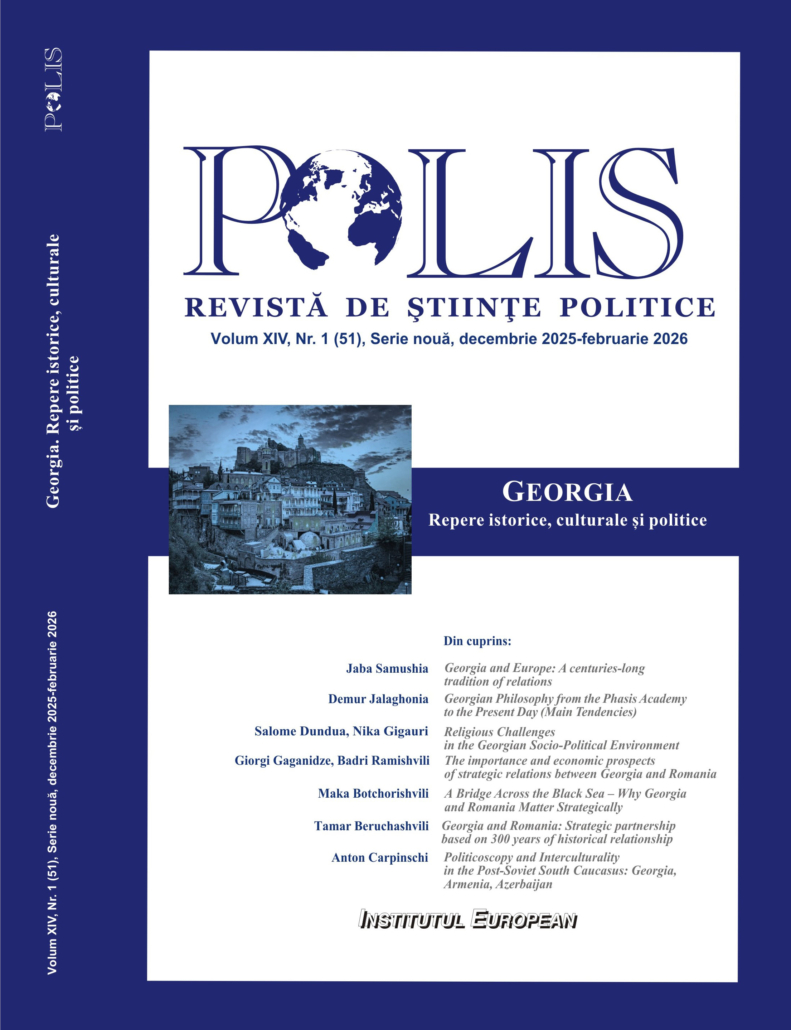
Coordonat de E.S. Tamar BERUCHASHVILI și Sabin DRĂGULIN
Volum XIV, Nr. 1 (51), Serie nouă, decembrie 2025-februarie 2026
Contemporary Trends in the Georgian Economy
Avtandil SILAGADZE
Abstract: The paper explores key contemporary trends in the Georgian economy. Specifically, it examines economic growth, the current state of various economic sectors, employment and unemployment dynamics, foreign investment flows, trade-related challenges, international reserves, external public debt, remittance patterns, inflation, poverty, and other relevant issues. According to the study’s conclusion, the Georgian economy in the post-pandemic period is marked by a positive growth trajectory. More specifically, the following trends have been identified: the overall GDP volume – particularly in the tourism sector – has nearly returned to pre-pandemic levels; GDP per capita has risen sharply; employment has increased, including in the private sector, though not substantially; inflation has declined; absolute poverty has decreased; and unemployment has dropped significantly. Foreign Direct Investment (FDI) has remained relatively stable, primarily due to reinvestment. Remittances continue to play a vital role in supporting the population. Exports of goods (largely driven by re-exports), trade turnover, trade in services, and the traditionally problematic trade deficit have all increased. The ratio of external public debt to nominal GDP has declined, and international reserves have grown. The national currency exchange rate remains stable. Looking ahead, key challenges for the Georgian economy include sustaining high economic growth; boosting investment in the real sector and generating new employment opportunities; enhancing the production of competitive domestic goods; promoting exports and import-substituting industries; expanding and diversifying export markets; further reducing poverty and unemployment; maintaining low inflation and currency stability; and strengthening mutually beneficial relations with neighboring countries, particularly the European Union.
Keywords: Economy, tourism, FDI, GEL, unemployment.
Introduction
Georgia was an independent democratic republic from 1918 to 1921, a period marked by promising institutional reforms that were ultimately left unfinished due to the country’s forcible incorporation into the Soviet administrative system. Following the collapse of the Soviet Union in the early 1990s, and amid a challenging political and economic environment, Georgia regained its independence.
In the development of a market economy in Georgia, five conditional stages can be distinguished.
The first stage (1991-1995) marked the initial construction of an independent economy, progressing at a relatively rapid pace. This period was characterized by the collapse of the planned economy, disruption of supply chains, cessation of centralized financing, hyperinflation, and the complex formation of new institutional structures – amid civil war, territorial conflicts, and a severe energy crisis. As a result, Georgia’s gross domestic product (GDP) declined by 60.3% between 1991 and 1994. During this time, close cooperation with international financial organizations began.
The second stage (1995-2003) was defined by relative stabilization of the Georgian economy. Economic conditions began to improve, and effective steps were taken toward market reforms. Key developments included monetary reform – the introduction of the national currency, the Georgian Lari (GEL), on September 25, 1995 – cessation of hyperinflation, the establishment of an independent two-tier banking system, price liberalization, large-scale property transformation, the creation of independent economic institutions, and the laying of foundations for macroeconomic stabilization. GDP growth reached 11.2% in 1996 compared to the previous year, one of the highest indicators since independence. During this period, groundwork was laid for the construction of international transit oil and gas pipelines and highways across Georgian territory. However, the Asian financial crisis of 1998 and a slowdown in reform momentum led to a decline in economic growth to 2.9% in 1999, followed by a change in government.
The third stage (2004-2012) followed the “Rose Revolution” and was marked by deregulatory and anti-corruption measures, which were unfortunately often accompanied by aggressive encroachments on property rights. This stage saw a significant inflow of foreign direct investment in 2007 and high economic growth, peaking at 12.6%. However, the global financial crisis and the war with Russia led to a sharp economic contraction, with GDP falling by 3.7% in 2009.
The fourth stage (2013-2020) began after another change in government. Economic growth during this period fluctuated between 5.1% and 5.4%, but was severely impacted by the COVID-19 pandemic, resulting in a contraction of -6.3% in 2020. Regional risks also intensified. Overall, the pandemic sharply curtailed economic activity and employment – particularly in the tourism sector – and led to increased spending on social programs1.
The fifth stage of economic reforms (2021–present) is the focus of this paper, which aims to examine the key trends shaping the Georgian economy.
Literature Review
The scientific literature on Georgia’s economic development trends situates this phenomenon within the broader context of post-Soviet socio-economic fluctuations. Tamar Atanelishvili2 has examined the reforms undertaken by the Democratic Republic of Georgia (1918-1921) across the agrarian, trade, and industrial sectors, as well as the establishment of key institutional bodies – including the State Bank of Georgia, the customs administration, the State Control Institute, the Statistical Service, and the Economic Council. Her work also addresses the challenges posed by the circulation of various monetary units, including the Georgian “bon.”
The reforms implemented in the Georgian economy during the 1990s – covering stages of transition, the role of the state, macroeconomic stabilization, institutional restructuring, privatization, financial and monetary systems, labor market dynamics, poverty, and foreign economic relations – are analyzed in the work of Temur Basilia, Avtandil Silagadze, and Tamaz Chikvaidze3.
Vladimer Papava4 explores both theoretical and applied aspects of macroeconomics during Georgia’s post-communist transition, with particular attention to the achievements and shortcomings of the International Monetary Fund’s activities in the country.
The prospects for Georgia’s socio-economic development through 2030, including the challenges of fostering conditions conducive to industrial and agricultural growth, are discussed in the work of Aleksandre Tvalchrelidze, Avtandil Silagadze, and colleagues5.
Labor emigration has had a significant impact on Georgia’s demographic and economic development. Remittances from emigrant workers contribute to mitigating demographic challenges and fostering economic growth6. The complexities surrounding remittance flows in Georgia are also explored in the work of Elguja Mekvabishvili and Tamar Atanelishvili7.
The liberal economic doctrines dominant in the late 1920s proved insufficient to prevent the severe consequences of the Great Depression, prompting a shift toward a new paradigm – strengthening the role of the state in economic affairs. The COVID-19 pandemic has once again brought renewed attention to the importance of state involvement in the economy8.
Post-Soviet countries, including Georgia, continue to face challenges related to reform implementation, resource constraints, and integration into the European Union. Nonetheless, some have begun to make tangible progress in areas such as energy transformation, digital development, and regional cooperation9.
This body of literature offers valuable insights into the reforms undertaken in independent Georgia. Building on this foundation, the present paper examines emerging economic realities and current trends in the country’s development.
Methodology
The research methodology draws upon data and guidance from authoritative sources, including the International Monetary Fund (IMF), the United Nations (UN), the International Labour Organization (ILO), the National Statistics Office of Georgia (Geostat), the National Bank of Georgia (NBG), and the Georgian Ministries of Economy, Finance, and Agriculture. It also incorporates materials from the World Bank and other relevant statistical and policy documents, alongside the works of prominent economists addressing the research topic. The study employs a combination of data collection, analytical, and comparative methods.
Contents
Georgia’s modern economic development has been marked by several notable trends, among which we have analyzed key issues.
Dynamics and Structure of Gross Domestic Product (GDP)
In recent years, the scale of the Georgian economy has expanded significantly. In 2024, the country’s real gross domestic product (GDP) reached $33.8 billion, while GDP at purchasing power parity (PPP, current international $) stood at $104.4 billion – representing a 79% increase compared to the corresponding figure in 202110.
This expansion was strongly influenced by rising domestic investment, particularly state-led infrastructure projects. Additionally, economic growth was largely driven by advancements in the service sector. When dividing GDP into two broad categories – the “real” sector (agriculture, industry, construction) and the “service” sector (trade, real estate, transport, communications, financial services, tourism, etc.) – the latter accounted for approximately 65% of Georgia’s GDP in 2024. Nevertheless, the agriculture, industry, and construction sectors also contributed meaningfully to economic growth, albeit to a lesser extent (see Table 1).
Table 1. Structure of GDP (%) in Georgia
| 2021 | 2022 | 2023 | 2024 | |
| Agriculture, forestry and fishing | 8.3 | 7.6 | 6.9 | 6.2 |
| Industry | 16.9 | 16.5 | 14.1 | 13.5 |
| Construction | 7.3 | 8.0 | 7.6 | 8.4 |
| Trade | 15.4 | 15.1 | 16.0 | 15.2 |
| Real estate | 9.8 | 9.7 | 10.6 | 9.9 |
| Other branches | 42.3 | 43.0 | 44.8 | 46.9 |
Source: https://www.geostat.ge/media/71257 21.10.2025
High economic growth is, by its nature, a reflection of progress across economic sectors. According to data from Geostat11, the largest contributions to the sectoral structure of GDP were made by wholesale and retail trade (15.2%), repair of motor vehicles and motorcycles (15.2%), real estate activities (9.9%), manufacturing (9.3%; down from 19.6% in 2023), construction (8.4%), public administration and defense including compulsory social security (7.0%), information and communication (6.4%), agriculture, forestry and fishing (6.2%), transport and storage (5.9%), education (5.7%), and financial and insurance activities (5.2%). A notable exception to this upward trend was the electricity, gas, steam, and air conditioning supply sector, which experienced a decline of 8.3% in 2024. This downturn is likely attributable to hydrological conditions, shifts in export-import structures, changes in domestic consumption, or broader fluctuations in economic activity.
Despite the progress achieved, Georgia must accelerate the development of its real economy – particularly in industry and agriculture. The country continues to underutilize its industrial and agricultural potential. With targeted government support, these sectors could significantly reduce import dependency and generate tens of thousands of new jobs12. Such a strategy would also contribute to a substantial reduction in emigration flows.
According to the Ministry of Agriculture of Georgia (https://1tv.ge/ news/soflis-meurne-obis-saministro-2024/, 21.10.2025), agri-food products accounted for 26% of the country’s total exports in 2024, reaching 107 international markets. The leading export items included wine ($276 million), alcoholic beverages ($186 million), mineral and fresh waters ($163 million), non-alcoholic carbonated drinks ($139.1 million), and nut crops ($106.2 million), among others. Georgia’s primary export destinations for agri-food products were Russia, the European Union, Azerbaijan, Armenia, Kazakhstan, Ukraine, and Kyrgyzstan.
Despite this export performance, domestic agricultural production remains insufficient to meet internal demand. Georgian agricultural products often lack competitiveness and productivity, hindered by chronic underinvestment, land fragmentation, outdated equipment, and low yields. Consequently, the country’s self-sufficiency in agri-food products remains low – approximately 40% – while reliance on imports is substantial. The range of imported agricultural and related products is broad and includes:
- a) Basic foodstuffs and raw materials – cereals and cereal products (e.g., wheat, wheat flour), fats and oils, sugar and confectionery, alcoholic and non-alcoholic beverages (e.g., spirits, beer, coffee);
- b) Animal-origin products – meat, dairy products, fish, eggs;
- c) Other agri-food items – tobacco products, various food additives, animal feed, nut crops, live plants, and seedlings.
Although the volume of Georgian agri-food exports has increased, the country remains heavily oriented toward food imports. As a result, the share of imported products in domestic consumption remains significantly high.
Among the various sectors of the economy, tourism warrants particular attention. Georgia is a highly attractive destination, and tourism serves as a vital source of employment and income. In 2024, tourism-related sectors accounted for 7.3% of GDP (compared to 7.2% in 2022), while the number of international visits reached 6.5 million – 78.8% of which were classified as tourist visits. This represents a 4.6% increase over the corresponding figure in 2023. The largest share of visitors originated from the Russian Federation (22.4%), Turkey (19.0%), and Armenia (12.7%) (geostat.ge, 20.10.2025).
It is worth noting that leading global economies do not typically prioritize tourism as a central pillar of economic development. In contrast, countries that have adopted tourism as a primary economic strategy often face heightened vulnerability during global crises – such as the financial downturn or the COVID-19 pandemic – and risk economic default. In the absence of viable alternatives, such dependence can lead to systemic collapse13.
Economic Growth
and GDP per Capita
The expansion of Georgia’s economy has been propelled by sustained high growth trends. Notably, the post-pandemic period witnessed robust economic performance, with Georgia recording some of its highest growth rates. In the context of ongoing geopolitical and global challenges, these figures reflect the country’s resilience to external shocks. International institutions forecast continued strong growth for Georgia over the next five years. Current GDP growth rates already surpass those of many other countries, underscoring Georgia’s competitive economic trajectory (see Table 2).
Table 2.GDP growth (annual %)
| 2021 | 2022 | 2023 | 2024 | ||
| Georgia | 10.6 | 11.0 | 7.8 | 9.4 | |
| Moldova | 13.9 | – 4.6 | 1.2 | 0.1 | |
| Armenia | 5.8 | 12.6 | 8.3 | 5.9 | |
| Azerbaijan | 5.6 | 4.7 | 1.4 | 4.1 | |
| Poland | 6.9 | 5.3 | 0.2 | 2.9 |
Computed from:https://data.worldbank.org/indicator/NY.GDP.MKTP.KD.ZG,accessed 18.10.2025.
In recent years, Georgia has experienced robust economic growth, driven by increased domestic output and the diversification of foreign markets. This upward trajectory is also reflected in the dynamics of GDP per capita, which has shown a marked growth trend. In 2024, Georgia’s GDP per capita reached $9,191 (or $28,418 in purchasing power parity terms), surpassing the corresponding figures for Armenia, Azerbaijan, and Moldova (see Table 3).
Table 3. GDP per Capita in Georgia, 2021–2024
| 2021 | 2022 | 2023 | 2024 | |
| GDP per capita (current US$) | 5 084 | 6 730 | 8 284 | 9 194 |
| GDP, PPP (current international $) | 18 916 | 22 461 | 25 072 | 28 418 |
Source: https://data.worldbank.org/indicator/NY.GDP.PCAP.PP.CD?locations=GE, accessed 21.10.2025.
In recent years, Georgia has recorded a substantial increase in GDP per capita – rising by 81% – driven by several key factors. These include sustained real economic growth, the strengthening of the national currency (the lari), rising employment and wage levels, and the continued development of core economic sectors.
Employment and Unemployment, Inflation and Poverty
Employment and Unemployment. Between 2021 and 2024, the total number of employed individuals in Georgia increased by 15%, including a 7% rise in employment within the business sector. Over the same period, the national unemployment rate declined from 20.6% in 2021 to 13.9% in 2024. However, unemployment remains particularly high among young people aged 18–2414. Persistent job shortages and inadequate wages continue to drive emigration, as many citizens seek better employment opportunities abroad.
Inflation and Poverty. In the immediate post-pandemic years, Georgia experienced elevated inflation rates – 9.6% in 2021 and 11.9% in 2022 – driven by a combination of global and regional factors. These included disruptions in global supply chains, a sharp rise in food prices, and the inflationary effects of the Russia–Ukraine war, which led to increased energy and food costs. Additionally, the influx of migrants from Russia and Ukraine heightened domestic demand, while a record surge in remittances from Russia contributed to the appreciation of the Georgian lari, raising the cost of imported goods. By 2023, inflation had moderated to 2.5%, largely due to tighter monetary policy and the gradual restoration of supply chains. In 2024, inflation further declined to 1.1%, falling below the National Bank of Georgia’s target rate of 3%15.
The recent sharp decline in inflation in Georgia has been primarily driven by the following factors: the weakening of external pressures (including the normalization of commodity prices), the tight monetary policy implemented by the National Bank of Georgia, and the stabilizing effect of a relatively steady exchange rate.
Poverty levels – defined as the proportion of the population living below the poverty line –represent a key socio-economic indicator closely linked to the broader macroeconomic environment. In Georgia, the share of the population living below the absolute poverty line has decreased significantly, from 17.6% in 2021 to 9.4% as of the latest data16.
Foreign Direct Investment (FDI)and Remittances
Foreign Direct Investment (FDI) remains one of the most important drivers of Georgia’s economic development. It plays a key role in attracting capital, fostering technological advancement, creating jobs, increasing capital stock, and supporting the stability of the national currency exchange rate. In recent years, the inflow of FDI to Georgia has shown volatility. However, the volume of reinvestments – exempt from taxation – and government investments in infrastructure projects has increased, contributing positively to the national economy.
FDI rose by 24.1% in 2024 compared to 2021, although similar indicators were higher in the two preceding years17. A significant portion of FDI consists of reinvested earnings, which are not subject to taxation. The largest share of foreign direct investment (FDI) in Georgia this year was directed toward the finance and insurance sector (56.4%), followed by real estate (11.4%), energy (9.4%), transport (7.2%), and manufacturing (7.2%). In contrast, investment in agriculture declined. The leading investor countries were the United Kingdom, Turkey, the Czech Republic, and the United Arab Emirates. The share of EU countries in total FDI stood at 28.2%, down from 35% in 2023, while FDI accounted for 4.0% of Georgia’s GDP (see Table 4).
Table 4. Foreign Direct Investment, net inflows (% of GDP)
| 2021 | 2022 | 2023 | 2024 | |
| Georgia | 6.7 | 9.2 | 6.8 | 4.0 |
| Armenia | 2.6 | 5.0 | 2.5 | 0.5 |
| Azerbaijan | -3.1 | -5.7 | 0.3 | 0.3 |
| Moldova | 2.8 | 4.0 | 2.1 | 1.8 |
Source: https://data.worldbank.org/indicator/BX.KLT.DINV.WD.GD.ZS, accessed 25.10.2025
In recent years, foreign direct investment (FDI) in Georgia has exhibited fluctuating dynamics. A substantial portion of FDI consists of reinvested earnings, while the share of EU countries remains significant. Only a small fraction of these investments has flowed into agriculture, although state investment in infrastructure projects has notably increased.
Remittances. Personal remittances received in Georgia are substantial, amounting to $4.06 billion – equivalent to 12% of GDP. This figure compares to 13.7% in 2023, 15.4% in 2022, and 14% in 2021. For comparison, remittances as a share of GDP in the same year were 10.5% in Moldova, 5% in Armenia, and 1.8% in Azerbaijan18.
The scale of remittances highlights Georgia’s considerable dependence on income sent by emigrants, which is primarily used for household consumption. Although remittances are not a newly generated domestic product and are not directly included in GDP calculations, they exert a significant indirect impact. When households spend remittance income on goods and services, it stimulates economic activity. If remittances are channeled into investments, they are directly reflected in GDP.
Foreign Trade, Foreign Debt, and International Reserves
Foreign trade. One of the defining features of Georgia’s economy is its persistent trade deficit, which underscores the need to promote exports, substitute imports, and fully leverage free trade agreements such as the Deep and Comprehensive Free Trade Area (DCFTA) with the European Union. Despite this challenge, Georgia’s foreign trade has shown a clear upward trend: between 2021 and 2024, exports of goods increased by 35%, imports by 67%, total trade turnover by 39%, the trade deficit widened by 44.1%, and trade in services grew 2.8 times between 2021 and 2023.
In the current period, Georgia’s major export goods include cars (38.9% of which are re-exported to neighboring countries), precious metals and concentrates (5.4%), alcoholic beverages (3.9%), natural grape wines (3.7%), and ferroalloys (3.0%). The leading export destinations are Kyrgyzstan (33.7%), Kazakhstan (20.6%), Russia (17.0%), and Azerbaijan (16.6%). European Union countries account for 11.9% of Georgia’s total exports and 25.1% of its imports. The main import partners during the same period are the United States (15.4%), Turkey (15.1%), China (10.7%), Russia (10.1%), and Germany (6.7%)19.
Reducing Georgia’s chronic trade deficit remains one of the country’s key economic challenges. Addressing this issue requires a sound economic policy that promotes diversified exports of domestically competitive products, encourages import substitution, strengthens the use of local infrastructure and transit potential, enhances macroeconomic stability, and attracts foreign investment.
External debt. The dynamics of Georgia’s state external debt between 2021 and 2025 have been relatively stable. The ratio of external public debt (in US dollars) to nominal GDP declined to 36.7% in the first quarter of 2025, down from 51.4% in 2021 and 36.7% in 2024. This improvement is largely attributed to robust economic growth and the appreciation of the national currency, the lari. Georgia’s external debt is primarily sourced from multilateral creditors – including the Asian Development Bank, European Investment Bank, World Bank, and International Monetary Fund – as well as bilateral partners such as France, Germany, and Japan20.
Georgia’s public external debt has shown a declining trend relative to nominal GDP, reflecting improved macroeconomic conditions.
International reserves. International reserves managed by the National Bank of Georgia, have experienced notable growth between 2021 and 2025 – driven by rapid economic expansion, foreign exchange inflows, and central bank interventions. These reserves, composed primarily of foreign currency and supplemented by 7 tons of gold purchased since 2024, increased by 27% in 2025 compared to 202121.
Overall, Georgia’s external sector is marked by an expanding foreign trade balance – including growth in exports, imports, and the trade deficit – a consistently high volume of remittances, a declining ratio of public external debt to GDP, and a rising trend in international reserves.
Conclusion
In the post-pandemic period, the Georgian economy has shown a steady growth trend, with GDP expanding across nearly all service and real sectors – tourism has nearly returned to pre-pandemic levels, and GDP per capita has risen sharply. Employment has increased modestly, particularly in the private sector, while inflation has declined and the absolute poverty rate has improved. The unemployment rate has dropped significantly, and Foreign Direct Investment (FDI) has remained relatively stable due to reinvestment, with EU countries contributing a substantial share. Only a small portion of FDI flows into agriculture, while a significant part of the population relies on remittances from emigrants. Exports of goods – largely driven by re-exports – along with trade turnover, the trade deficit, and trade in services have all increased. The ratio of external public debt to nominal GDP has decreased, international reserves have grown, and the national currency exchange rate has remained stable.
The future challenges facing Georgia’s economy include sustaining high economic growth, increasing investment in the real sector, and generating new employment opportunities. Key priorities involve attracting foreign investment, boosting the production of competitive domestic goods – particularly to meet internal demand – and promoting the development of export-oriented and import-substituting products. Expanding and diversifying export markets, making fuller use of domestic resources, and establishing an effective employment system are essential for further reducing poverty and unemployment. Maintaining low inflation and a stable national currency remains critical, alongside fostering the emergence of regional financial markets and centers. Strengthening mutually beneficial relations with neighboring countries – especially with the European Union and other international partners – will also be vital to long-term economic resilience and integration.
Notes
- org/indicator, (accessed 17.10.2025).
- Atanelishvili, Economic reforms in the Democratic Republic of Georgia, Universali, 2006.
- Basilia, A. Silagadze, & T. Chikvaidze, The economy of post-socialist Georgia on the threshold of the 21st century, Tbilisi, 2001.
- Papava, The International Monetary Fund in Georgia: Achievements and mistakes Tbilisi Publishing House, 2000, https://dspace.nplg.gov.ge/bitstream/1234/473506/1/SaertashorisoSavalutoFondiSaqartveloshi_2000.pdf (Accessed October 23, 2025), and Idem, Macroeconomics of the post-communist transition period, Tbilisi University Press, 2005, https://www.researchgate.net/publication/320735954_postkomunisturi_gardamavali_periodis_makroekonomika (Accessed October 25, 2025).
- Tvalchrelidze, A. Silagadze, G. Keshelashvili, & D. Gegia, Georgia’s social economic development program. Nekeri, 2021, https://www.researchgate.net/publication/320010393_ (Accessed October 25, 2025).
- Zubiashvili, A. Silagadze, & I. Kutubidze, „The impact of migration on the development of economy and demography of Georgia in the period of globalization”, Bulletin of the Georgian National Academy of Sciences, 17(3), 2023, http://science.org.ge/bnas/vol-17-3.html (Accessed October 25, 2025).
- Mekvabishvili & T. Atanelishvili, „Personal remittances in the post-Soviet countries: Comparative analysis”, Bulletin of the Georgian National Academy of Sciences, 11(3), 2017, http://science.org.ge/bnas/vol-11-3.html (Accessed October 23, 2025).
- Silagadze, „Covid depression and search for a new paradigm”, Bulletin of the Georgian National Academy of Sciences, 16(1), 2022 http://science.org.ge/bnas/vol-16-1.html (Accessed October 23, 2025).
- Silagadze, E. Mekvabishvili, G. Gaganidze, T. Atanelishvili, & M. Chikviladze, „Adaptation of the economic policies of the US, EU and post-Soviet countries to new realities of the global economy: A comparative analysis”, Scientific Bulletin of Mukachevo State University. Series Economics, 11(4), 2024, (Accessed October 25, 2025).
- org/indicator, (accessed 25.10.2025).
- ge, (accessed 18.10.2025).
- Tvalchrelidze, A. Silagadze, G. Keshelashvili, & D. Gegia, Georgia’s social economic development program. Nekeri, op.cit.
- Ibidem, pp. 254-256.
- https://www.geostat.ge/ka/modules/categories/683/dasakmeba-umushevroba, (accessed 24.10.2025)
- https://data.worldbank.org/indicator/FP.CPI.TOTL.ZG?locations=MD-GE-AM, ( accessed 24.10.2025)
- Geostat, (accessed 24.10.2025).
- Geostat, (accessed 22.10.2025)
- World Bank, (accessed 23.10.2025)
- Geostat, (accessed 22.10.2025)
- Ministry of Finance of Georgia, (accessed 24.10.2025).
- National Bank of Georgia, (accessed 24.10.2025).
Bibliography
Books and Monographs
ATANELISHVILI, T., Economic reforms in the Democratic Republic of Georgia, Universali, 2006.
BASILIA, T., SILAGADZE, A., & CHIKVAIDZE, T., The economy of post-socialist Georgia on the threshold of the 21st century, Tbilisi, 2001.
Journal Articles and Reports
SILAGADZE, A., MEKVABISHVILI, E., GAGANIDZE, G., ATANELISHVILI, T., & CHIKVILADZE, M., „Adaptation of the economic policies of the US, EU and post-Soviet countries to new realities of the global economy: A comparative analysis”, Scientific Bulletin of Mukachevo State University. Series Economics, 11(4), 2025.
Online resources
MEKVABISHVILI, E., & ATANELISHVILI, T., „Personal remittances in the post-Soviet countries: Comparative analysis”, Bulletin of the Georgian National Academy of Sciences, 11(3), 2017, http://science.org.ge/bnas/vol-11-3.html.
PAPAVA, V., The International Monetary Fund in Georgia: Achievements and mistakes, Tbilisi, Publishing House, 2000. https://dspace.nplg.gov.ge/bitstream/1234/473506/1/SaertashorisoSavalutoFondiSaqartveloshi_2000.pdf.
IDEM, Macroeconomics of the post-communist transition period, Tbilisi University Press, 2005, https://www.researchgate.net/publication/320735954_postkomunisturi_gardamavali_periodis_makroekonomika.
SILAGADZE, A., „Covid depression and search for a new paradigm. Bulletin of the Georgian National Academy of Sciences, 16(1), 2022, http://science.org.ge/bnas/vol-16-1.html.
TVALCHRELIDZE, A., SILAGADZE, A., KESHELASHVILI, G., & GEGIA, D. (2021). Georgia’s social economic development program, Nekeri, https://www.researchgate.net/ publication/320010393_.
ZUBIASHVILI, T., SILAGADZE, A., & KUTUBIDZE, I., „The impact of migration on the development of economy and demography of Georgia in the period of globalization”, Bulletin of the Georgian National Academy of Sciences, 17(3), 2023,
http://science.org.ge/bnas/vol-17-3.html
Statistical and Institutional Sources
World Bank. (n.d.). World development indicators. https://data.worldbank.org/indicator
National Statistics Office of Georgia. (n.d.). https://www.geostat.ge
National Bank of Georgia. (n.d.). https://nbg.gov.ge
Ministry of Finance of Georgia. (n.d.). https://www.mof.ge
Ministry of Economy and Sustainable Development of Georgia. (n.d.). https://www.economy.ge
Ministry of Rural Development of Georgia. (2024). https://1tv.ge/news/ soflis-meurneobis-saministro-2024