


Coordonatori: E.S. Ihor PROKOPCHUK, Sabin DRĂGULIN și Sorin BOCANCEA
Volum XIV, Nr. 3 (53), Serie nouă, iunie-august 2026
Criminalization and Anti-Corruption in Ukraine and Georgia
Alexandre KUKHIANIDZE
Nino KUKHIANIDZE
Abstract: This article compares the development and resilience of anti-corruption institutions in Ukraine and Georgia. Although both states inherited weak post-Soviet institutions, experienced major political transformations, and pursued European Union membership, their reform trajectories have diverged. Ukraine developed a specialized anti-corruption architecture whose investigative, prosecutorial, preventive, and adjudicative functions are institutionally dispersed and partly protected by competitive appointments, civil-society oversight, and international conditionality. Georgia achieved a substantial reduction in petty corruption after the 2003 Rose Revolution, but retained centralized political control over law-enforcement and judicial institutions; its later Anti-Corruption Bureau lacked independent investigative authority and remained vulnerable to executive influence. Using a qualitative comparative case-study design, the article examines legislation, official assessments, institutional mandates, appointment procedures, and selected enforcement outcomes. It argues that EU conditionality can reinforce anti-corruption reform only when it interacts with domestic political commitment, autonomous institutions, and an active civil society. Formal institutional creation alone does not prevent political capture.
Keywords: Ukraine, Georgia, criminalization, corruption, reforms, democratization, authoritarianism.
Introduction
Corruption is treated here not merely as individual bribery but as a mode of institutional capture through which public authority is subordinated to private, criminal, oligarchic, or partisan interests. “Criminalization” therefore refers to the penetration of economic and state institutions by criminal networks and informal patronage, while “legal criminalization” refers separately to the use of criminal law against designated conduct or status. This distinction is essential to the comparison: Georgia’s post-2003 reforms were highly effective against organized crime and petty corruption, yet did not establish durable safeguards against elite political control; Ukraine’s later model distributed anti-corruption functions across specialized bodies whose autonomy has remained contested but comparatively resilient.
This study examines why specialized anti-corruption institutions developed greater operational autonomy and resilience in Ukraine than in Georgia. It traces the post-Soviet criminalization of both states, compares the mandates and appointment safeguards of their anti-corruption bodies, and evaluates how EU conditionality interacted with domestic political incentives after candidate status was granted.
Key research questions:
- How did post-Soviet criminalization and state capture develop in Ukraine and Georgia?
- How did the institutional design, appointment procedures, and enforcement powers of the two countries’ anti-corruption systems differ?
- Under what domestic political and institutional conditions did EU conditionality strengthen – or fail to strengthen – anti-corruption reform?
This study employs a qualitative comparative approach, utilizing a set of methods to analyze the evolution, legal mandates, and political trajectories of anti-corruption bureaus in Ukraine and Georgia. The research focuses on two post-Soviet states that share a similar historical legacy in public administration, key milestones in democratic transformation (the 2003 Rose Revolution and the 2014 Euromaidan), and an aspiration for EU integration.
The study identifies independent and dependent variables and comparative operationalization: Ukraine versus Georgia. Operationalized independent variables include legislatively enshrined mandates (criminal investigation powers versus administrative oversight), independence guarantees (international selection commissions versus executive appointments), and external conditions based on EU criteria (high direct conditionality – EU candidate status, seven recommendations, visa liberalization, independent anti-corruption infrastructure versus high initial and evolving conditionality (radical anti-corruption reforms driven by EU and NATO integration plans, twelve EU candidate status criteria, de-oligarchization and institutional neutrality). Operationalized dependent variables include institutional resilience (high structural autonomy against legislative rollbacks, civil society and international donor influence versus restructuring-prone and portfolio shifts following changes in political dynamics); the capacity to enforce “grand corruption” (high formal output versus low formal output on top officials), and vulnerability to political capture or abolition (legislative attempts to alter selection rules, trim investigative powers, or subordinate prosecutors versus risk of political capture such as the ruling party’s capture of institutional appointment mechanisms which makes bodies vulnerable to political influence.
Data collection methods include an analysis of national legislation, court rulings, and official regulations establishing and governing anti-corruption bodies; a review of official reports, assessments, and compliance findings prepared by international organizations and civil society groups; and the tracking of specific cases and operational outcomes, such as asset declaration audits and initiated investigations. Comparative analysis is used to contrast the legal frameworks and procedural autonomy of the anti-corruption bureaus in Ukraine and Georgia, alongside a method of tracking pivotal events –such as the granting of EU candidate status to both states, and the halting of the European integration process by the ruling “Georgian Dream” party following the 2024 parliamentary elections.
Criminalization in Ukraine Following the Collapse of the USSR
The collapse of the Soviet Union in 1991 led not only to a profound crisis but also to a political, economic, and social transformation in Ukraine1. On one hand, gaining independence opened up opportunities for democratization and economic reforms; on the other hand, the disintegration of old state structures and societal demoralization gave rise to a period of instability that fostered widespread criminalization. The weakening of state institutions, absence of the culture and traditions of the rule of law, undemocratic procedures for privatizing state property, and economic hardships led to a surge in organized crime and corruption, as well as the consolidation of oligarchic power2.
Soviet-style governance structures collapsed rapidly, whereas establishing new democratic institutions, transitioning to a market economy, reforming the judiciary, and addressing widespread poverty alongside entrenched crime and corruption required significantly more time3. A legal vacuum and weak oversight enabled managers of state enterprises – in league with emerging financial-industrial and criminal groups – to exploit privatization to appropriate assets and capital; meanwhile, rampant corruption and moral decay within law enforcement agencies facilitated the growth of organized crime. Consequently, disputes were frequently resolved through informal or criminal means4. Thus, privatization became a means of unfairly acquiring material and financial resources at minimal cost. Former Soviet and Party officials, as well as new entrepreneurs, engaged in financial schemes and smuggling, while criminal groups helped them eliminate competitors, controlled racketeering operations, or carried out contract killings. Violent clashes between gangs became a feature of economic life in the 1990s, particularly in major cities5.
All of this led to a significant expansion of the shadow economy and the formation of influential informal networks that utilized corruption, violence, and patronage to enrich themselves illegally at the expense of the country’s majority population. Emerging non-governmental organizations and independent media outlets did not yet possess the capacity to exercise effective civic oversight within Ukrainian society.
With the strengthening of new political, state, and civil democratic institutions by the early 2000s, there was a decline in violent crime; however, criminal elements managed to integrate into legitimate business, becoming less visible yet remaining influential through corrupt ties to political structures, via money laundering and other schemes. Despite the waning of violent organized crime after the 1990s, forms of corruption such as bribery, kickbacks, theft, embezzlement, fraud, and money laundering evolved into a systemic and more entrenched form of criminalization in Ukraine. Corruption linked organized crime with the authorities, the business sector, and even segments of the population, facilitating the emergence and growing influence of oligarchic capital, which leveraged its political connections and economic power. This enabled oligarchs to control the media, influence elections, and alter legislation to their own advantage6. Corruption and oligarchic interests flourished even further after 2014, when Russia’s annexation of Crimea and the war it instigated in Ukraine’s Donetsk and Luhansk regions led to a sharp rise in illegal arms trafficking, smuggling, and other forms of criminal enterprise7. According to an analysis published in the European journal eucrim (The European Law Forum: Prevention, Investigation, Prosecution), which is based on Transparency International’s Global Corruption Barometer study, the proportion of the Ukrainian population reporting paying a bribe to obtain basic government services increased from 37% in 2011 to 38% in 2017. The report concludes that, despite political changes, corrupt officials continue to use opaque schemes8. A comprehensive report published by the Centre for Eastern Studies (OSW) details that while older oligarchic factions were temporarily placed on the defensive, new political-business groups – explicitly described as “oligarchic” – emerged around the new Ukrainian political leadership after 2014. The authors found that informal patronage networks persisted because political power remained tied to the control of business assets9. “Ukraine has long been a hotspot in the global arms trade, a situation that has intensified since the beginning of Russia-backed conflict in the east in 2014”10. However, by this time, the geopolitical landscape shifted against Russian influence and domestic corrupt networks; the need to ensure national security and the surge in civic engagement among the Ukrainian population fostered the strengthening of state institutions, a dramatic rise in national consciousness and patriotism, and the consolidation of Ukrainian society. The struggle for sovereignty and survival evolved into a fight against the two main adversaries of Ukrainian statehood: Russia’s aggressive policies and domestic corruption. Efforts to curb corruption were undertaken following the 2004 Orange Revolution and the tragic events of the 2013-2014 Euromaidan; these included police reorganization, increased transparency in public procurement, and numerous other reforms. However, the systematic implementation of anti-corruption reforms and the strengthening of civil society became a national priority for Ukraine following Russia’s full-scale invasion in 2022 and the country’s designation as an EU candidate.
Ukraine has been making slow but steady progress in combating corruption – although corruption remains a critical challenge in its EU integration process. This trajectory is contextualized by Transparency International’s Corruption Perceptions Index (CPI), which measures perceptions of public-sector corruption rather than corruption itself:
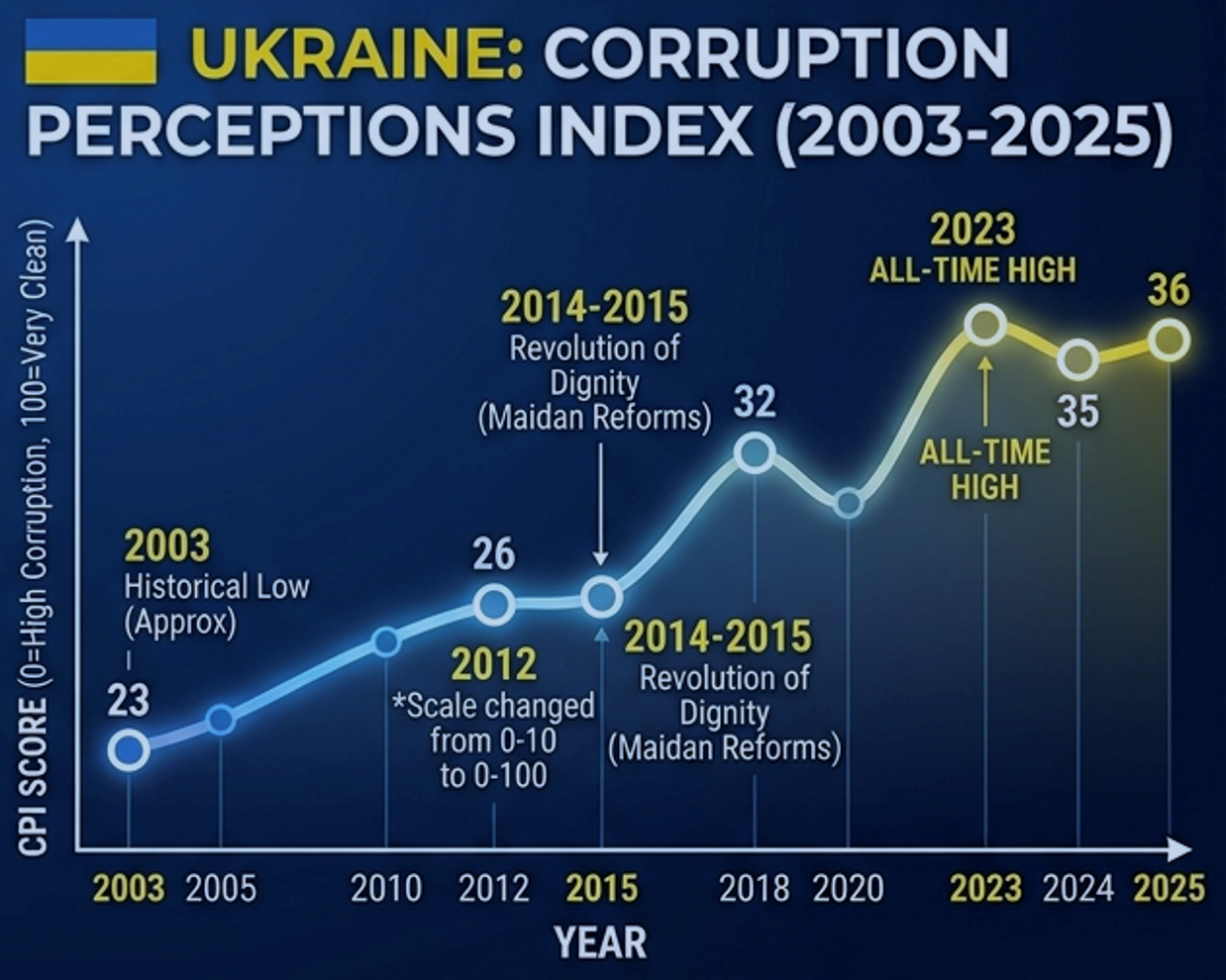
Source: Transparency International’s CPI, https://www.transparency.org/en/cpi/2025/index/ukr
Criminalization in Georgia Following the Collapse of the USSR
Criminalization in Georgia represents one of the most drastic institutional transformations in the post-Soviet space. Post-Soviet Georgian criminalization can be divided into three distinct phases:
- Criminal state capture and a corrupt system of public administration (1991-2003): the spread of organized crime and the formation of systemic, institutionalized corruption.
- State reforms to combat crime and corruption (following the 2003 Rose Revolution): radical anti-mafia legislation, sweeping police reform, and harsh penalties for crimes.
- Democratic transfer of power following the 2012 parliamentary elections, the antidemocratic backsliding, and formation of the Georgian “mafia state”.
Following the 1991 Soviet collapse, Georgia experienced systemic state failure, civil wars, and secessionist armed conflicts in Abkhazia and South Ossetia. In this institutional vacuum, criminal networks – specifically the organized criminal subculture known as the “Thieves-in-Law” (Kanonieri Kurdebi) – captured core state functions. They controlled the shadow economy, managed informal trade, smuggling, and commercial disputes, operating as parallel judicial authorities. Institutional corruption flourished; law enforcement agencies and government institutions became deeply compromised by petty and elite corruption, relying heavily on informal bribery networks to maintain basic operations.
Following the 2003 Rose Revolution, the administration of President Mikheil Saakashvili instituted radical reforms designed to eradicate organized crime and corruption, and re-establish state capacity11. In 2005, Georgia amended its Criminal Code to introduce unprecedented legislation specifically criminalizing membership in organized crime groups or belonging to the status of a “Thieves-in-Law” (mafia bosses), regardless of whether a specific underlying criminal act was proven. According to Article 223 “Membership of the criminal underworld; Thief in Law” of the Criminal Code of Georgia, membership in the criminal underworld shall be punished by imprisonment for a term of five to eight years, with or without a fine, and being a “Thief-in-Law” shall be punished by imprisonment for a term of seven to ten years, with or without a fine12.
In the security sector, the government fired thousands of traffic police officers in a single day, replacing them with a modernized Patrol Police unit to disrupt street-level bribe extraction13. Soon, all other police structures were reformed, and similar measures were taken in the Prosecutor’s office and in the judiciary.
Concerning any crime, the state adopted a zero-tolerance policy, leading to a massive spike in incarceration rates during the mid-to-late 2000s, making Georgia one of the most incarcerated nations per capita in Europe at the time. Eradicating street-level corruption required a combination of high salaries, new equipment, and strict central oversight, as well as the criminalization of informal social networks. Radical eradication of organized crime and corruption caused authoritarian risks. Despite street crime and petty corruption being drastically reduced, the central government’s unchecked executive authority led to over-incarceration, human rights abuses within the penitentiary system, and concerns regarding elite corruption14.
Police reform was perceived as successful because efficiency was usually measured through declines in organized crime and corruption and increases in public trust. The Rose Revolution led to revolutionary methods of government rather than the rule of law. As a result, the old soviet tradition, when police serve the authorities instead of the law and citizens, was maintained, and “…technical modernization…” did not “…automatically produce democratic policing,” with the police as an element of an authoritarian modernization15.
Not only the police but the Prosecutor’s Office and the Judiciary remained under the centralized control of the ruling United National Movement (UNM). Ultimately, the concentration of presidential political power at the expense of the legislative and judiciary caused a lack of democratic development and violations of human rights, especially in prisons. By 2012, the need for a change of government was evident. A prison scandal involving the sexual abuse of male inmates – which broke roughly a month before the 2012 parliamentary elections – served as the catalyst that secured victory for the new Georgian Dream (GD) party, founded by Bidzina Ivanishvili, a Russian oligarch of Georgian descent. Although later controversy surrounded the production, timing, and political use of some recordings, the footage exposed serious abuses within the penitentiary system and decisively affected public opinion before the election.
Following the transfer of power, Georgian Dream gradually consolidated influence over state institutions. Government rhetoric concerning a so-called “deep state” was used to justify personnel and institutional changes that critics described as partisan. Key positions across law-enforcement, security, prosecutorial, and local-government bodies were increasingly filled by politically connected officials. The judiciary, which had previously been criticized for its alignment with the UNM government, proved vulnerable to influence by the succeeding administration as well. This continuity illustrates how institutions lacking structural independence can be repurposed by successive governing parties. Criminal proceedings against former President Mikheil Saakashvili and several leading opposition figures have subsequently intensified domestic and international concerns about selective justice and democratic pluralism.
Anti-Corruption Reform in Ukraine after EU Candidate Status
Ukraine’s fight against corruption after receiving EU candidate status on June 23, 2022 can be understood as a shift from a largely domestic reform agenda toward a European integration-driven system of anti-corruption conditionality. Candidate status created stronger incentives and external monitoring for Ukraine to demonstrate that anti-corruption institutions, judicial independence, transparency, and enforcement were becoming durable features of democratic governance. The European Council, which granted Ukraine the candidate status, linked further progress toward EU membership to fulfillment of the conditions identified by the European Commission. The EU framework therefore made the fight against corruption part of Ukraine’s broader rule-of-law and democratization process16.
A central feature of Ukraine’s post-candidate-status trajectory was the further consolidation, operationalization, and protection of specialized institutions established during the post-Euromaidan reform period:
- NABU – National Anti-Corruption Bureau of Ukraine, which investigates high-level corruption;
- SAPO – Specialized Anti-Corruption Prosecutor’s Office, which prosecutes corruption cases investigated by NABU;
- HACC – High Anti-Corruption Court, which adjudicates major corruption cases;
- NACP – National Agency on Corruption Prevention, which focuses primarily on prevention, asset declarations, conflicts of interest, political-finance oversight, and anti-corruption policy.
These steps reduced the ability of political and traditional law enforcement structures to control investigations involving powerful political or economic actors. The OECD described the newly created anti-corruption organizations as among Ukraine’s strongest functioning public institutions and reports that their performance has improved over time17.
Especially important post-candidate-status development was the appointment of the new NABU director and head of SAPO through a competitive process involving international experts. The OECD considered these appointments significant because international involvement helped reinforce transparency and merit-based selection18.
Before 2022, Ukraine’s anti-corruption reforms were strongly influenced by the post-Maidan reform process; however, after candidate status, fighting corruption became directly connected with EU accession negotiations and the rule-of-law requirements for membership.
The Ukrainian experience indicates that external conditionality must extend beyond the adoption of anti-corruption legislation to the independent and effective application of that legislation. The central challenge is to preserve institutions capable of investigating ministers, judges, prosecutors, members of parliament, senior law-enforcement officials, and economically powerful actors without improper political interference.
Undisclosed assets and finances can undermine public confidence in democratic institutions and electoral competition. This is why another important step was the restoration and strengthening of Ukraine’s electronic asset-declaration system, which requires public officials to disclose their assets and financial interests, and allows anti-corruption organizations to identify unexplained wealth and potential conflicts of interest. According to the OECD’s 2025 assessment, Ukraine reopened its comprehensive and digitized asset-declaration system and strengthened mechanisms for monitoring declarations. The OECD’s 2025 assessment identified strengthened whistleblower protection as one of Ukraine’s significant achievements. Governmental employees frequently possess information that is useful for external investigators; therefore, protecting them strengthens institutional accountability. This is important because productive anti-corruption policy cannot depend only on prosecutors and investigators19.
In a democratic society, political power does not automatically provide immunity from criminal accountability. There have also been significant efforts aimed at increasing enforcement against high-level corruption. NABU and SAPO initiated hundreds of new criminal cases, involving the defense, energy, law-enforcement, and oversight sectors, including former MPs, ministers, tax and customs officials, and other senior actors20.
Despite all efforts, judicial reform and independence remain one of Ukraine’s most difficult anti-corruption problems and major weaknesses. The OECD’s 2025 monitoring rated Ukraine’s performance in judicial independence at 57.4/100, unchanged from its 2023 baseline. By comparison, anti-corruption institutions received a substantially stronger score of 92.7/100 in 202521. New anti-corruption institutions appeared more efficient than the older judicial system in Ukraine.
Events in 2025 demonstrated that reform is neither linear nor irreversible. Legislative measures supported by the presidential majority threatened the independence of NABU and SAPO, prompting strong protests from civil society and international partners. Subsequent legislation restored key guarantees of their independence. The episode revealed continuing risks of political interference, but also demonstrated the resilience produced by domestic mobilization, institutional pluralism, and international scrutiny. It therefore complicates any characterization of Ukraine as an unqualified anti-corruption success.
Ukraine is in a particularly complicated situation because of the Russian military invasion, and wartime conditions make transparency and accountability more difficult. This is why anti-corruption policy has become increasingly connected to defense procurement, reconstruction, public procurement, and management of international financial assistance. The OECD’s assessment indicates that Ukraine has made important progress but continues to face risks in public procurement, enforcement, asset recovery, and judicial independence22.
By 2026, the overall assessment of Ukraine’s anti-corruption efforts suggests a significant improvement. The OECD’s 2025 monitoring gave Ukraine particularly strong results in anti-corruption policy, whistleblower protection, and anti-corruption institutions. Its anti-corruption-policy score increased from 53.0 in 2023 to 91.9 in 2025, while the score for specialized anti-corruption institutions rose from 78.6 to 92.7. Enforcement of corruption offences also increased, though only from 34.2 to 39.123.
The key OECD publications that directly assess Ukraine’s national anti-corruption framework are the OECD Integrity and Anti-Corruption Review of Ukraine (2025) and its accompanying country profile in the OECD Anti-Corruption and Integrity Outlook (2026). The OECD explicitly states that Ukraine has successfully built and maintained an anti-corruption framework that aligns closely with international standards and its EU integration goals24.
Anti-Corruption Reform in Georgia after EU Candidate Status
Georgia’s fight against corruption after receiving EU candidate status is more complicated than Ukraine’s experience. Georgia had already developed a relatively sophisticated anti-corruption system before candidate status, particularly in combating petty and administrative corruption. But this system was created before Georgian Dream came to power in 2012. However, by the time Georgia received EU candidate status, the main problems remained high-level corruption, political influence on law enforcement, conflicts of interest, judicial independence, and the autonomy of anti-corruption bodies. Ordinary citizens of Georgia no longer felt the direct pressure of corrupt police officers and officials, and the ruling Georgian Dream party saw no political incentive to dismantle this system or spark public discontent. The ruling party accepted the system unchanged, and during the entire period of its rule did not take any significant steps to increase the efficiency of combating high-level corruption, except for some actions to simulate this fight in the first year after Georgia was granted EU candidate status.
Georgia applied for European Union membership on March 3, 2022 following the outbreak of war in Ukraine, and on December 14, 2023, the European Council granted Georgia candidate status, on the understanding that the relevant reforms associated with the nine steps of the Commission’s recommendations of 8 November 2023 were implemented25. The Commission’s recommendations (November 8, 2023) required Georgia to: Ensure a free, fair and competitive electoral process, notably in 2024; Implement a judicial reform, including reform of the High Council of Justice and the Prosecutor’s Office; Further address the effectiveness and ensure the institutional independence and impartiality of the Anti-Corruption Bureau, the Special Investigative Service and the Personal Data Protection Service; Establish a strong track record in investigating corruption and organised crime cases; Improve the protection of human rights, ensuring freedom of assembly and expression; Consult and engage with civil society, allowing for their meaningful involvement in legislative and policymaking processes and ensure they can operate freely26.The Georgian Dream Government not only failed to implement the above recommendations, but also suspended the very process of Georgia’s admission to the EU, soon after the parliamentary elections in Georgia of October, 2024. This decision caused a great wave of indignation in Georgian society, especially among young people, and led to massive and prolonged meetings, demonstrations, and clashes with police and state security forces throughout Georgia. The result of these clashes was a brutal campaign launched by the Georgian Dream to persecute protesters, mass arrests, torture, substantial financial penalties, and the detention of political opponents, primarily among civil activists and student youth. Georgian Dream initiated the adoption of a number of anti-democratic laws aimed at destroying civil society and the political opposition, and also began reforms aimed at establishing full party control over the entire education system in the country, primarily in universities27. This kind of policy is accompanied by disinformation in the style of Russian propaganda and ideological attacks on the EU and diplomatic representations of Western countries in Georgia to undermine confidence in Western values and the very idea of Georgia’s membership in the EU.
An important institutional development preceding candidate status was that the Parliament of Georgia adopted legislation establishing the Anti-Corruption Bureau (ACB) in November 2022. The ACB mandate included coordinating anti-corruption policy, monitoring implementation, and developing recommendations. The EU welcomed this establishment as significant, but the key question was whether the institution could operate independently of political influence. The problem was that the Prime Minister of Georgia appointed the ACB Director. This decision by the ruling Georgian Dream party ignored demands of the parliamentary opposition to appoint the Director based on parliamentary consensus. As a result, the ACB of Georgia aligned its actions with the ruling party. In September 2024, one month before the parliamentary election of 2024, the ACB issued decisions against the leading civil society organizations, “Transparency International – Georgia” (TIG) and “Choose Europe” which prevented them from registering as observers of the 2024 elections, monitoring the electoral campaign, and other activities relating to the electoral process28. The decision was so odious, and the civil society protest so strong, that the government cancelled it soon. Another case was the ACB’s attempt to check asset declarations of three hundred top politicians and government officials of Georgia, including judges. The four top judges who had earlier been sanctioned by the US government because of corruption applied to the court against the ACB, demanding to investigate why they were included in the list and putting under question the qualifications of the commission members who selected and included them in the list. As a result, the process was effectively blocked, and all four judges successfully avoided verification of their asset declarations. On June 12, 2025, Tbilisi City Court granted the Anti-Corruption Bureau the right to demand from five civil society organizations vast amounts of programmatic, administrative, financial and personal information, including on all their contractors and individual beneficiaries, from 1 January 2024 to 10 June 2025. The order invokes the Law on Grants, the Law on Political Associations of Citizens and the Law on Combating Corruption, all recently amended by the ruling Georgian Dream party in its campaign aimed at curtailing the rights to freedom of association and expression and other human rights. The ruling party Georgian Dream weaponized the country’s justice system and the Anti-Corruption Bureau to suppress human rights activities and civil society organizations29.
In 2025, the parliamentary Speaker announced the abolition of the ACB, stating that the bureau’s functions will be transferred to the State Audit Office by 2 March 2026. ‘As a result of consultations with the government, a common view was formed that this function better fits the State Audit Office within the constitutional framework of public governance, as a higher and more independent constitutional body’, he said30.
The ACB’s appointment structure, limited mandate, and record generated substantial concerns about its political dependence and its capacity to investigate high-level corruption. The Georgian case demonstrates that institutional creation does not necessarily produce institutional independence, impartiality, or effective enforcement
.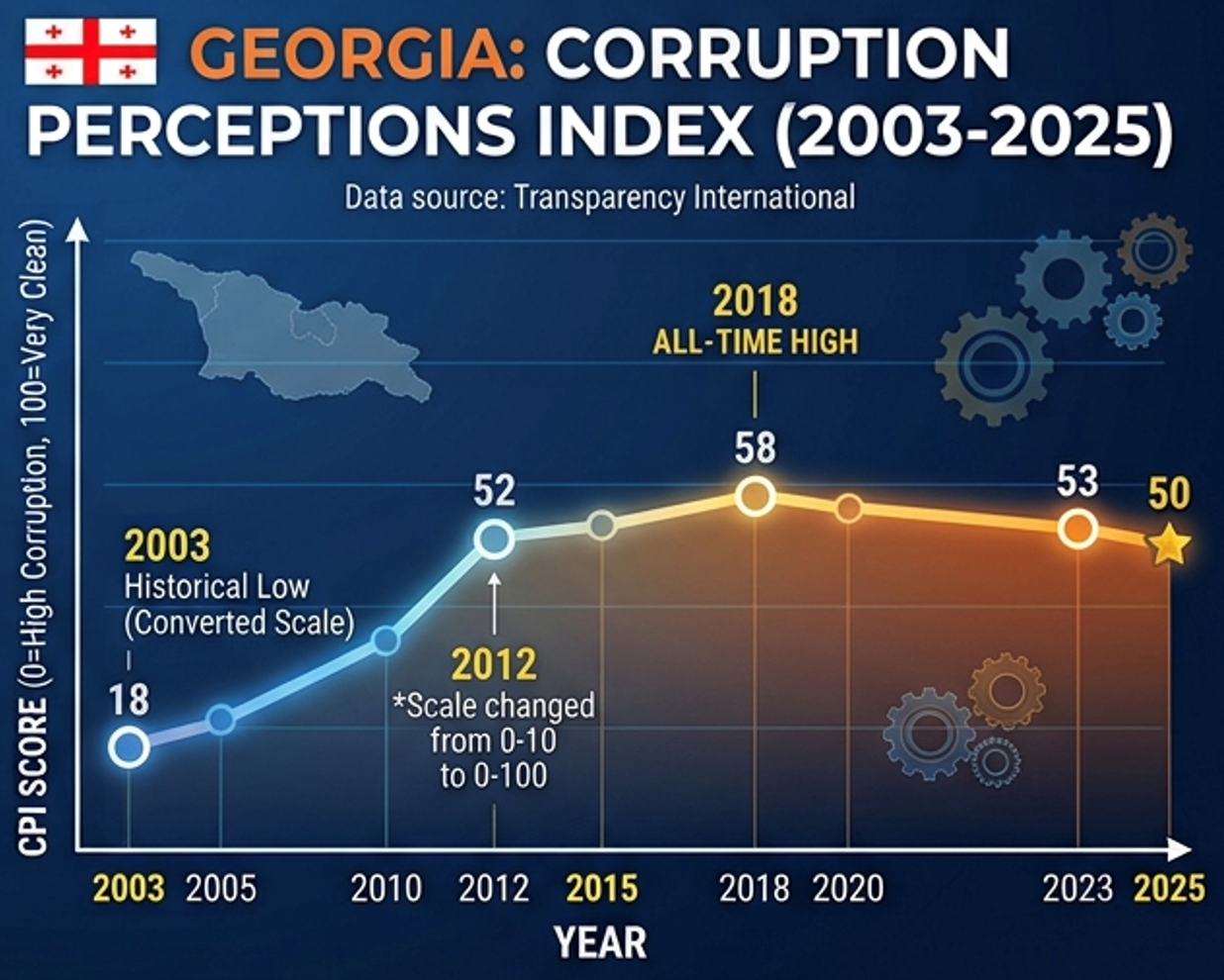
Source: Transparency International’s CPI, https://www.transparency.org/en/cpi/2025/index/geo
The European Commission’s 2025 assessment concluded that Georgia’s democratic backsliding had become so serious that the country was effectively a “candidate country in name only”. Anti-corruption reform became increasingly intertwined with the deterioration of democratic checks and balances31.
Conclusions
In the 1990s, Ukraine and Georgia underwent similar processes of criminalization; however, in the subsequent fight against corruption, they chose two distinct approaches and anti-corruption models for institutional reform.
Amidst a gradual improvement in the effectiveness of anti-corruption efforts, Ukraine has continued to develop democratic governance principles and strengthen civil society and anti-corruption bodies as part of its EU integration process. Despite Russia’s horrific aggression against it, Ukraine is successfully advancing along the path of European integration and the fight against corruption, particularly at the highest levels.
Ukraine’s experience demonstrates that anti-corruption reform is simultaneously a rule-of-law reform and a democratization process. The post-2022 experience illustrates a strong relationship between EU candidate status, strengthening of anti-corruption institutions, increased investigative, prosecutorial, and judicial independence and accountability of political elites, and finally, consolidation of democratic institutions.
Following the post-Euromaidan reform process, Ukraine established a new, specialized anti-corruption institutional framework: the National Anti-Corruption Bureau to conduct pre-trial investigations, the Specialized Anti-Corruption Prosecutor’s Office to handle prosecutions, and the High Anti-Corruption Court to adjudicate cases. Bolstered by Western assistance and requirements linked to EU accession, this institutional system has demonstrated substantial resilience and improved performance, despite the war with Russia.
A contrasting trajectory is evident in Georgia. The primary shortcoming in Georgia’s anti-corruption efforts in 2003-2012 was not a failure to implement radical anti-crime and anti-corruption reforms, but rather the excessive centralization of presidential power and the retention of political control over the entire law enforcement apparatus, including the judiciary. Consequently, reforms were not synchronized with democratization processes and failed to safeguard human rights – particularly political rights and the rights of prisoners. The revolution ushered in revolutionary methods of governance rather than the rule of law. For this reason, the ruling UNM was defeated in the 2012 parliamentary elections. The opposition GD, led by Russian oligarch Bidzina Ivanishvili, came to power, followed by a gradual yet accelerating democratic backslide. Anti-corruption efforts remained confined to the grassroots level, leaving political and elite corruption untouched. By 2025, corruption perception indicators had fallen below 2012 levels, demonstrating that Georgia’s greatest success in combating corruption occurred between 2004 and 2012, whereas the period from 2012 to 2025 has been marked by stagnation and even regression in this struggle.
The Anti-Corruption Bureau, established in late 2022 to meet conditions for EU candidate status, was not granted the authority to conduct independent pre-trial criminal investigations; instead, it became dependent on the ruling party’s political will and an instrument for exerting pressure on civil society. However, after “Georgian Dream” unilaterally halted the European integration process and effectively abandoned Western support, the Georgian parliament decided to abolish the agency and transfer its functions to the State Audit Office. The dismantling of Georgia’s Anti-Corruption Bureau –- a move that sharply contradicts the conditions for EU integration – further evidences Georgian Dream’s abandonment of the fight against high-level corruption, and, at the same time, the use of the low-level corruption control mechanisms inherited from the UNM.
Georgia’s democratic and rule-of-law deterioration has coincided with the weakening of external reform incentives and persistent concerns about elite corruption. The comparison suggests that EU conditionality can reinforce democratic and anti-corruption institutions when it is supported by domestic political commitment, institutional autonomy, and civil-society oversight. When governing elites reject or evade that conditionality, however, formal compliance may give way to political capture and institutional dismantling.
Notes
- Kuzio, Ukraine: State and Nation Building, Routledge, London, 1998.
- Kerstin, The Capture of the State by Organized Crime in Ukraine. Organised Crime in Europe, Springer, 2004, pp. 271–298.
- Aslund, How Ukraine Became a Market Economy and Democracy, Peterson Institute for International Economics, Washington D.C., 2009.
- Volkov, Violent Entrepreneurs: The Use of Force in the Making of Russian and Post-Soviet Capitalism, Cornell University Press, 2002.
- Kerstin, op.cit.
- Rosaria, The Rise of the Ukrainian Oligarchs, The Soviet and Post-Soviet Review, 30, no. 3, 2003, pp. 293-323.
- Lucan, Pluralism by Default: Weak States and the Rise of Competitive Authoritarianism, Johns Hopkins University Press, 2015.
- Kos, War and Corruption in Ukraine, 2022, Vol. 17(2), eucrim, pp. 152–157. DOI: https://doi.org/ 10.30709/eucrim-2022-007.
- Kononczuk, Keystone of the system: Old and New Oligarchs in Ukraine. Centre for Eastern Studies. Number 59, Warsaw, August 2016, https://www.osw.waw.pl/sites/default/files/pw_59_ang_keystone_system_net_0.pdf#:~:text=1.%20The%20’old’%20oligarchs%20(temporarily)%20on%20the,the%20key%20mechanisms%20safeguarding%20the%20specifically%20Ukrainian.
- Ukraine Sees Jump In Illegal Weapons Sales. Organized Crime and Corruption Reporting Project (OCCRP) (October 23, 2018). https://www.occrp.org/en/news/ukraine-sees-jump-in-illegal-weapons-sales
- O’Shea, Democratic police reform, security sector reform, anti-corruption and spoilers: lessons from Georgia, Conflict, Security & Development, 22(5), 2022, pp. 387-409.
- Criminal Code of Georgia, https://matsne.gov.ge/en/document/download/16426/157/en/pdf.
- Lili di Puppo, Police reform in Georgia. Cracks in an anti-corruption success story. U4 Anticorruption Resource Center, 2010, https://cdn.sanity.io/files/1f1-lcoov/production/bd4b26c6f3ff367ba87e3fe28169cdcfa9c4f249.pdf
- O’Shea, op.cit.
- Meladze and T. Gamkrelidze, The Fatal Flaws in Georgia’s National Police Modernization. Just Security, April 22, 2026, https://www.justsecurity.org/136827/georgia-national-police-modernizat-ion-flaws/
- European Council, Conclusions on Ukraine, the membership applications of Ukraine, the Republic of Moldova and Georgia, Western Balkans and external relations. Ukraine, Council of the EU, 23 June 2022, https://www.consilium.europa.eu/en/press/press-releases/2022/06/23/ eur-opean-council-conclusions-on-ukrai-ne-the-membership-applications-of-ukraine-the-republic-of-moldova-an-d-georgia-western-balkans-and-external-relations-23-june-2022/pdf.
- OECD, OECD Integrity and Anti-Corruption Review of Ukraine, OECD Public Governance Reviews, OECD Publishing, Paris, 2025, https://doi.org/10.1; OECD Anti-Corruption and Integrity Outlook 2026: Harnessing the Integrity Advantage, OECD Publishing, Paris, March 24, 2006, https://doi.org/ 10.1787/16708b78-en.787/7dbe965b-en.
- Idem, Review of Anti-Corruption Reforms in Ukraine under the Fifth Round of Monitoring: The Istanbul Anti-Corruption Action Plan, OECD Publishing, Paris, 2024, https://doi.org/1787/9e03ebb6-en.
- Idem, Ukraine Fifth Round of Anti-Corruption Monitoring Follow-Up Report. The Istanbul Anti-Corruption Action Plan. Revised version, September 2025. https://www.oecd.org/content/dam/oecd/en/publications/reports/2025/09/ukraine-fifth-round-of-anti-corruption-monitoring-follow-up-report_218cb aa8/097f0a38-en.pdf.
- Idem, OECD Integrity and Anti-Corruption Review of Ukraine, cit.
- Idem, Ukraine Fifth Round of Anti-Corruption Monitoring Follow-Up Report. The Istanbul Anti-Corruption Action Plan, cit.
- See: OECD Integrity and Anti‑Corruption Review of Ukraine. Organisation for Economic Co-operation and Development, May 6, 2025, https://www.oecd.org/en/pub-lications/oecd-integrity-and-anti-corr-uption-review-of-ukraine_7dbe965b-en.html; Anti‑Corruption and Integrity Outlook 2026: Ukraine. Organisation for Economic Co-operation and Development (OECD), May 7, 2026, https://www.oecd.org/ en/publications/anti-corruption-and-integrity-outlook-2026_0c8910f8-en/ukraine_3b2dc8e9-en.html.
- European Commission, Membership status: candidate country. Enlargement and Eastern Neighbourhood, 2024, https://enlargement.ec.europa.eu/countries/georgia_en )
- European Commission, Communication from the Commission to the European Parliament, the Council, the European Economic and Social Committee and the Committee of the Regions. Communication on EU, Enlargement Policy, Brussels, November 8, 2023, https://enlargement.ec.europa.eu/document/download/cc71d42b-6c07-4d-eb-9069-5ca2082d166d_en?filena-me=COM_2023_690%20Communication%20on%20EU%20Enlargement%20Policy_and_Annex.pdf ).
- Chanturia, Georgia’s University Reform Is Not a Neutral Initiative. It’s a Political Act. Civil Georgia, January 28, 2026, https://civil.ge/archives/718654
- ACB of Georgia, Decision No. 03/029-24 of the Director, September 24, 2024, regarding the restriction of the powers of non-governmental organizations in the 2024 parli-am-entary electios, https://acb.gov.ge/ files/biuro/%E1%83%A1%E1%83%98%E1%83%90%E1%83%AE%E1%83%9A%E1%83%94%E1%83%94%E1%83%91%E1%83%98/antikorufciuli%20biuros%20ufrosis%20gadawyvetileba_029.pdf ).
- Amnesty International, Georgia: Court order on five independent NGOs a blow to freedom of association, London, June 19, 2025, https://www.amnesty.org/en/latest/news/2025/06/georgia-court-order-on-five-independent-ngos-a-blow-to-freedom-of-association/
- Bardouka, „Georgia confirms dissolution of Anti-Corruption Bureau”, OC Media, November 17, 2025, https://oc-media.org/georgia-confirms-dissolution-of-anti-corrupt-ion-bureau/.
- European Commission, Enlargement Package shows progress towards EU membership for key enlargement partners. Directorate-General for Enlargement and Eastern Neighbourhood, November 4, 2025, https://enlargement.ec.europa.eu/news/2025-enlargement-package-shows-progress-towards-eu-membership-k-ey-enlargement-partners-2025-11-04_en )
Bibliography
Books
KUZIO, T., Ukraine: State and Nation Building, Routledge, London, 1998.
KERSTIN, Z., The Capture of the State by Organized Crime in Ukraine. Organised Crime in Europe, Springer, 2004, pp. 271-298.
ASLUND, A., How Ukraine Became a Market Economy and Democracy, Peterson Institute for International Economics, Washington D.C., 2009.
LUCAN, W., Pluralism by Default: Weak States and the Rise of Competitive Authoritarianism, Johns Hopkins University Press, 2015.
VOLKOV, V., Violent Entrepreneurs: The Use of Force in the Making of Russian and Post-Soviet Capitalism, Cornell University Press, 2002.
Articles and studies
O’SHEA, L., „Democratic police reform, security sector reform, anti-corruption and spoilers: lessons from Georgia”, Conflict, Security & Development, 22(5), 2022, pp.387-409.
ROSARIA, P., „The Rise of the Ukrainian Oligarchs”, The Soviet and Post-Soviet Review, 30, no. 3, 2003, pp. 293-323.
Online resources
BARDOUKA, Y., “Georgia confirms dissolution of Anti-Corruption Bureau”, OC Media, November 17, 2025, https://oc-media.org/georgia-confirms-dissolution-of-anti-corruption-bureau/.
CHANTURIA, R., “Georgia’s University Reform Is Not a Neutral Initiative. It’s a Political Act”, Civil Georgia, January 28, 2026, https://civil.ge/arch-ives/ 718654
Criminal Code of Georgia, https://matsne.gov.ge/en/document/download/16426/157/en/pdf.
KOS, D., “War and Corruption in Ukraine”, 2022, Vol. 17(2), eucrim, pp. 152-157, DOI: https://doi.org/ 10.30709/eucrim-2022-007
KONONCZUK, W., “Keystone of the system: Old and New Oligarchs in Ukraine”, Centre for Eastern Studies, Number 59, Warsaw, August 2016, https://www.osw.waw.pl/sites/default/files/pw_59_ang_keystone_system_net_0.pdf#:~:text=1.%20The%20’old’%20oligarchs%20(temporarily)%20on%20the,the%20key%20mechanisms%20safeguarding%20the%20specifically%20Ukrainian
di PUPPO, L., “Police reform in Georgia. Cracks in an anti-corruption success story”, U4 Anticorruption Resource Center, 2010, https://cdn.sanity.io/ files/1f1lcoov/production/bd4b26c6f3ff367ba87e3fe28169cdcfa9c4f249.pdf
MELADZE, G. and GAMKRELIDZE, T., The Fatal Flaws in Georgia’s National Police Modernization. Just Security, April 22, 2026, https://www.justsecurity.org/136827/georgia-national-police-modernization-flaws/
Documents
ACB of Georgia, Decision No. 03/029-24 of the Director, dated September 24, 2024, regarding the restriction of the powers of non-governmental organizations in the 2024 parliamentary elections, https://acb.gov.ge/files/biuro/%E1%83%A1%E1%83%98%E1%83%90%E1%83%AE%E1%83%9A%E1%83%94%E1%83%94%E1%83%91%E1%83%98/antikorufciuli%20biuros%20ufrosis%20gadawyvetileba_029.pdf.
Amnesty International, Georgia: Court order on five independent NGOs a blow to freedom of association, London, June 19, 2025, https://www.amnesty.org/en/latest/news/2025/06/georgia-court-order-on-five-independent-ngos-a-blow-to-freedom-of-association/
European Council, Conclusions on Ukraine, the membership applications of Ukraine, the Republic of Moldova and Georgia, Western Balkans and external relations. II.Ukraine. Council of the EU, 23 June 2022, https://www.consilium.europa.eu/en/press/press-releases/2022/06/23/european-council-conclusions-on-ukraine-the-membership-applications-of-ukraine-the-republic-of-moldova-and-georgia-western-balkans-and-external-relations-23-june-2022/pdf.
European Commission, Georgia. Membership status: candidate country. Enlargement and Eastern Neighbourhood, 2024, https://enlargement.ec.europa.eu/countries/georgia_en
Idem, Enlargement Package shows progress towards EU membership for key enlargement partners, November 4, 2025, Directorate-General for Enlargement and Eastern Neighbourhood, https://enlargement.ec.europa.eu/news/2025-enlargement-package-shows-pr-ogress-towards-eu-membership-key-e-nlargement-partners-2025-11-04_en
Idem, Communication from the Commission to the European Parliament, the Council, the European Economic and Social Committee and the Committee of the Regions. Communication on EU Enlargement Policy, Brussels, November 8, 2023. https://enlargement.ec.europa.eu/document/download/cc71d42b-6c07-4deb-9069-5ca2082d166d_en?filename= COM_2023_690%20Communication%20on%20EU%20Enlargement%20Policy_and_Annex.pdf
OECD, Integrity and Anti-Corruption Review of Ukraine, OECD Public Governance Reviews, OECD Publishing, Paris, May 6, 2025, https://doi.org/10.1787/7dbe965b-en.
OECD, Anti‑Corruption and Integrity Outlook 2026: Ukraine. Organisation for Economic Co-operation and Development (OECD), May 7, 2026, https://www.oecd.org/en/publications/anti-corruption-and-integrity-outlook-2026_0c8910f8-en/ukraine_3b2dc8e9-en.html
OECD, Anti-Corruption and Integrity Outlook 2026: Harnessing the Integrity Advantage, OECD Publishing, Paris, March 24, 2006, https://doi.org/10.1787/16708b78-en
IDEM, Review of Anti-Corruption Reforms in Ukraine under the Fifth Round of Monitoring: The Istanbul Anti-Corruption Action Plan, OECD Publishing, Paris, 2024, https://doi.org/10.1787/9e03ebb6-en.
IDEM, Ukraine Fifth Round of Anticorruption Monitoring Follow-Up Report. The Istanbul Anti-Corruption Action Plan. Revised version, Sep-tember 2025. https://www.oecd.org/ content/dam/oecd/en/publications/reports/2025/09/ukraine-fifth-round-of-anti-corruption-monitoring-follow-up-report_218cb-aa8/097f0a38-en.pdf
IDEM, Anti-Corruption and Integrity Outlook 2026 Harnessing the Integrity Advantage, 2026, https://www.oecd.org/ content/dam/oecd/en/publications/reports/2026/03/anti-corruption-and-in-te-grity-outlook-2026-country-note-s_b1-df9263/ukraine_904c61de/3b2dc8e9-en.pdf
Ukraine Sees Jump in Illegal Weapons Sales. Organized Crime and Corruption Reporting Project (OCCRP), October 23, 2018, https://www.occrp.org/en/news/ ukraine-sees-jump-in-illegal-weapons-sales