


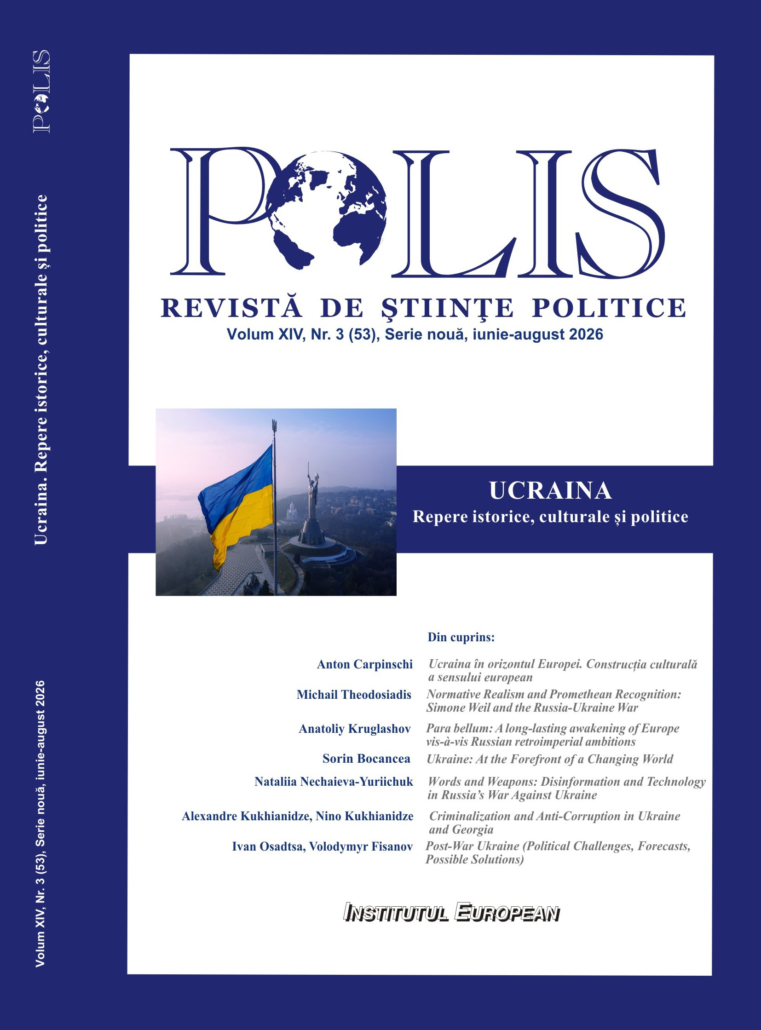
Coordonatori: E.S. Ihor PROKOPCHUK, Sabin DRĂGULIN și Sorin BOCANCEA
Volum XIV, Nr. 3 (53), Serie nouă, iunie-august 2026
Language and Legal Culture: A Question of Correlation
Oksana DATSO
Abstract: This article examines the correlation between language and legal culture, starting from the premise that legal language is not a neutral technical code but a carrier of the substantive values, cognitive categories, and normative traditions specific to a given legal order. The methodology combines a comparative review of legal-linguistic scholarship with a doctrinal analysis of legal translation theory and of the international Plain Language reform movement. Three research hypotheses are examined. The first holds that legal language reflects and reproduces the deeper cultural assumptions of the legal system in which it operates, including its treatment of proper names, euphemisms, and judicial discourse. The second holds that legal translation between jurisdictions is not a transparent transfer of meaning but an act that both reveals and partially reconstructs the differences between legal cultures, particularly within multilingual settings such as the European Union. The third holds that legal discourse’s resistance to linguistic simplification is not an inherent feature of law but a historically and jurisdictionally contingent phenomenon, as demonstrated by the uneven progress of the Plain Language movement across common-law and civil-law jurisdictions. The analysis confirms the first two hypotheses on the basis of the reviewed scholarship, while confirming the third only partially: available case studies show substantial variation by document type, jurisdiction, and language, rather than a uniform pattern of resistance or reform. The article concludes that legal culture and legal language are mutually constitutive, and that reform efforts aimed at improving access to justice through simplified legal language must take into account the specific cultural and doctrinal traditions of each legal system rather than assuming a universal model of legal communication.
Keywords: legal linguistics, legal translation, legal culture, plain language movement, comparative law.
Introduction
Language is the medium through which law exists, is communicated, and is applied; it is also, however, far more than a neutral vehicle for legal content. A growing body of legal-linguistic scholarship treats legal language as an integral component of legal culture – understood here as the set of deeply rooted values, cognitive categories, and interpretive traditions that characterise a given legal system and distinguish it from others. The way a legal system names its institutions, structures its judicial discourse, and resolves ambiguity in normative texts is inseparable from the cultural and historical context in which that system developed.
The relevance of examining the correlation between language and legal culture has grown alongside two parallel developments: the intensification of cross-border legal communication, exemplified by the multilingual legal order of the European Union, and the international movement toward simplifying legal language in the name of access to justice. Both developments raise the same underlying question – to what extent can legal meaning travel across languages and cultures without loss or distortion, and to what extent is legal language irreducibly tied to the cultural matrix of a specific legal order.
The aim of this article is to examine, on the basis of a comparative review of the international legal-linguistic literature, the correlation between language and legal culture, with particular attention to legal translation and to the Plain Language reform movement as two domains in which this correlation is most directly tested.
Three research hypotheses structure the analysis. H1: legal language reflects and reproduces the deeper cultural assumptions of the legal system in which it operates. H2: legal translation between jurisdictions is not a transparent transfer of meaning but an act that both reveals and partially reconstructs the differences between legal cultures. H3: legal discourse’s resistance to linguistic simplification is not an inherent feature of law as such but a historically and jurisdictionally contingent phenomenon.
Legal Language as a Carrier of Legal Culture
- Piszcz and H. Sierocka examine how elements of legal language, proper names and euphemisms among them, are connected with extra-linguistic cultural factors influencing the formation of language units, and how judicial discourse reflects the culture of a given justice system. Their analysis, conducted from a sociocultural perspective on the basis of English/Polish translation of corporate documentation in company registration proceedings, considers factors such as the country of origin of the source text, its legal form, its length, the certified or non-certified status of the translation, and the translator’s characteristics as variables affecting the cultural loading of legal communication1. Their study also notes that although the Polish government has embraced the principle that legal clarifications should be written in understandable, accessible, and simple language, the language of legal clarifications published in practice has not consistently achieved this standard2.
- Galdia situates this cultural embeddedness of legal language within the broader development of legal linguistics as a discipline. He traces how legal-linguistic studies moved from an initial focus on the content of laws toward an interest in the ways laws are communicated, and how legal terminology in different languages, legal French terminology being historically rooted in legal Latin, for instance, continues to bear the imprint of the legal culture from which it emerged. Galdia further observes that legal linguists have progressively shifted their attention from isolated legal vocabulary to the broader written and oral textual structures in which legal terminology is embedded and through which it is properly understood3.
Taken together, these two contributions support Hypothesis 1: legal language is not merely descriptive of legal norms but is shaped by, and in turn reproduces, the cultural assumptions of the legal system in which it is used – from the naming conventions found in corporate and judicial documents to the broader textual traditions of a given legal-linguistic community.
Legal Translation as a Site of Encounter Between Legal Cultures
- Jopek-Bosiacka’s comparative analysis of legislative drafting guidelines demonstrates that legal translation cannot be reduced to a mechanical transfer of terms between languages. Comparing Polish legislative drafting guidelines with European Union drafting guidelines and with selected common-law bill-drafting manuals, she shows that legislative guidelines from different legal cultures diverge with respect to the domains they regulate, and that these divergences directly affect both translated texts and the process of legal translation itself, particularly under the pressures of Europeanisation, standardisation, unification, and hybridisation of national legislative discourses. Her central conclusion is that law, as a system of norms, always actualises in a particular language and a particular culture, and that a legal translation of adequate quality must reproduce the normative patterns embedded in the national legal culture and system from which the source text originates4.
This dynamic is examined at the supranational level in the introduction to the special issue of the International Journal of Language & Law devoted to „EU Legal Culture and Translation”. The editors argue that, owing to the extreme degree of mediation and filtering of law through the European Union’s official languages, EU legal culture emerges through translation as a hybrid, supranational, pan-European construct that remains mutually dependent on the national legal cultures of the Member States. The contributions to that special issue address, among other topics, the role of English as the Union’s lingua franca, the impact of national legal cultures on legal translation, and the interpretation of strategic ambiguity by the Court of Justice of the European Union5.
A comparative perspective from outside the European context is offered by P.B. Potter’s study of the Chinese legal system, which examines the interaction between globalisation and local legal culture as a factor shaping the reception and interpretation of transplanted legal concepts and their linguistic expression6. Read alongside B. Kielar’s earlier account of the translation dimension of legal language7, these contributions indicate that the tension between the transnational circulation of legal norms and the persistence of locally rooted legal-linguistic traditions is not specific to the European Union but recurs, in varying forms, wherever legal transplantation and cross-cultural legal communication take place.
These findings support Hypothesis 2. Legal translation, whether at the level of national legislative drafting or of supranational integration, does not neutrally convey legal meaning across linguistic boundaries; rather, it exposes the underlying divergences between legal cultures and, in the process of translation itself, contributes to reshaping the legal-linguistic constructs through which those cultures are expressed.
The Plain Language Movement: Testing the Limits of Cultural Resistance
The Plain Language movement offers a direct empirical test of whether the cultural embeddedness of legal language constitutes an absolute barrier to simplification or merely a variable and negotiable feature of legal discourse. M. Bouyé and C. Gledhill’s corpus-assisted analysis of legal French shows that the popularisation of legal knowledge is regarded as critical for equal access to law and justice, and that legal discourse has been widely criticised for its obscure terminology and convoluted phrasing – criticism that gave rise to the Plain Language movement in English-speaking countries. Significantly, they show that the reception of this movement has not been uniform even within the French language itself: in Canada, Plain Language principles have been applied to French since the 1980s as a consequence of the official bilingualism policy, whereas in France the concept has only recently begun to be discussed8.
- Kmiecicka and E. Michalska likewise observe that increasing scholarly attention is being paid to the recipients of legal texts, who are often unable to understand documents that nonetheless bind them legally, and they review the range of proposed solutions for simplifying legal and juridical texts, noting that European countries are frequently cited as examples of increasingly effective measures for making legal texts more accessible9. At the level of specific document types, E. Boleszczuk’s comparative analysis of six British wills, three drafted in traditional legalese and three in plain English, illustrates that some categories of legal documents are markedly more resistant to reform than others, and that despite extensive discussion of clearer-drafting rules, no uniform standards for their application have yet emerged, which itself delays the pace of reform10. A practical, jurisdiction-specific instance of successful reform is documented by C.R. Dyer and co-authors, who describe the redesign of family-law court forms in Washington State as a deliberate strategy for improving access to justice through plain-language legal communication11.
These findings confirm Hypothesis 3 only partially. They do not support the view that legal discourse is inherently or uniformly resistant to linguistic simplification: successful reforms have been documented in specific jurisdictions (Washington State family-law forms) and specific linguistic communities (Canadian legal French). At the same time, the uneven diffusion of Plain Language principles – present in Canadian French but only recently discussed in France, established for some document types but resistant in others, such as wills – confirms that resistance to simplification, where it exists, is a variable, culturally and institutionally contingent phenomenon rather than a fixed property of legal language as such.
Conclusions
The comparative review of legal-linguistic scholarship undertaken in this article confirms the first hypothesis: legal language functions as a carrier of legal culture, embedding within its terminology, naming conventions, and textual structures the cognitive categories and normative traditions of the legal system in which it operates.
The second hypothesis is likewise confirmed. Legal translation, whether between national legal systems or within the multilingual architecture of the European Union, is not a neutral transfer of legal meaning but a process that exposes underlying divergences between legal cultures and actively participates in constructing new, hybrid legal-linguistic forms, as most visibly demonstrated by the emergence of a distinct EU legal culture through translation.
The third hypothesis finds only partial confirmation. The reviewed case studies – spanning legal French in France and Canada, court forms in Washington State, and the drafting of wills in Britain – do not support a general claim that legal discourse is inherently resistant to simplification. Instead, they show that the pace and success of Plain Language reform vary considerably by jurisdiction, document type, and linguistic community, which suggests that such resistance, where documented, reflects specific institutional and cultural configurations rather than an intrinsic property of legal language.
Taken together, these findings indicate that legal culture and legal language are mutually constitutive: legal culture shapes the terminology, structure, and interpretive conventions of legal language, while legal language, in turn, sustains and transmits that culture across generations of practitioners and, through translation, across national and linguistic boundaries. This has a direct implication for legal-language reform policy: initiatives aimed at improving access to justice through plain or simplified legal language cannot proceed from a universal model of legal communication, but must instead be calibrated to the specific cultural, doctrinal, and institutional traditions of each legal system. Further research, in particular, systematic comparative studies covering a wider range of jurisdictions, document types, and legal traditions than those reviewed here, would be needed to establish more precisely the conditions under which resistance to legal-language simplification is overcome.
Notes
- Anna Piszcz, Halina Sierocka, “The Role of Culture in Legal Languages, Legal Interpretation and Legal Translation”, International Journal for the Semiotics of Law – Revue internationale de Sémiotique juridique, Vol. 33, Nr. 3, 2020, pp. 533-542.
- Marcus Galdia, “Conceptual Origins of Legal Linguistics”, Comparative Legilinguistics, Vol. 47, 2021, pp. 17-56.
- Anna Jopek-Bosiacka, “Theoretical and Logical Prerequisites for Legal Translation”, International Journal of Language & Law, Vol. 7, 2018, pp. 47-69.
- Friedemann Vogel (ed.), “EU Legal Culture and Translation” [Introduction to the Special Issue], International Journal of Language & Law, Vol. 7, 2018, https://www.languageandlaw.eu/jll, (accessed 2.09.2026).
- Pitman B. Potter, The Chinese Legal System: Globalisation and Local Legal Culture, Routledge, London, 2001.
- Barbara Kielar, Language of the Law in the Aspect of Translation, Wydawnictwa Uniwersytetu Warszawskiego, Warsaw, 1997.
- Manon Bouyé, Christopher Gledhill, “The Phraseology of Legal French and Legal Popularisation in France and Canada: A Corpus-Assisted Analysis”, Languages, Vol. 9, Nr. 3, 2024, p. 107.
- Eliza Kmiecicka, Emilia Michalska, “Legal Communication and the Idea of Plain Language: Possibilities and Limitations”, Journal of International Legal Communication, Vol. 10, Nr. 3, 2023, pp. 72-78.
- Emilia Boleszczuk, “Plain Language Solutions to the Problems of Legalese — A Case Study of Wills”, Comparative Legilinguistics, Vol. 5, 2011.
- Charles R. Dyer, Joan E. Fairbanks, M.L. Greiner, Kirsten Barron, Janet L. Skreen, Josefina Cerrillo-Ramirez, Andrew, Lee, Bill Hinsee, “Improving Access to Justice: Plain Language Family Law Court Forms in Washington State”, Seattle Journal for Social Justice, Vol. 11, Nr. 3, 2013.
Bibliography
Books
KIELAR, Barbara, Language of the Law in the Aspect of Translation, Wydawnictwa Uniwersytetu Warszawskiego, Warsaw, 1997.
POTTER, Pitman B., The Chinese Legal System: Globalisation and Local Legal Culture, Routledge, London, 2001.
Articles and studies
BOLESZCZUK, Emilia, “Plain Language Solutions to the Problems of Legalese – A Case Study of Wills”, Comparative Legilinguistics, Vol. 5, 2011.
BOUYÉ, Manon, GLEDHILL, Christopher, “The Phraseology of Legal French and Legal Popularisation in France and Canada: A Corpus-Assisted Analysis”, Languages, Vol. 9, Nr. 3, 2024, p. 107.
DYER, Charles R., FAIRBANKS, Joan E., GREINER, M.L., BARRON, Kirsten, SKREEN, Janet L., CERRILLO-RAMIREZ, Josefina, LEE, Andrew, HINSEE, Bill, “Improving Access to Justice: Plain Language Family Law Court Forms in Washington State”, Seattle Journal for Social Justice, Vol. 11, Nr. 3, 2013.
GALDIA, Marcus, “Conceptual Origins of Legal Linguistics”, Comparative Legilinguistics, Vol. 47, 2021, pp. 17-56.
JOPEK-BOSIACKA, Anna, “Theoretical and Logical Prerequisites for Legal Translation”, International Journal of Language & Law, Vol. 7, 2018, pp. 47-69.
KMIECICKA, Eliza, MICHALSKA, Emilia, “Legal Communication and the Idea of Plain Language: Possibi-lities and Limitations”, Journal of International Legal Communication, Vol. 10, Nr. 3, 2023, pp. 72-78.
PISZCZ, Anna, SIEROCKA, Halina, “The Role of Culture in Legal Languages, Legal Interpretation and Legal Translation”, International Journal for the Semiotics of Law – Revue internationale de Sémiotique juridique, Vol. 33, Nr. 3, 2020, pp. 533-542.
Online resources
VOGEL, Friedemann (ed.), “EU Legal Culture and Translation” [Introduction to the Special Issue], International Journal of Language & Law, Vol. 7, 2018, https://www.languageandlaw.eu/jll, (accessed 2 September 2026).